Original Author: Ye Zhen
Original Source: Wall Street Watch
As Bitcoin prices fall below key support levels, the turmoil in the digital asset market is intensifying, and Strategy (MSTR), at the center of this storm, is facing unprecedented pressure.
The company, founded by Michael Saylor, confirmed on Thursday that it is experiencing a net loss of up to $12.4 billion in the fourth quarter due to a significant impairment of the fair value of its Bitcoin assets. The loss primarily stems from a $17.4 billion unrealized fair value loss resulting from accounting standards requiring mark-to-market valuation.
With Bitcoin dropping below $63,000, Strategy's stock plummeted 17.1% on Thursday. This not only erased all gains made after the U.S. elections but also led to a nearly 80% decline from the historical high in November 2024.
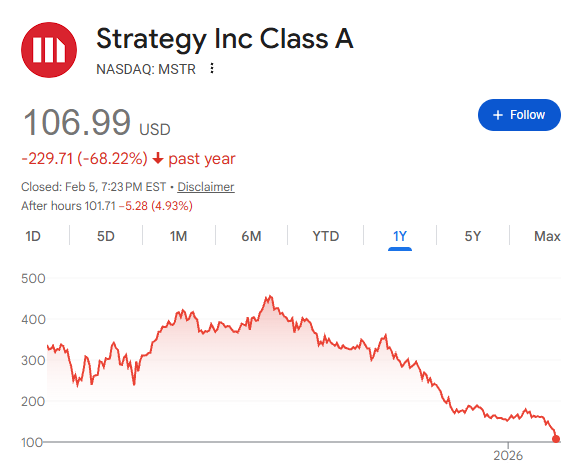
The Bitcoin held by the company is currently valued at approximately $46 billion, with an average purchase cost of $76,052 per coin. This marks the first time since 2023 that the market value of the company's Bitcoin holdings has fallen below its cumulative cost basis.
In the face of the market crash, Michael Saylor admitted during the earnings call that "selling Bitcoin is an option," despite his proclamations of "HODL" (hold on for dear life) on social media platform X.
What further unsettles the market is that the once-cyclical model of financing to buy Bitcoin, which relied on "equity premium," has come to a halt. The company's cost basis now exceeds the market price for the first time, and its financial experiment is facing severe tests.
As MSTR's stock price plummets, convertible bond investors are likely to seek early cash redemption rather than converting to equity. The first $1 billion redemption may be due on September 15, 2027, with another $6.4 billion potentially maturing in 2028, bringing the total potential cash demand to $8.2 billion.
The Logic of Financing to Buy Bitcoin is Under Scrutiny
Strategy has served as a high-beta proxy for Bitcoin, with its stock price soaring over 3,500% from 2020 to 2024. However, this engine is built on an unstable foundation. With the launch of spot Bitcoin ETFs, investors now have cheaper and more direct risk exposure, diminishing Strategy's uniqueness.
More critically, the collapse of valuation premium has occurred. Strategy's enterprise value once approached twice the value of its Bitcoin holdings, but this premium has nearly evaporated. If Bitcoin prices remain at current levels, Strategy's market value would need to drop by about 13% to completely eliminate the premium. Once the mNAV (market value to crypto asset value ratio) falls below 1, it means the company's market value is less than the value of its holdings, and the logic of financing to buy Bitcoin will be rendered completely ineffective.
During the earnings call following the report, CEO Phong Le attempted to reassure investors, stating, "This is your first downturn; my advice is to hold on," but this comment sparked anger in the live comment section. Benchmark Co. analyst Mark Palmer pointed out that in the current environment, the market's focus has shifted to how the company can raise funds under challenging conditions.
The Balance Sheet is in a State of Insolvency
The deterioration of financial data has intensified market concerns about Strategy's ability to service its debt. Data shows that as of February 1, the company held over 713,000 Bitcoins, with an average cost basis of $76,052. As Bitcoin trading prices are far below this cost line, Strategy's balance sheet is in a state of insolvency.
Strategy carries $8.2 billion in convertible debt, and while Saylor emphasizes that the company has $2.25 billion in cash reserves, sufficient to cover interest and dividend payments for the next two years without margin call risks, concerns in the market remain.
Currently, Strategy's convertible bond structure shows different maturity pressure points. The $1.01 billion convertible bond issued in September 2024 has a conversion price of $183.19, allowing holders to exercise redemption rights on September 15, 2027. The $3 billion zero-coupon convertible bond issued in November 2024 has a conversion price as high as $672.4, redeemable on June 1, 2028. Additionally, several convertible bonds with conversion prices ranging from $149.77 to $433.43 will face redemption pressure in 2028.
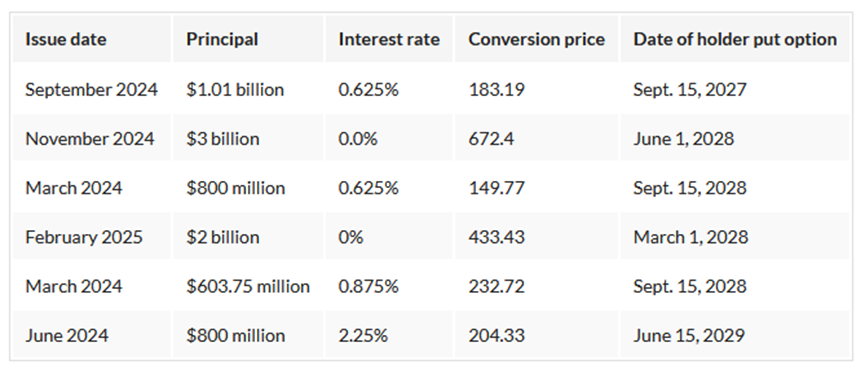
S&P Global previously warned in a report that if Bitcoin prices face severe pressure at the time of debt maturity, it could force the company to liquidate assets at low prices, which would be viewed as a "debt restructuring equivalent to default."
Phong Le candidly stated during the call, "If Bitcoin drops 90%, the company will not be able to repay its debt solely by selling Bitcoin and will have to seek debt restructuring."
Saylor Maintains a Bullish Stance
Despite the pressure, Saylor remained optimistic during the earnings call. "We have a cryptocurrency president who is determined to make the U.S. a Bitcoin superpower, the world's cryptocurrency capital, and a leader in digital assets," Saylor stated. "You cannot underestimate the importance of gaining support for the industry and digital capital at the highest levels of political structure."
Saylor also downplayed the threat of quantum computing to Bitcoin, stating it "will not pose a threat for at least another 10 years," and reiterated that this is "FUD" (fear, uncertainty, and doubt). He maintained his consistent stance that selling Bitcoin remains one of the options to address market conditions.
Strategy reiterated on Thursday that it does not expect to generate profits or earnings in the current fiscal year and the foreseeable future. Based on these expectations, the company stated that distributions to perpetual preferred shareholders are expected to be tax-exempt.
However, well-known short-sellers like Michael Burry have issued more severe warnings. According to Bloomberg, Burry reiterated his scrutiny of Strategy this week, warning that the decline in Bitcoin could trigger a "death spiral" among corporate holders. This view aligns with long-time critics like Jim Chanos, who have long pointed out the risks of Strategy's reliance on non-earning assets and speculative leverage.
Meanwhile, Saylor downplayed the threat of quantum computing to Bitcoin during the meeting, calling it "FUD" (fear, uncertainty, and doubt), and stated that this threat would not emerge for at least another 10 years.
Although management is attempting to maintain an optimistic tone and describe profitability as a distant prospect, investors are facing a harsh reality check as Bitcoin falls below cost and financing channels narrow.
免责声明:本文章仅代表作者个人观点,不代表本平台的立场和观点。本文章仅供信息分享,不构成对任何人的任何投资建议。用户与作者之间的任何争议,与本平台无关。如网页中刊载的文章或图片涉及侵权,请提供相关的权利证明和身份证明发送邮件到support@aicoin.com,本平台相关工作人员将会进行核查。


