Written by: Will A-Wang
The development of digitalization and the financial industry has long been inseparable. Over the past few decades, electronic systems have replaced physical trading of stocks and bonds, and online platforms have enabled investors to directly manage their portfolios. Today, digital assets, from cryptocurrencies to tokenized securities, are driving the next wave of financial innovation and rapidly entering the mainstream market.
Although cryptocurrencies and stablecoins were the first to open up early market exploration, tokenized money market funds (MMFs) have truly gained significant attention from traditional financial institutions due to their alignment with traditional financial logic, becoming the next frontier in the digital finance space.
Tokenized money market funds can meet investors' similar needs in digital form while unlocking new advantages, including higher settlement flexibility, portability, and collateral efficiency, and are expected to enhance financial stability through faster and more transparent redemption processes.
1. Behind the $10 Billion Scale
By the end of January, the total scale of tokenized U.S. Treasuries approached $10 billion, a milestone that confirms this category has moved from the concept validation stage to a new phase of actual operational infrastructure. Behind this achievement, another equally important event is occurring: Circle's USYC has slightly surpassed BlackRock's BUIDL, becoming the largest tokenized Treasury product.
As of January 22, USYC's assets under management reached $1.69 billion, while BUIDL stood at $1.684 billion, with a difference of approximately $6.14 million, or 0.36%.
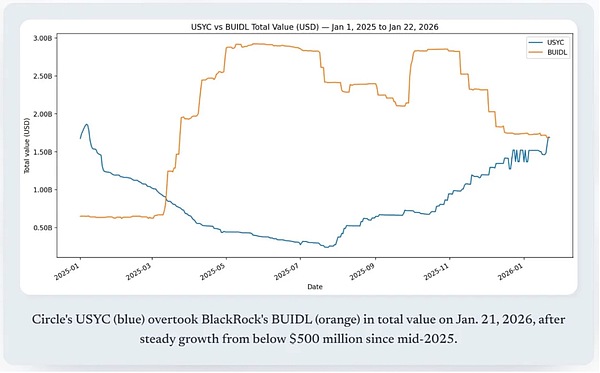
(How BlackRock lost control of the $10B tokenized Treasury market to Circle for one simple, mechanical reason)
This signal indicates that the importance of distribution channels and collateral operation mechanisms has now surpassed brand recognition in determining which type of on-chain cash equivalents will prevail.
In the past 30 days, USYC's assets under management grew by 11%, while BUIDL shrank by 2.85%. This divergence in trends is not merely due to marketing success but reflects a continuous inflow of net new funds to one side, while the other faces ongoing outflows due to redemptions.
This is not a story of Circle defeating BlackRock in a brand battle, but rather the design advantages of collateral circulation processes overcoming the cognitive advantages of brand identity.
Moreover, this phenomenon directly points to the core infrastructure issues currently being publicly discussed by regulators and institutional investors: Who will build the underlying architecture to convert idle funds in the crypto space into effective collateral that generates returns?
2. Distribution and Collateral Empowerment, Outshining Brand Halo
The core structural advantage of USYC lies in its distribution capability achieved through exchange collateral channels.
On July 24, Binance announced that institutional clients could hold USYC and use it as off-exchange collateral for derivatives, with related custody managed by bank third-party custodians or Ceffu, and it could be redeemed for USD stablecoins (USDC) almost in real-time. In contrast, Binance included BUIDL in its off-exchange collateral list only four months later, on November 14.
This timing difference is crucial. If the cash collateral system is established first in the prime brokerage business and derivatives trading processes, the product that completes integration earlier will firmly control the flow of funds. USYC is not just a product that has been listed; it has deeply embedded itself into the operational infrastructure for managing institutional margins and automating collateral operations.
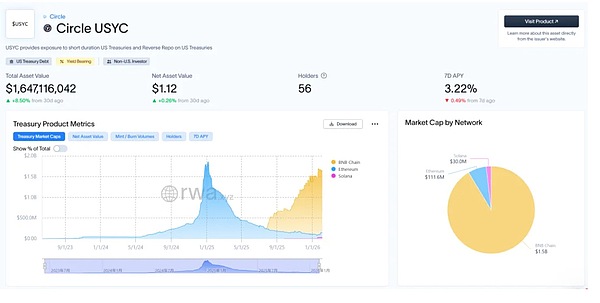
(RWA.XYZ)
Circle completed its acquisition of Hashnote in January 2025, positioning USYC as an interest-generating collateral that can circulate through USDC's ecosystem. This means that institutions that have already completed stablecoin fund circulation through the Circle ecosystem can quickly access USYC without needing to build new operational links. Circle plans to incorporate Hashnote's tokenized money market fund into its Bermuda licensing regulatory framework, leveraging the local mature digital asset regulatory framework to optimize USYC's compliance operations and cross-regional expansion.
I remember in an interview before Hashnote's acquisition, its CEO clearly stated that USYC, as collateral margin, is a significant distinction from other interest-generating stablecoins.
Although BlackRock's BUIDL entered the crypto market relying on brand influence, it failed to integrate into the crypto-native collateral system with an equally plug-and-play model. I once thought BUIDL could achieve widespread success, but the current market results have confirmed the deviation of that judgment. This is akin to the soul-searching question in the VC industry: when leading institutions like BAI enter the market, what exactly is your core competitive advantage?
3. Product Mechanism Adaptation to Trading Collateral Scenarios
The RWA.xyz platform makes a clear distinction between the two products in the "Use of Income" section: USYC is labeled as "Accumulates," meaning interest is directly added to the token balance for compound growth; BUIDL is labeled as "Distributes," meaning returns are paid out independently.
This difference is a mechanistic essence distinction, not merely a superficial difference. The collateral system (especially automated margin and derivatives infrastructure) prefers a "one-time setup, no intervention" balance model, allowing asset value to grow automatically through compound interest without manual processing of return payouts.
Compared to the distributing structure, the accumulating structure can integrate more seamlessly into automated collateral processes. For institutions building scalable collateral channels across multiple trading venues and counterparties, the simpler the product structure, the lower the operational costs and friction losses.
RWA.xyz has set substantive differentiated access thresholds for the two products: BUIDL is only open to U.S. qualified investors, requiring a minimum investment of 5 million USDC; USYC, on the other hand, is available to non-U.S. investors, with a minimum investment threshold of 100,000 USDC.
The client screening logic of the two products has structural differences. In the U.S., individuals must hold $5 million in investable assets to qualify as accredited investors, while institutions must reach $25 million, which excludes the vast majority of crypto-native funds, proprietary trading teams, and small to medium-sized institutions.
In contrast, USYC's $100,000 minimum threshold and non-U.S. access rules open doors for a broader range of offshore institutions, family offices, and trading companies—these entities, while operating outside the U.S. regulatory framework, still require dollar-denominated, yield-generating collateral.
BlackRock's brand influence cannot be underestimated, but a brand cannot override access restrictions: if a fund does not meet the accredited investor threshold or operates in non-U.S. regions, it cannot choose BUIDL, while USYC becomes a viable option.
The target market for on-chain collateral is highly skewed towards non-U.S. entities and small to medium-sized institutions, which is precisely USYC's core service clientele.
4. Reversal of Fund Flows
The simplest explanation for this reversal in dynamics is also the most reasonable: the flow of funds has shifted.
In the past 30 days, USYC's scale grew by 11%, while BUIDL shrank by 2.85%. This is not due to differences at the marketing level, but rather a direct result of net inflows to one product while experiencing net outflows from another.
This reversal in dynamics is not a gradual market shift but a result triggered by a specific event or funding allocation decision. USYC's access to Binance, adoption of an accumulating structure, and setting a lower access threshold have all significantly reduced the friction costs of fund participation; meanwhile, BUIDL has not created comparable issuance and circulation momentum during the same period.
The current market size of tokenized U.S. Treasuries has reached $10 billion, which, compared to the $310 billion stablecoin market, still represents a small proportion, but its role is shifting from a niche experimental product to a practical default option.
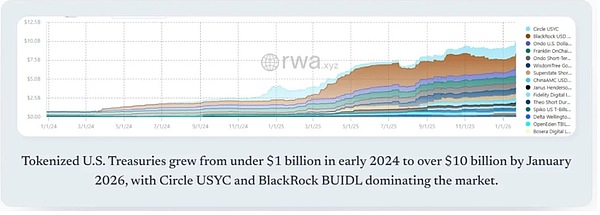
(How BlackRock lost control of the $10B tokenized Treasury market to Circle for one simple, mechanical reason)
The International Organization of Securities Commissions (IOSCO) recently released guidelines indicating that tokenized money market funds are increasingly becoming reserve assets for stablecoins and collateral for crypto-related transactions—this is the core associative logic driving the growth of USYC.
J.P. Morgan defines tokenized money market funds as the next high ground after stablecoins, with its core competitiveness focusing on the cross-chain circulation of assets and the efficiency of collateral use.
J.P. Morgan's analysis positions tokenized U.S. Treasuries as an iterative form of stablecoins, rather than a substitute option: these assets are programmable cash equivalents, with faster settlement speeds and more convenient cross-chain circulation, and compared to traditional custody models, they have lower operational costs when integrated into collateral systems.
In its research report, it clearly states that when money market funds are tokenized on the blockchain, market participants are expected to gain higher practicality and efficiency, including:
Simplified Payment Processes: When tokenized assets are on the same ledger as on-chain currencies such as deposit tokens, stablecoins, and blockchain deposit accounts, investors can benefit from faster delivery versus payment (DvP) settlement cycles. Particularly for tokenized money market funds, securities and cash can be transferred simultaneously, shortening the trading and settlement process by approximately 60 to 90 minutes, thereby accelerating transaction turnover, significantly reducing liquidity usage, increasing transparency, and lowering transaction costs.
Decentralized Finance (DeFi) Integration: Tokenization enables money market funds to implement lending, trading, and pooled asset management functions within smart contract protocols, supporting complex multi-party interactions.
Programmability: Tokenized money market funds are expected to further automate manual processes, achieve more complex logical operations, and reduce errors. For example, designs can allow tokenized money market funds to automatically allocate dividends to investors based on specific fund interest rate data. This increasingly enhanced programmability can reduce manual processing, intermediary steps, and operational errors.
Trading and Settlement: The blockchain can serve as a unified record of ownership and a venue for financial activities, allowing investors in tokenized money market funds to enjoy near-instant settlement services, with complete transparency between parties, thus reducing delays and reconciliation work among intermediaries.
Collateral Applications: Provided that eligibility requirements are met and the receiving party is willing to accept, tokenized money market funds can be used as collateral in both traditional and digital asset markets. Additionally, real-time automated transfer of collateral can enhance intraday liquidity.
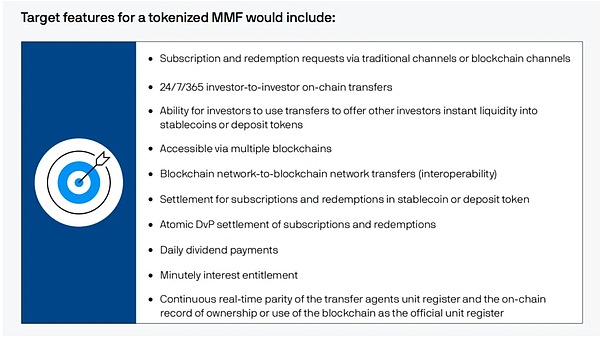
(Tokenization of Money Market Funds, JPM)
Against the backdrop of stablecoin yields approaching zero, tokenized U.S. Treasuries provide the market with on-chain risk-free yields that can be accessed without users leaving the crypto ecosystem. Institutions no longer need to leave funds idle in non-yielding stablecoins or transfer funds off-chain to earn returns; they can now hold yield-generating collateral on-chain that has cash liquidity and can compound like government bonds.
5. Future Trends
The milestone of $10 billion is far less important than the market penetration it reflects.
Currently, the scale of tokenized U.S. Treasuries accounts for about 3% to 4% of the circulating supply of stablecoins. Considering the current trends in fund flows and collateral integration progress, if this penetration rate doubles in the next 12 months (a conservative assumption), the scale of tokenized U.S. Treasuries could reach $20 billion to $25 billion.
If the flywheel effect of collateral accelerates further, and more trading platforms replicate Binance-style off-exchange trading channels, this scale could even exceed $40 billion to $60 billion.
Core indicators that are truly valuable for reference can be quantified:
Net issuance trends,
Official announcements on collateral integration dynamics,
Adjustments to access thresholds, and
Shifts in market preferences for yield handling models.
The growth trend of USYC over the past 30 days and the contraction of BUIDL's scale is the first early signal; USYC's integration with Binance is the second signal; the significant gap in client access between the two is the third signal.
The reason USYC was able to surpass BUIDL is not because Circle invested more in marketing than BlackRock, but because its issuance channels, product mechanisms, and access rules precisely align with the actual usage needs of institutions for on-chain collateral.
The scale of the tokenized U.S. Treasuries market surpassing $10 billion is not due to a single benchmark product dominating, but rather multiple products have entered the competitive stage at the infrastructure level:
Competing on who can integrate faster,
Who can lower trading friction more effectively,
Who can reach target clientele more broadly.
Brand recognition has opened the market door for the sector, but the optimization of collateral trading process design is the key to keeping that door wide open.
The industry is rapidly evolving, with financial institutions, regulatory bodies, and technology providers working together to address key challenges such as privacy protection, identity verification, infrastructure, and compliance. As regulatory frameworks gradually improve and digital identity solutions mature, the adoption rate of tokenized money market funds is expected to accelerate, creating new opportunities for innovation and growth.
免责声明:本文章仅代表作者个人观点,不代表本平台的立场和观点。本文章仅供信息分享,不构成对任何人的任何投资建议。用户与作者之间的任何争议,与本平台无关。如网页中刊载的文章或图片涉及侵权,请提供相关的权利证明和身份证明发送邮件到support@aicoin.com,本平台相关工作人员将会进行核查。