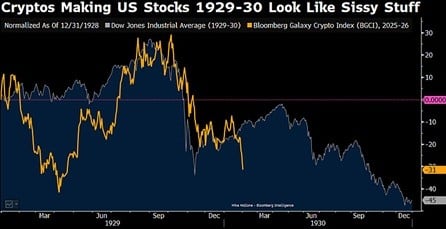
Bloomberg Intelligence Senior Commodity Strategist Mike McGlone shared on social media platform X on Feb. 3 a comparison of bitcoin and the broader crypto market with the 1929-30 U.S. stock market collapse, contending that recent crypto price behavior exceeds one of the most severe equity downturns in history.
He wrote:
“ Bitcoin and cryptos 2025-26 are making the 1929-30 US stock market crash look tame.”
Alongside the remark, McGlone shared a Bloomberg chart titled “Cryptos Making US Stocks 1929-30 Look Like Sissy Stuff,” which normalizes performance to a common starting point. The chart contrasts the Dow Jones Industrial Average during 1929-30 with the Bloomberg Galaxy Crypto Index across 2025-26. On a normalized basis, the crypto index displays repeated advances above 20% followed by abrupt reversals, alongside drawdowns exceeding 30% within a compressed timeframe. In contrast, the Dow’s decline unfolded more gradually, with losses accumulating over months before reaching roughly 40% by late 1930. The comparison highlights volatility intensity rather than absolute price levels, illustrating how crypto markets condense extreme boom-and-bust cycles into much shorter periods.
As of Feb. 6, 2026, bitcoin trades near $65,480, marking its lowest level in 15 months and a sharp 48% retreat from its October 2025 peak of $126,000. While this “ crypto winter” mirrors historical volatility, the market’s foundation is now built on institutional pillars, including $95 billion in U.S. spot bitcoin ETFs and treasury holdings by over 170 publicly traded companies. Despite the current risk-off sentiment and daily trading volumes hitting $168 billion amidst heavy liquidations, bitcoin’s 56% market share continues to distinguish it from the broader altcoin sector, contrasting with the Dow Jones of 1929, which represented a traditional industrial base rather than a global digital hedge.
Read more: Strategist Warns Crypto Echoes 1929 With Bitcoin Driving Downside Risk Debate
McGlone expanded on his view in another post on Feb. 3, questioning whether 2025 marked an apex for risk-asset-driven inflation and identifying it as a central reason bitcoin could emerge as a tactical short. He outlined that bitcoin may need to prove resilience by holding above $100,000 during periods of stress, while describing the asset as both “overhyped” and the “first-born” of crypto, referencing its 2009 launch. He pointed to the existence of millions of digital tokens and mass participation through exchange-traded funds as indicators of late-cycle behavior. He also drew a parallel to internet stocks in 2000, suggesting last year may ultimately be viewed as a cyclical peak for crypto markets.
In a separate update shared on Feb. 1, the strategist outlined a 2026 base case centered on rising volatility and downside risk for bitcoin. He identified $50,000 as an initial support level, with potential extension toward $10,000 if volatility accelerates and risk assets revert. He cautioned that $100,000 may represent a cyclical ceiling for bitcoin under weakening equity conditions, framing 2026 as a reversionary phase following inflation-driven excess.
- Why is bitcoin being compared to the 1929 stock market crash?
Mike McGlone argues crypto volatility now exceeds the speed and intensity of the 1929-30 Dow collapse. - What does the Bloomberg Galaxy Crypto Index show?
It highlights repeated 20% surges and 30% drawdowns in crypto over short time spans. - How does crypto volatility differ from the Dow’s 1929 decline?
Crypto compresses extreme market cycles into far shorter windows than historic equities. - Why is bitcoin still viewed as structurally distinct?
Its fixed supply, dominant liquidity, and ETF access separate it from other digital assets.
免责声明:本文章仅代表作者个人观点,不代表本平台的立场和观点。本文章仅供信息分享,不构成对任何人的任何投资建议。用户与作者之间的任何争议,与本平台无关。如网页中刊载的文章或图片涉及侵权,请提供相关的权利证明和身份证明发送邮件到support@aicoin.com,本平台相关工作人员将会进行核查。


