Since the beginning of 2026, the cryptocurrency market has continued to experience fluctuations and corrections. Bitcoin has dropped from its historical high of $125,000 on October 12, 2025, to around $77,000 on February 3, marking a cumulative decline of over 38%.
As prices weaken, major global institutions have voiced differing predictions for the future market—some warn that a bear market has arrived, with Bitcoin potentially falling to $58,000; others are optimistic about the long-term potential of Ethereum and other cryptocurrencies; while some maintain a neutral stance, believing the market is in a transitional adjustment period. Below, we summarize the core viewpoints of various institutions based on the latest news from February, highlighting the market's bullish and bearish divides.

1. Bearish Camp: Bear Market Established, Bitcoin's Correction Bottom Moves Lower
Several institutions have released bearish reports, asserting that the cryptocurrency market has entered a bear market and that Bitcoin's price has not yet bottomed out. Some institutions have given a pessimistic forecast of $58,000, warning of liquidity contraction and the risk of capital withdrawal.
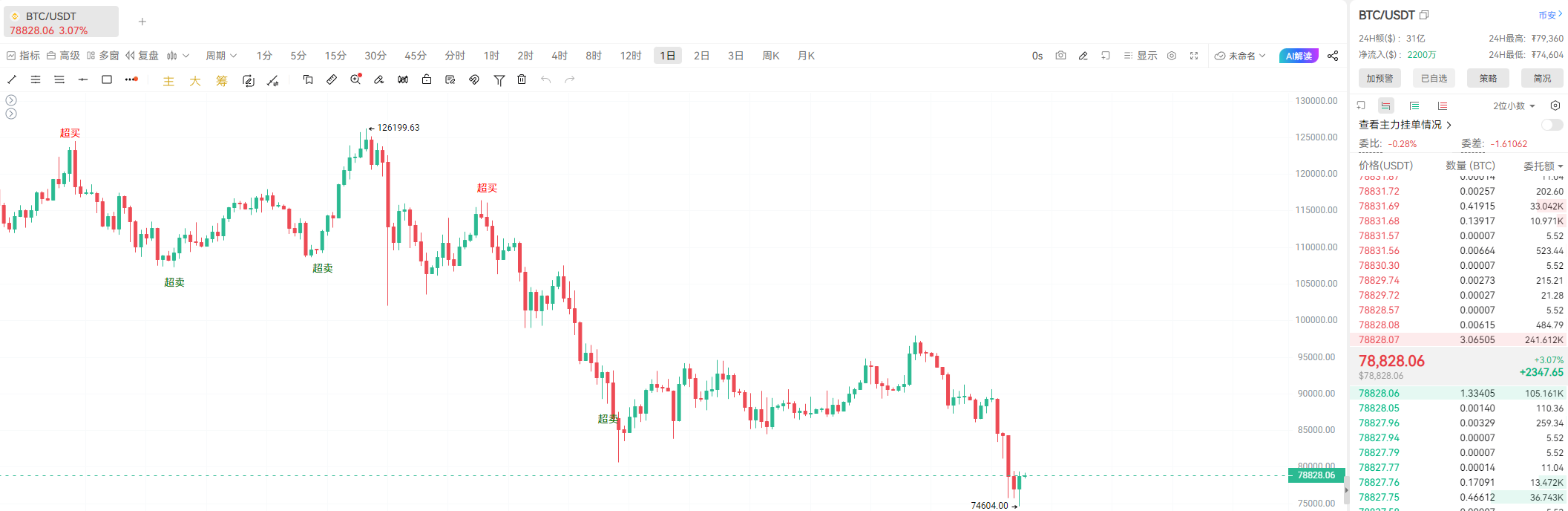
(1) CryptoQuant: Bear Market Has Begun, Bitcoin May Drop to $56,000
● The on-chain analysis company CryptoQuant was among the first to declare that the "bear market has started." It noted that the three waves of demand for Bitcoin since 2023 have all dissipated, and demand has remained below trend levels since October 2025, causing prices to lose key support.
● Technically, Bitcoin has fallen below the 365-day moving average, which serves as the boundary between bull and bear markets, and the perpetual futures funding rate has dropped to its lowest level since December 2023.
● The institution believes Bitcoin may drop to $70,000 in the short term, and if it does not recover in the long term, it could fall to $56,000, which may be reached in the second half of 2026.
(2) Galaxy Digital: May Drop to $58,000 in the Short Term
● Alex Thorn, head of research at Galaxy Digital, stated on February 3 that Bitcoin may drop to around $58,000, near the 200-week moving average, in the coming weeks or months.
● Currently, Bitcoin has corrected about 38% from its historical high, and a significant drop last weekend triggered over $2 billion in long liquidations, with 46% of Bitcoin supply in a loss state. There is a supply gap in the $70,000-$80,000 range, and breaking below this will accelerate the downward trend.
● Additionally, the narrative of Bitcoin as "digital gold" has failed, with funds shifting to precious metals, further intensifying the correction pressure.
(3) Bloomberg: Bitcoin Has Dropped 25%, Recovery Will Take Time
● Bloomberg reported on February 2 that Bitcoin has fallen 25% from its recent high, briefly dropping below $76,000, which is about a 40% retracement from its historical high, marking the longest monthly consecutive decline since 2018.
● It pointed out that this round of decline is the result of the disappearance of buying interest, liquidity contraction, and weakened confidence. The current market depth is over 30% lower than the high in October 2025, with continuous net outflows from spot ETFs.
2. Bullish Camp: Long-Term Logic Unbroken, Ethereum Becomes the Focus
Amid the dominant bearish voices, some institutions remain optimistic, believing that the correction is a short-term phenomenon. Goldman Sachs is particularly bullish on Ethereum, while Bitwise and Grayscale express confidence in Bitcoin's long-term trajectory.
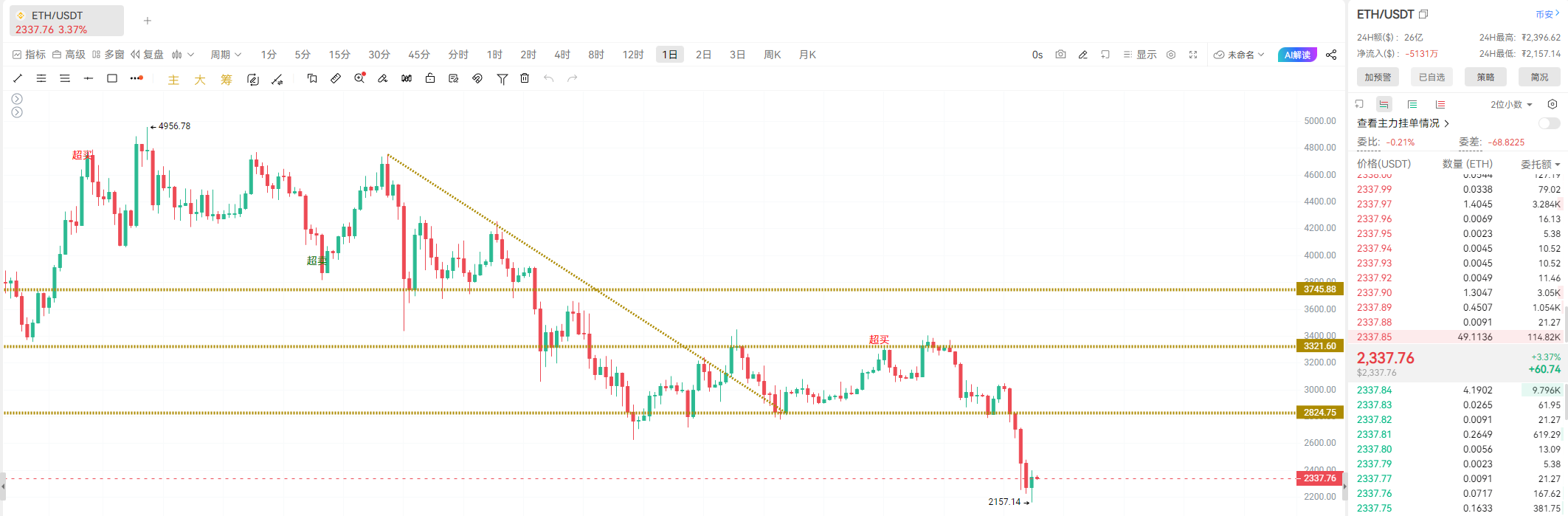
(1) Goldman Sachs: Bullish on Ethereum, Calls It Undervalued
● Goldman Sachs reported on February 2 that despite the overall market weakening, the fundamentals of the Ethereum network are strong, making it a core asset that is undervalued.
● In January, the number of new daily Ethereum addresses reached a historical high of 427,000, growing over 160% compared to the peak of DeFi in 2020, with daily active addresses increasing by 27.5% month-over-month and trading volume rising by 36%.
● Currently, Ethereum's market cap is below its realized market cap, which is typically a sign of long-term accumulation. Goldman Sachs believes it may surpass Bitcoin in the future to become the dominant value storage asset.
(2) Bitwise: Bitcoin Will Reach New Historical Highs
As a representative of Bitcoin bulls, Bitwise predicts that Bitcoin will reach new historical highs under the combined effects of continued ETF inflows, Federal Reserve interest rate cuts, and the halving effect.
● Despite recent net outflows from ETFs, in the long term, U.S. crypto spot ETF funds have exceeded $12 billion, with a solid dual-driven pattern from retail and institutional investors.
● It also predicts that Bitcoin's volatility in 2026 will be lower than that of Nvidia stocks, and the number of crypto ETFs is expected to exceed 100, with native AI projects in crypto potentially becoming new growth points.
(3) Grayscale and a16z: Focus on Long-Term Value
● Grayscale defines 2026 as the "dawn of the institutional era," believing that after regulatory clarity, institutions will accelerate their entry, and Bitcoin may reach historical highs in the first half of the year, with stablecoins and RWA tokenization expanding market breadth.
● a16z focuses on long-term implementation, emphasizing that the integration of AI and crypto will become a main theme, believing that the advancement of crypto legislation will unleash industry potential, and cryptocurrencies with practical application scenarios will gain long-term growth space.
3. Neutral Camp: Fluctuating Adjustment, Waiting for Turning Point
Some institutions maintain a neutral stance, believing the market is in a transitional adjustment period, primarily fluctuating in the short term, with trends dependent on macro policies, regulations, and capital flows, necessitating a wait for key turning points.
(1) VanEck: Year of Fluctuating Adjustment, Suggests Dollar-Cost Averaging
VanEck believes that 2026 will be a year of fluctuating adjustment for the crypto market, with Bitcoin's maximum drawdown only at 35%, and risks have been partially released. However, factors such as tightening global liquidity and uncertainty in Federal Reserve policies make it difficult to form an upward trend in the short term.
It suggests that ordinary investors should dollar-cost average into Bitcoin with 1%-3% of their funds, appropriately reducing positions during market overheating, while also being optimistic about the penetration of stablecoins in the B2B payment sector.
(2) Galaxy and Messari: Seeking Balance Amid Transition
Galaxy holds a neutral overall stance, believing that Bitcoin's price may fluctuate between $70,000 and $130,000 in 2026, gradually transitioning to a gold-like pricing model, with ecological advancements providing long-term support.
Messari defines 2026 as a year of industry transformation, believing that the crypto industry is transitioning from speculation to value integration, with the integration of AI, DePIN, and traditional finance dominating industry development, and short-term fluctuations do not alter the long-term trend.
4. Market Summary and Institutional Consensus
The cryptocurrency market is experiencing intense bullish and bearish confrontations, with clear short-term correction pressures, but the long-term growth logic remains intact. In the short term, the bearish camp dominates, with Bitcoin potentially touching $56,000-$58,000; the bullish camp believes the correction is an opportunity for positioning, with strong fundamentals for Ethereum.
In the long term, institutional consensus is clear:
● First, the industry is transitioning from retail speculation to institutional dominance;
● Second, stablecoins and RWA will connect real finance with the on-chain world;
● Third, the integration of AI and blockchain will become a new growth point;
● Fourth, regulatory clarity will unleash industry potential.
For ordinary investors, institutions generally advise a rational view of volatility, avoiding high leverage, prioritizing Bitcoin and Ethereum, and using dollar-cost averaging to diversify risk. Future market trends will primarily depend on Federal Reserve policies, the advancement of U.S. crypto regulatory legislation, and the flow of institutional funds and ecological implementation progress.
Join our community to discuss and grow stronger together!
Official Telegram community: https://t.me/aicoincn
AiCoin Chinese Twitter: https://x.com/AiCoinzh
OKX benefits group: https://aicoin.com/link/chat?cid=l61eM4owQ
Binance benefits group: https://aicoin.com/link/chat?cid=ynr7d1P6Z
免责声明:本文章仅代表作者个人观点,不代表本平台的立场和观点。本文章仅供信息分享,不构成对任何人的任何投资建议。用户与作者之间的任何争议,与本平台无关。如网页中刊载的文章或图片涉及侵权,请提供相关的权利证明和身份证明发送邮件到support@aicoin.com,本平台相关工作人员将会进行核查。


