"My method is actually very simple," Vitalik Buterin said last week when asked how he made $70,000 in a year. "I look for markets that have already entered a 'crazy mode' and then bet against them—these crazy things won't happen."
When the world goes crazy, rationality is the best arbitrage
At the end of January 2026, in an interview in Chiang Mai, Ethereum founder Vitalik Buterin openly discussed his trading experience on the prediction market Polymarket: in 2025, he used about $440,000 in capital to earn approximately $70,000 in profit.
Although this amount is insignificant for Vitalik, who is worth hundreds of millions, the trading strategy he mentioned in the interview and his understanding of Polymarket's settlement mechanism indicate that he was not "just playing around," but rather built a very sophisticated trading logic after deeply exploring the entire prediction market system.
To make it easier for the audience to understand, he also proactively provided several specific examples: for instance, last year, the Nobel Peace Prize winner, Trump, repeatedly stated publicly that he was the most qualified person to win the award.
After extensive media coverage, the probability of Trump winning the award once exceeded 15%, and many traders believed that, given Trump's style, he would use various threats and inducements to force the Norwegian Nobel Committee to ultimately compromise and award him the prize.
Vitalik's judgment on this matter was straightforward: this 15% does not reflect the real probability but rather reflects emotions. What I need to do is to stand on the opposite side of the emotions and use rationality to profit from that overestimated probability difference.
Starting from "Trump will not win the Nobel Prize," reverse-engineering Vitalik's Polymarket account
Based on the clues Vitalik revealed in the interview and Polymarket's mechanism for "verifiable trader performance," we can actually attempt to outline his account profile: $440,000 in capital, $70,000 in annual profit, made money by betting that Trump would not win the 2025 Nobel Peace Prize.
After a filtering process, two accounts surfaced: momom and terremoto.
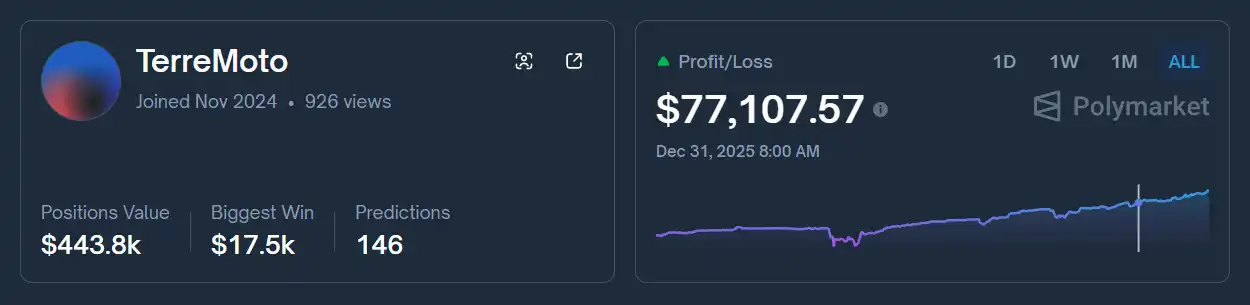
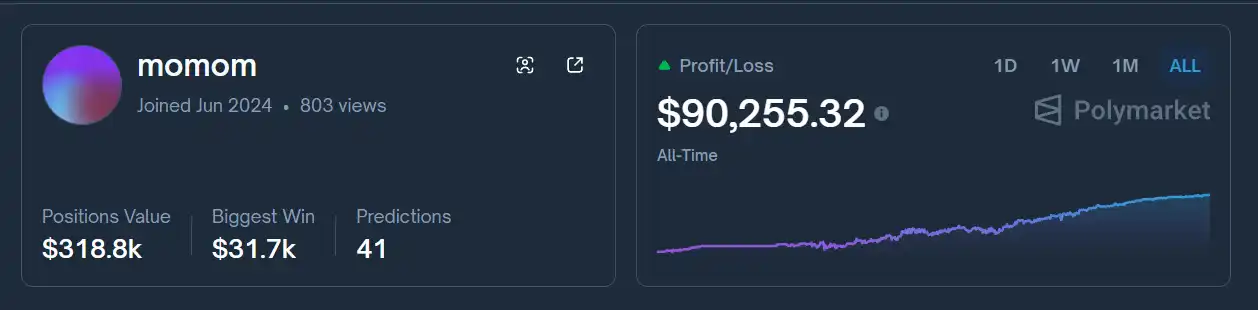
In addition to matching the capital and profit, both accounts' trading logic perfectly aligns with Vitalik's profit system of "shorting emotions": over 70% of the trades were bets against something happening, with no trades related to guessing cryptocurrency prices or sports.
Further on-chain funding tracing revealed that while terremoto's funding amount matched the $440,000, this money was broken down into dozens of small deposits of a few thousand dollars, and there were no other activities between multiple on-chain wallets apart from fund transfers.
In contrast, momom's on-chain deposits consisted of several large transfers exceeding $100,000. Combined with the fact that momom had only one trade betting "Yes," and terremoto's trading frequency was high enough to resemble a full-time trader active in the prediction market daily, we ultimately believe momom better fits Vitalik's profile.
If momom is Vitalik: what exactly is his strategy?
Imagine this: today is March 3, 2025. As a die-hard Trump supporter, you are very confident that he is not the puppet president controlled by the deep state as in the past. In the year since Trump took office, he has fulfilled various campaign promises (ICE cracking down on immigrants, raising tariffs to "protect domestic businesses," etc.).
You also clearly remember that he promised during his campaign to push for the release of documents related to UFOs and aliens.
Just yesterday, you saw in the news that U.S. lawmakers are promoting new legislation to establish a "UFO task force." In the comments, someone mentioned another piece of news:
A former U.S. Air Force officer and intelligence official, David Grusch, revealed that the U.S. government has been running a "decades-long UAP crash retrieval and reverse engineering program," recovering "non-human origin" spacecraft and "non-human biological remains."
Connecting these clues, you realize something significant: Trump is very likely to release the alien documents!
At this point, you see that the probability of "Will the U.S. announce the existence of aliens in 2025?" in the prediction market is only 10%. This means Trump has nearly 11 months to release the relevant documents.
"This probability is severely underestimated!" you conclude after gathering information from news, comments, and even your own searches, and subsequently bet "Yes."
This is a bet with a potential return of nearly ten times; you believe this is your most successful investment since the beginning of 2025. What you don't know is that on the other side of the order book is Vitalik.
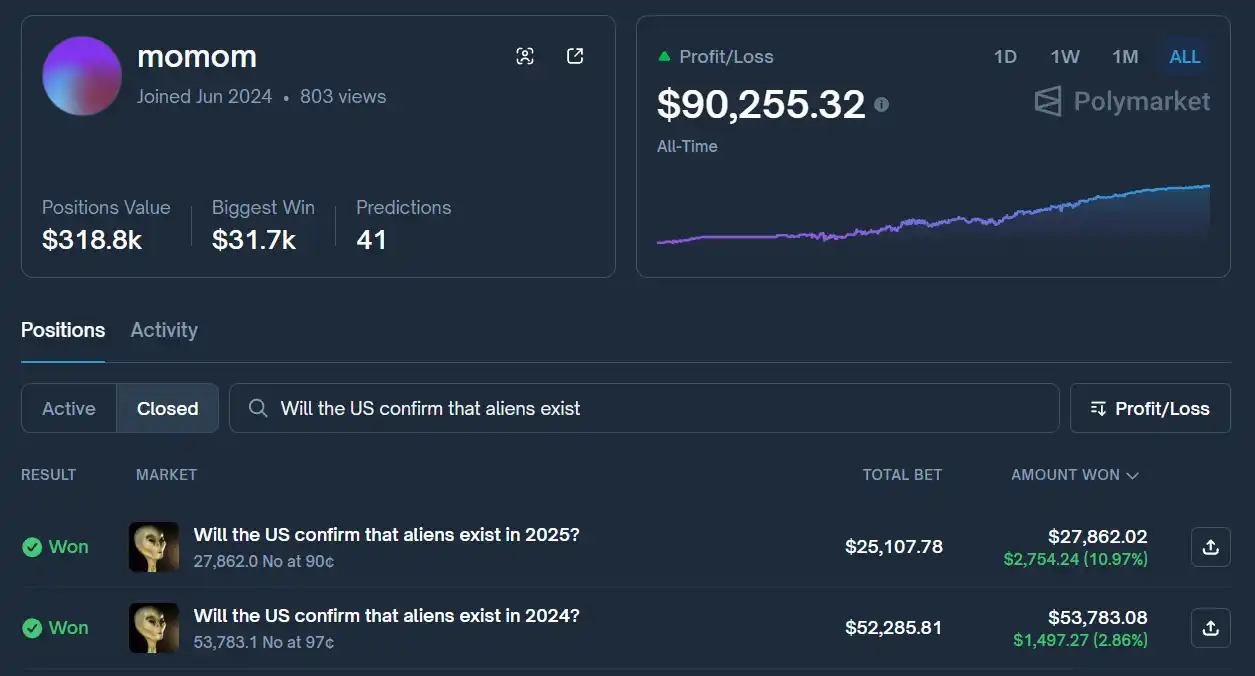
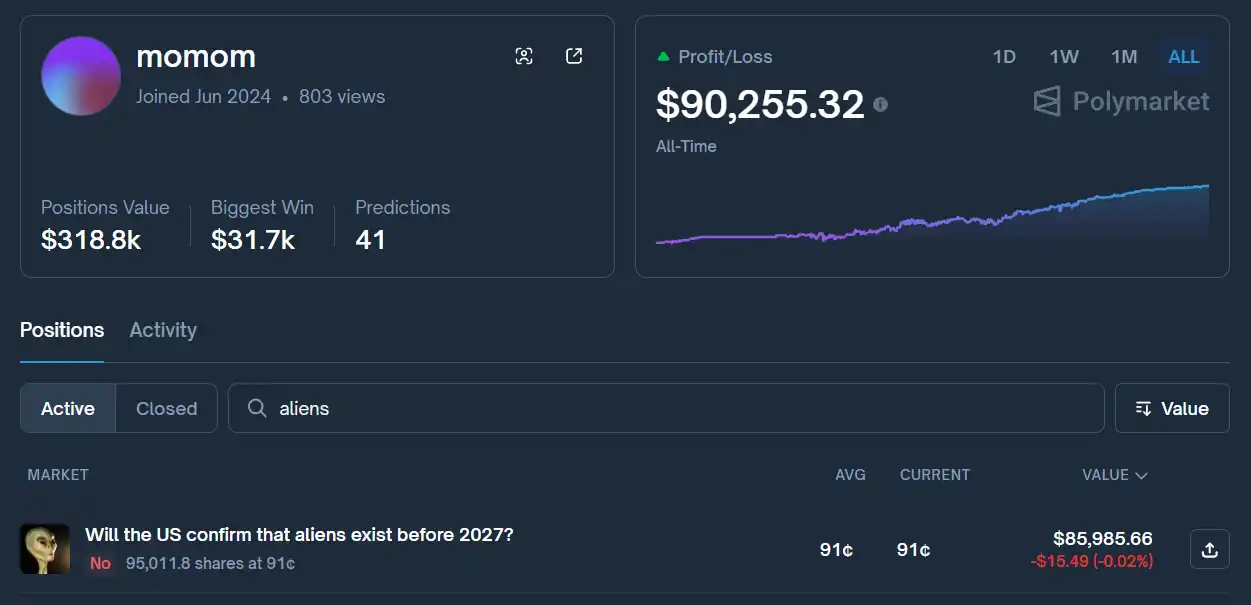
This was the operation of that account in March of last year: amidst the noise of various markets and overwhelming media coverage, he bet against the U.S. announcing the existence of aliens within the next ten months when the probability was at 10%. This trade ultimately brought him a 10% profit.
Interestingly, the exact same market reappeared, and he bet again that the event would not happen this year. Even as of the time of writing, this trade is still losing money. You could even follow his trade at a lower cost than Vitalik's.
Conclusion
Only a month has passed in 2026, yet various things that previously seemed impossible have repeatedly filled the headlines of major media: Venezuelan President Maduro was grabbed by the U.S. like a chick and flown back to the U.S., Trump has not spared even NATO allies in his quest to acquire Greenland, and the Epstein documents have mentioned nearly all major political and business figures in the U.S.
Undeniably, we are living in an era overwhelmed by uncertainty. In this context, "it seems that anything is possible."
The emergence of prediction markets translates this illusion directly into probabilities: every breaking news story, every tweet, every exaggerated media interpretation will temporarily push up the price of a "Yes" bet.
Many star traders like Vitalik utilize the overestimation of probabilities to bet against certain extreme events happening. After optimizing such strategies through a well-established trading system based on mathematics and statistics, this approach has become one of the most robust investment methods in prediction markets today.
免责声明:本文章仅代表作者个人观点,不代表本平台的立场和观点。本文章仅供信息分享,不构成对任何人的任何投资建议。用户与作者之间的任何争议,与本平台无关。如网页中刊载的文章或图片涉及侵权,请提供相关的权利证明和身份证明发送邮件到support@aicoin.com,本平台相关工作人员将会进行核查。


