This article is only a personal market opinion and does not constitute investment advice. Any actions taken based on this are at your own risk.
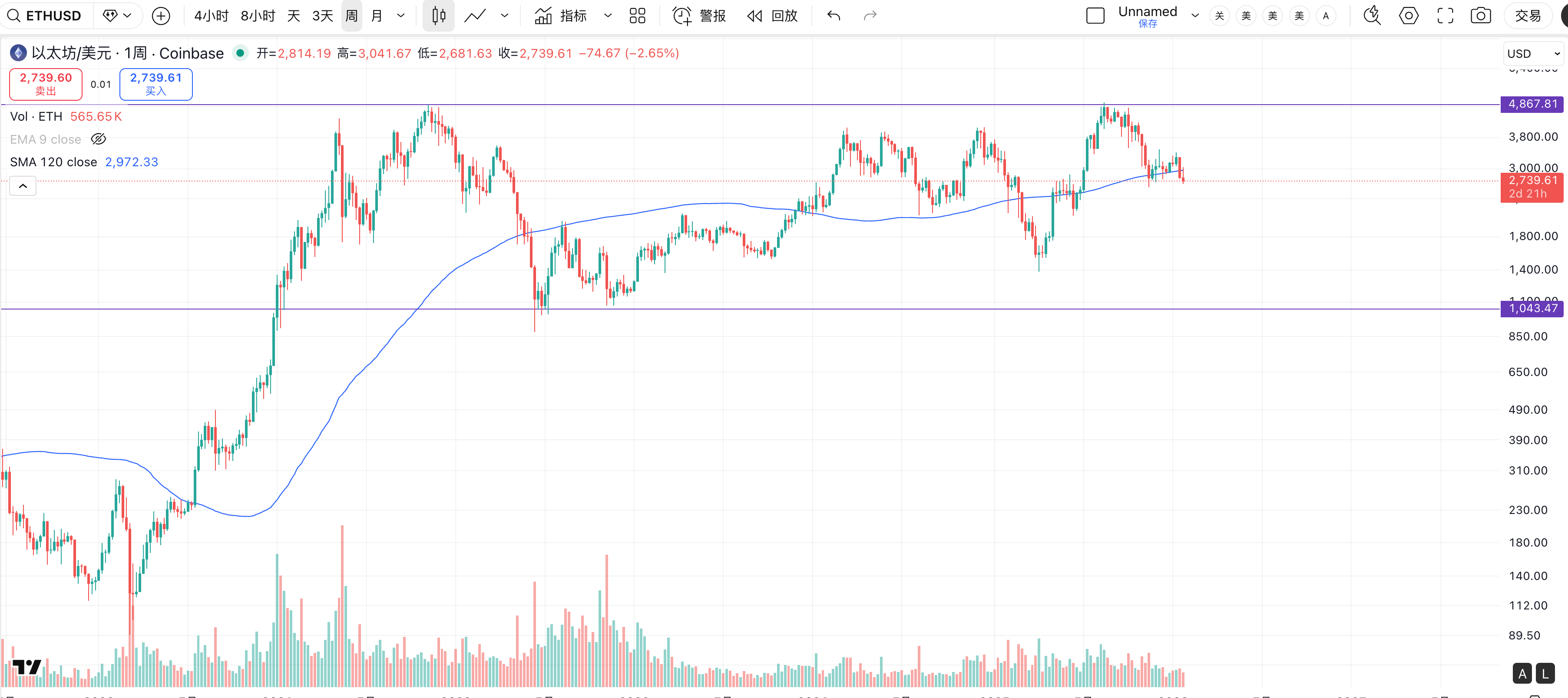
With the significant drop in the past two days, ETH has once again broken below the 120-week line on a weekly basis, entering the decline range of the second half of the bear market. Since December, the bearish view has been validated again. The only downside is that after January 8, there was a slight rebound for another week, which was slightly beyond expectations, but it is not a big deal; it is just a matter of a one-week delay, not a misjudgment of the trend.
Last week, the weekly close confirmed that ETH broke below the 120-week line. In the first half of this week, ETH confirmed a rebound, peaking and then retreating without recovering. Subsequently, last night, along with the entire market's significant drop, it announced the entry into the decline range of the second half.
The decline in the second half has just begun, and the high point of this week, 3040, is unlikely to be seen for a long time. Enjoy the bear market that belongs to the shorts.
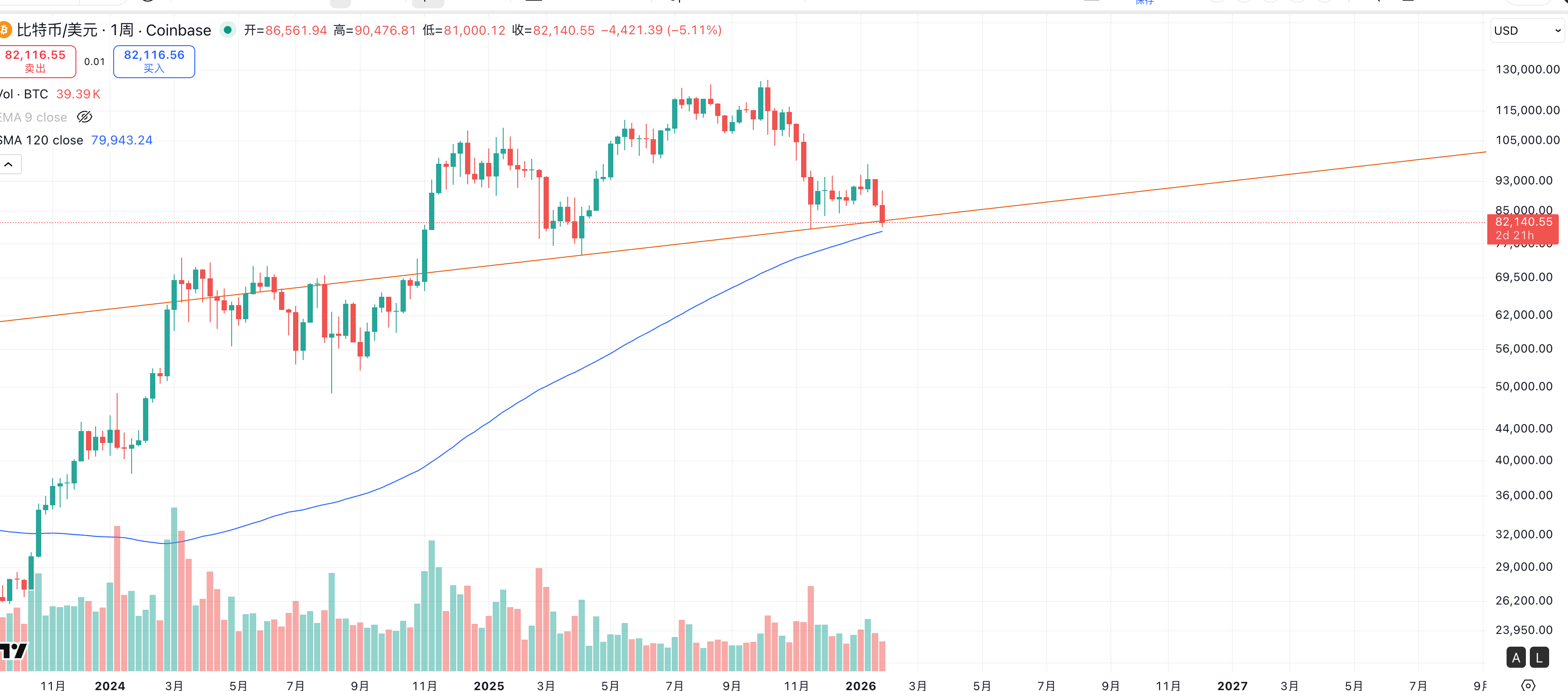
BTC is similar; currently, the weekly head and shoulders pattern is basically formed, with the 120-week line around 80,000. It is estimated that it can still fluctuate slightly here, but it should not change the overall trend.
Once it breaks below 80,000 on a weekly basis, the next stop will be below 60,000, with any rebounds in between being shorting opportunities. From a timing perspective, it has been over two months since the first bottom in November, and it is time to choose a direction.
Still the previous view: do not use the argument of "liquidity easing" anymore. Even if liquidity is eased, it is useless if it does not enter the crypto space. In the end, it is a situation of small rises and large falls, overall trending downwards.
Finally, here is my view on BTC:
1. Before the listing of the BTC spot ETF, BTC is in the "primary market equity investment stage," trading on scarcity, anti-fiat, and immutability. Essentially, it is a narrative aimed at the future—if the world changes, BTC will be valuable. From a traditional financial perspective, BTC at this stage is a risky investment without a validated business model. At this stage, we do not look at valuation models but at concepts and growth.
2. After the listing of the spot ETF, BTC has been recognized as a major asset, entering the mainstream asset system. Its role has therefore changed; it is no longer a purely narrative asset. In the stock market, it has transformed from a complete risk investment into an investment that requires consideration of valuation models. The investment at the "story" level still exists, but compared to before the listing, it has been significantly compressed.
3. BTC is currently undergoing a phase of value reassessment, which is a stage that all "emerging" technological entities must go through, such as the internet in 2000 and AI companies after the AI bubble burst. The current confusion lies in the fact that it is experiencing a phase of multiple narratives and corresponding valuation models in conflict: digital gold (hedging against inflation), risk assets (Nasdaq β), liquidity amplifiers, and extreme systemic safe-haven assets.
4. You can see the above models expressed in most analytical frameworks, but no single model has emerged victorious. At this current stage, BTC's rise cannot match mainstream technology (AI) and other thematic narrative assets. Before a consensus on value reassessment is formed, BTC may struggle to see significant improvement. The four valuation models mentioned above may lead to BTC's rise and fall at different times, but they are unlikely to change the trend of small rises and large falls.
5. In the next stage, I believe the most likely narrative and corresponding model is none of the above. I lean towards what Musk refers to as energy currency. However, the premise for energy currency to be realized is that the value of human labor approaches zero. When humans no longer have labor value, the current system linking wages to labor loses its meaning. The currency system will need to be rebuilt, and BTC's big opportunity will come again.
6. How far is this stage? Not far:
i. When the marginal value of labor begins to decline significantly (it has already started to decline, but not yet significantly);
ii. When robots gradually replace humans, especially when they start replacing mid-level cognitive tasks, most people will find their work meaningless.
iii. When the bottleneck of human development is no longer technology but energy (there are already signs).
As these three conditions become increasingly evident, the next era belonging to BTC will arrive.
Follow me to maximize trend profits with minimal operations.

免责声明:本文章仅代表作者个人观点,不代表本平台的立场和观点。本文章仅供信息分享,不构成对任何人的任何投资建议。用户与作者之间的任何争议,与本平台无关。如网页中刊载的文章或图片涉及侵权,请提供相关的权利证明和身份证明发送邮件到support@aicoin.com,本平台相关工作人员将会进行核查。