As January 2026 draws to a close, a sobering reality has set in for many crypto enthusiasts: bitcoin’s narrative as a “digital gold” safe haven is crumbling. What we are witnessing is a deepening of a trend established throughout 2025—a tight, almost symbiotic correlation between the top cryptocurrency and traditional risk assets, specifically the tech-heavy Nasdaq Composite.
The events of Jan. 29 served as a stark manifestation of this tether. As U.S. tech titans began reporting financial results, the Nasdaq underwent a violent free-fall, sliding from 23,830 points to an intraday low of 23,230. The primary anchor dragging the index down was Microsoft. Despite reporting robust 17% revenue growth, the stock plummeted 11% at its nadir.
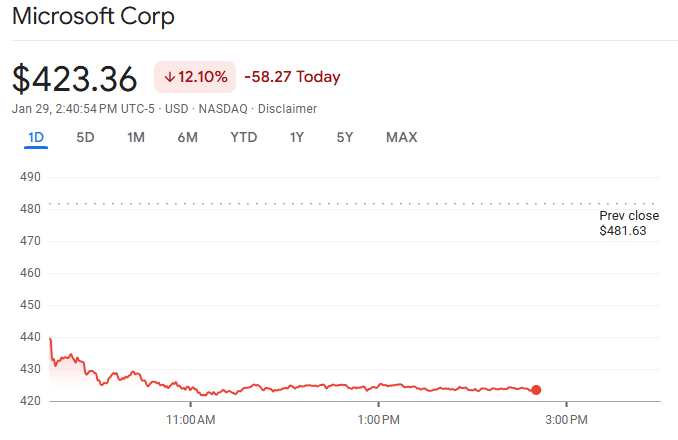
While Meta Platforms’ revenue surge and Tesla’s modest profitability attempted to provide a floor, the message from the trading floor was clear: Investors are seemingly no longer buying the artificial intelligence (AI) hype on credit. Instead, the market is punishing companies that fail to bridge the gap between massive AI capital expenditure and immediate bottom-line results.
The anxiety over AI spending bled directly into the crypto markets. Bitcoin briefly dipped to $83,460—a level not seen since late November 2025. As a consequence, bitcoin’s valuation retreated to $1.67 trillion, pulling the total crypto market capitalization down to $2.95 trillion. The volatility triggered a massive liquidation event, flushing out more than $860 million in long and short positions.
Read more: Crypto Bloodbath: Bitcoin Slips Below $85K, $796M Liquidated as Traders Get Forced Out
With more market observers now contending that bitcoin is essentially a high-beta version of the Nasdaq, all eyes are fixed on the upcoming earnings from Apple and Nvidia to dictate the cryptocurrency’s short-term trajectory.
Meanwhile, beyond its correlation with Silicon Valley, bitcoin’s sensitivity to global instability was on full display Jan. 29. Reports that the U.S. is contemplating strikes on Iran sent shockwaves through the markets. As they have been doing for much of January, investors retreated to gold and silver, shunning risk-on digital assets as geopolitical tensions in the Middle East increased. Since the start of the year, gold is up by nearly 30%, while silver has surged by a staggering 65%.
While bitcoin bulls are looking to February as the month of redemption—hoping to flip the script and finally breach the elusive $100,000 psychological ceiling—the technical and fundamental wreckage of January suggests an uphill climb. In fact, traders on platforms like Polymarket and Kalshi currently place the odds of bitcoin hitting $100,000 by mid-February at less than 10%.
Some analysts now view $100,000 as a second- or third-quarter target, with February more likely to be a month of base-building around the $80,000 to $88,000 range. However, while charts suggest a period of hibernation, some believe the legislative calendar in Washington may hold the spark necessary to bypass months of consolidation and retest the six-figure barrier.
- Why did bitcoin drop below $84,000? Its price fell as Nasdaq tech stocks slid and AI spending fears spread.
- How much was liquidated during the crash? Over $860 million in long and short positions were wiped out.
- What assets gained as bitcoin fell? Gold surged nearly 30% and silver jumped 65% amid Middle East tensions.
- Can bitcoin hit $100,000 soon? Odds for February are under 10%, with analysts eyeing Q2 or Q3 instead.
免责声明:本文章仅代表作者个人观点,不代表本平台的立场和观点。本文章仅供信息分享,不构成对任何人的任何投资建议。用户与作者之间的任何争议,与本平台无关。如网页中刊载的文章或图片涉及侵权,请提供相关的权利证明和身份证明发送邮件到support@aicoin.com,本平台相关工作人员将会进行核查。


