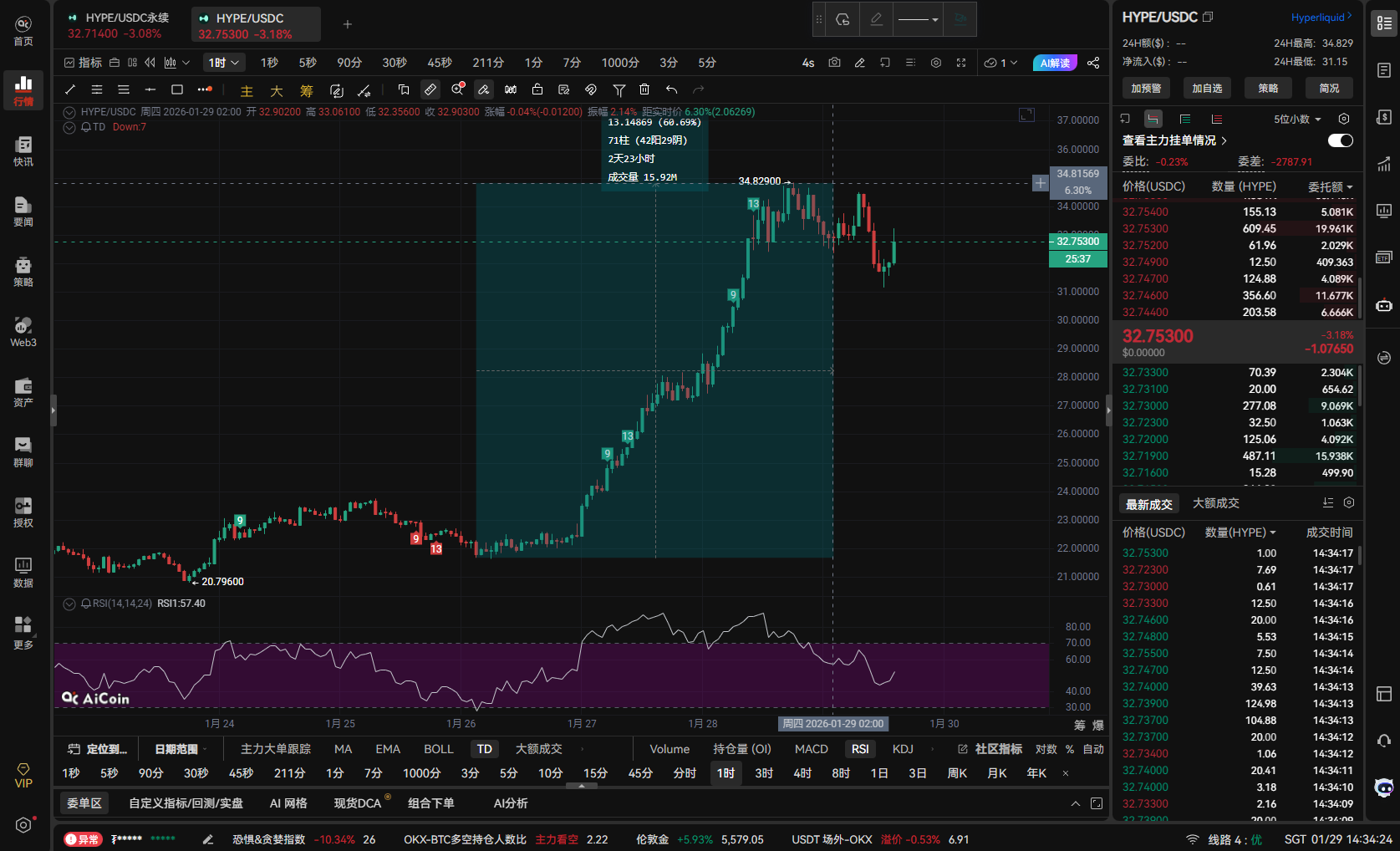
On January 29, 2026, in the UTC+8 time zone, a flash crash surrounding the Venus Protocol governance token XVS tore a visible rift in the BNB Chain ecosystem. According to data from a single source, XVS's price dropped by approximately 40% within 24 hours, with a maximum drop of over 30% in a single hour, causing the price curve to nearly plummet vertically. On-chain tracking revealed that a whale had previously increased their position in XVS through high-leverage circular borrowing on Venus, ultimately triggering a series of liquidations during the price plunge, resulting in a loss of about $1.09 million (also from a single source). This incident transformed a leverage strategy that should have been "actuarially controllable" into an extreme risk case, pointing directly to a core contradiction: when the risk control model of decentralized lending encounters the violent fluctuations of low market cap governance tokens, the structural conflict between the two is far sharper than imagined.
From Silence to Plunge: The XVS Flash Crash
● Operational Path Analysis: Public chain data can reconstruct the general path— the whale first accumulated 532,000 XVS in batches on the spot or on-chain, with a total cost of about $2.81 million, then pledged a large amount of XVS into the Venus Protocol, borrowed assets from the lending pool, and then flowed back to buy more XVS to increase their position. This "pledge—borrow—repurchase—re-pledge" closed loop allowed their nominal holdings to far exceed their own funds, completely tying their position to the price of XVS.
● Key Nodes of the Plunge: According to price monitoring from a single source, XVS accumulated a drop of about 40% within 24 hours on the day of the event, with a maximum drop of over 30% in one hour, far exceeding the range that conventional liquidity could bear. As the price fell below the whale's safe zone, the collateral value plummeted, triggering liquidation bots on Venus to sell XVS, further increasing selling pressure and forming a positive feedback spiral of "price drop—liquidation sell-off—further price drop."
● Rarity and Symbolic Significance: PANews described it as the "first flash crash case of a small-cap token triggered by a single whale operation in 2026," highlighting the rarity of the event. Unlike past occurrences of contract liquidations or compliance-related downturns, this was ignited by a single high-leverage position on-chain, completed within a transparent DeFi protocol, thus possessing a strong "demonstration effect": any strategy relying on high leverage and betting on fragile liquidity assets could become a test case for the entire system on an extreme day.
Dancing on the Edge with a Health Ratio of 1.07
● The Nested Structure of Circular Borrowing: In the DeFi world, circular borrowing appears to be a seemingly "infinitely magnifying" yield strategy: users first buy the target asset (in this case, XVS), pledge it into a lending protocol like Venus, then borrow another asset to repurchase more XVS for further pledging. Each additional round of leverage increases the nominal position, magnifying returns in a rising market, but correspondingly, even a single-digit price correction can exponentially amplify margin pressure and liquidation risk.
● Health on the Edge of a Cliff: On-chain analyst Yu Jin mentioned that the whale's position health ratio once dropped to 1.07, stating that this meant the position was "still on the edge of a cliff." This metric essentially represents the cushion between collateral value and liabilities; the closer the value is to the liquidation line, the more likely even minor price fluctuations can trigger forced liquidations. The specific algorithm for health ratios in the current market still needs to be verified against the Venus protocol documentation, so a technical breakdown will not be provided here, but it can be confirmed that when the entire system dances on the decimal point of 1.xx, even slight changes in market sentiment can push it over the edge.
● Bear Market and Liquidity Amplification Effect: Coupled with the still relatively tepid market atmosphere at the beginning of 2026, XVS, as an asset ranked beyond the top 200 by market cap, was already facing a continuous decline in liquidity. In such an environment, a price correction that is not extreme can quickly amplify into a demand for margin calls; once holders are unable to add to their positions, liquidations will be triggered one by one, dumping collateral assets back into the market. The concentrated outflow of liquidation sell-offs on Venus put pressure on the order book, causing prices to passively slide down, ultimately evolving into a systemic sell-off and a "collective judgment day" for high-leverage strategies.
Governance Tokens as Collateral: The Invisible Trap of Liquidity
● The Background of Small Market Cap and Weak Liquidity: As the governance token of Venus Protocol, XVS has long been positioned outside the top 200 in crypto asset market cap, with daily trading volume and depth far below that of leading assets. This is usually not noticeable, but during extreme volatility, small market cap and thin liquidity can quickly amplify price shocks—without sufficient buying support to absorb selling pressure, prices will adjust with greater slippage, creating a visible sense of "missing out."
● Pledging Shrinks Circulating Supply: In this incident, the whale and other participants pledged a large amount of XVS into the Venus lending pool, effectively "withdrawing" a significant portion of chips from the circulating market. On the surface, this seems beneficial for stabilizing prices, but in reality, it reduces the amount of externally tradable chips and thins the order book. Once liquidations occur, the concentrated sell-off of XVS needs to find buyers in a much smaller circulating supply, leading to a price drop that exceeds expectations, which is a typical "liquidity trap."
● The Dual Structure of Prosperity and Backlash: During market booms, including governance tokens like XVS in the collateral list of leading lending protocols like Venus can increase TVL, enhance asset utilization, and provide additional yield space for participants. However, once the market turns and sentiment weakens, the collateral attributes of low market cap governance tokens can backfire on the system: price declines weaken collateral value, triggering forced sales and further destroying confidence. This dual structure of shifting from "yield-driven" to "risk amplification" is a challenge that all lending protocols must confront when designing collateral pools.
Retail Investors Following the Myth of Circular Lending: The Backlash of the 2025 Narrative
● The Night Before the Strategy Became Famous: Looking back at Q4 2025, circular lending strategies accelerated in popularity among retail investors. On social media, KOLs and research accounts repeatedly told the story of "pledging high-yield tokens, borrowing stable assets at low cost, and then increasing positions," accompanied by charts and annualized yield screenshots, constructing an almost perfect narrative of passive appreciation. For retail investors who had experienced long-term fluctuations, this "on-chain visible, logically coherent" strategy quickly became one of the few remaining stories that still offered imaginative potential.
● From Star Strategy to Risk Case: Prior to this, similar circular lending cases often ended with "small profits over time," where holders achieved returns exceeding spot through moderate leverage and strict health monitoring. It was these successful cases that further solidified the perception that "as long as leverage is controlled, it is safe." However, the XVS flash crash triggered by a single whale exposed the other side of the strategy under the spotlight: when the target asset lacks liquidity and the market environment cools, even the most meticulous position management can be instantly breached by a price crash.
● The Secondary Education of Retail Investor Mindset: After the event, retail investors' imaginations of high-leverage returns will inevitably undergo a cooling phase. Many will intuitively realize for the first time that governance tokens as collateral do not imply "safety backed by the protocol," but rather may become the first chips to be abandoned in a systemic downturn due to their governance attributes misaligned with economic value. This flash crash not only corrected the illusion of "guaranteed profits" from circular lending but also forced participants to rethink: is the other side of high returns controllable risk or structural asymmetry?
Stress Testing the Largest Lending Protocol on the BNB Chain
● The Central Position of Venus: As one of the oldest and largest lending protocols on the BNB Chain, Venus Protocol has long borne a significant amount of collateral and borrowing demand for assets within the BNB ecosystem. Whether it is BNB itself or a host of ecosystem tokens, they all obtain leverage or liquidity through Venus, making Venus a "system-level hub" in the financial infrastructure of the BNB Chain, where its stability directly relates to the risk perception of the entire ecosystem.
● Exposure of Risk Control Shortcomings: The XVS liquidation event was, in essence, a naturally occurring "extreme scenario" within the existing risk control framework of Venus. In terms of collateral selection, including governance tokens with relatively weak market cap and liquidity in the high-permission collateral basket inherently raised the baseline of systemic risk; regarding liquidation thresholds and discount designs, although specific parameters were not mastered, it was evident that when prices rapidly declined, liquidation actions exhibited significant concentration, causing secondary shocks to the market; the price oracle mechanism's ability to balance "timely response" and "avoiding risk amplification from abnormal prices" during severe fluctuations also revealed areas needing reassessment.
● Impact on the Ecosystem and Model: For the BNB Chain, this event undoubtedly served as a "live stress test." On one hand, it tested the resilience and liquidation efficiency of on-chain lending protocols under extreme volatility; on the other hand, it prompted the market to reassess the sustainability of the "governance token collateral model." In the future, whether in the design of new protocols or adjustments to existing protocol parameters, there will be more consideration of the performance of mid- to long-tail assets like XVS in extreme market conditions, treating this practical case as a warning sample that must be studied and addressed.
After the Liquidation: The Divergence of DeFi Risk Control and Circular Lending Narratives
The XVS flash crash concentrated all potential contradictions in the combination of "high-leverage circular lending + small-cap governance token collateral" and ignited them in a short time. High leverage made positions extremely sensitive to price changes, while small market cap and weak liquidity made prices more susceptible to liquidation selling pressure pushing them into uncontrollable ranges. The combination of these factors formed a typical structural risk template rather than a simple black swan event. The whale attempted to dance on the edge with compounding and leverage but was gently pushed off the cliff by market sentiment with a health ratio of only 1.07.
From the perspectives of the protocol, the whale, and retail investors, future response paths will likely unfold along several main lines: for lending protocols like Venus, increasing the collateral threshold for small-cap governance tokens, setting borrowing limits for single assets or single accounts, and optimizing liquidation processes and oracle fault tolerance mechanisms will all enter the discussion list; for whales and professional players, how to reserve enough "breathing space" for the worst-case scenarios while pursuing returns, avoiding excessive reliance of a single position on a single asset, will become a new consensus on risk control; for retail investors, the market's spontaneous reduction of leverage and decreased blind following of single strategies may also quietly occur on a psychological level.
The XVS flash crash is more like the starting point for discussions on DeFi risk pricing and lending risk control in 2026. It reminds all participants that in a world where transparency is public and rules are written into contracts, risks do not disappear into thin air; they only migrate and amplify between different roles. In this sense, viewing it as a result inevitably derived from structural contradictions may be closer to reality than simply categorizing it as an "occasional black swan."
Join our community to discuss and become stronger together!
Official Telegram community: https://t.me/aicoincn
AiCoin Chinese Twitter: https://x.com/AiCoinzh
OKX Benefits Group: https://aicoin.com/link/chat?cid=l61eM4owQ
Binance Benefits Group: https://aicoin.com/link/chat?cid=ynr7d1P6Z
免责声明:本文章仅代表作者个人观点,不代表本平台的立场和观点。本文章仅供信息分享,不构成对任何人的任何投资建议。用户与作者之间的任何争议,与本平台无关。如网页中刊载的文章或图片涉及侵权,请提供相关的权利证明和身份证明发送邮件到support@aicoin.com,本平台相关工作人员将会进行核查。