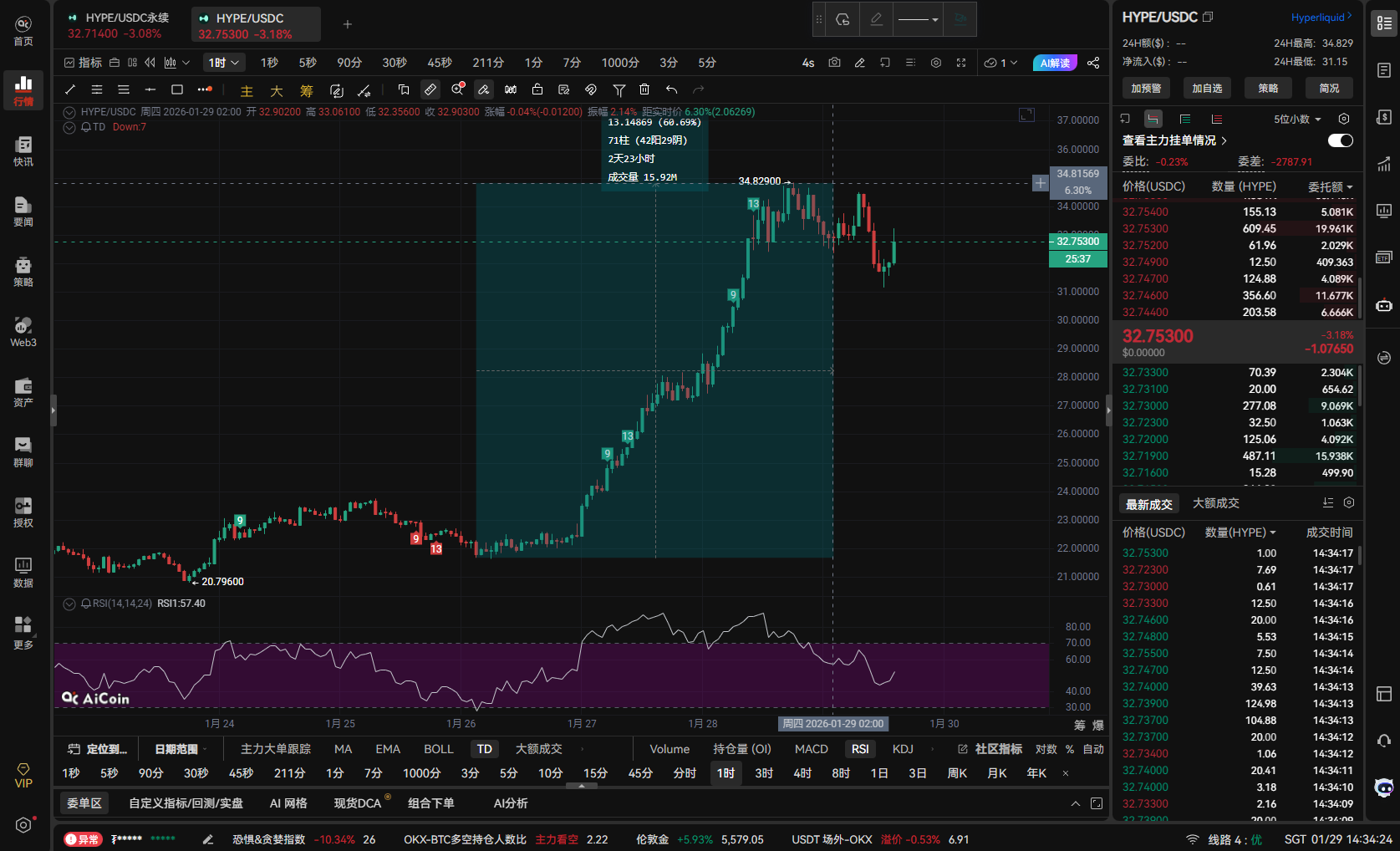
On January 29, 2026, the native token XVS of the BSC ecosystem lending protocol Venus plummeted from about $5.3 to around $3.1 within 24 hours, a drop of nearly 40%. This sudden flash crash quickly spread across the blockchain and the community. During this period, a whale address that heavily leveraged a circular lending strategy to increase its XVS holdings on Venus was liquidated for approximately 287,000 XVS (about $930,000), resulting in an estimated total loss of about $1.09 million, making it the most glaring "bleeding point" in this market cycle. This event once again exposed the inherent systemic fragility of low market cap tokens combined with high leverage DeFi strategies, which can lead to a domino effect of on-chain liquidations during extreme volatility: a slight price crash can trigger a chain reaction of liquidations. In light of this liquidation, we need to question: why did a seemingly "routine" high-leverage bet evolve into a moment of suspense where all assets on the chain held their breath?
Whale's Gamble on XVS: From Frenzied Accumulation to Critical Health Ratio
● Leverage Path: According to on-chain data, the whale employed a typical circular lending path on Venus—first staking assets to borrow funds, then using the borrowed funds to buy more XVS, and re-staking the newly purchased XVS, thus amplifying the position in a loop. On the surface, this strategy leverages DeFi infrastructure to continuously multiply an initial 1x exposure into several times or even higher. As long as the price rises in the short term, the returns can be exponentially amplified, seemingly a "sure-win" accumulation game.
● Liquidity Sensitivity: The problem is that while XVS is the native token of Venus, its market cap and liquidity are significantly smaller compared to mainstream large-cap assets, with limited order depth. Under this premise, the whale's circular leverage strategy essentially turned a highly price-sensitive asset into an extremely concentrated collateral. Once the market experiences unilateral selling pressure, even if the magnitude is not shocking, it is enough to quickly deteriorate the risk indicators of the position.
● Critical Health Ratio: On-chain analysts pointed out that the whale's position "health ratio" once dropped to about 1.07, warning that if the price fell below around $3.2, it would trigger further liquidations (this range assessment comes from a single source and requires more data validation). This means that before the market truly "lost control," the position was already on the edge of a cliff, and any additional volatility could become the last straw that breaks the structure, while the whale remained in a high-leverage exposure state.
● Edge of the Cliff: Narratively, this was not a sudden explosion in front of a black swan without warning; on the contrary, multiple risk indicators on-chain had already lit up yellow before the price completely broke out of the controllable range. However, for large players deeply entrenched in circular lending strategies, the high health ratio on paper easily creates the illusion of "still having room," while the deep reality of XVS indicates that the true safety margin is much thinner than the numbers suggest.
40% Plunge in 24 Hours: On-Chain Liquidation and Price Resonance
● Time and Magnitude: According to public data, around January 29, 2026, the price of XVS dropped from about $5.3 to around $3.1, with a decline of nearly 40% within 24 hours. For a small-cap token that is already quite volatile, such a sharp downturn not only breached the psychological defense line of short-term bulls but also quickly triggered a series of warning thresholds for lending positions collateralized by XVS.
● Scale of Liquidation and Loss: During this downturn, on-chain monitoring showed that the whale's position on Venus was liquidated for approximately 287,000 XVS, valued at about $930,000 at the time. Combined with its previous accumulation and leverage path, the actual loss from this single event was estimated at around $1.09 million. The difference here comes from the significant gap between the high-cost accumulation and the price at which it was liquidated, resulting in a loss of over a million dollars in just one day.
● Liquidation Amplifying the Downtrend: In a low liquidity environment, liquidation is not a "silent" backend accounting action but requires actual selling of XVS on the open market to exchange for assets to repay debts. For a token like XVS with limited depth, this means that the larger the liquidation, the heavier the selling pressure, the faster the price drops, which in turn triggers more positions to approach the liquidation line, creating a chain reaction of price declines.
● No Evidence of Manipulation: Currently, there is no evidence to prove that this flash crash was driven by malicious attacks or price manipulation, nor is there any direct correlation with known attack patterns or abnormal on-chain behavior. A more reasonable explanation is that the high volatility of small-cap tokens, combined with the whale's high-leverage circular lending strategy, amplified each other in this market cycle, ultimately evolving into a typical "liquidation cascade."
Fragility of Small-Cap Tokens: The Feast of Longing and the Final Chapter of Liquidation
● Depth Discrepancy: Compared to large-cap assets like BTC and ETH, tokens like XVS exhibit an order of magnitude difference in trading depth, order sizes, and capacity to withstand selling pressure. For the same amount of sell orders, a large-cap asset might only experience a slight pullback, while on XVS, it could lead to significant slippage, directly breaking through multiple support levels. This inherent difference constitutes an "invisible amplifier" for high-leverage strategies.
● Strategy Fragility: On-chain analyst Yu Jin pointed out that this event highlighted the "fragility of high-leverage circular lending strategies for small-cap tokens under extreme volatility." When the underlying asset itself can experience double-digit percentage fluctuations within a day, adding several times or even higher financial leverage means that even a slight adverse market movement can compress the originally "safe" health ratio to the brink of liquidation in a very short time.
● Concentration and Cascading Liquidations: Repeatedly staking, borrowing, and buying the same token within the same protocol may seem like keeping "chips in one's own hands," but in reality, it continuously increases the entire system's dependence on a single asset. Once the price shifts from rising to falling, not only does the whale face a series of liquidations, but the value of the collateral it relies on also declines, dragging other borrowers using the same asset towards the risk threshold, transforming individual strategies into systemic concentration risks and potential cascades at the protocol level.
● Invincible in Bull Markets and the Endgame of Major Drops: In a unidirectional bull market, such strategies are often seen as "the most efficient tools for going long," with paper profits often multiplying several times or even dozens of times, appearing flawless. However, the structural contradiction is that as long as there is a significant drop in a single day, even if the magnitude is within historical volatility ranges, it is enough to put high-leverage players in a situation where "one liquidation is the endgame," leaving little room for adjusting positions or gradually stopping losses.
Venus's Double-Edged Sword Moment: The Line Between Protocol Security and Aggressive Strategies
● Protocol Status and Token Reality: As one of the main lending protocols on the BSC chain, Venus has long supported large-scale collateral and lending demands, making it a core infrastructure in the BSC DeFi landscape. However, the overall market cap and liquidity of its native token XVS have not formed a linear match with the protocol's TVL, leading to a reality: the protocol itself is large, but as collateral and speculative targets, XVS remains a typical small-cap token.
● Protocol vs. Strategy: From the current public information, Venus's contracts, liquidation, and lending mechanisms have not shown systemic failures; this series of liquidations is more a consequence of overly aggressive user-side strategies. If all risks are simply attributed to the project being "problematic," it not only overlooks the inherently neutral nature of DeFi lending products but also obscures the parts that truly need reflection—namely, what kind of leverage and concentration individuals assume when using these tools.
● The Double-Edged Sword of Automatic Liquidation: The design intent of the automated liquidation mechanism is to promptly sell part of the assets when the value of collateral declines, ensuring the solvency of the entire fund pool and avoiding bad debts. This indeed plays a protective role at the system level: the overall safety of the pool and other users is maintained. However, for a single large player, this mechanism instantaneously becomes a cold executioner’s knife—once triggered, it ruthlessly sells off large positions according to the rules, and in a low liquidity environment, it may even actively accelerate its own losses.
● Common Risks: Similar high-leverage liquidation events are not unique to Venus but have repeatedly occurred across multiple chains and various DeFi lending and derivatives protocols. From Aave to various decentralized perpetual contract platforms, wherever users are allowed to leverage and concentrate bets on a single asset, encountering extreme volatility poses a common risk of being forcibly liquidated, facing slippage, and suffering "secondary damage," which is a structural issue the entire industry needs to address in the long term.
Panic and Bottom Fishing Coexist: A New Round of Reshuffling in On-Chain Games
● Sudden Change in Sentiment: When the whale's position began to be liquidated, the XVS market experienced severe volatility in a short time, with candlesticks showing long shadows and the community's sentiment rapidly shifting from observation to panic. Each step down in price triggered new questions on social media about whether there would be greater selling pressure, amplifying the passive selling in the market and the external emotional resonance, making the flash crash visually and psychologically more dramatic.
● Passive Selling vs. Active Buying: On the other hand, every XVS passively sold by the whale inevitably had someone on the other side choosing to buy. The liquidation mechanism forced the chips of high-leverage players to be "cleared" into the market, attracting buying power from small and medium investors, potential institutions, and low-leverage players, attempting to acquire chips at lower positions. This dynamic of selling and buying formed a typical "whale liquidation, market diversely absorbing" game pattern.
● Chip Migration: From a longer-term perspective, large-scale forced liquidations often drive the migration of chips from high-leverage players to low-leverage or non-leverage holders. After the liquidation is completed, the original concentration of risk is dispersed, with some chips entering long-term holding addresses and others flowing to short-term traders, resulting in a more diversified overall holding structure. While this is a devastating outcome for those liquidated, it represents a process of "passive deleveraging" for the protocol and market structure.
● Structural Turning Point: This flash crash of XVS may very well become a turning point on two levels: first, the restructuring of XVS holding structures, where the previously highly concentrated large chips in a single address are split; second, the re-evaluation of user structures and strategy preferences on Venus, where some players using high-leverage circular lending will be forced to exit or reduce risk, and more conservative users will reassess health ratios, collateral choices, and leverage multiples, thereby changing the behavioral patterns on the protocol for some time to come.
Lessons DeFi Players Must Learn Before the Next Flash Crash
The XVS event encapsulated multiple risks: the underlying asset's small market cap and limited liquidity, the whale's high concentration on a single asset, and the amplification of high leverage through multiple rounds of circular lending. Once the price experiences an unexpected significant drop in a single day, the liquidation mechanism will almost "mechanically" lay all risks bare. For DeFi users, the first lesson is to learn to distinguish between "protocol security" and "strategy security"—the contract has not been attacked, and the fund pool has no bad debts does not mean that one's position has sufficient safety margins. Even if the health ratio on paper looks acceptable, as long as the underlying asset lacks liquidity and has excessive slippage, the actual tolerable drawdown space may be far lower than the numbers suggest.
From the perspective of risk management, several fundamentals should no longer be overlooked: first, control leverage multiples, especially on small-cap, highly volatile assets, to avoid indiscriminately amplifying exposure in circular lending; second, diversify collateral assets and position concentration, ensuring that the entire strategy's fate is not entirely tied to a single token; third, continuously monitor liquidation thresholds, market depth, and real-time slippage, understanding that in a real selling environment, there may be a significant gap between the liquidation price and the expected price. Looking ahead, Venus and other DeFi lending protocols are likely to make more refined adjustments in parameter settings, risk limits, and user education, such as tightening the borrowing limits for certain small-cap assets, increasing risk weights, or providing more intuitive prompts about liquidation risks in front-end interactions. For all participants, what truly determines whether one can navigate the next flash crash is not any particular "magic strategy," but rather a respect for leverage, liquidity, and concentration.
Join our community to discuss and become stronger together!
Official Telegram community: https://t.me/aicoincn
AiCoin Chinese Twitter: https://x.com/AiCoinzh
OKX benefits group: https://aicoin.com/link/chat?cid=l61eM4owQ
Binance benefits group: https://aicoin.com/link/chat?cid=ynr7d1P6Z
免责声明:本文章仅代表作者个人观点,不代表本平台的立场和观点。本文章仅供信息分享,不构成对任何人的任何投资建议。用户与作者之间的任何争议,与本平台无关。如网页中刊载的文章或图片涉及侵权,请提供相关的权利证明和身份证明发送邮件到support@aicoin.com,本平台相关工作人员将会进行核查。