Author: Spinach Spinach
A seemingly technical regulatory guideline has actually sounded the alarm for the wild growth of "synthetic equity," and the rules of the game are now clear!
On January 28, 2026, the three major divisions of the U.S. Securities and Exchange Commission (SEC) — the Division of Corporation Finance, the Division of Investment Management, and the Division of Trading and Markets
— jointly issued a statement regarding Tokenized Securities.
The official title of this statement is so plain it could put you to sleep, but its content is extremely important: it systematically defines the classification framework for tokenized securities for the first time and clearly states — no matter what chain you put the securities on or what fancy technology you use to package them, a security is a security, and federal securities laws apply as they should.
In the SEC's own words: "The format in which a security is issued or the methods by which holders are recorded (e.g., onchain vs. offchain) does not affect application of the federal securities laws."
Does it sound like a correct but meaningless statement? Hold on, the real impact of this statement lies in the details.
1. Timing: Why Now?
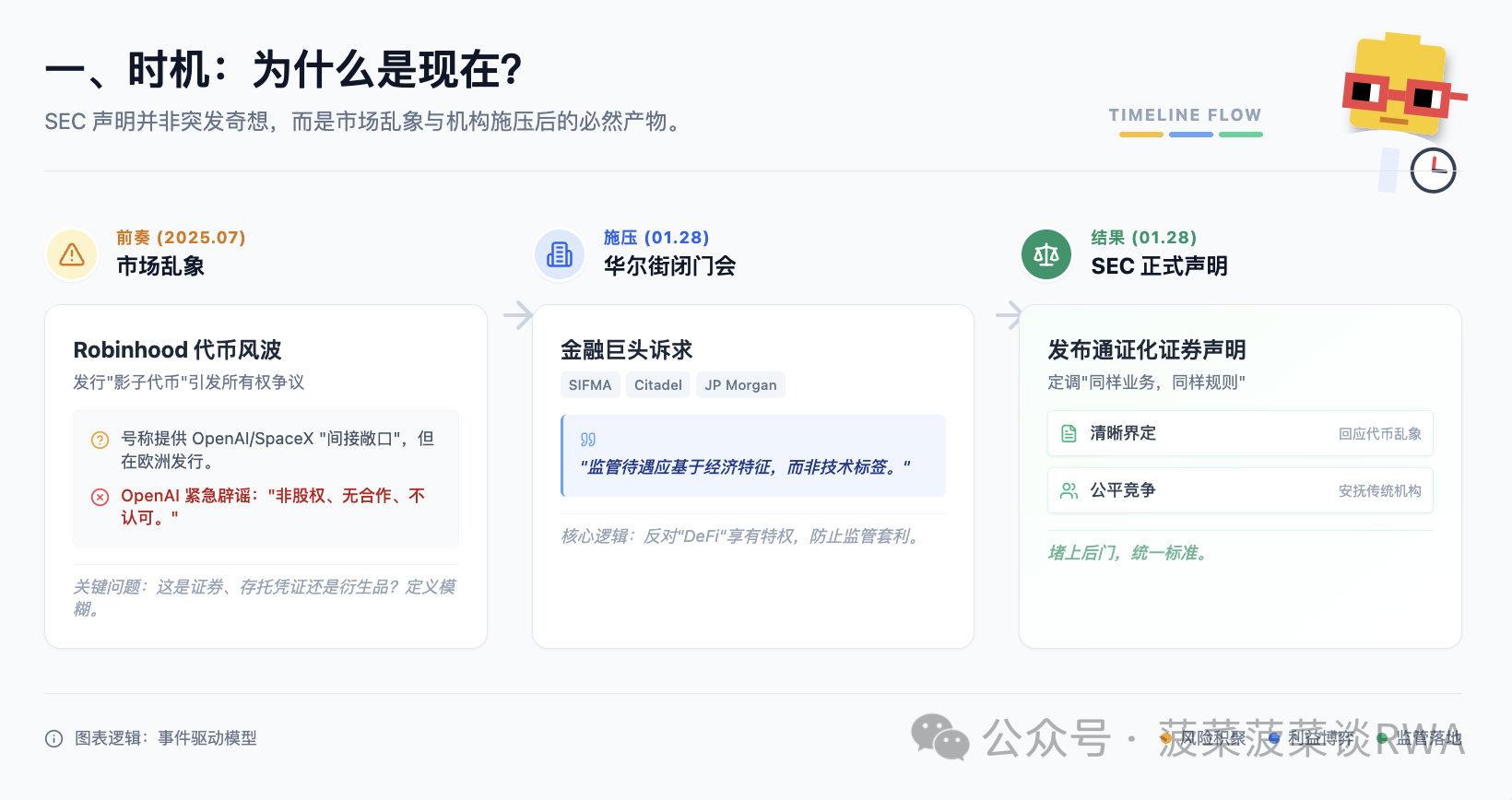
The timing of this statement's release is no coincidence. On the same day (January 28), heavyweight players on Wall Street — the Securities Industry and Financial Markets Association (SIFMA), Citadel, and JPMorgan — had just held a closed-door meeting with the SEC's Crypto Task Force. According to the SEC's publicly released meeting memo, the core demand from these traditional financial giants was singular:
"Do not create special backdoors for tokenized securities."
They are concerned that if the SEC provides lenient exemptions for securities traded on-chain, it would "undermine investor protection and lead to market fragmentation."
SIFMA wrote in the meeting materials: "Regulatory treatment should be based on economic characteristics, not on the technology used or categorical labels (such as 'DeFi')." In other words, Wall Street does not oppose tokenization but firmly opposes tokenization becoming a tool for regulatory arbitrage.
Earlier, in July 2025, a farce had already laid the groundwork for this statement: Robinhood launched so-called "OpenAI tokens" and "SpaceX tokens" in the European market, claiming to provide retail investors with "indirect exposure" to these top private companies.
As a result, OpenAI immediately issued a statement on social media denying: "These 'OpenAI tokens' are not equity in OpenAI. We have not collaborated with Robinhood, have not participated in this matter, and do not endorse it. Any transfer of OpenAI equity requires our approval — we have not approved any transfers."
The essence of this controversy lies in: What exactly are the tokens issued by Robinhood? Are they real equity? Custodial receipts? Or purely synthetic derivatives?
At that time, the market was in chaos, and regulation lacked clear guidance. The SEC's statement is a formal response to this kind of gray area.
2. Core Framework: Issuer-Led vs. Third-Party Led
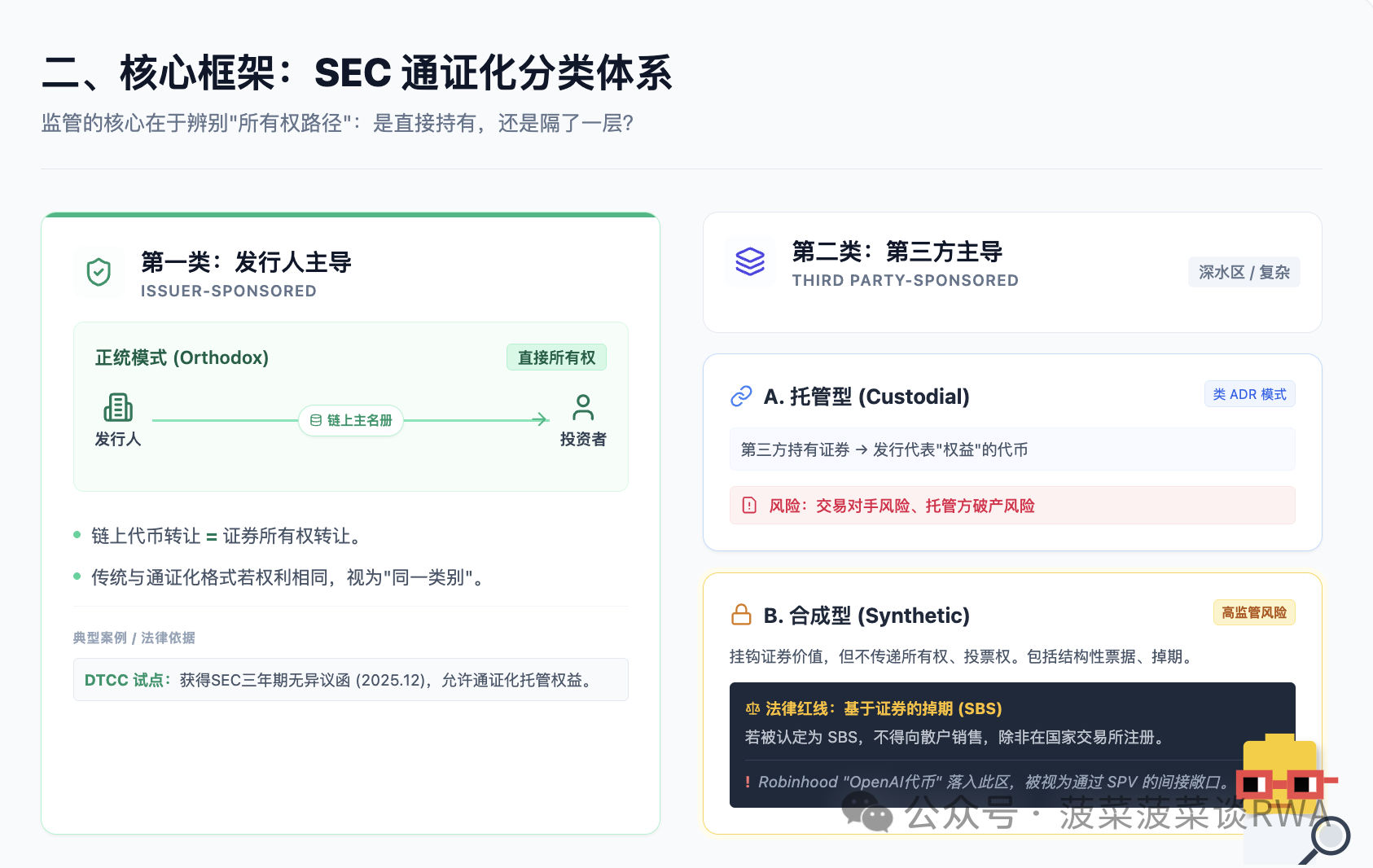
The SEC established a concise classification system in the statement. Tokenized securities are divided into two main categories:
First Category: Issuer-Sponsored Tokenized Securities
This is the most "orthodox" model. The issuer (such as a publicly listed company) directly issues its securities in the form of crypto assets, integrating blockchain into its "master securityholder file." In this model, the transfer of on-chain tokens is directly equivalent to the transfer of ownership of the securities. The only difference lies in the method of record-keeping — from a traditional centralized database to a distributed ledger.
The SEC specifically pointed out that issuers can issue both traditional format and tokenized format securities simultaneously. If both "have substantially similar characteristics and holders enjoy substantially similar rights and privileges," they can be considered "the same category" of securities.
This provides direct legal basis for the securities tokenization pilot project that DTCC is preparing — in December 2025, the SEC had already issued a three-year no-action letter to DTCC, allowing it to pilot tokenized security entitlements on supported blockchains.
Second Category: Third Party-Sponsored Tokenized Securities
This is where it gets complicated. When a third party (unrelated to the securities issuer) attempts to tokenize securities issued by others, things become complex. The SEC further subdivides this situation into two models:
Custodial Tokenized Securities:
The third party holds the underlying securities and then issues tokens representing "security entitlements." Essentially similar to ADRs (American Depositary Receipts) — what you buy is not the stock itself, but an indirect entitlement to the stocks held by the custodian. The key risk is that investors face counterparty risk from the custodian, including bankruptcy risk.
Synthetic Tokenized Securities:
The third party issues its own securities that "link" to the value of another security but do not convey any ownership, voting rights, or information rights to the underlying asset. This includes structured notes, linked securities, and — importantly — security-based swaps.
The SEC devoted considerable space in the statement to explain the definition and limitations of security-based swaps. According to Section 3(a)(68) of the Exchange Act, a security-based swap is a contract linked to a single security, a narrow-based security index, or specific issuer-related events.
Such products may not be sold to non "eligible contract participants" unless registered with the SEC and traded on a national securities exchange.
This regulation is highly impactful. Looking back at Robinhood's "OpenAI tokens," under the framework of the SEC's statement, they likely fall into the category of "synthetic tokenization" — because the token holders do not receive actual equity in OpenAI, but rather "indirect exposure" provided through an SPV (special purpose vehicle).
If deemed a security-based swap, their sale to retail investors would face strict legal obstacles.
3. Technology Cannot Change Economic Substance
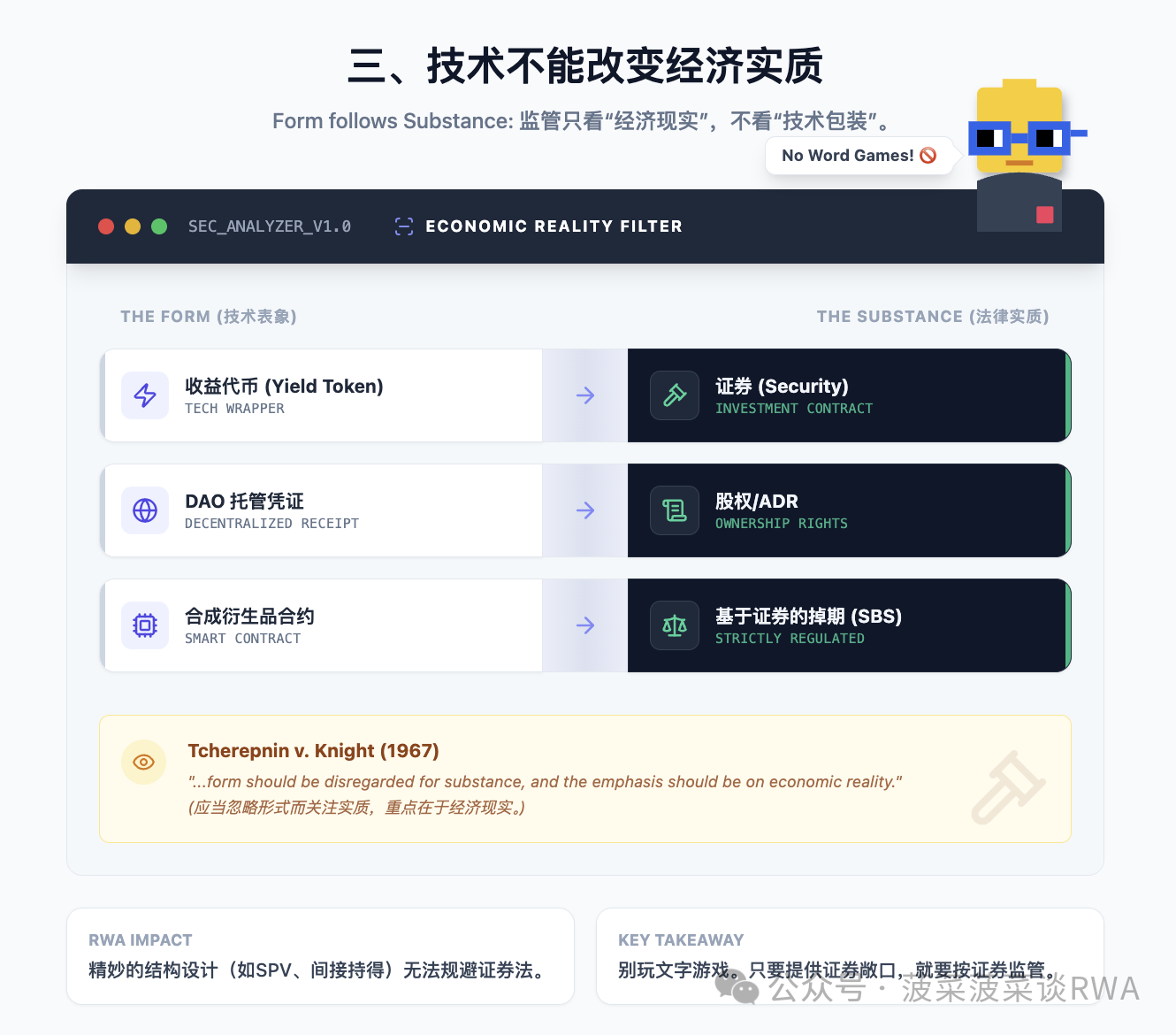
The core idea repeatedly emphasized in this statement is: form follows substance. The SEC cited the principle from the 1967 Supreme Court case Tcherepnin v. Knight: "In exploring the meaning and scope of the term 'security,' form should be disregarded for substance, and the emphasis should be on economic reality."
This means that no matter what name you give a product or what technology you use to implement it, regulators only care about one question: what is the economic substance of this thing? If its function is to provide exposure to the value of a certain security, then it must be regulated under securities law. If it also involves the economic characteristics of swaps, then it must also meet the regulatory requirements for swaps.
This principle has far-reaching implications for the entire RWA (Real World Assets) industry. In recent years, many projects have attempted to evade the applicability of securities laws through clever structural designs — for example, issuing "revenue tokens" instead of "equity tokens," using "custodial receipts" instead of "direct ownership," and operating under the guise of "derivative contracts" instead of "securities."
The SEC's statement essentially tells the market:
- Stop playing word games; we are looking at economic substance.
4. Interpretation: The SEC's Regulatory Philosophy is Taking Shape
When viewed in a larger context, this statement reveals that the SEC's philosophy on crypto asset regulation is becoming clearer.
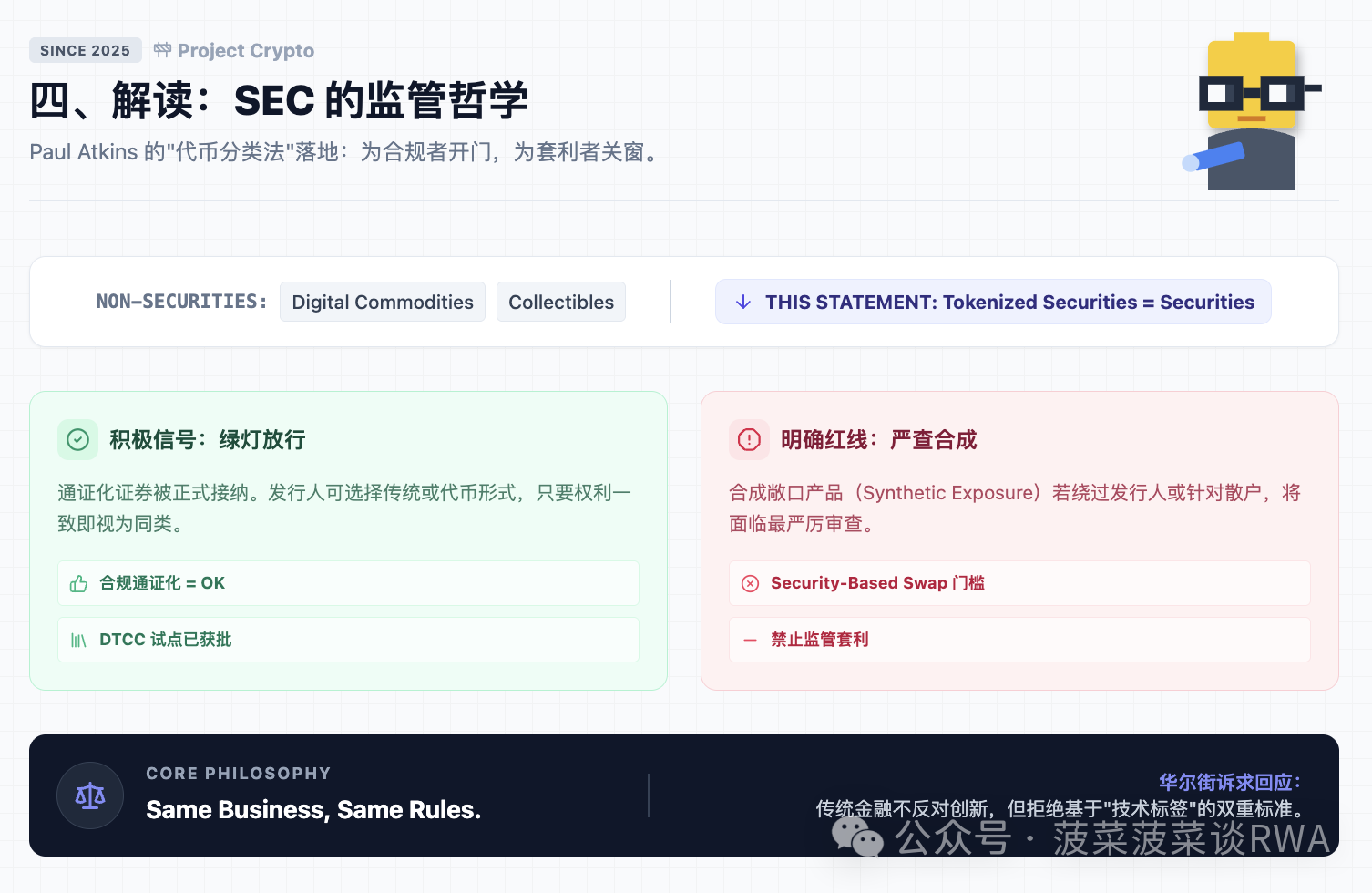
Since taking office in 2025, SEC Chairman Paul Atkins has been promoting the "Project Crypto" initiative, whose core goal is to establish a clear regulatory framework for crypto assets. In a speech in November 2025, he proposed a "token taxonomy" concept: digital commodities, network tokens, digital collectibles, and digital tools are not securities, but tokenized securities are securities.
This statement is a concrete implementation of this classification framework in the field of tokenized securities. Its core message is dual:
On one hand, the SEC has released a positive signal to the market: Tokenized securities are accepted.
Issuers can choose to issue traditional securities such as stocks and bonds in tokenized form, and the regulatory framework is clear and operational. The DTCC's pilot has been approved, and more institutional participants are entering the market. This is good news for companies that genuinely want to pursue compliant tokenization.
On the other hand, the SEC has drawn a clear red line: synthetic exposure products must play by the rules.
Those attempting to issue through third parties, bypass issuer authorization, and sell synthetic equity to retail investors will face strict legal scrutiny. If your product is essentially a security-based swap, it must meet the thresholds for qualified investors and trading venue requirements.
This position aligns closely with Wall Street's demands. Traditional financial institutions do not oppose innovation, but they are concerned about "regulatory arbitrage" — if on-chain securities can be traded under more lenient rules, traditional market participants will be at a competitive disadvantage.
The SEC's statement essentially says: there will be no double standards.
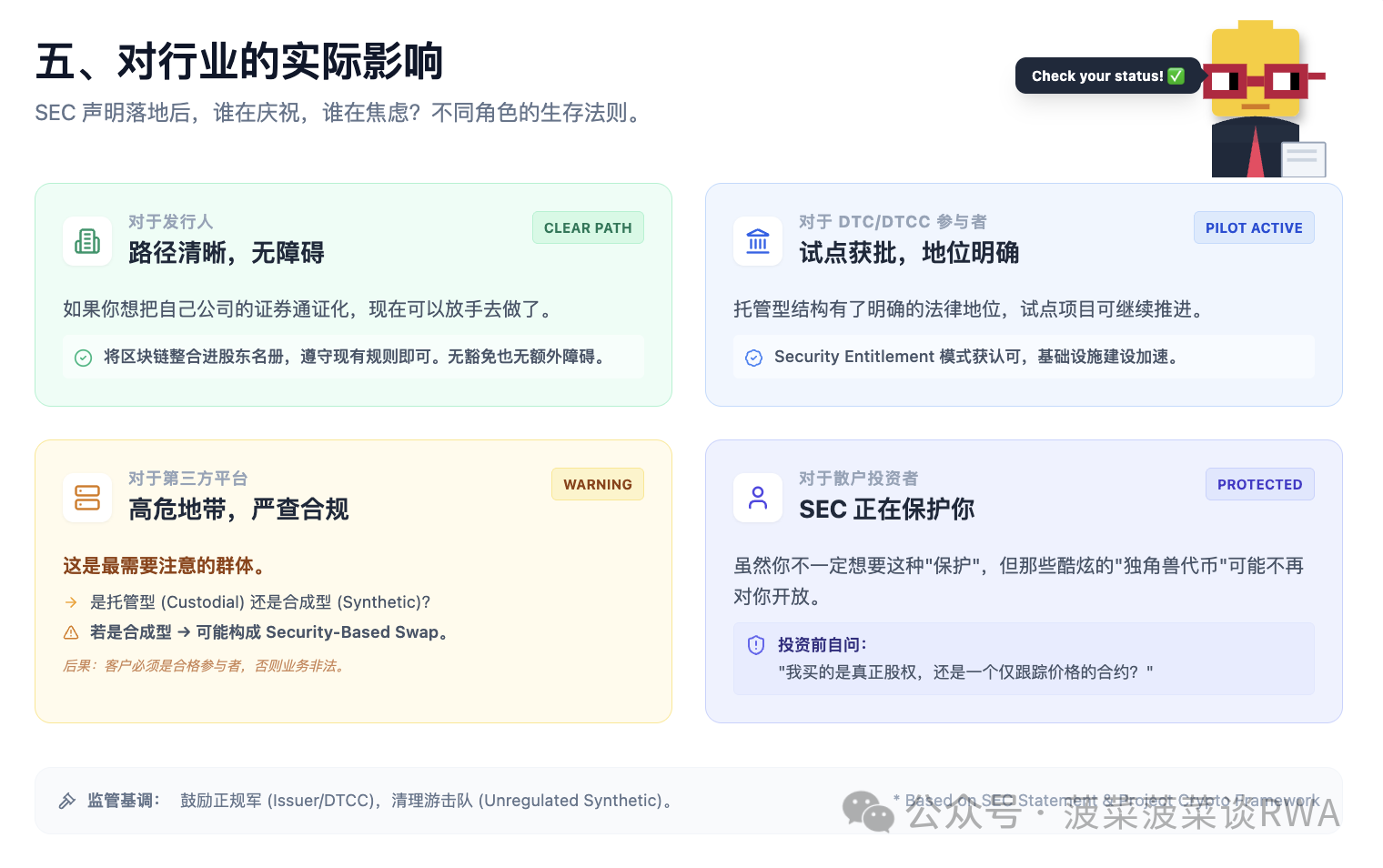
5. Actual Impact on the Industry
The impact of this statement varies for different types of market participants:
For Issuers:
If you want to tokenize your company's securities, the path is clear. Integrate blockchain into the shareholder register and comply with existing securities issuance and disclosure rules. There are no special exemptions, but also no additional barriers.
For DTC/DTCC Participants:
Approved pilot projects can continue to advance. The tokenization model for security entitlements has been recognized, and custodial structures now have a clear legal status.
For Third-Party Platforms:
This is the group that needs to pay the most attention. If you want to issue products linked to other securities, you must first clarify: is your product custodial or synthetic? If it is synthetic, does it constitute a security-based swap? If it does, are all your clients qualified contract participants? The answers to these questions will determine whether your business model is legal.
For Retail Investors:
The SEC is protecting you — even if you may not necessarily want that protection. Those seemingly cool "private equity tokens" and "unicorn company exposures," if not following the proper issuance process, likely should not be sold to you at all. Before buying, ask one question: what exactly am I buying? Is it real equity? Or just a contract that "tracks the price"?
6. Conclusion
The core message of the SEC's statement can be summarized in one sentence: technology neutrality, substance first. Blockchain is a tool, not a safe haven for the law. Tokenization can change the way securities are recorded and transferred, but it cannot change the economic essence and regulatory attributes of securities.
For the entire RWA industry, this is both a constraint and an opportunity.
- The constraint is: those attempting to evade regulation through technical packaging will find it increasingly difficult to succeed.
- The opportunity is: the path to compliant tokenization is becoming clearer, and the barriers to entry for institutional investors are lowering.
Looking back at the Robinhood incident in 2025, OpenAI's public denial left the entire industry embarrassed.
The subtext of this statement may be: we do not want to see similar farces again. If you want to pursue tokenization, do it right — either obtain issuer authorization or honestly comply with derivatives rules.
The gray area that touches neither side is being illuminated by the sunlight of regulation.
Sources:
- SEC, "Statement on Tokenized Securities," Division of Corporation Finance, Division of Investment Management, Division of Trading and Markets, January 28, 2026.
- SEC Crypto Task Force Meeting Memorandum with SIFMA, Cahill Gordon & Reindel, Citadel, and JPMorgan, January 28, 2026.
- SEC, "Tokenization Trending: Statement on the Division of Trading and Markets' No-Action Letter Related to DTC's Development of Securities Tokenization Services," Commissioner Hester M. Peirce, December 11, 2025.
- SIFMA, "Regulatory Mapping Chart Showing Application of Federal Securities Laws to Tokenized Securities," submitted to SEC Crypto Task Force, December 22, 2025.
- OpenAI statement on X (formerly Twitter) regarding Robinhood's tokenized shares, July 2, 2025.
- Tcherepnin v. Knight, 389 U.S. 332 (1967).
免责声明:本文章仅代表作者个人观点,不代表本平台的立场和观点。本文章仅供信息分享,不构成对任何人的任何投资建议。用户与作者之间的任何争议,与本平台无关。如网页中刊载的文章或图片涉及侵权,请提供相关的权利证明和身份证明发送邮件到support@aicoin.com,本平台相关工作人员将会进行核查。


