Content Source: World Economic Forum Annual Meeting
Content Organized by: Peter_Techub News
With the rapid evolution of artificial intelligence (AI) technology, discussions around "Will AI replace human jobs?" continue to heat up. From the tech industry to traditional sectors, from corporate management to frontline workers, anxiety is spreading globally.
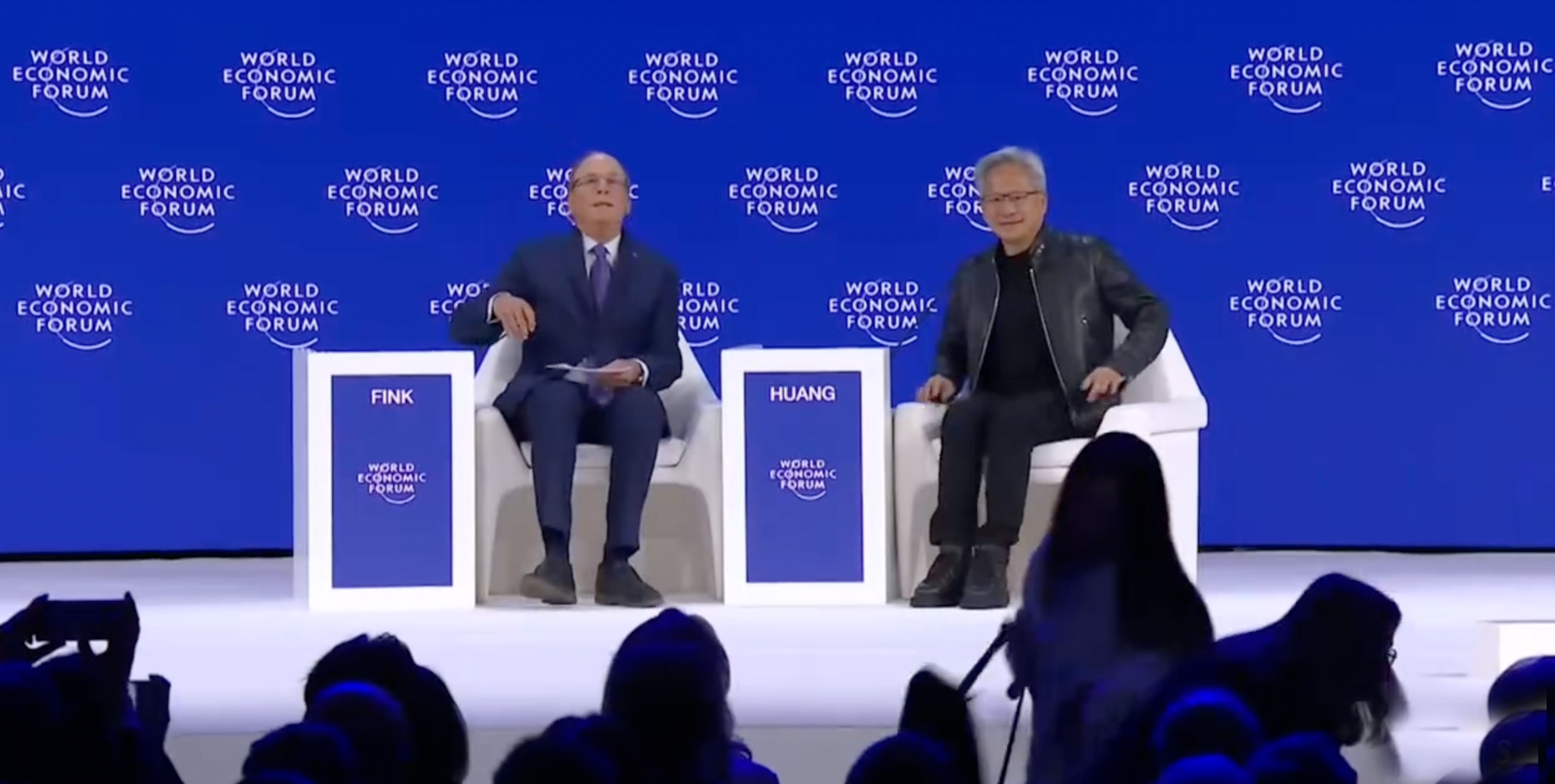
At the recent World Economic Forum, Jensen Huang, founder and CEO of NVIDIA, provided a perspective on this issue that differs from the mainstream narrative. He pointed out that the general concerns about AI may be misplaced. In Huang's view, AI is not merely a simple efficiency tool but a "platform-level leap" that is reshaping computing methods, industrial structures, and economic systems.
AI as a New Generation of General Computing Platform
Huang compares AI to PCs, the internet, and cloud computing, believing it also possesses the attributes of a "general platform." In the past, software relied on humans to pre-write rules, and computers could only operate in highly structured environments; however, the emergence of AI has enabled computers to understand natural language, images, and complex semantics for the first time, allowing for reasoning and decision-making in real-time environments.
He noted that the large models and intelligent applications currently receiving widespread attention are merely the initial forms of this platform. In the future, a multitude of new applications will be built directly on AI capabilities, driving a shift in software paradigms from "instruction-based" to "intention-based."
AI Changes Tasks, Not the Purpose of Work
Addressing the core question of "Will AI replace jobs?", Huang suggested distinguishing between a job's "tasks" and its "purpose."
Using the medical field as an example, he pointed out that when AI made breakthroughs in medical image recognition, there was a viewpoint that radiologists would be quickly replaced. However, the reality is quite the opposite: AI has automated repetitive tasks like image analysis, allowing doctors to focus more on diagnostic decision-making, patient communication, and interdisciplinary collaboration. The overall efficiency of the healthcare system has improved, leading to increased service demand and job growth.
Similar changes are also occurring in the nursing sector. The application of AI in organizing medical records and data entry has reduced the time nurses spend on numerous administrative tasks, allowing them to return to their core patient-centered responsibilities.
In Huang's view, AI automates "how to do" rather than "why to do." When the goals of work are amplified and efficiency is enhanced, the employment structure often changes, but it does not necessarily lead to a reduction in jobs.
AI is Triggering a New Wave of Infrastructure Development
At the industrial level, Huang emphasized that AI is not just a competition of algorithms or models, but a global infrastructure development initiative.
He broke down the AI industry into multiple layers, including energy, chips and computing power, data centers, models, and applications, and pointed out that these layers are expanding simultaneously. Globally, the construction of "AI factories" is accelerating, with related investments reaching hundreds of billions of dollars and expected to approach the trillion-dollar level.
This process is also creating a large number of new industrial jobs, including high-skill engineering positions and roles related to the manufacturing, installation, and operation of computing infrastructure. In some regions, there has even been a noticeable upward trend in salaries for these positions.
The Technical Barrier is Being Rapidly Lowered
Huang also noted that another significant impact of AI is the substantial reduction of technical barriers. As natural language becomes the primary mode of human-computer interaction, more individuals without technical backgrounds can directly participate in software development and product creation.
He believes this change will broaden the participation in technological innovation, allowing more regions and populations to enter the digital economy.
On a global level, Huang introduced the concept of "National Intelligence," suggesting that language and culture are becoming important resources in the AI era. Through localized training and applications, countries can build intelligent systems that meet their own needs rather than relying solely on external technological inputs.
Conclusion
In Huang's description, AI is not a cold "replacement machine," but a general technology that amplifies human capabilities and reshapes the structure of productivity.
The real question that needs to be answered may not be "Will AI replace human jobs?" but rather: Are society, industries, and individuals ready to adapt to this profound technological transformation?
免责声明:本文章仅代表作者个人观点,不代表本平台的立场和观点。本文章仅供信息分享,不构成对任何人的任何投资建议。用户与作者之间的任何争议,与本平台无关。如网页中刊载的文章或图片涉及侵权,请提供相关的权利证明和身份证明发送邮件到support@aicoin.com,本平台相关工作人员将会进行核查。


