Speaking before global business leaders at the World Economic Forum in Davos, Trump framed his first year back in office as a historic reversal of U.S. fortunes. “After 12 months back in the White House, our economy is booming,” he said, adding that “the United States is in the midst of the fastest and most dramatic economic turnaround in our country’s history.”
Trump contrasted his record with that of Joe Biden, repeatedly blaming the prior administration for extreme inflation, border insecurity, and weak U.S. growth. Under Biden, Trump said, the U.S. suffered from “the nightmare of stagflation,” while his own policies had produced “virtually no inflation, and extraordinarily high economic growth.”
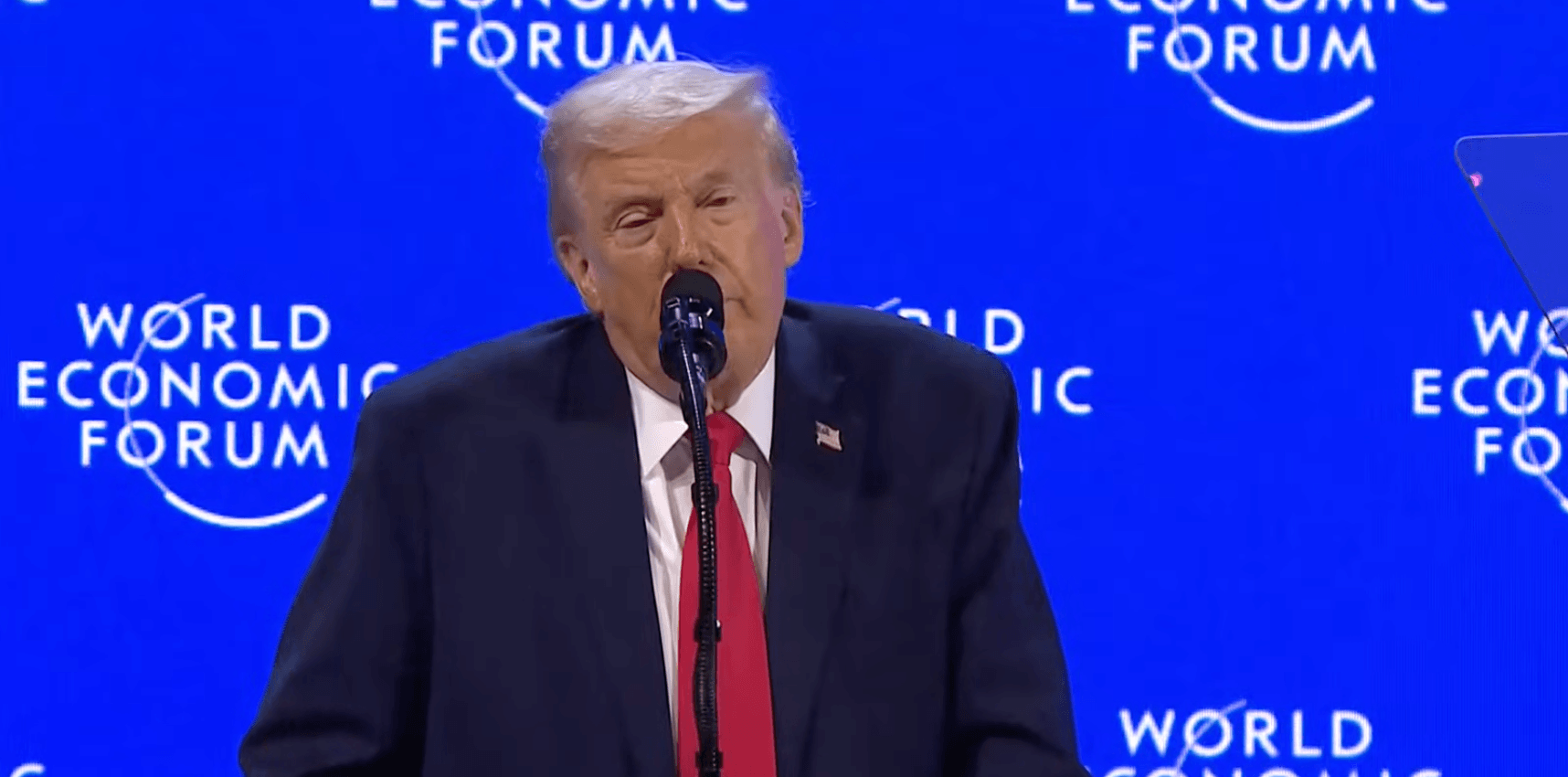
U.S. President Donald Trump at the World Economic Forum (WEF) event in Davos on Wednesday.
The president leaned heavily into American exceptionalism, portraying the U.S. as the indispensable engine of global prosperity. “The USA is the economic engine on the planet, and when America booms, the entire world booms,” Trump told the Davos audience, suggesting other nations would benefit by copying Washington’s approach rather than pursuing what he derided as failed European models.
Trump’s speech was packed with sweeping claims about deregulation, tax policy, and energy. He said his administration had slashed federal employment, cut regulations at a historic pace, and reversed what he called the “Green New Scam.” He argued that reopening fossil fuel production and embracing nuclear energy had pushed gasoline prices sharply lower while strengthening national security.
Energy policy flowed naturally into geopolitics, where Trump pivoted to one of the most arresting moments of the speech: Greenland. The president argued that the massive Arctic territory occupies a critical strategic position between the United States, Russia, and China and cannot be adequately defended without American control. “No nation or group of nations is in any position to be able to secure Greenland other than the United States,” he said.
Trump framed his renewed push to acquire Greenland as a matter of hemispheric defense, not minerals or commerce. “This enormous, unsecured island is actually part of North America,” he said, calling it “a core national security interest of the United States of America.” He added that Washington was seeking “immediate negotiations” with Denmark to revisit a purchase that past U.S. presidents had contemplated for nearly two centuries.
The president insisted the move would strengthen NATO rather than undermine it, even as he repeated familiar complaints about alliance burden-sharing. While stopping short of threatening force, Trump warned that refusal would carry consequences, remarking bluntly that Denmark could say yes, “or you can say no, and we will remember.”
Beyond territory and trade, Trump devoted significant attention to technology, casting both artificial intelligence (AI) and crypto as arenas of global competition with China. He said the U.S. was “leading the world in AI by a lot,” crediting deregulation and allowing companies to build their own power generation to meet soaring energy demand from data centers.
On digital assets, Trump struck an unusually explicit tone. “I’m also working to ensure America remains the crypto capital of the world,” he said, pointing to the signing of the Genius Act and pending crypto market structure legislation. He acknowledged the political appeal of the issue but stressed geopolitical stakes, arguing that Washington had to move before Beijing did.
Trump said crypto policy had become a decisive electoral issue, claiming that millions of voters had opposed Democrats over their prior hostility to digital assets. “China wanted that market, too,” he said, adding that once lost, technological leadership would be nearly impossible to regain.
Also read: Gold Smashes $4,886 as Silver Teases $100 and Global Anxiety Boils Over
The speech also featured Trump’s familiar rhetorical flourishes and self-referential asides, from joking about how quickly his economic program worked to recounting confrontational tariff negotiations with European leaders over prescription drug prices. Throughout, he portrayed himself as a singular dealmaker willing to say what others would not.
Closing on national security, Trump argued that economic strength underpins military power and global stability. “National security requires economic security and economic prosperity,” he said, asserting that the U.S. was now stronger than at any point in its history. Whether the Davos audience found the claims persuasive or provocative, the message was unmistakable: Trump sees American leadership as nonnegotiable—and Greenland as unfinished business.
Wall Street crept higher after Trump’s Davos remarks, with green ink sprinkled across the major indexes by 12 p.m. EST. But fifteen minutes later, major stock indices started edging back into the red and remained mostly flat. All told, the equities action hinted at a calm, risk-on mood rather than a headline-grabbing reaction to the speech—still a clear upgrade from yesterday’s rout. Crypto markets and bitcoin ( BTC) suffered, as the leading crypto asset dipped down to an intraday low of $87,193 per coin at 12:15 p.m. EST.
- What did Trump emphasize most in his Davos speech?
He focused on U.S. economic performance, American exceptionalism, and global competitiveness. - Why did Trump bring up Greenland?
He argued that the territory is essential to U.S. and allied national security due to its strategic location. - What did Trump say about crypto?
He said the U.S. must remain the “ crypto capital of the world” to prevent China from dominating the sector. - How did Trump compare himself to Biden?
He blamed Biden for inflation and weak growth while crediting his own policies for an economic turnaround.
免责声明:本文章仅代表作者个人观点,不代表本平台的立场和观点。本文章仅供信息分享,不构成对任何人的任何投资建议。用户与作者之间的任何争议,与本平台无关。如网页中刊载的文章或图片涉及侵权,请提供相关的权利证明和身份证明发送邮件到support@aicoin.com,本平台相关工作人员将会进行核查。


