Written by: Prathik Desai
Translated by: Block unicorn
Historically, currency has rarely been neutral; it typically has an appreciation aspect. Long before the advent of modern banking, people expected to earn returns from holding or lending currency.
As early as around 3000 BC, ancient Mesopotamia began charging interest on loans of silver. By the 5th century BC, ancient Greece was using maritime loans (nautikà) to finance high-risk maritime trade. Under this system, lenders provided financing for a merchant's single voyage, bearing the entire loss if the ship sank, but demanding high interest (usually between 22% and 30%) if the ship returned successfully. In Rome, interest was so deeply embedded in economic life that it often led to debt crises, making voluntary debt relief a politically necessary choice.
In these systems, the notion that currency is not merely a passive store of value has remained consistent. Holding currency without compensation is an exception. Even after the rise of modern finance, people's views on the nature of currency have further solidified. Bank deposits yield interest. It is widely believed that currency that cannot compound will gradually lose economic value.
It is against this backdrop that stablecoins have entered the financial system. Setting aside blockchain technology, they have little in common with any cryptocurrency or speculative asset. They claim to be digital dollars, designed for a blockchain-enabled world, blurring geographical boundaries and reducing costs. Stablecoins promise faster settlement speeds, lower friction, and 24/7 availability. However, U.S. law prohibits stablecoin issuers from paying returns (or interest) to holders.
This is why the "CLARITY Act," currently under consideration in the U.S. Congress, has become a controversial piece of legislation. When interpreted alongside its sister bill—the "GENIUS Act," which is set to pass in July 2025—it prohibits stablecoin issuers from paying interest to holders but allows for "activity-based rewards."
This has sparked strong protests from the banking sector against the current proposed form of legislation. Some amendments proposed by banking lobbyists aim to completely eliminate the reward mechanism for stablecoins.
In today's in-depth analysis, I will explain what impact the current version of the "CLARITY Act" may have on the cryptocurrency industry and why the cryptocurrency sector is clearly dissatisfied with this proposed legislation.
Let’s get into the main content…
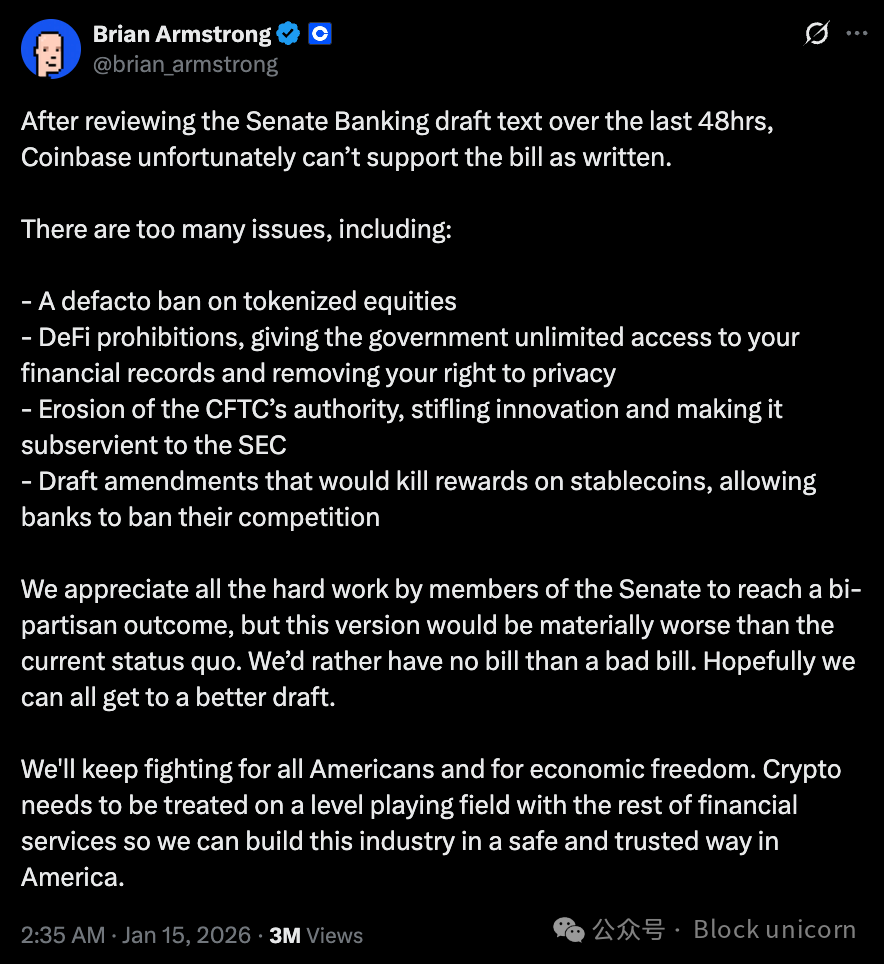
Less than 48 hours after reviewing the Senate Banking Committee's draft, Coinbase publicly withdrew its support. CEO Brian Armstrong stated on Twitter, "We would prefer no bill over a bad bill." He believes that this proposal, which claims to provide regulatory clarity, would actually make the situation for the entire industry worse than maintaining the status quo.
Just hours after the largest publicly listed cryptocurrency company in the U.S. withdrew its support, the Senate Banking Committee postponed its review, and a closed-door meeting was scheduled to discuss amendments to the bill.
The core opposition to this legislation is evident. The legislation aims to view stablecoins purely as payment tools, rather than any form of monetary equivalent. This is crucial for anyone expecting stablecoins to fundamentally change payment methods and is also the most disappointing aspect.
This legislation devalues stablecoins to mere conduits for funds, rather than assets that can be used to optimize capital. As I mentioned earlier, this is not how currency operates. The legislation prohibits interest from being generated on the underlying stablecoins and also bans activity-based rewards, thereby limiting stablecoins from achieving what they claim to excel at—yield optimization.
This has also raised concerns about competition. If banks can pay interest on deposits and offer rewards for debit/credit card spending, why should stablecoin issuers be prohibited from doing so? This would tilt the competitive landscape in favor of existing institutions and undermine the multiple long-term benefits that stablecoins promise.
Brian's criticism is not limited to the yield and rewards of stablecoins; it also touches on the legislation's overall negative impact on the industry. He also pointed out issues with the DeFi ban.
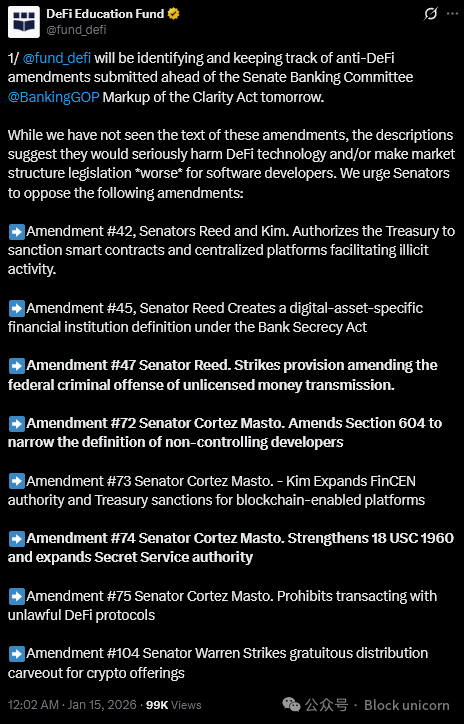
The DeFi Education Fund (a DeFi policy and advocacy organization) has also urged senators to oppose the proposed amendments to the legislation, as these amendments appear to be "anti-DeFi."
The organization posted on X, stating, "While we have not yet seen the text of these amendments, the descriptions suggest they would severely harm DeFi technology and/or make market structure legislation more unfavorable for software developers."
Although the "CLARITY Act" formally recognizes decentralization, it comes with a narrow definition. Protocols that are under "common control" or retain the ability to modify rules or restrict trading capabilities may face compliance obligations similar to banks.
The regulation aims to introduce scrutiny and accountability mechanisms. However, decentralization is not a static state; it is a dynamic process that requires evolving governance and emergency controls to enhance resilience rather than achieve monopoly. These rigid definitions create additional uncertainty for developers and users.
Next is tokenization, where there is a significant gap between promises and policies. Tokenized stocks and funds can provide faster settlement speeds, lower counterparty risks, and more sustained price discovery mechanisms. Ultimately, they will achieve more efficient markets by shortening settlement cycles and reducing the capital tied up in post-trade processes.
However, the current draft of the "CLARITY Act" places the regulatory status of tokenized securities in a state of uncertainty. While the wording does not explicitly prohibit it, it introduces enough uncertainty regarding the custody of tokenized stocks.
If stablecoins are framed as purely payment tools and tokenized assets are restricted to the issuance phase, the path to more efficient capital markets will be significantly narrowed.
Some believe that stablecoins can continue to exist as payment tools while yields can be provided through tokenized money market funds, DeFi vaults, or traditional banks. This view is technically not wrong. But market participants will always seek more efficient ways to optimize capital. Innovation drives people to seek workarounds. These workarounds often include moving capital overseas. Sometimes, this transfer can be so discreet that regulators may later regret not anticipating this capital flight.
However, the main argument against this legislation outweighs all other arguments. It is hard not to see that the bill, in its current form, structurally reinforces the position of banks, weakens the prospects for innovation, and creates significant barriers for an industry that could help optimize the current market.
Worse still, this legislation may come at two extremely high costs. First, it stifles any hope of healthy competition between the banking and cryptocurrency industries while allowing banks to earn more profits. Second, it leaves customers completely at the mercy of these banks, unable to maximize returns in a regulated market.
These are extremely high costs and are precisely the fundamental reasons critics are unwilling to support it.
Worryingly, this legislation appears to be aimed at protecting consumers, providing regulatory certainty, and incorporating cryptocurrencies into the regulatory framework, but its provisions cleverly imply the opposite.
These provisions pre-determine which parts of the financial system can participate in value competition. Banks can continue to operate within a familiar framework, while stablecoin issuers will be forced to survive and operate in a much narrower economic environment.
But capital does not like to passively wait; it will flow to more efficient areas. History shows that whenever capital is restricted in one channel, it will find another channel. Ironically, this is precisely the situation that regulation aims to prevent.
For the cryptocurrency industry, the good news is that the divisions over the legislation extend beyond the cryptocurrency realm.
The bill has not yet garnered enough support in Congress. Some Democratic lawmakers are reluctant to vote in favor until discussions and reviews of certain proposed amendments take place. Without their support, even if the bill views the opposition from the cryptocurrency industry as noise, it cannot pass. Even if all 53 Republican senators vote in favor, the bill still needs the support of at least 7 Democratic senators to pass by a simple majority and overcome procedural hurdles.
I do not expect the U.S. to produce a bill that satisfies everyone. I even think it is neither possible nor desirable. The issue is that the U.S. is not merely regulating a new asset class; it is attempting to legislate a form of currency whose inherent properties make it highly competitive. This adds to the difficulty, as it forces lawmakers to confront competition and draft terms that may challenge existing institutions (in this case, banks).
The impulse to tighten definitions, limit permissible behaviors, and maintain existing structures is understandable. However, doing so risks turning regulation into a defensive tool that repels rather than attracts capital.
Therefore, it is important that opposition to the "CLARITY Act" should not be interpreted as opposition to regulation. If the goal is to integrate cryptocurrencies into the financial system rather than simply isolate them, then the U.S. must establish rules that allow new forms of currency to compete, fail, and evolve within a clear regulatory framework. This will force existing institutions to elevate their standards.
Ultimately, legislation that undermines the interests of the groups it claims to protect is worse than no legislation at all.
This concludes today's in-depth analysis. See you in the next article.
免责声明:本文章仅代表作者个人观点,不代表本平台的立场和观点。本文章仅供信息分享,不构成对任何人的任何投资建议。用户与作者之间的任何争议,与本平台无关。如网页中刊载的文章或图片涉及侵权,请提供相关的权利证明和身份证明发送邮件到support@aicoin.com,本平台相关工作人员将会进行核查。


