Written by: Glendon, Techub News
Following JPMorgan's consideration of providing institutional cryptocurrency trading services, another financial giant on Wall Street is embracing the crypto industry with a more proactive stance.
In the early hours of today, global custodian giant State Street officially announced the launch of its digital asset platform, which will develop a range of core products, including tokenized money market funds (MMF), exchange-traded funds (ETF), tokenized assets, and cash products such as tokenized deposits and stablecoins. Moreover, the platform integrates wallet management, custody, and cash functionalities, aiming to support the development of tokenized products across jurisdictions and covering both private and public permissioned blockchain networks.
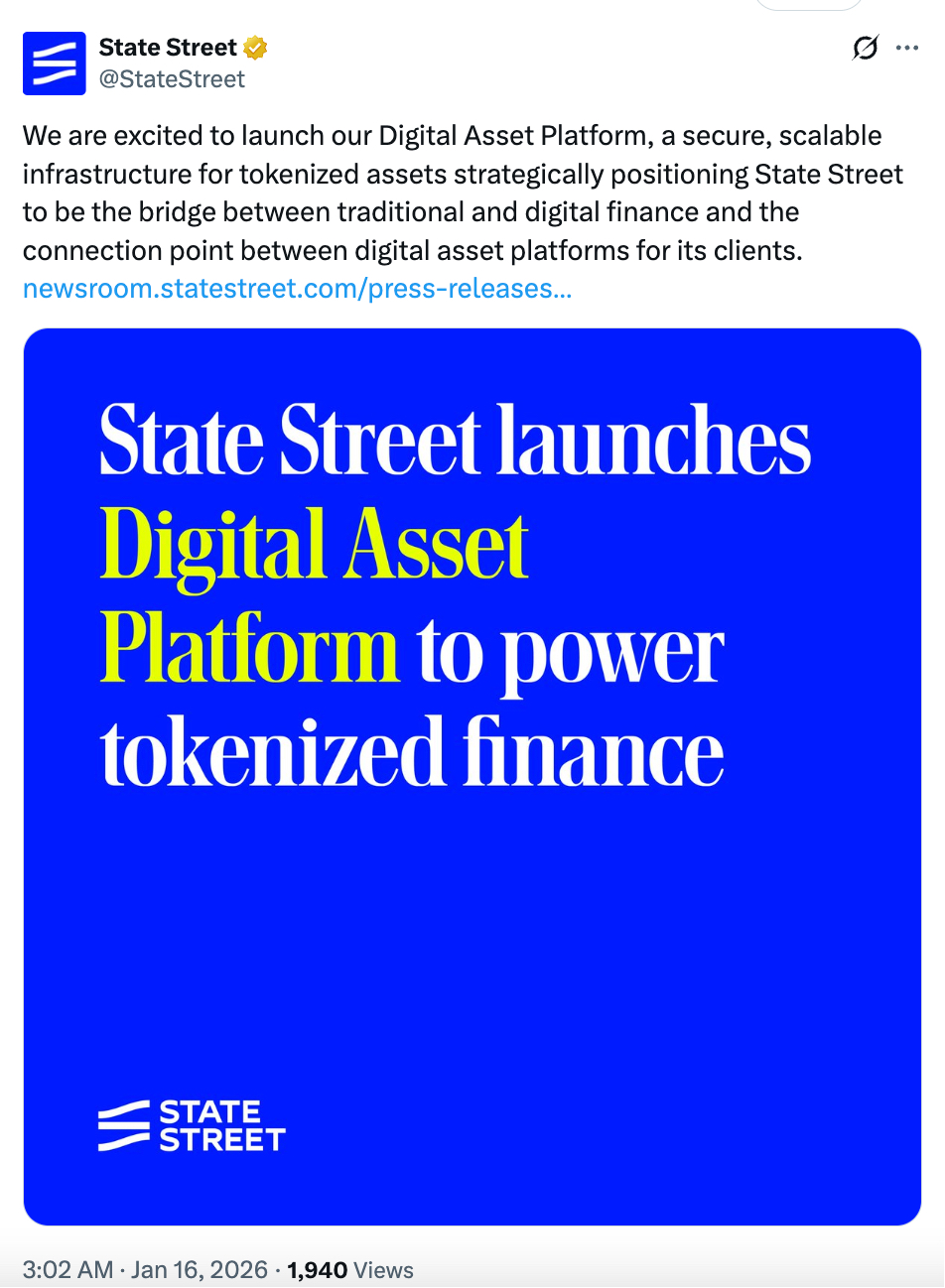
The launch of this platform marks a significant leap in State Street's exploration of the crypto field, transitioning from the experimental phase to practical, scalable solutions. While meeting security and compliance standards, it also signifies that the giant will shift from its long-standing role as a "behind-the-scenes service provider" to a direct market participant in asset issuance.
State Street Enters the Crypto Field: From Exploration to Deepening
As the second oldest bank in the United States, State Street was founded in 1792 and is headquartered in Boston, Massachusetts. It is a wholly-owned subsidiary of State Street Corporation and a leading global custodian bank and asset management institution. Its main business covers various fields, including asset custody, fund management, and securities trading, providing services to thousands of institutional investors worldwide. As of September 30, 2025, State Street managed assets totaling $5.4 trillion, with custodial assets (AUCA) reaching as high as $51.7 trillion, accounting for 18% of the global custody market share, with operations in over 100 markets worldwide.
Compared to JPMorgan's decade-long development history in the crypto business, State Street's entry into the crypto industry is relatively recent, but its level of enthusiasm is equally impressive. Looking back at its exploration in the crypto field, the trajectory of its business expansion is also clearly visible.
State Street's entry into the cryptocurrency industry began in 2021. In March, as Bitcoin first broke the $60,000 mark, driving a comprehensive rise in the crypto market, the global financial market was shaken by the emergence of this new market, and crypto assets truly garnered widespread attention from mainstream institutions. Against this backdrop, State Street took a key step in its digital asset strategy in April, when its Currenex trading technology division partnered with UK foreign exchange trading infrastructure provider Pure Digital to explore the establishment of an institution-focused digital currency trading platform.
In June of the same year, State Street officially launched its digital finance division, "State Street Digital," to facilitate the bank's transition towards the digital economy and decentralized finance. This division will be led by State Street's Executive Vice President Nadine Chakar, focusing on areas such as cryptocurrencies, central bank digital currencies, blockchain, and DeFi. State Street's Chairman and CEO Ron O'Hanley clearly stated at the time that the financial industry is transitioning to digital finance, and digital assets will be one of the most significant forces impacting the financial industry in the next five years. Therefore, digital assets should be rapidly integrated into the existing financial services framework to provide clients with solutions that meet both their traditional investment needs and digital asset investment needs. His strategic judgment laid the tone for State Street's subsequent development.
During this period, State Street also actively laid out its cryptocurrency ETF business and planned to offer cryptocurrency services to its private fund clients, which is also one of the key business directions of the newly established digital finance division.
The establishment of State Street's digital finance division is seen by the industry as a strategic turning point in its proactive penetration from traditional custody services into the digital asset ecosystem. The entry of this financial giant undoubtedly greatly enhances market acceptance of cryptocurrencies and promotes the compliance and mainstreaming of the industry. Meanwhile, in addition to State Street, an increasing number of large banks have begun to follow the crypto trend, specifically establishing branches for cryptocurrency business. For example, Bank of New York Mellon and Goldman Sachs have launched cryptocurrency-related businesses.
In February 2022, State Street formulated a plan to provide digital wallet custody services to clients and actively collaborated with U.S. regulators to seek approval for offering cryptocurrency custody services. However, due to the unclear regulatory framework of the U.S. cryptocurrency industry, the uncertainty of the regulatory environment has delayed the advancement of State Street's plan. To date, State Street's cryptocurrency custody services in the U.S. market have not received any formal approval from federal or state regulatory agencies and remain in the application and compliance preparation stage.
During this period, State Street also attempted other avenues to expand its crypto custody business. In March 2023, it partnered with UK crypto custody firm Copper to launch a new crypto custody service. Unfortunately, this collaboration was soon terminated, and both parties decided to continue advancing their digital strategies within their respective product development frameworks. In 2024, the digital asset division "State Street Digital" underwent layoffs and restructuring, but State Street did not abandon its plan to provide cryptocurrency custody services and is still awaiting regulatory approval.
In August 2024, State Street announced that it would initially focus on the tokenization of traditional assets and chose Taurus to provide digital asset services. At the same time, it emphasized plans to offer digital asset custody services once the U.S. regulatory environment improves to reduce systemic risk. This statement marks a significant shift in State Street's strategic direction.
Active Attempts at Diversified Layouts
Since 2024, State Street has been active in the crypto ETF business and tokenized asset field. It has engaged in deep cooperation with Galaxy Digital, launching several ETFs focused on crypto companies, such as the tokenized fund product "SSGA Active Trust," which invests in stocks of cryptocurrency and blockchain companies, as well as cryptocurrency futures ETFs. In September of the same year, State Street's asset management business, State Street Global Advisors, directly launched three actively managed ETFs focused on digital assets and disruptive technologies: the SPDR Galaxy Digital Asset Ecosystem ETF, the SPDR Galaxy Hedged Digital Asset Ecosystem ETF, and the SPDR Galaxy Transformative Technology Accelerator ETF.
In October, State Street's Chief Product Officer Donna Milrod responded to rumors in an interview with Financial News regarding "State Street exploring the creation of stablecoins and developing tokenized deposits." She clearly stated that the bank's short-term goal is to focus on the tokenization of bond and money market funds, and there are currently no plans to create stablecoins or tokenized deposits. However, she emphasized, "This does not mean we won't do it in the future; we just feel that it is not necessary to do so at this time." This statement seems to foreshadow the launch of State Street's digital asset platform today.
Currently, State Street's collaboration with Galaxy Digital has deepened further, planning to launch a tokenized liquidity fund, the "State Street Galaxy Onchain Liquidity Sweep Fund" (SWEEP), early this year. This fund will use stablecoins to facilitate round-the-clock investor fund flow, thereby expanding the application of public chains in institutional cash management. The fund will initially be issued on the Solana blockchain and will gradually expand to the Stellar and Ethereum blockchains. Currently, Ondo Finance has committed approximately $200 million as seed funding for this product, demonstrating strong market demand for innovative tokenized products.
From the trajectory of State Street's crypto business development, it is evident that this financial giant has a high recognition of the tokenized asset field. Its "2025 Digital Asset Outlook" report clearly pointed out that institutions generally recognize the significant advantages of tokenization technology in enhancing transparency, accelerating transaction efficiency, and reducing compliance costs. Nearly half of the institutions expect this technology to bring over 40% cost savings.
This report also provides strong data support and theoretical basis for State Street's strategic layout in the tokenized asset field. Therefore, State Street's announcement today of the launch of its digital asset platform can be seen as a natural progression.
State Street's Chief Product Officer Donna Milrod stated in the announcement, "What clients need is a trusted infrastructure that truly makes digital assets work, rather than remaining in the experimental stage." Based on this, State Street positions the platform as a secure, scalable tokenized asset infrastructure and aims to make it a bridge between traditional finance and digital finance, providing its clients with access to various digital asset platforms.
It is worth mentioning that the timing of State Street's announcement to launch the digital asset platform is quite strategic, coinciding with a critical policy window, as the "CLARITY Act" is undergoing negotiation and review. Although this act has sparked controversy over tokenized stocks and stablecoin rewards due to comments from Coinbase CEO Brian Armstrong, leading to a postponement of the hearing, relevant parties are still actively advancing the legislative process. According to Crypto In America reporter Eleanor Terrett, if banks, Coinbase, and the Democratic side can reach an agreement on the "revenue" clause in the coming days, the act may still be advanced.
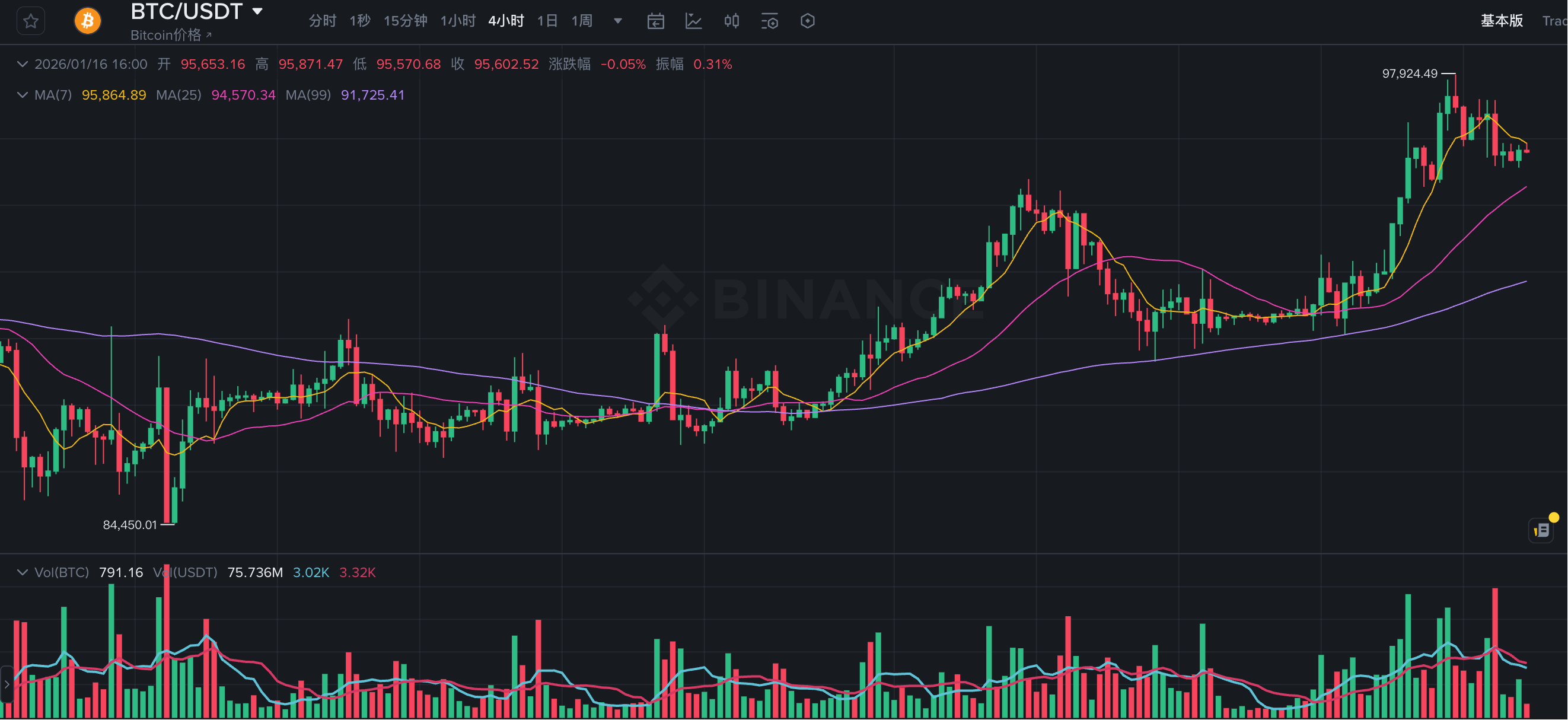
Meanwhile, the crypto market, after a prolonged slump, is showing signs of recovery. Multiple data points indicate that Bitcoin's on-chain structure has shown signs of improvement, and the recent sell-off in the crypto market may be nearing its end. Notably, market sentiment has undergone a significant shift, with the cryptocurrency fear and greed index suddenly climbing to 61 yesterday, marking the first shift to a "greed state" since mid-October last year. This change in sentiment has been visually reflected in the market, with Bitcoin approaching $98,000, reaching its highest level since November 14 of last year, which may indicate that market vitality is gradually recovering.
Additionally, the latest report from JPMorgan analysts further confirms the foresight and necessity of State Street's strategy. The report indicates that following a record inflow of nearly $130 billion in 2025, inflows into the cryptocurrency market are expected to increase further in 2026, primarily driven by institutional investors. Analysts expect that the introduction of more crypto regulatory frameworks, including the U.S. "CLARITY Act," will support this growth and may further drive institutional adoption of digital assets, as well as trigger a wave of venture capital, mergers and acquisitions, and IPOs in areas such as stablecoin issuers, payment companies, and exchanges.
Thus, it is evident that State Street's move is timely, once again reflecting that the traditional financial system on Wall Street is accelerating the integration of cryptocurrencies. This also marks a transformation of this financial institution, which has a history of over 230 years, from a cautious explorer in the cryptocurrency field to a steadfast innovator. This transformation will not only bring new growth opportunities to State Street but also provide important references for the digital upgrade of global financial infrastructure.
Following JPMorgan, State Street has once again opened the door to innovation in the digital finance field, which may inspire banking giants like Citibank and Goldman Sachs to further lay out the crypto market. At the beginning of the new year, State Street may also become a key force in driving the arrival of a true "institutional era."
免责声明:本文章仅代表作者个人观点,不代表本平台的立场和观点。本文章仅供信息分享,不构成对任何人的任何投资建议。用户与作者之间的任何争议,与本平台无关。如网页中刊载的文章或图片涉及侵权,请提供相关的权利证明和身份证明发送邮件到support@aicoin.com,本平台相关工作人员将会进行核查。