Written by: Curry, Deep Tide TechFlow
X has stopped allowing tweet mining.
Product lead Nikita Bier announced yesterday that all applications rewarding users for posting will have their API access revoked.
He also kindly added: developers who have been banned can contact us, and we will help you move to Threads and Bluesky.
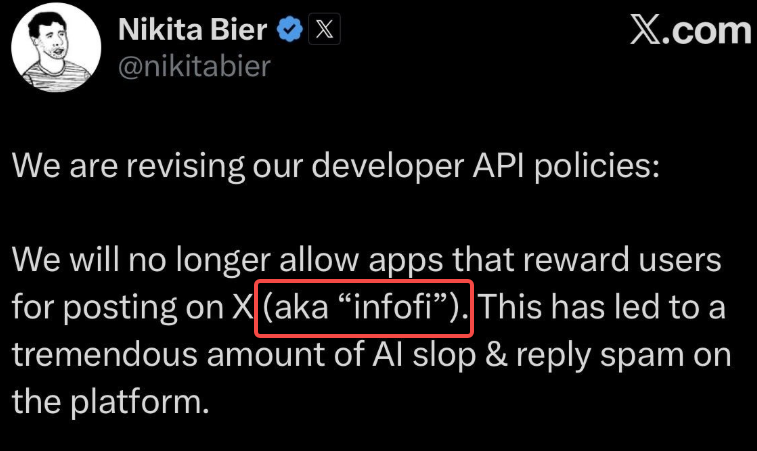
The landlord is kicking people out and even calling moving companies.
As soon as the news broke, the InfoFi sector collapsed. KAITO dropped by 20%, Cookie fell by 20%, and the Kaito Yappers community of 157,000 people was directly banned.
However, less than an hour later, Kaito founder Yu Hu published a lengthy article.
The article neither apologized to the community nor protested X's policy; the core message was simple:
Change places.
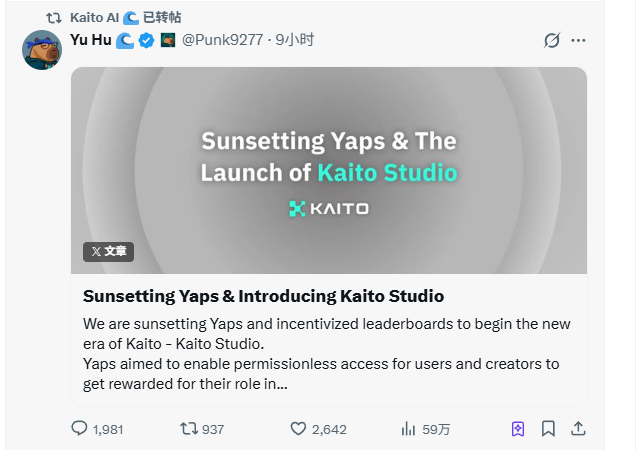
Yaps is no longer in operation; the new product is called Kaito Studio, which will follow traditional marketing routes, collaborating one-on-one with brands and creators, no longer an open model where anyone can earn points.
Twitter is no longer serving, so we will go to YouTube and TikTok. The crypto circle is also no longer serving; we will focus on finance, AI, and the entire creator economy, which is a $200 billion market.
The product is ready, the direction is set, the data is available, and a new story is in place.
However, I feel this doesn't seem like an emergency response that could be written in an hour. It feels more like they knew this day would come, and the draft was already in the drawer, just waiting for X to take action.
At the same time, there were earlier signals on-chain.
Kaito's multi-signature contract had previously distributed 24 million KAITO tokens to 5 addresses. One of those addresses had already transferred all 5 million KAITO tokens to Binance a week ago.
It feels more like securing the bag.
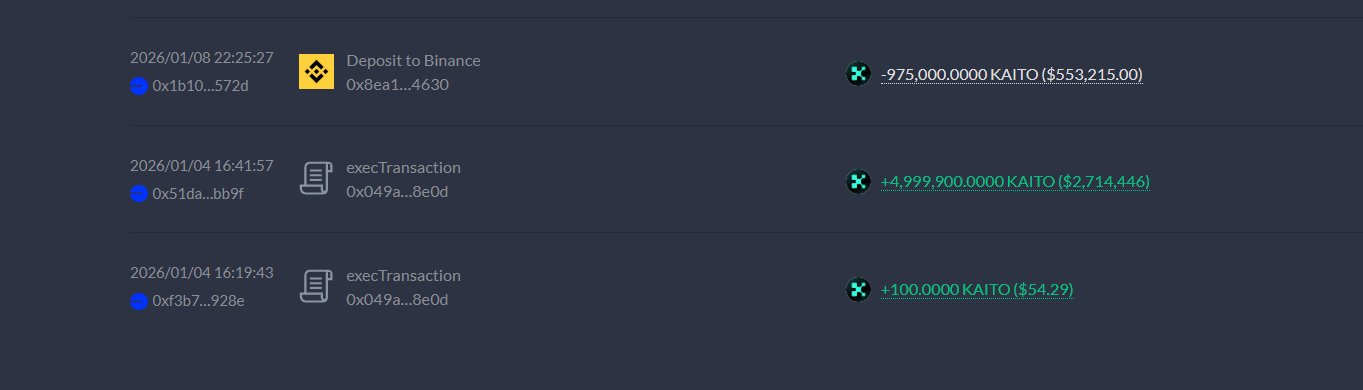
Communicating in advance, writing the article in advance, transferring the tokens to the exchange in advance—everything that needed to be done was done.
Then X made the official announcement, and the long article immediately followed, presenting a beautiful posture, actively transforming, and embracing change.
Yu Hu wrote in the statement: "After discussions with X, both parties agree that a completely unlicensed distribution system is no longer feasible."
Agreed unanimously.
Being kicked out is framed as reaching a consensus. A product being sentenced to death is packaged as a strategic upgrade. We have seen this kind of rhetoric too many times in the crypto circle.
Project parties will never say, "We failed." They say they are exploring new possibilities, that the market environment has changed, and that this is a planned transformation.
Very dignified, but also very public relations.
In fact, X's ban was just the final blow. The business of tweet mining was already on the verge of collapse.
Tweet mining sounds appealing, tokenizing attention, allowing creators to receive fair compensation, and decentralizing the information economy.
But in practice, we all know it has gone awry.
When rewards are tied to posting, people will post more. If AI can generate content in bulk, then let AI post. If there are no limits on accounts, then open a bunch of alt accounts…
CryptoQuant data shows that on January 9, bots generated 7.75 million crypto tweets on X, a year-on-year increase of 1224%.
ZachXBT criticized last year, saying these InfoFi platforms are the culprits of AI-generated junk content. He offered a $5,000 reward for user data to expose the bots.
Serious discussions have been replaced by a screen full of GM, LFG, and bullish comments, making it difficult to distinguish between real people and bots.
X's product lead Nikita Bier actually tweeted last week: CT is dying from suicide, not from the algorithm.
Crypto Twitter is committing suicide, not being killed by the algorithm.
At that time, the crypto community criticized him for being arrogant and kept responding to him with GM memes.
Looking back now, doesn’t it seem like a notification before the execution of the tweet mining business?
Regarding junk content, Kaito founder Yu Hu said they tried various methods. Raising the threshold, adding filters, changing incentive designs.
But it was of no use.
If you reward posting with tokens, you are incentivizing noise creation. No matter how high the threshold, it cannot surpass profit-driven motives. Human nature is what it is. As long as the incentives exist, spam will not stop.
What’s worse is that the lifeline is in someone else's hands.
What business is Kaito in? Leveraging X's traffic, using tokens to incentivize users to produce content, and selling the data to project parties for marketing.
X is the foundation, and Kaito is the house built on top.
If the owner of the foundation decides to reclaim it, the house will collapse. No need for reasons, no need for discussions, just an announcement is enough.
In simple terms, the story that InfoFi tells is about a decentralized attention economy. But the attention part has never been in your hands. The algorithm belongs to the platform, the API belongs to the platform, and the users belong to the platform.
You can put points on-chain and decentralize tokens, but you cannot decentralize Twitter.
Parasites want to overthrow their hosts. The host doesn’t need a revolution; just pulling the plug will do.
In recent years, this entrepreneurial mindset has been popular in Web3: borrowing traffic from Web2 to create momentum for Web3. But users are on Twitter, data is on Twitter, attention is on Twitter, but the tokens are issued by themselves, and the money is earned by themselves.
It sounds clever, like using a small force to move a great weight.
But ultimately, other people's traffic is still other people's. The platform allows you today because it hasn’t been a hindrance to them yet. The day it becomes a hindrance, the vampire-like business will truly be unsustainable.
This serves as a wake-up call for all Web3 projects that started by leveraging platform traffic.
If your lifeline is in someone else's hands, then every penny you earn is just temporarily not reclaimed by them.
Think carefully about whether you are starting a business or renting a house. Renters should not have a landlord mentality, nor should they think the house is theirs.
Kaito says it will go to YouTube and TikTok next.
Are the landlords over there easier to deal with than Musk?
免责声明:本文章仅代表作者个人观点,不代表本平台的立场和观点。本文章仅供信息分享,不构成对任何人的任何投资建议。用户与作者之间的任何争议,与本平台无关。如网页中刊载的文章或图片涉及侵权,请提供相关的权利证明和身份证明发送邮件到support@aicoin.com,本平台相关工作人员将会进行核查。


