Author: Cat Teacher scupt
YZi Labs (related to CZ) + Hyperliquid collaboration, is it really "stable" or just marketing? Let's break it down by evidence and risks.
1) What does the project do? What problem does it solve?
One-sentence positioning: A private, non-signature on-chain trading terminal that provides professional DeFi users with unified access to cross-chain spot, perpetual, pre-issue tokens, and yields.
Target Users and Pain Points
Target Users:
High-frequency traders
Narrative-driven speculators
Whale wallet holders
Advanced DeFi native users
Institutional asset allocators
Core Pain Points:
DeFi fragmentation: Multiple clicks for trading, complex gas management, frequent switching of cross-chain wallets
Lack of CEX-level experience: Unable to achieve the speed, privacy, and aggregation capabilities of centralized exchanges, leading to trading alpha leakage and user loss
Complicated operations: Advanced users need to switch between multiple front-ends, networks, and wallets in multiple tabs
Why is it needed now: With the long-tail growth of tokens, strategies, and DeFi primitives, the market needs a solution that is chain-invisible and executes uniformly, without repeated authorizations or network switching.
Authenticity of the Problem
Evidence of Necessity:
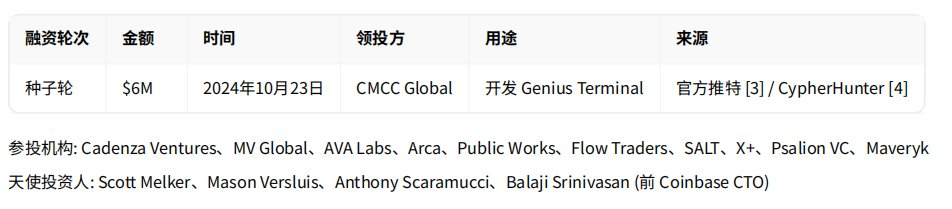
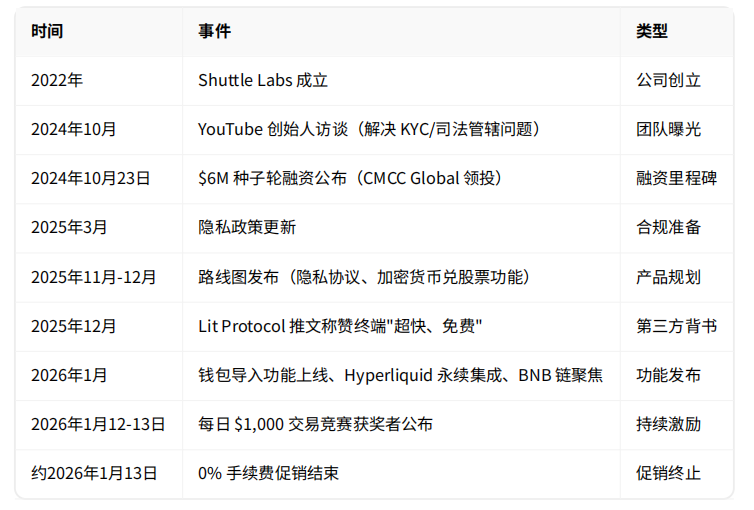
Capital validation: In October 2024, Shuttle Labs raised $6M in seed funding for the development of Genius Terminal, led by CMCC Global, with participation from Arca, Balaji Srinivasan, Avalanche, Flow Traders, etc.
User participation: As of January 13, 2026, a daily trading competition prize of $1,000 is awarded (winners announced), Twitter has 27,600 followers, and wallet import functionality has recently launched.
Third-party endorsement: Lit Protocol praised the terminal as "super fast, free" in a tweet in December 2025 and used its technology.
Consistency of multiple sources: The official website, documentation, Twitter, and LinkedIn all focus on professional trading, with no tokens/TVL indicating application-centric rather than protocol-centric.
Conclusion: The problem is a real necessity; DeFi users have a clear demand for unified, private, and efficient trading tools, and the financing and active reward mechanisms validate market recognition.
2) How does it solve it? (Product/Mechanism)
Product Form and Core Process
Product Form: A unified on-chain trading application/terminal (not a base protocol), aggregating spot, perpetual, pre-issue trading, and yield functions.
Core Workflow:
One-time authentication: Users log in using email/Google/Apple via biometric (key method)
Wallet management: Import/track multiple wallets in a single dashboard
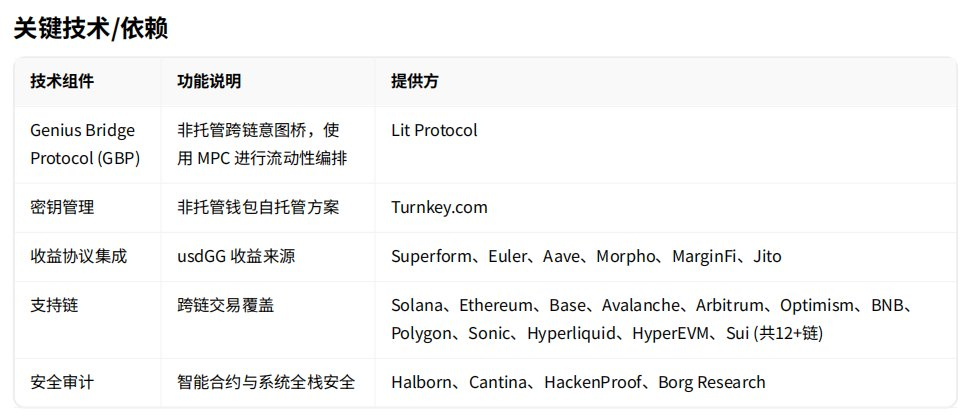
Non-signature trading: Users specify trading intentions/portfolio behaviors, and the terminal executes atomic routing through aggregators and the native cross-chain bridge (Genius Bridge Protocol)
Privacy enhancement: Ghost Orders feature splits orders into up to 500 wallets for transaction obfuscation
Yield management: Idle funds automatically generate yield through the usdGG stablecoin
Currently Available Features
Status: Mainnet launched (not testnet or invite-only)
Feature List:
Cross-chain spot/perpetual/pre-issue token trading
Ghost Orders privacy trading (order splitting)
Multi-wallet import and tracking
Unified portfolio and yield management (usdGG stablecoin)
Real-time market insights (heat maps, radar charts)
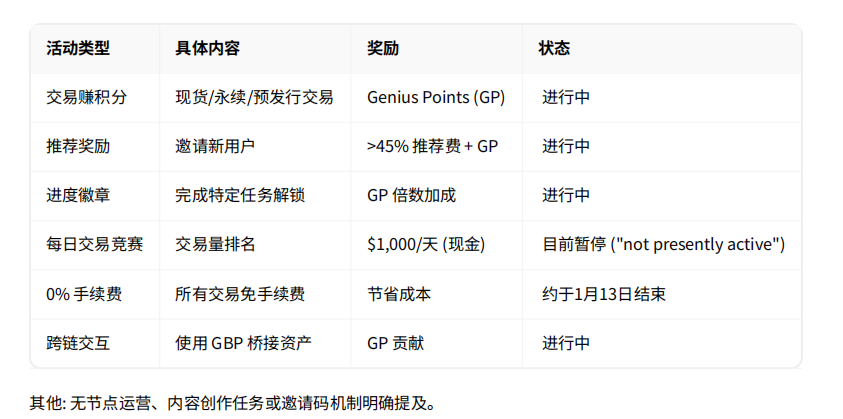
0% fee promotion (ending around January 13, 2026)
Daily $1,000 trading competition with a 50 million Genius Points (GP) reward system
Referral rewards and progress badges
3) Core Competitiveness/Differentiation (Moat)
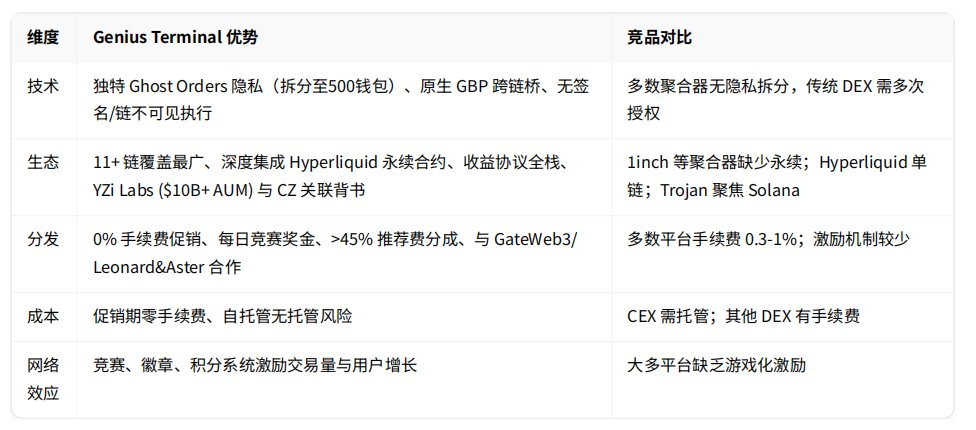
Differentiation from Competitors
Substitutability Analysis
Substitutability: Low
Reasons:
Proprietary privacy technology: The ability to split Ghost Orders is difficult to replicate in the short term, requiring complex liquidity management and MPC infrastructure
Native cross-chain bridge: GBP as a dedicated bridge protocol has completed audits from multiple institutions, with high reconstruction costs
Extensive integration: Covering 12+ chain ecosystems for spot, perpetual, and yield requires significant business development and technical adaptation
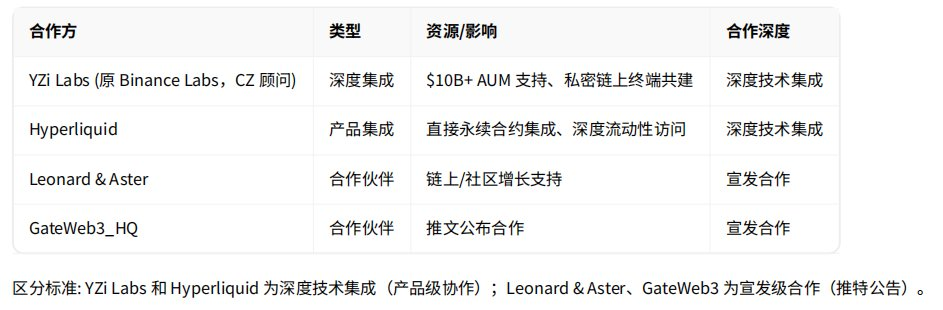
Endorsement barriers: Deep integration with YZi Labs associated with CZ, $6M funding, and top VC support provide a competitive moat
User experience: A professional UX with no pop-ups and no visible gas fees is sticky for whales/high-frequency traders
Risks: If large aggregators like 1inch and CoW Swap add similar privacy features, it may pose a threat; however, there are currently no direct competitors in the market.
4) Financing Situation and Quality of Investors
Financing Details
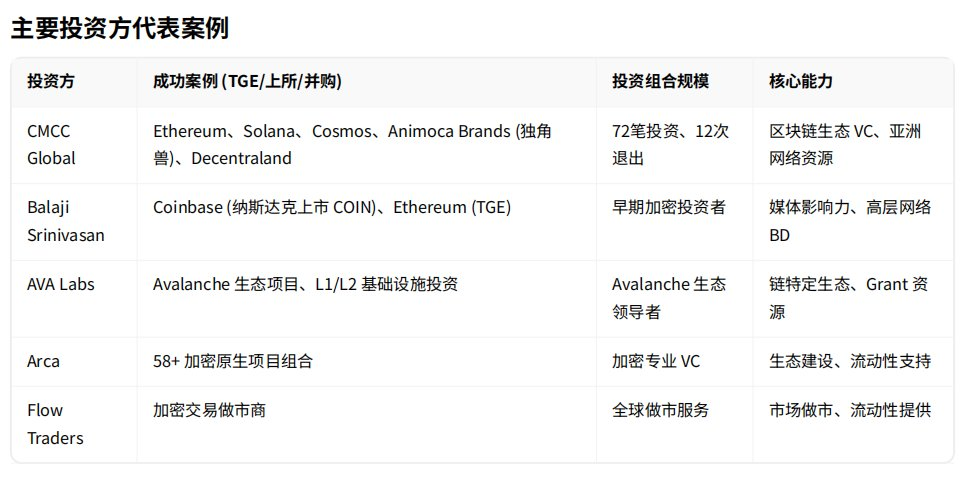
Resources brought by investors
Ecological resources: CMCC Global (Asian ecosystem), AVA Labs (Avalanche integration)
Listing/market making: Flow Traders as a professional market maker, Arca liquidity support
Business development and network: High-level relationships with Balaji Srinivasan, deep cooperation with YZi Labs (CZ advisor, $10B+ AUM)
Media Exposure: Scott Melker (podcast influence), Anthony Scaramucci / SALT (conference resources)
5) Team Background
Core Member Background
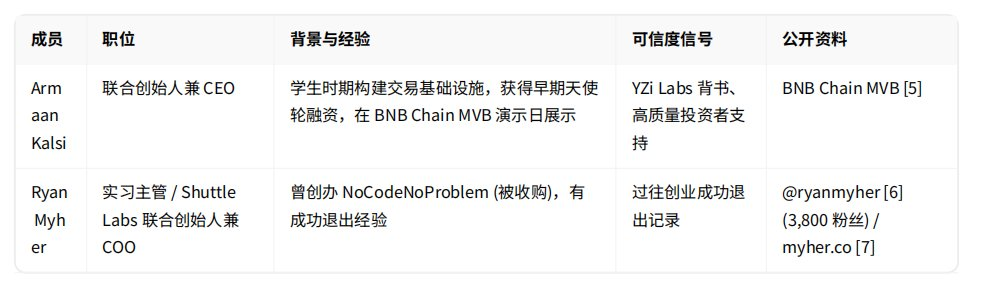
Entrepreneurial Record and Credibility
Success case: Ryan Myher's NoCodeNoProblem was acquired, proving execution capability
Credibility limitations: Limited information on other core team members, LinkedIn and company pages are inaccessible
Offsetting factors: High-quality investors (CMCC Global, Balaji Srinivasan) endorsements, deep integration cooperation with YZi Labs ($10B+ AUM) provide credibility support
Assessment: Moderate credibility; the founder has some background but lacks sufficient public information; relies on the quality of investors and partners for endorsement.
6) Awards/Qualifications/Endorsements
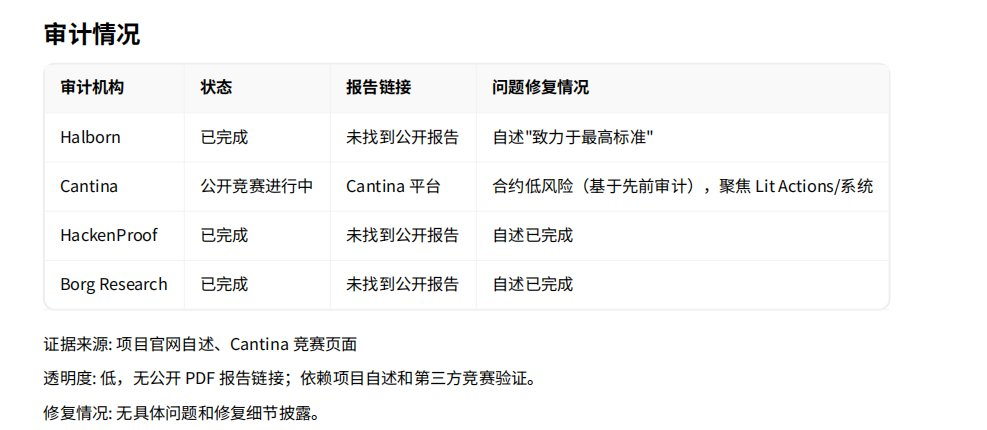
Audit and Security Qualifications
Audit Institutions (full-stack security verification):
Halborn
Cantina (public competition, $25,000+ prize pool)
HackenProof
Borg Research
Penetration Testing: Completed by white hat hackers
- Key partners
7) Technology and Security (Evidence Required)
Open Source Status
Partially open source: EVM contract code (e.g., GeniusVaultCore.sol) can be found on GitHub (inferred from Cantina audit scope as genius-foundation/genius-contracts)
Front-end closed source: No official Genius Pro / Shuttle Labs main front-end repository is publicly available
Third-party code: There are unrelated fan/third-party repositories (e.g., itechdp/Tradegenius-Portal, last commit in January 2024)
GitHub Activity: No recent submission records in official repositories for nearly 30/90 days (as of January 13, 2026 UTC)
Evidence: Search results show no verifiable official repositories with recent activity; the Cantina competition referenced Lit Actions and service code (8,000+ lines) but did not provide specific commit timestamps.
Assessment: Low GitHub transparency, lacking public evidence of active development.
8) Product and On-chain Data (Traction)
Users and Growth
Data Availability: No public DAU/MAU/retention/conversion rate data
Indirect Growth Signals:
Reward system active: 50 million Genius Points (GP) earned through trading
USDC referral rewards: >45% referral fee sharing
Progress badges and points multiplier unlocking mechanism
Historical competition prize: $250,000 total prize pool (past)
Current daily competition: $1,000/day prize (ongoing as of January 13, 2026)
Social Media: Twitter 27,600 followers, tweet interactions 100-500 likes, 5,000-50,000 views (as of January 13, 2026)
On-chain Metrics
TVL: $0 (no record on DefiLlama as of January 2026) Active addresses/trade count/fees/income: No verifiable data
Block Explorer: No publicly available deployed contract addresses
Dune Dashboard: dune.com/geniusterminal exists but has no public data
Revenue Mechanism: Fees collected through FeeCollector.sol; usdGG LP earns native yield from trades (no token issuance); but no specific data disclosed.
Growth Driver Analysis
Subsidy-driven risk: High
Growth mainly relies on points/referrals/competition incentives
0% fee promotion is expected to end around January 13, 2026
Lack of organic user metrics (DAU/retention) verification
Event conclusion risk: If subsidies stop and no alternative incentives are provided, the probability of user loss is high; data performance after the promotion ends needs to be monitored.
Assessment: Extremely low data transparency, on-chain traction cannot be verified; growth may heavily depend on incentives rather than product stickiness.
9) What has been done in the past? What is being done now? (Activities and Tasks)
Historical Activity Timeline
Current Activity/Task List (as of January 13, 2026 UTC)
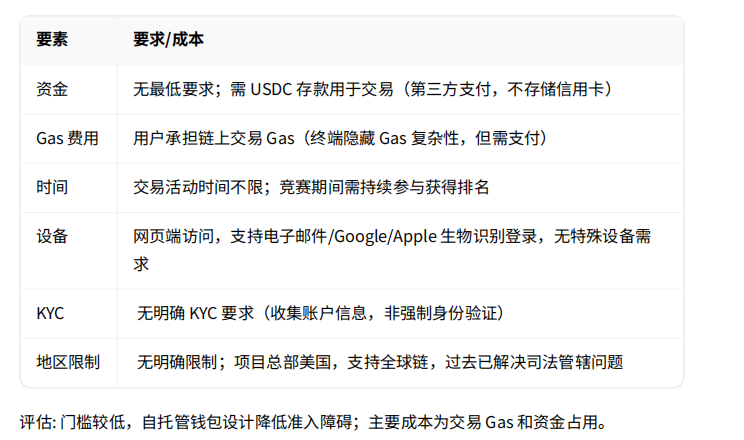
- Participation threshold and cost
10) Activity Entry Point: How to Maximize Cost-Effectiveness
Key Weights of Points/XP/Contribution Rules
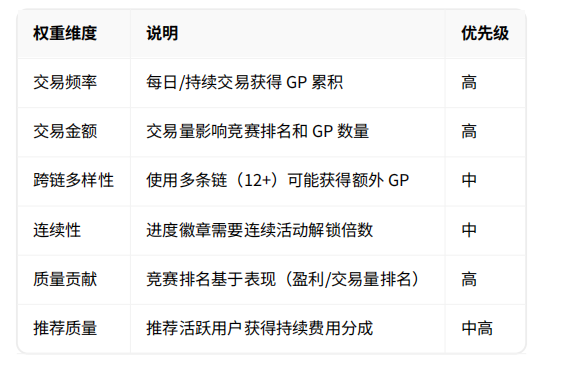
High Cost-Effectiveness Task Priorities (1-5)
- Priority 1: Daily small transactions to increase frequency
Utilize 0% fees (if still valid) or low gas chains (like Base, Arbitrum) for small transactions
Goal: Accumulate GP and unlock progress badge multipliers
Cost: Only gas fees (approximately $0.01-0.5 per transaction)
- Priority 2: Refer high-quality users
Invite DeFi users with real trading needs (like community members)
Earnings: >45% ongoing fee sharing + referral GP
Cost: 0 (pure promotion)
- Priority 3: Cross-chain diversified interactions
Complete at least 1 transaction on each of the supported 12+ chains (preferably Solana, Base, Hyperliquid perpetual)
Goal: Increase GP diversity weight (speculative)
Cost: Total gas fees per chain ~$5-20
- Priority 4: Participate in daily competitions (if resumed)
Monitor competition restart, focus on trading volume/profit ranking
Earnings: $1,000 cash reward (distributed to top performers)
Cost: Requires significant capital and time investment; high risk
- Priority 5: Use Ghost Orders feature
Test the privacy splitting feature (even for small amounts) to demonstrate product usage depth
Goal: Potential additional GP or airdrop weight recognition
Cost: Normal trading gas
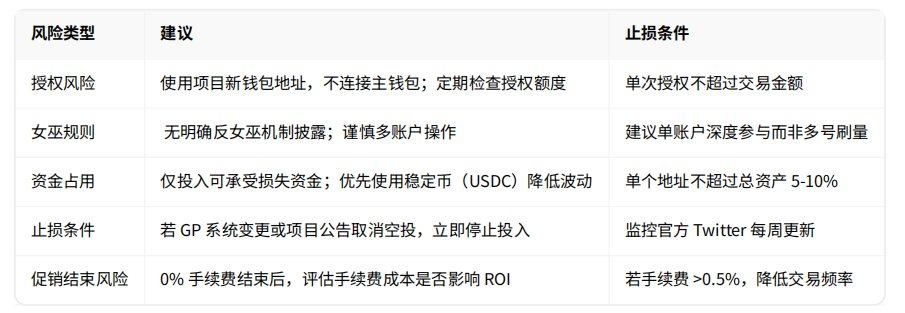
Risk Control Recommendations
11) Competitors and Benchmarking
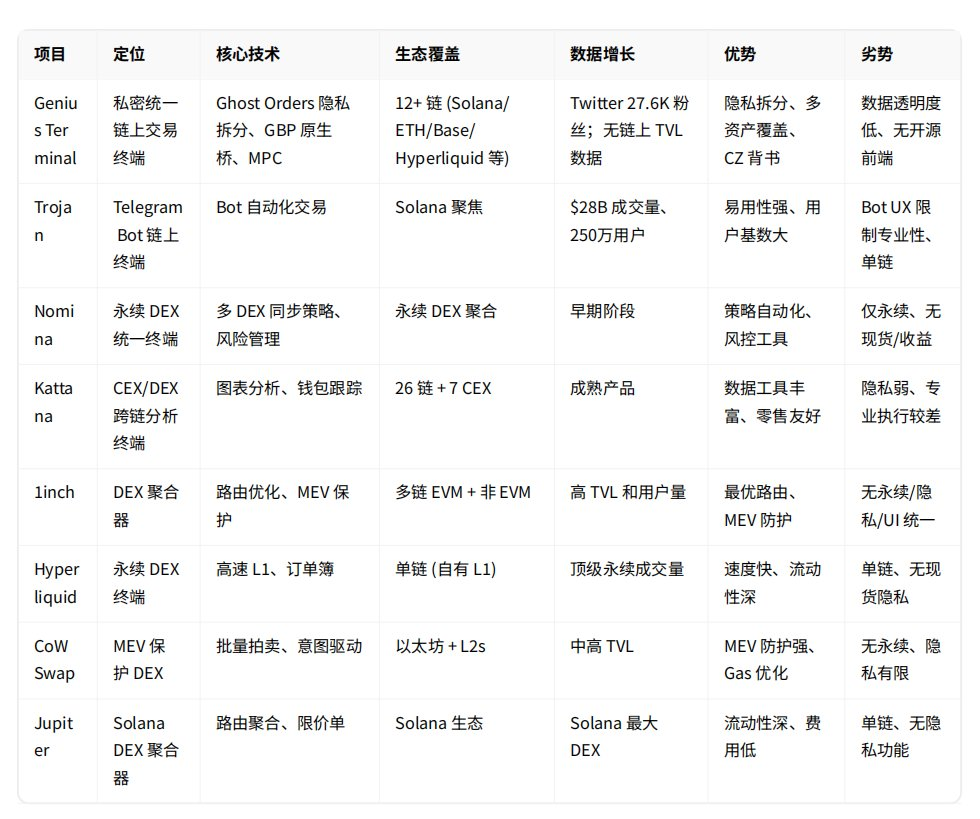
List of Similar Projects and Comparisons
Competitive Landscape Summary
Genius leading dimensions: Privacy splitting (unique Ghost Orders), multi-asset coverage (spot + perpetual + yield + pre-issue), cross-chain breadth (12+ chains)
Competitor advantages: 1inch/Jupiter higher TVL, Hyperliquid faster speed, Trojan larger user base
Differentiated positioning: Genius focuses on privacy + professional trading tools, filling the gap for high-frequency/whale users in multi-chain privacy trading
12) Community Evaluation and Public Sentiment
Community Size and Quality
Scale Metrics:
Twitter: 27,600 followers (verified as of January 13, 2026 UTC)
Tweet interactions: 100-500 likes, 5,000-50,000 views per tweet
Discord/Telegram: No official community found
Quality Assessment:
Trader-oriented: Community focuses on trading competitions, feature releases, partnership announcements
Developer content: Low, no clear developer discussions, GitHub issues, or technical contribution evidence
Airdrop attributes: Medium to high, points system and competitions attract users with airdrop expectations
Major Positive and Negative Opinions
Positive:
Multi-chain support (12+ chains) and 0% fees are popular
Collaboration with YZi Labs (CZ related) and Hyperliquid enhances confidence
Privacy feature (Ghost Orders) seen as an innovative highlight
Negative:
No prominent negative opinions found in high-interaction tweets (within the search window)
Implied risks: Low data transparency, lack of community channels may raise trust issues
Official Response Speed
Response Method: Through promotional tweets and feature announcements (like wallet import, competition winners)
Frequency: Moderate (2-3 updates per week)
Specific Cases: No clear examples of responses to community issues
Community Health Conclusion
Rating: Below average
Reasons:
Stable growth in Twitter followers and interactions
Incentive mechanisms drive active participation
Lack of in-depth community channels like Discord/Telegram
Low developer participation, strong airdrop attributes
Insufficient data transparency may affect long-term trust
13) Token and Airdrop Expectations (Focus: Uncertainty)
Is there a clear indication of token issuance?
Official Evidence:
Points system: 50 million Genius Points (GP) earned through trading and referrals, implying future token conversion
Tweet hints: An official tweet on January 5, 2026, mentioned "Genius is changing that for you in 2026" (regarding airdrops)
Vague roadmap: Documentation and tweets lack clear TGE timing or token economics
Conclusion: High probability of token issuance, but no official confirmation; the GP system strongly suggests tokenization, but lacks a clear roadmap.
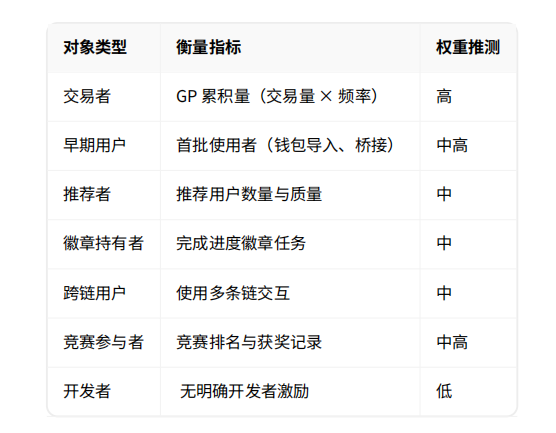
Possible Airdrop Recipients and Measurement Indicators
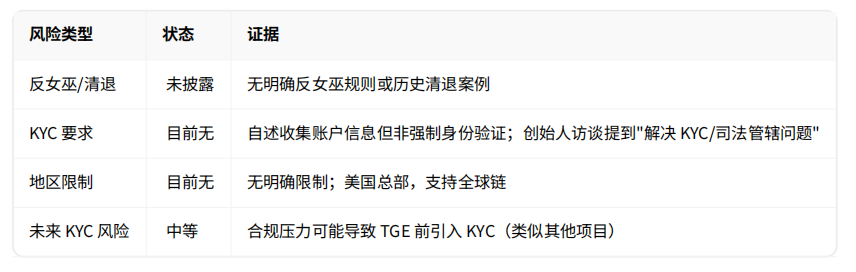
Anti-manipulation/clearing/KYC/regional restriction risks
Maximum Uncertainty (1-3)
Unknown GP conversion ratio: How 50 million GP will convert to tokens, whether linear exchange, total supply ratio unclear
Uncertain TGE timing: No official timetable; "2026" is only a vague hint, may be delayed or canceled
Airdrop distribution criteria vague: Specific weights for trading volume, referrals, badges not disclosed, final distribution may differ significantly from expectations
14) Compliance and Governance
Entity Location and Regional Restrictions
Entity:
Genius Foundation (deploying GBP protocol)
Shuttle Labs (operating entity, New York, established in 2022, 11-50 employees)
Regional Restrictions:
No clear regional restrictions
Headquarters in the U.S., supporting a global multi-chain network
Founder interview (October 2024) mentioned that KYC/jurisdiction issues have been resolved
Potential Compliance Risks:
U.S. Regulation: Based in New York, may face SEC/CFTC scrutiny over securities-like tokens or derivatives trading
Future KYC: KYC may be introduced before TGE to meet compliance requirements
Cross-chain Regulation: Involves multi-chain bridges and perpetual contracts, may trigger multi-jurisdictional regulation
Governance Structure
Known Information:
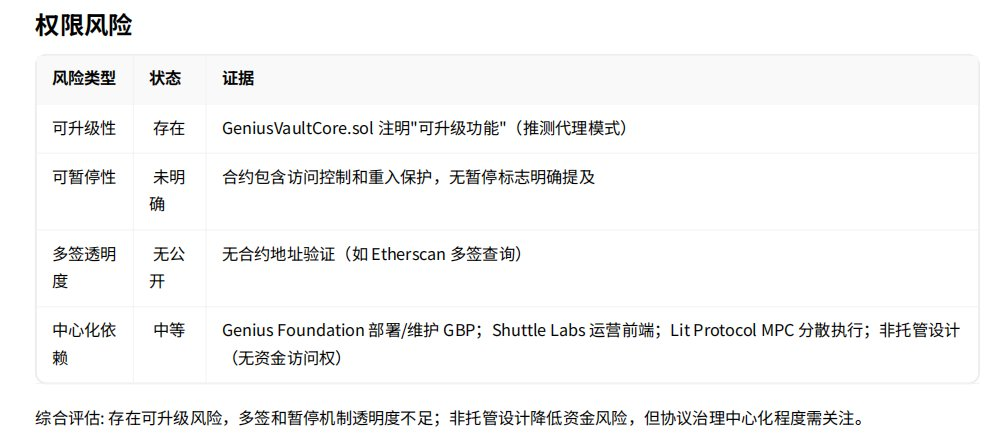
Genius Foundation controls the deployment and maintenance of the GBP protocol
Shuttle Labs operates the frontend and products
Non-custodial design (Turnkey + Lit Protocol MPC)
Power Concentration:
Medium concentration: Foundation and Shuttle Labs control core infrastructure
No mention of DAO governance
No multi-signature details disclosed
No community governance mechanism
Risk: Project decisions and upgrades are led by a centralized team, lacking decentralized governance safeguards.
15) Roadmap Credibility
Milestones for the next 3-12 months
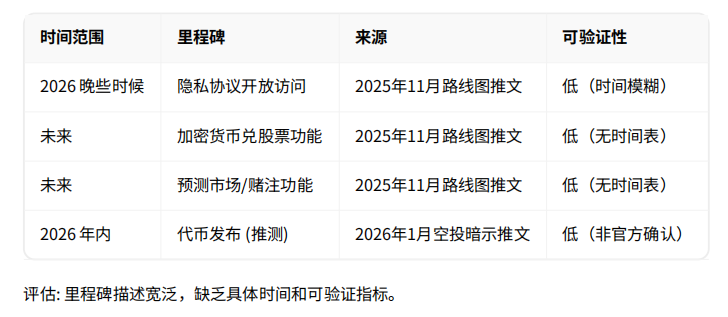
Historical Deliveries on Time
Delivered Features:
Wallet import feature launched (January 13, 2026)
Hyperliquid perpetual integration
Multi-chain support (10+ networks)
Ghost Orders privacy feature
Daily competitions ongoing ($1,000/day prize, winners announced on January 12-13, 2026)
Missed Deadline Record: No clear record of delays
Delivery Quality: Features delivered on time
免责声明:本文章仅代表作者个人观点,不代表本平台的立场和观点。本文章仅供信息分享,不构成对任何人的任何投资建议。用户与作者之间的任何争议,与本平台无关。如网页中刊载的文章或图片涉及侵权,请提供相关的权利证明和身份证明发送邮件到support@aicoin.com,本平台相关工作人员将会进行核查。


