Written by: Glendon, Techub News
The highly anticipated "Cryptocurrency Market Structure Legislation" hearing is set to commence tomorrow. As a milestone bill in the U.S. digital asset regulatory process, the legislative progress of the "Digital Asset Market Clarity Act" (CLARITY) has been a focal point for the market.
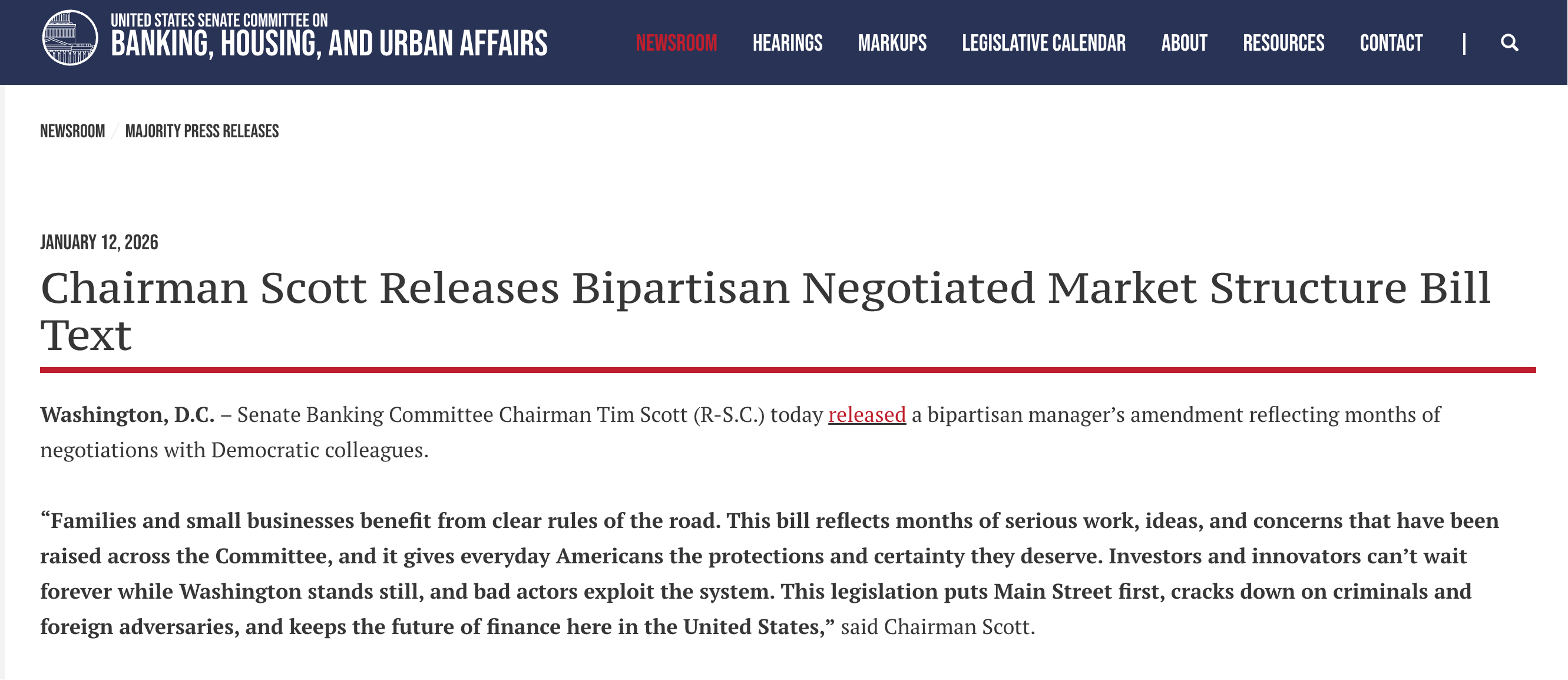
Currently, Tim Scott, the Chairman of the U.S. Senate Banking Committee, has publicly released a bipartisan agreement on the CLARITY Act amendment, which spans 278 pages. Tim Scott stated that the bill is the result of months of serious work, brainstorming, and consideration of various concerns by the committee, representing an important negotiation outcome that will provide the necessary protection and certainty for ordinary Americans.
Notably, a detailed document obtained by CoinDesk lists over 75 amendments submitted by U.S. senators. These provisions have been proposed jointly by Republican and Democratic senators and cover various aspects, including a comprehensive ban on stablecoin yields, preventing "public officials from profiting from cryptocurrency interests," and modifying the definitions of digital asset mixers and tumblers. During the hearing, lawmakers will discuss the various amendments, vote on whether to adopt any of them, and ultimately vote on whether to advance the bill.
Before the hearing begins, let’s take a look at the core content and far-reaching implications of the latest draft of the CLARITY Act.
Overall Framework of the CLARITY Act
To understand the CLARITY Act in depth, it is essential to clarify its positioning as a legislative proposal aimed at establishing a comprehensive federal regulatory framework for the U.S. digital asset market. Around this core objective, the overall structure of the bill can be divided into six main areas: regulatory responsibilities, clear asset classification, consumer protection, promotion of innovation, regulation of decentralized finance, and curbing illegal financial activities. Specifically:
Establishing clear regulatory classifications: Distinguishing between "securities" and "commodities" in digital assets, providing legal certainty for specific digital assets such as "Network Tokens" and "Ancillary Assets" with non-security treatment, and delineating the regulatory responsibilities of the U.S. Securities and Exchange Commission (SEC) and the Commodity Futures Trading Commission (CFTC).
Regulating digital asset issuance and secondary markets: Setting specific information disclosure, registration exemptions, and compliance requirements for securities issuance activities involving digital assets.
Preventing financial crimes: Incorporating digital asset businesses into the anti-money laundering and anti-terrorism financing systems under the Bank Secrecy Act, and establishing a dedicated fraud prevention and law enforcement cooperation mechanism.
Encouraging responsible financial innovation: Clearly allowing regulated banks, credit unions, and other financial institutions to participate in a range of digital asset businesses legally, and establishing a "regulatory sandbox" for small innovative enterprises.
Regulating decentralized finance: Providing compliance guidance and risk control requirements for non-fully decentralized financial protocols and distributed ledger applications.
Protecting consumers and investors: Offering specific consumer protection provisions and information disclosure requirements for stablecoin holders, digital asset ATM users, and others.
Core Asset Definitions and Classification Framework
The core of the bill lies in constructing a new digital asset definition system, which serves as the foundation of the entire regulatory framework. Among these, Network Tokens refer to digital commodities that are essentially associated with distributed ledger systems, with their value primarily derived from or expected to derive from the use of that system. Under specific conditions, the bill classifies them as "non-securities," thus granting them specific treatment under federal securities law.
Ancillary Assets also fall under the category of Network Tokens, but they have a unique value determination logic, relying on the entrepreneurial efforts of their issuers or related parties to establish value. Their value is significantly influenced by the ongoing activities of the issuer or its affiliates. While these assets may still involve securities issuance (such as investment contracts), the bill establishes a dedicated, relatively simplified information disclosure system for them and allows for registration exemptions within certain limits. Therefore, Ancillary Assets themselves are not directly defined as securities.
For "digital assets" and "digital commodities," the bill adopts the definitions from the existing Commodity Exchange Act, referring to assets created, recorded, or transferred using distributed ledger technology or similar technologies, with their trading primarily regulated by the CFTC. Notably, Network Tokens are explicitly defined as a subclass of digital commodities.
This key innovative measure in the bill is significant, as it provides a clear exit path for Network Tokens to transition from "Ancillary Assets" (partially regulated by the SEC) to "non-security commodities" (regulated by the CFTC) through "classification certification" and "ongoing efforts" tests. In simple terms, a "Network Token" at the time of issuance, if reliant on the efforts of the initiator, may be considered an Ancillary Asset, subject to SEC disclosure rules. However, as the issuer or related parties cease substantial management efforts, material information is made public, and the network becomes sufficiently decentralized, the asset can apply for certification to shed its "Ancillary Asset" status, thus trading entirely as a "Network Token" (pure digital commodity) under the CFTC regulatory framework in the secondary market.
Auxiliary Asset Issuance and Disclosure System Under SEC Regulation
Based on the clear definitions and classifications of core assets, the CLARITY Act establishes a registration exemption pathway and standardized ongoing disclosure system for the issuance of "investment contracts" related to Ancillary Assets under the "Crypto Regulation." The core system is primarily reflected in Sections 101 - 105 of the bill, which adds a "4B clause" to the Securities Act of 1933.
Information disclosure system: For digital asset issuances that meet the "Ancillary Asset" definition, if the public financing amount exceeds $5 million or the average daily trading volume exceeds $5 million, the issuer must regularly (twice a year) submit a series of information disclosure reports to the SEC covering company basic information, economic activities, technical details, risk factors, and more.
Registration exemption: The bill establishes a registration exemption pathway for the issuance of investment contracts involving "Ancillary Assets." Issuers can be exempted from the full securities registration process within certain limits (up to $50 million per issuance, not exceeding a total of $200 million) if they meet certain conditions (such as issuance caps, issuer qualifications, and fulfilling information disclosure obligations).
Special disposal restrictions: Restrictions are placed on tokens held by related parties of the issuer (such as founders, executives, and large holders), including lock-up periods and sale ratio limits (e.g., a 12-month lock-up before obtaining "non-common control" certification, with limited sale volumes) to prevent insider trading and market manipulation.
In addition to the above, Sections 106 - 109 of the bill also involve updates to other rules, including the exercise of delegated exemptions, modernization of record-keeping rules, limited exemptions from state securities laws, and clarifying that digital commodities are not covered by investor protection company insurance, further enhancing the regulatory framework for the digital asset market.
Preventing Illegal Financial Activities
The CLARITY Act comprehensively strengthens the financial crime regulatory framework for digital assets within the existing framework of the Bank Secrecy Act and establishes new risk prevention measures.
Under this regulatory framework, the bill first amends the Bank Secrecy Act in Section 201, explicitly including digital commodity brokers, digital commodity dealers, and digital commodity exchanges that allow direct customer access in the definition of "financial institutions," thereby directly imposing anti-money laundering/anti-terrorism financing obligations on them, requiring compliance with BSA regulations (such as establishing anti-money laundering programs, record-keeping, suspicious activity reporting, customer identification programs, etc.) and OFAC sanctions regulations.
Then, in Sections 203-204, the bill establishes the "Preventing Illegal Financial Partnerships Act" and the "Financial Technology Protection Act" framework, creating public-private partnership information-sharing pilot projects and independent working groups to specifically study illegal activities utilizing digital assets, such as terrorism and drug trafficking, and propose targeted countermeasures.
Additionally, the bill introduces the "Digital Asset ATM Fraud Prevention Act" in Section 205, requiring operators of self-service digital asset trading terminals to fulfill strict consumer notification obligations, transaction amount limits, waiting periods (for new users), and risk screening (such as using on-chain analysis tools) to prevent fraud from multiple dimensions.
Furthermore, the bill emphasizes the need for the Treasury Department and other agencies to research and report on the illegal use of digital assets, stablecoin risks, digital asset mixer risks, and assess the activities of foreign counterparts.
Responsible Innovation in Decentralized Finance
As the digital asset market continues to evolve, emerging areas such as DeFi have become the focus of financial market attention. In response, the bill establishes a "DeFi Safe Harbor," clearly determining that non-custodial, non-key-controlled, and non-interfering trading applications are considered pure software, strictly regulating centralized entities while exempting broker registration, thus providing some space for the innovative development of DeFi. The bill also addresses compliance management in various aspects such as Ethereum staking, stablecoin yield, and ETF listings, and attempts to establish risk management and compliance guidance in several provisions:
Section 301: Requires the SEC and the Treasury Department to formulate rules clarifying how operators of non-decentralized financial trading protocols (i.e., protocols controlled by a single or related party) should register and comply with securities laws and the Bank Secrecy Act based on their functional activities.
Section 302: Requires the Treasury Department to issue guidelines clarifying the responsibilities of distributed ledger application layers operated by U.S. entities (such as front-end web applications) in complying with economic sanctions and anti-money laundering/anti-terrorism financing.
Section 305: Provides legal protection for stablecoin issuers and digital asset service providers, allowing them to temporarily freeze transactions suspected of illegal activity when there is reasonable suspicion or upon receiving a written request from law enforcement.
Section 308: Requires digital asset intermediaries to conduct and publicly disclose risk assessments before using DeFi protocols, establishing monitoring and risk control procedures for fraud, market manipulation, and money laundering.
Promoting Responsible Banking and Regulatory Innovation
The CLARITY Act also opens the door for traditional financial institutions to participate in digital asset businesses, explicitly granting regulated deposit institutions and financial holding companies the statutory authority to engage in digital asset activities. In Section 401 of the bill, it clearly authorizes financial holding companies, banks (including national banks and state member banks), federal credit unions, and other federally regulated deposit institutions to engage in a range of digital asset businesses, including custody, trading, lending, payments, operating nodes, providing wallet software, and market making. As long as they comply with existing banking regulations such as the National Bank Act and the Federal Reserve Act, banks can conduct the aforementioned activities without additional prior notification or approval procedures, significantly simplifying the process for traditional financial institutions to enter the digital asset space and removing many obstacles for them.
Moreover, in Sections 402-403, the bill requires the SEC and CFTC to develop joint rules to facilitate the combination of margin for securities, futures, swaps, and digital commodities, and to encourage banking regulators to establish corresponding capital requirements.
Notably, the bill's measures to prevent "regulatory arbitrage" concerning stablecoins have sparked intense discussions within the industry. In Section 404, the bill explicitly prohibits digital asset service providers from paying interest solely for holding stablecoins, to prevent stablecoins from being mistakenly viewed as deposit products. However, the bill is not entirely "one-size-fits-all"; it allows rewards linked to specific activities (such as payments, governance, providing liquidity, etc.) but requires clear information disclosure and must inform customers that stablecoins are not "deposits" and are not protected by deposit insurance. The purpose of this measure is clear: to prevent stablecoins from eroding the deposit base of banks (especially community banks) and to maintain the stability of the banking system.
In addition to the aforementioned regulatory measures for traditional financial institutions and stablecoins, the bill also showcases various innovative concepts, involving inter-agency collaboration, research and pilot programs, and strengthening international regulatory cooperation. In Section 501, the bill proposes the establishment of a "CFTC-SEC Micro Innovation Sandbox," allowing eligible U.S. small startups (with 25 or fewer employees and annual revenue of $10 million or less) to test innovative financial products on a limited scale and for a limited time. These companies can receive temporary, limited regulatory exemptions or guidance, provided they meet core regulatory objectives and investor protection.
Misunderstandings and Facts Related to the Bill
As the CLARITY Act is about to be reviewed, the official website of the U.S. Senate Committee has clarified seven significant misunderstandings that have sparked major controversies and has summarized the important significance of the bill as follows:
Misunderstanding 1: The bill deviates from securities law, weakening investor protection and compliance obligations for digital asset securities. Fact: This statement is false. The bill is rooted in long-established principles of securities law, clearly defining which digital assets are considered securities and which are commodities. Entities subject to the bill's requirements must disclose to the SEC, comply with resale restrictions, and are protected against evasion. Under this framework, securities are still regarded as securities, fraud remains illegal, and the SEC retains full enforcement authority over digital asset securities.
Misunderstanding 2: It puts banks, taxpayers, and the financial system at risk. Fact: The bill is fundamentally an investor protection law. It incorporates digital assets into a clear regulatory framework, holding accountable those committing fraud, market manipulation, and abuse of power. The bill aims to prevent future collapses similar to FTX by establishing a regulatory framework that informs investors of significant risks, prevents insider manipulation of the market, and punishes wrongdoers. Clear regulation protects investors, not uncertainty.
Misunderstanding 3: It creates loopholes to evade U.S. laws. Fact: The bill fills regulatory gaps. It clearly delineates the jurisdiction between the SEC and CFTC, establishes a joint advisory committee to coordinate digital asset regulatory requirements, and includes specific protective measures against evasion.
Misunderstanding 4: It fails to address illegal finance and national security risks. Fact: The bill contains the strongest illegal financing regulatory framework Congress has developed for digital assets to date. It ensures that key digital asset intermediaries comply with the Bank Secrecy Act (BSA) and anti-money laundering and anti-terrorism financing obligations, strengthens sanctions compliance, and authorizes the Treasury Department to address high-risk foreign activities.
Misunderstanding 5: It allows illegal financial activities through DeFi trading protocols. Fact: Quite the opposite. The bill aims to combat illegal activities while protecting legitimate software development and innovation. It clarifies the sanctions obligations applicable to decentralized financial protocols, requiring centralized digital asset intermediaries interacting with these protocols to implement risk management standards and establishing corresponding rules for intermediaries that are not genuinely decentralized. Code is protected, but illegal activities are not.
Misunderstanding 6: It criminalizes software developers or prohibits self-custody. Fact: The bill explicitly protects software developers and guarantees individuals' rights to self-custody of digital assets. Developers who merely publish or maintain code without controlling customer funds are not considered financial intermediaries. At the same time, regulators retain the power to address actual threats in a targeted manner.
Misunderstanding 7: The bill was drafted by the crypto industry to serve its interests. Fact: The bill is the result of years of bipartisan cooperation, involving extensive communication with regulatory and enforcement agencies, and is always oriented towards the public interest. It aims to strengthen national security, protect investors, and ensure that innovation can occur under clear and enforceable rules.
In summary, the CLARITY Act replaces uncertainty with clarity, significantly enhances enforcement against wrongdoers, and provides modern protections for consumers, investors, and the financial system.
Conclusion
From the detailed and comprehensive provisions of the bill, it is evident that the CLARITY Act is an ambitious comprehensive legislative proposal. However, its success will depend on the details of the final text, the subsequent refinement of rules by regulatory agencies, and the ability to adapt to the evolving digital asset ecosystem.
As for whether the bill will pass in this week's hearing, it remains uncertain. However, SEC Chairman Paul Atkins is confident about its passage. In an interview with Fox Business, he stated that the CLARITY Act will be sent to President Trump’s desk for signing within this year. He further explained, "This bill aligns with the President's strategic goal of making the U.S. a global cryptocurrency hub; clear legislation and defined rules will bring certainty to the market. We fully support this bill and are very optimistic about its prospects for being presented to the President for signing this year. The bill will have a tremendous impact on the cryptocurrency market."
At the same time, Standard Chartered Bank has publicly predicted that the CLARITY Act will pass in the first quarter of 2026, based on its analysis of market dynamics and policy trends. These views indicate a high level of optimism within the industry regarding the implementation prospects of the bill. If the bill is passed, it will effectively alleviate long-standing pressures in the market and, more importantly, take a historic step towards ending the long-standing regulatory ambiguity in the U.S. digital asset market.
免责声明:本文章仅代表作者个人观点,不代表本平台的立场和观点。本文章仅供信息分享,不构成对任何人的任何投资建议。用户与作者之间的任何争议,与本平台无关。如网页中刊载的文章或图片涉及侵权,请提供相关的权利证明和身份证明发送邮件到support@aicoin.com,本平台相关工作人员将会进行核查。


