The options market pricing for Bitcoin in 2026 shows that the probabilities of it dropping to $50,000 or rising to $250,000 are nearly equal. Behind this extreme divergence, an industry transformation driven by regulation, products, and capital is accelerating.
In December 2025, the Galaxy Digital research team released the "2026 Forecast" report, which sparked widespread attention in the crypto industry. The report painted a contradictory picture: the short-term outlook for Bitcoin is described as "too chaotic to predict accurately," yet it asserts that Bitcoin could reach $250,000 by the end of 2027.
This coexistence of short-term uncertainty and long-term optimism is a microcosm of the critical transformation period the crypto market is in for 2026. The industry is shifting from a phase reliant on narratives and cyclical speculation to a new era dominated by clear rules, infrastructure expansion, and institutional capital.
1. Bitcoin Seeking Direction Amid Uncertainty
● Alex Thorn, Global Research Director at Galaxy Digital, pointed out that 2026 may be one of the most unpredictable phases for Bitcoin. The pricing in the derivatives market clearly reflects this uncertainty: the options market shows that by the end of June 2026, the chances of Bitcoin dropping to around $70,000 or rising to $130,000 are roughly equal.
Even more surprisingly, the pricing range for the end of 2026 is much broader, with probabilities nearly equal from about $50,000 to $250,000. This reflects a high degree of divergence in market expectations for the medium to short term.
● This extreme price range prediction stems from the interplay of multiple complex factors. Macroeconomic fluctuations, potential political risks, and uneven development dynamics within the crypto market are intertwined. As long as Bitcoin's price fails to clearly break through and stabilize above the key resistance area of $100,000 to $105,000, short-term downside risks remain.
● Signals of maturity in the Bitcoin market are also beginning to emerge. Long-term volatility is showing a structural decline, partly due to the introduction of larger institutional strategies, such as covered calls and yield generation plans, which have helped to suppress extreme volatility.
2. From Enforcement Opposition to Framework Building
● The regulatory environment is undergoing a historic transformation. In November 2025, the U.S. Securities and Exchange Commission (SEC) released its report on inspection priorities for fiscal year 2026, which for the first time did not list "crypto assets" as a top risk area.
● This change starkly contrasts with the SEC's practice over the past five years of consistently viewing crypto assets as high-risk and frequently taking enforcement actions. This "not mentioning" is a more shocking signal than the previous "frequent mentions," marking a shift in U.S. crypto regulation from a "crackdown" to an "embrace" model.
● Behind this shift is a reallocation of regulatory authority. According to the legislative progress of the CLARITY Act, the regulatory authority over the spot markets for "digital commodities" like Bitcoin and Ethereum will officially be transferred to the Commodity Futures Trading Commission (CFTC), with the SEC retaining jurisdiction only over "security tokens."
Legislative breakthroughs in the structure of the U.S. crypto market may occur in the first quarter of 2026. Once passed, this will provide clear regulatory certainty for DeFi protocols and altcoins, attracting offshore crypto companies back to the U.S.
3. ETF Explosion: From Bitcoin to Diversified Crypto Products
Galaxy predicts that the U.S. will launch over 50 spot altcoin ETFs, along with another 50 crypto ETFs. This prediction is based on the SEC simplifying the approval process and the growing market demand for diversified crypto products.
● Since the launch of the first spot Bitcoin ETF in the U.S. in 2024, cryptocurrency ETFs have become central to the digital asset industry. By the end of 2025, numerous Bitcoin, Ethereum, and other altcoin ETFs have emerged in the market.
● This trend is expected to accelerate in 2026, with more altcoin ETFs likely to appear, including Dogecoin and Cardano. The share of cryptocurrency ETFs in the total assets of global exchange-traded funds (ETFs) is expected to exceed 5%, completely removing barriers for traditional pensions and retail investors to participate in emerging sectors.
● Net inflows into U.S. spot crypto ETFs are expected to exceed $50 billion. If the current adoption trend of global crypto exchange-traded products (ETPs) continues, the total assets could reach $400 billion by the end of 2026.
4. From Financial Margins to Mainstream Infrastructure
The infrastructure of the crypto market is undergoing profound changes. Decentralized exchanges (DEXs) are expected to account for over 25% of total spot trading volume, indicating the continued growth of decentralized finance protocols and increased user acceptance.
● The weekly trading volume of prediction market platform Polymarket is expected to continue exceeding $1.5 billion. Prediction markets are evolving from native gambling tools to global risk pricing infrastructure, becoming a more accurate collective expectation indicator than traditional polls through probability pricing and capital gaming mechanisms.
● The supply of stablecoins has increased more than tenfold over five years, recently surpassing $300 billion. Under favorable regulatory and macro conditions, the circulation could approach or even exceed $1 trillion by the end of 2026.
● The market size for tokenized real-world assets is also expected to grow significantly. The on-chain value was close to $35 billion in 2025, and by 2026, some scenarios predict it could reach $500 billion or more. The core of this transformation is not the pursuit of novelty but the aim to make capital more programmable and settlements more continuous.
5. From Tentative Engagement to Structural Allocation
● Bitcoin allocation on corporate balance sheets is becoming an important source of demand. Public companies currently hold over one million Bitcoins, representing a significant portion of the total supply. By 2026, digital asset financial companies may hold over $200 billion in cryptocurrencies.
● Corporate Bitcoin financial allocations have surged from about 197,000 Bitcoins in January 2023 to over 1.08 million Bitcoins, an increase of approximately 450%. U.S. companies hold the majority of the largest positions.
● More than 15 crypto companies may conduct IPOs or upgrade listings in the U.S., indicating a growing acceptance of the crypto industry by traditional capital markets. A major bank or brokerage accepting tokenized stocks as collateral would mark another significant milestone in the integration of traditional finance and crypto assets.
● In the context of clear regulations and improved market structure, the on-chain primary market is reopening in a more structured form. Initial coin offerings are returning in a more compliant and transparent manner, expanding early participation opportunities.
6. Industry Consensus and Divergence
● Different institutions have both consensus and unique perspectives on the outlook for the crypto market in 2026. Nexo believes that progress in the crypto industry in 2026 will rely less on the next narrative or price milestone and more on whether these systems can scale reliably and compliantly.
● BitMart Research Institute predicts that with the implementation of the U.S. GENIUS and CLARITY Acts, the crypto industry will enter a golden period transitioning from enforcement-led to rules-led. This shift could unleash institutional funds exceeding a trillion dollars.
● Ray Salmond, Market Director at CoinTelegraph, points out that the crypto market in 2026 faces three major variables: a 100 basis point rate cut by the Federal Reserve, legislative breakthroughs in the U.S., and AI bubble risks. The performance in the first quarter will determine whether the bull market continues or reverses.
Here is a comparison of predictions from various institutions regarding key areas of the crypto market in 2026:
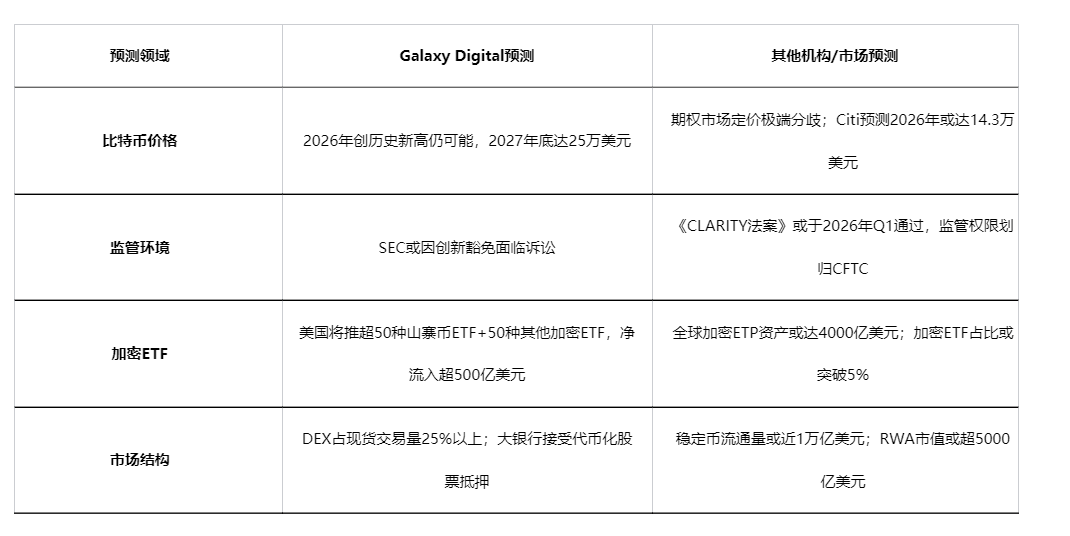
The crypto market is undergoing a profound transformation driven by the clarification of regulatory frameworks, the diversification of product structures, and the maturation of market infrastructure. From the SEC's silence to the CFTC's takeover, from Bitcoin ETFs to diversified altcoin products, from corporate financial allocations to tokenized real-world assets, each change is reshaping the boundaries and possibilities of this industry.
2026 may not see the kind of exhilarating price surges typical of past cycles, but "seemingly quieter, yet profoundly deeper" changes are occurring.
When crypto systems begin to operate reliably, compliantly, and at scale like traditional financial infrastructure, true value creation is just beginning.
Join our community to discuss and grow stronger together!
Official Telegram community: https://t.me/aicoincn
AiCoin Chinese Twitter: https://x.com/AiCoinzh
OKX benefits group: https://aicoin.com/link/chat?cid=l61eM4owQ
Binance benefits group: https://aicoin.com/link/chat?cid=ynr7d1P6Z
免责声明:本文章仅代表作者个人观点,不代表本平台的立场和观点。本文章仅供信息分享,不构成对任何人的任何投资建议。用户与作者之间的任何争议,与本平台无关。如网页中刊载的文章或图片涉及侵权,请提供相关的权利证明和身份证明发送邮件到support@aicoin.com,本平台相关工作人员将会进行核查。