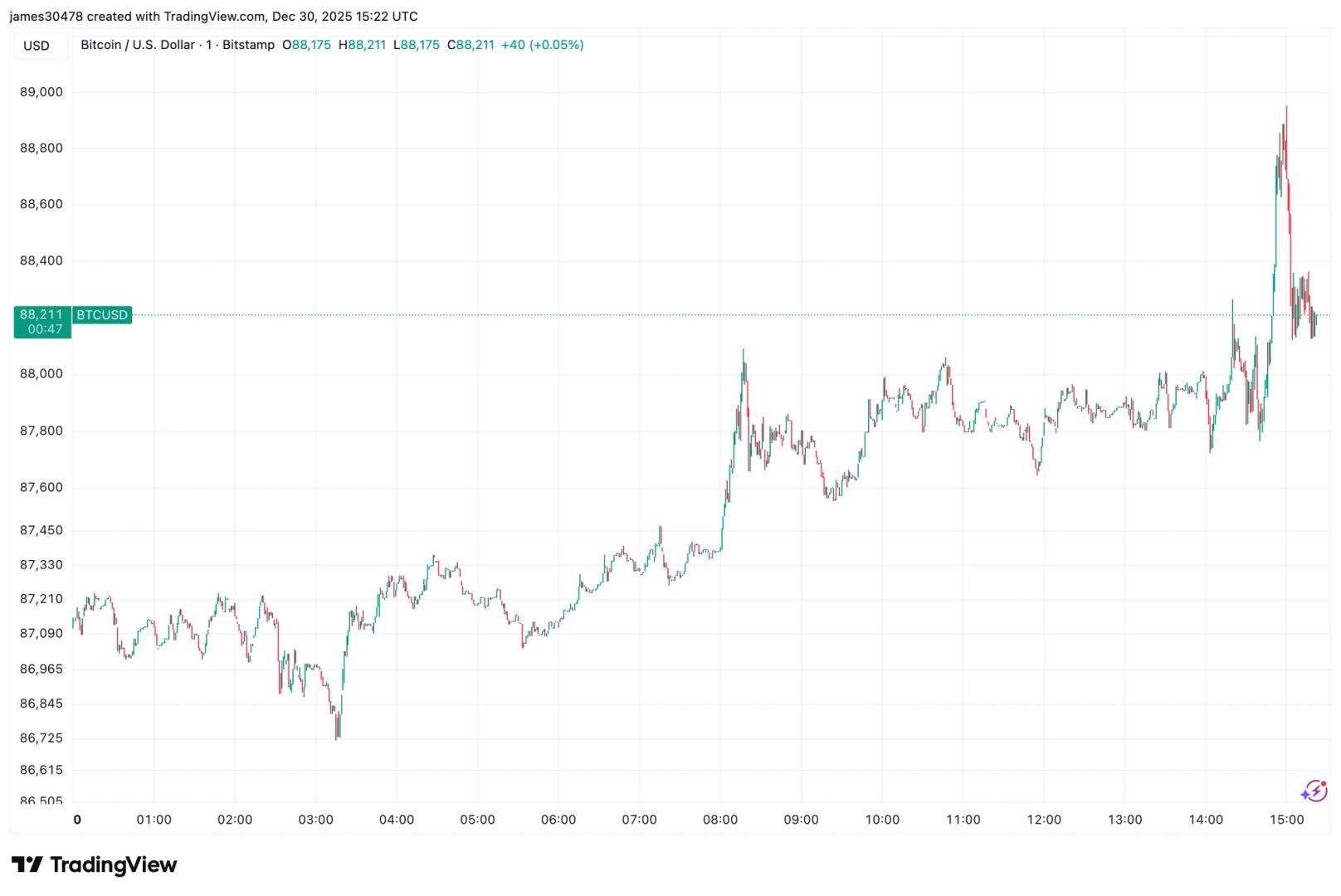
What to know : Bitcoin was trading higher during U.S. market hours, marking a notable shift after a month in which BTC fell roughly 20 percent cumulatively while American stocks were open. Declining open interest suggests the move is driven by short-covering rather than fresh leveraged longs. Broader crypto markets remain fragile as ETF outflows, tax-related positioning, and light holiday liquidity pressure prices.
Crypto prices kicked off the U.S. trading day with a modest rally, with bitcoin re-taking the $89,000 level after having dropped to $87,000 one day ago.
Bitcoin being higher during U.S. market hours is a notable shift after the past month in which prices have seemingly dropped every single day during the U.S. session. Indeed, bitcoin has seen about a 20% cumulative decline during the American trading day over the last 30 days, according to Velo data.
As for Wednesday's small advance, Coinglass data shows bitcoin open interest denominated in BTC has fallen since the U.S. market opened, dropping from 514,000 BTC to 511,000. This decline in open interest alongside rising price action points to short positions being closed rather than new leveraged longs being added.
Crypto-related stocks like Coinbase (COIN), Robinhood (HOOD) and Circle (CRCL) were all little-changed, as were the broader S&P 500 and Nasdaq.
Year-end de-risking, record ETF outflows, and thin holiday liquidity are keeping the market subdued, according to Wintermute strategist Jasper de Mare.
All three major crypto assets remain below key systematic levels, with price action largely driven by rollover flows and tax-related positioning, he continued.
Spot bitcoin ETFs saw $19.3 million in net outflows on Monday, marking the seventh straight day of redemptions. In mid-December alone, $1.29 billion was pulled from bitcoin funds, led by a $157 million single-day outflow from BlackRock’s IBIT, according to de Mare. While IBIT has recorded $25 billion in inflows year-to-date, he said December’s risk-off rotation may reflect tax-loss harvesting. He added that altcoins, largely outside the IRS’s wash-sale rules, have not shown the same selling pressure.
On the derivatives side, over $27 billion in BTC and ETH options expired on Dec. 26 in the largest single-day expiry in crypto history, according to Deribit data. Funding rates and open interest — which peaked at $70 billion in June — have steadily declined into year-end.
BTC’s 7-day realized volatility fell sharply into Dec. 25, but has started to pick up, driven by erratic intraday swings. De Mare advised traders to avoid overfitting short-dated signals until institutional flows return in early January.
免责声明:本文章仅代表作者个人观点,不代表本平台的立场和观点。本文章仅供信息分享,不构成对任何人的任何投资建议。用户与作者之间的任何争议,与本平台无关。如网页中刊载的文章或图片涉及侵权,请提供相关的权利证明和身份证明发送邮件到support@aicoin.com,本平台相关工作人员将会进行核查。


