If 2024 was the birth year of spot bitcoin ETFs, 2025 was their first real stress test. What unfolded was a year defined by extremes. Massive inflow surges were followed by equally violent pullbacks, yet liquidity remained deep, and investor participation never disappeared.
Bitcoin ETFs entered 2025 on a strong footing. January opened with steady inflows, led by multi-billion-dollar weeks such as Jan. 17 ($1.96 billion) and Jan. 24 ($1.76 billion), pushing net assets above $120 billion early in the year. Trading volumes were healthy, but orderly. Confidence was still intact.
February delivered the first shock. A brutal risk-off rotation triggered consecutive weeks of heavy outflows, including a staggering $2.61 billion exit in late February. Despite the drawdown, total assets remained resilient above $95 billion, highlighting how quickly ETFs had embedded themselves into institutional portfolios.
March and April brought stabilization. While volatility persisted, inflows returned sporadically, culminating in a powerful $3.06 billion inflow week in late April. By May, momentum had fully flipped. Bitcoin ETFs logged some of their strongest demand of the year, including a $2.75 billion inflow in mid-May and a steady climb in net assets back above $130 billion.
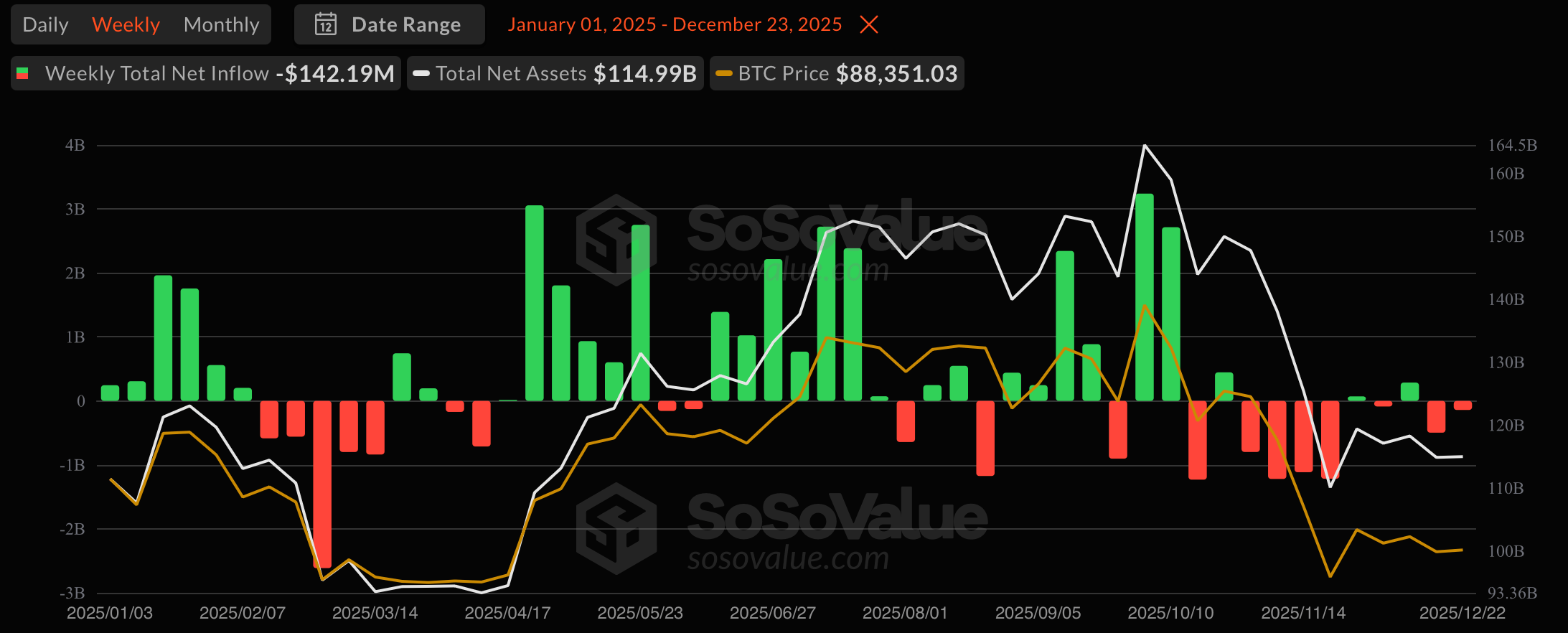
Bitcoin ETFs weekly performance from Jan 1 to Dec 23.
Summer marked the year’s strongest stretch. June and July delivered repeated billion-dollar inflow weeks, peaking with $2.72 billion and $2.39 billion entries. By early July, net assets hovered near $152 billion, while weekly trading volumes consistently exceeded $20 billion. Liquidity was no longer a question.
Then came the autumn whiplash. August and September saw sharp reversals, including a $1.17 billion outflow in late August and a $902 million exit in late September. October briefly reignited bullish sentiment with back-to-back monster inflows of $3.24 billion and $2.71 billion, pushing assets to a yearly high near $165 billion.
November and December closed the year on a defensive note. Bitcoin ETFs suffered three separate billion-dollar outflow weeks in November alone, including a $1.22 billion drawdown. December continued the volatility, ending with consecutive weekly outflows and net assets slipping back toward $115 billion by year-end.
Read more: ETF Weekly: Bitcoin and Ether Post Combined Losses of $1.14 Billion
Still, perspective matters. Throughout 2025, bitcoin ETFs consistently posted enormous trading volumes, often $20–40 billion per week, proving their role as the primary institutional gateway to BTC exposure. Even during selloffs, capital rotated rather than vanished.
Looking ahead to 2026, the lesson is clear. Bitcoin ETFs are no longer novelty products. They are macro-sensitive instruments, responding to liquidity cycles, rate expectations, and broader risk sentiment. If volatility defined 2025, maturity will likely define what comes next.
- What defined Bitcoin ETF performance in 2025?
Bitcoin ETFs swung between record inflows and sharp outflows, reflecting a full-cycle stress test for the market. - Did heavy outflows signal weakening investor interest?
No, liquidity stayed deep as capital rotated rather than exited during risk-off periods. - When did Bitcoin ETFs see their strongest demand?
Peak inflows arrived in late spring and summer, with multiple billion-dollar weeks and assets near yearly highs. - What does 2025 suggest for Bitcoin ETFs in 2026?
ETFs have matured into macro-sensitive instruments tied to rates, liquidity, and global risk sentiment.
免责声明:本文章仅代表作者个人观点,不代表本平台的立场和观点。本文章仅供信息分享,不构成对任何人的任何投资建议。用户与作者之间的任何争议,与本平台无关。如网页中刊载的文章或图片涉及侵权,请提供相关的权利证明和身份证明发送邮件到support@aicoin.com,本平台相关工作人员将会进行核查。


