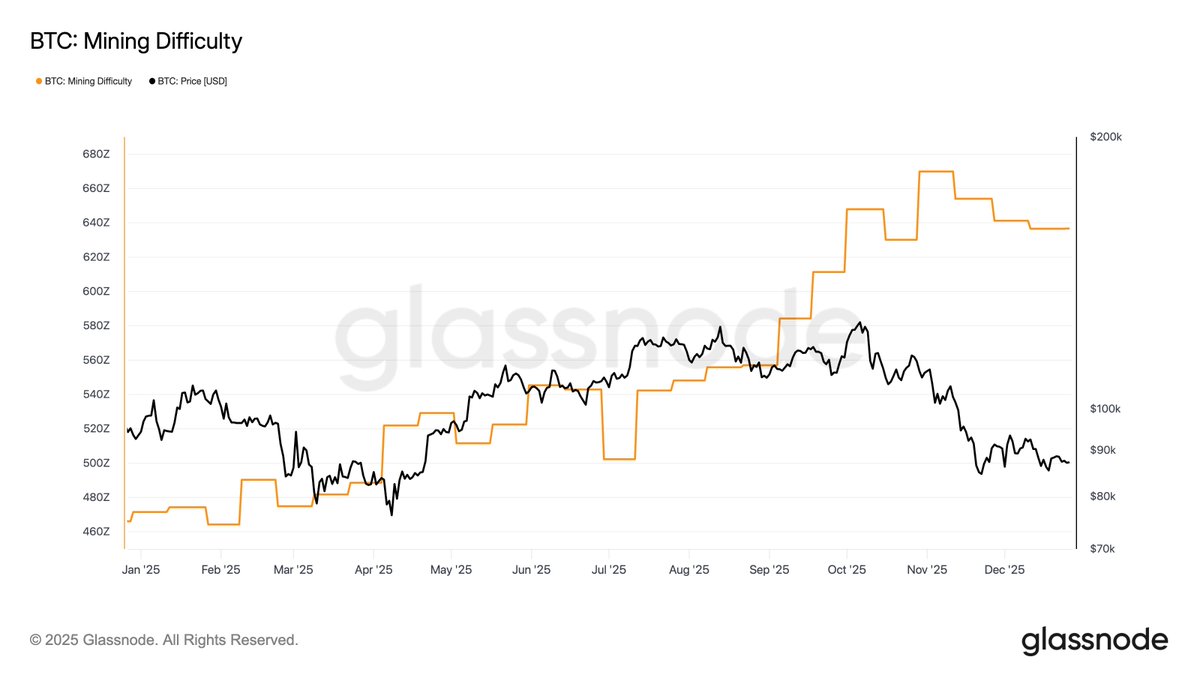
During the period from last Christmas to this Christmas, the mining difficulty of $BTC has increased by 36.5%. Throughout this year, although the price of Bitcoin has generally declined, the mining difficulty has continued to rise, which precisely illustrates a fact that many people overlook: the supply side has not exited due to the price drop; instead, it remains at the table with higher efficiency and heavier capital.
Hashrate corresponds to the capital expenditures, electricity, and long-term operational decisions that have already occurred, and these actions inherently have a significant lag. In the context of a weakening BTC price, the significant increase in mining difficulty can only indicate that the hashrate already invested has not exited; miners choose to withstand cost pressures through efficiency improvements and economies of scale. At least in this year, there has been no systemic, passive clearing of hashrate.
More importantly, this divergence means that Bitcoin is in a typical stage of supply-side rigidity. New hashrate continues to enter the market, continuously raising the production cost of a single BTC, while the demand side has not expanded in sync, making it naturally difficult for prices to establish a smooth trend.
Therefore, the market characteristics during this phase often manifest as a lack of elasticity in price increases and difficulty in losing control during price declines, with more time being consumed within high-cost ranges. In simpler terms, the cost of BTC mining is gradually increasing, and the price decline has not caused panic among miners; rather, it has increased capital investment in BTC mining.
@bitget VIP, lower fees, better benefits
免责声明:本文章仅代表作者个人观点,不代表本平台的立场和观点。本文章仅供信息分享,不构成对任何人的任何投资建议。用户与作者之间的任何争议,与本平台无关。如网页中刊载的文章或图片涉及侵权,请提供相关的权利证明和身份证明发送邮件到support@aicoin.com,本平台相关工作人员将会进行核查。


