For a long time, we understood prediction markets as a very "rational" thing: people bet on the future based on public information, and market prices reflect consensus. However, over the past year, we have increasingly realized one thing: many prediction markets are not "predicting the future," but rather exposing results that "have already been known by a few."
When a result is already determined but not yet public, prediction markets can become extremely brutal: they do not require leaks, anonymous tips, or even a single word. The direction of funds itself is a leak.
Prediction markets are changing the way "secrets" exist:
Imagine a few scenarios:
- A popular TV series has already been filmed; will the main character die?
- The selection process for a gaming award is basically over, but the results have not been announced.
- An AI company is about to release key product or acquisition news.
- The regulatory outcome of a certain crypto protocol, listing time, governance voting direction.
In the traditional world, these are called "insider information." But after the emergence of prediction markets, they face a new problem: as long as someone knows and can bet, secrets are hard to escape market capture. You do not need to know "who said what"; you just need to look at:
- Which options are heavily bet on.
- Which addresses continue to place bets during critical time periods.
- Which accounts repeatedly "bet correctly in advance" on similar events.
This is not a conspiracy theory; it is a natural result of probability and incentives.
From "Content Reporting" to "Result Pressure Testing"
This is also why we began to reflect on traditional news models. The past content logic was: event occurs → a few people know → report (publish) → the public knows.
What prediction markets bring is another path: event occurs → someone knows → someone bets → price starts to deviate → the world has "already known."
There is even a more extreme path: event occurs → someone knows → someone bets → price starts to deviate → leading to a change in the event.
Regarding this path, I can give a classic example from the end of Coinbase's (NASDAQ: COIN) Q3 2025 earnings call, where CEO Brian Armstrong said something that seemed casual:
"I’m a bit fascinated by a prediction market; I’m tracking what people are betting on regarding what we will say in this earnings call… So I have to say these words before the call ends: Bitcoin, Ethereum, blockchain, staking, and Web3."
These words are not random; they are the content on which people bet in the prediction market regarding whether certain words would appear in this call. After Armstrong said this, the relevant prediction market settled immediately, and those who bet on the mentioned words being said made a profit. It was reported that there was about $80,000 in betting volume on platforms like Kalshi and Polymarket that was settled instantly.
In other words, if there were no such bets, in another parallel world, Brian Armstrong would have simply gone through the earnings call process without deliberately saying those words. This is the "reality distortion field" of prediction markets; the act of betting itself has the power to change reality. This is common in sports betting, where outcomes often lean towards the option with the least betting due to insider manipulation. However, whether it is the words from the Coinbase earnings call or a football match, they ultimately have little impact on our world. But as Polymarket and Kalshi grow, the topics on these platforms will get closer to our lives, and this "reality distortion field" of prediction markets will genuinely affect our lives.
In the future world, content will no longer be the starting point of information but a tool for verification and explanation. In extreme cases, content can even change reality. This is what Rhythm BlockBeats' prediction market reporting is doing: it is not a "prediction market navigation station," nor is it simply restating what happened on Polymarket or Kalshi.
What we truly care about are three things:
- Which events' odds changes do not seem driven by sentiment or public information?
- Are there addresses that consistently heavily bet "before the results" with an unusually high historical hit rate?
- Do these behaviors point to some "known but not publicly disclosed" facts?
We analyze:
- The topics and option odds in prediction markets.
- The on-chain addresses of bettors and their associated behaviors.
- Similar betting patterns in historical events.
To do one thing: treat prediction markets as a "secret pressure tester," rather than an opinion ballot box.
Currently, we are focusing on several key areas:
- Macroeconomic policy trends and geopolitical issues that can impact capital markets.
- The AI industry: product release times, mergers and acquisitions, core personnel changes.
- The crypto industry: TGE, regulation, governance results, major protocol changes.
The Future of the Content Industry:
The real challenge of prediction markets is not accuracy, but that they are dismantling a long-standing order in the content industry and regulation: only information that is allowed to be spoken will become "public knowledge." When everything can be bet on, secrets are no longer constrained solely by systems, professional ethics, or news blockades, but must continuously contend with price discovery mechanisms.
In mild scenarios, this means that the endings of series, award allocations, and business decisions will be known in advance by the market; in extreme scenarios, it even touches on war and geopolitical conflicts: people can learn "military intelligence" level information through bets placed by soldiers on the front lines, directly influencing the course of wars. When results are already held by a few, and the market allows betting around those results, the price itself may become an unavoidable signal of reality.
The first time I felt awe for the financial industry was when I read a small story in college about Ray Dalio, the founder of Bridgewater Associates, who helped McDonald's hedge chicken futures in his early years. In the U.S., large restaurant chains almost always hedge their core raw materials with futures to withstand severe price fluctuations, ensuring that consumers can always enjoy stable quality and controllable prices for McNuggets. What made me feel awe was not Dalio's later achievements, but my first clear realization that the original intention of financial markets was never for trading itself, but to make the real world operate more stably and predictably.
Futures markets help people hedge against commodity price risks, while stock markets help socially valuable companies finance and develop more efficiently. In this process, the participation of traders and speculators provides liquidity, farmers lock in future profits in advance, and companies obtain stable cost structures. Although market participants have their own needs, the overall system is a long-term positive EV system.
This also brings us back to a more fundamental question: when speculative liquidity of such a large scale as Polymarket already exists, is it possible to guide it towards more genuinely positive EV directions? If a certain event occurs, it will have a significant impact on personal life, assets, or decisions. Can we leverage the liquidity of prediction markets, or even evolve a form of "event insurance" product through combinations of multiple markets, similar to "flight delay insurance" in our current lives? While it may not compensate for our losses from flight delays, it can provide some psychological comfort.
Prediction markets are not challenging a single media outlet; they are posing a larger question: when the world begins to be bet on, who still has the ability to decide "what can be known?" and "when can it be known?" We will continue to explore this path. Additionally, the BlockBeats prediction market analysis team has been established. If you also love content and are curious about prediction markets, you are welcome to join us at any time. (Resumes can be sent to contact@theblockbeats.org or HR telegram @Jhy10vewh0 with the note "Prediction Market.") We also welcome entrepreneurial teams related to prediction markets and AI to discuss with us. Rhythm BlockBeats will do its best to provide maximum exposure for excellent startup teams. Contact email: contact@theblockbeats.org.
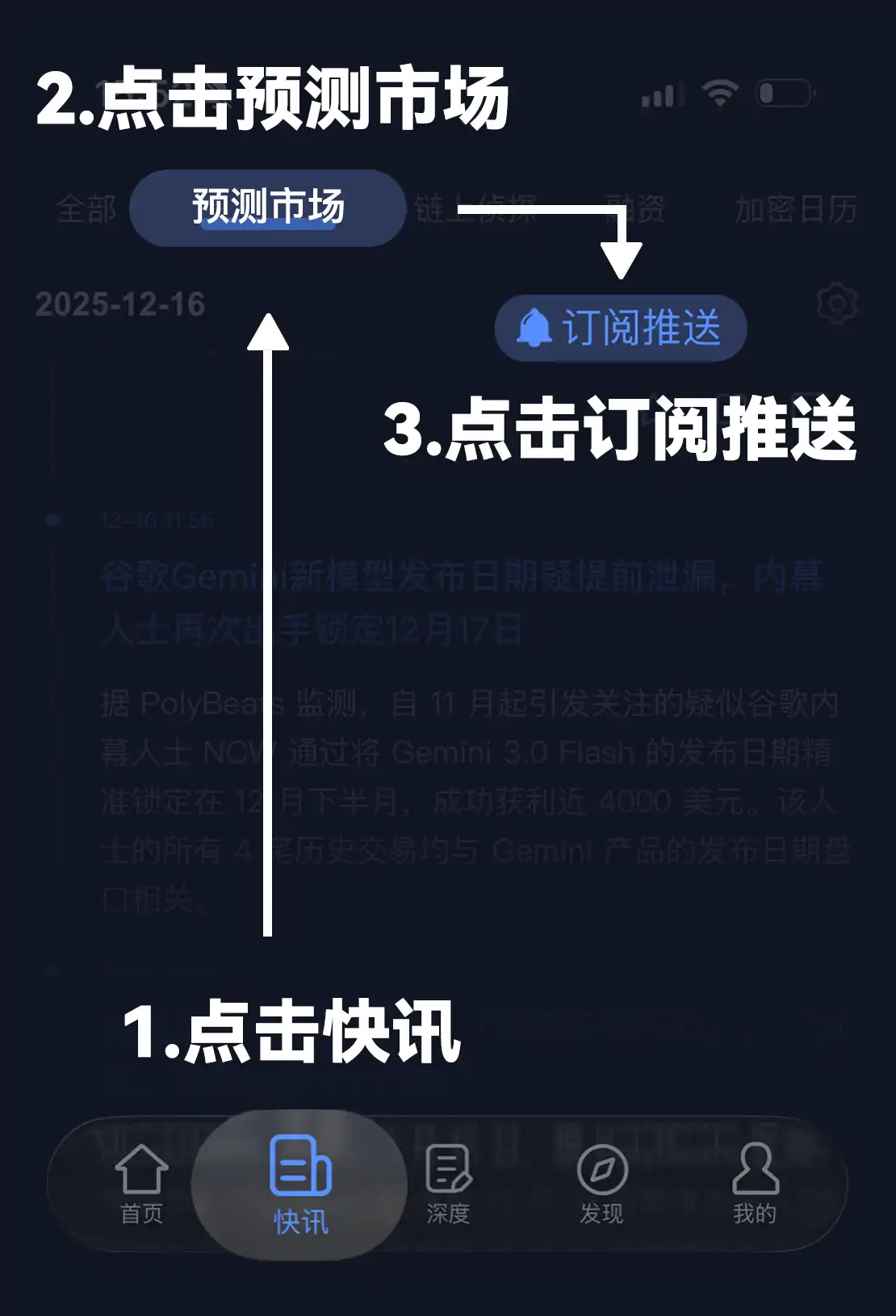
Finally, if you want to receive timely updates on the latest news we discover in prediction markets, you can subscribe on the Rhythm APP. After subscribing, you will receive real-time push notifications for prediction market news. The specific operation path is shown in the image below (please update to the latest version of the APP).
免责声明:本文章仅代表作者个人观点,不代表本平台的立场和观点。本文章仅供信息分享,不构成对任何人的任何投资建议。用户与作者之间的任何争议,与本平台无关。如网页中刊载的文章或图片涉及侵权,请提供相关的权利证明和身份证明发送邮件到support@aicoin.com,本平台相关工作人员将会进行核查。


