Grayscale is stating, quite bluntly, that while cryptocurrency is not as early as it once was, it is still incredibly small in comparison to its potential.
Currently, tokenized assets make up about 0.1% of the world’s bond and equity markets. In Grayscale’s base case, that number does not increase at all; instead, it explodes, possibly increasing 1,000 times by 2030, as infrastructure develops and regulations cease to function as a constant brake.
Market is changing
The capitalization of the digital asset market has already moved from being solely focused on Bitcoin to a more expansive multi-sector market, where non-Bitcoin assets are gradually gaining market share. Instead of growing in a straightforward dominance-rotation loop, Bitcoin and other crypto sectors now grow in parallel on a log scale. That, in and of itself, challenges the conventional four-year cycle theory.
HOT Stories 'Smartest Man Alive' Keeps Shilling XRP, Calls It 'Digital God'SBI Starts XRP Lending, Shiba Inu Whale Awakens With 53 Billion SHIB Transfer, New Ethereum Hack Revealed — Crypto News DigestCrypto Market Prediction: Will Shiba Inu (SHIB) Crash Ever End? Ethereum (ETH) Already Sniffing $3,000; Bitcoin (BTC) Price Expodes in Unexpected Volume Spike'True Currency': Did Elon Musk Just Describe Bitcoin?
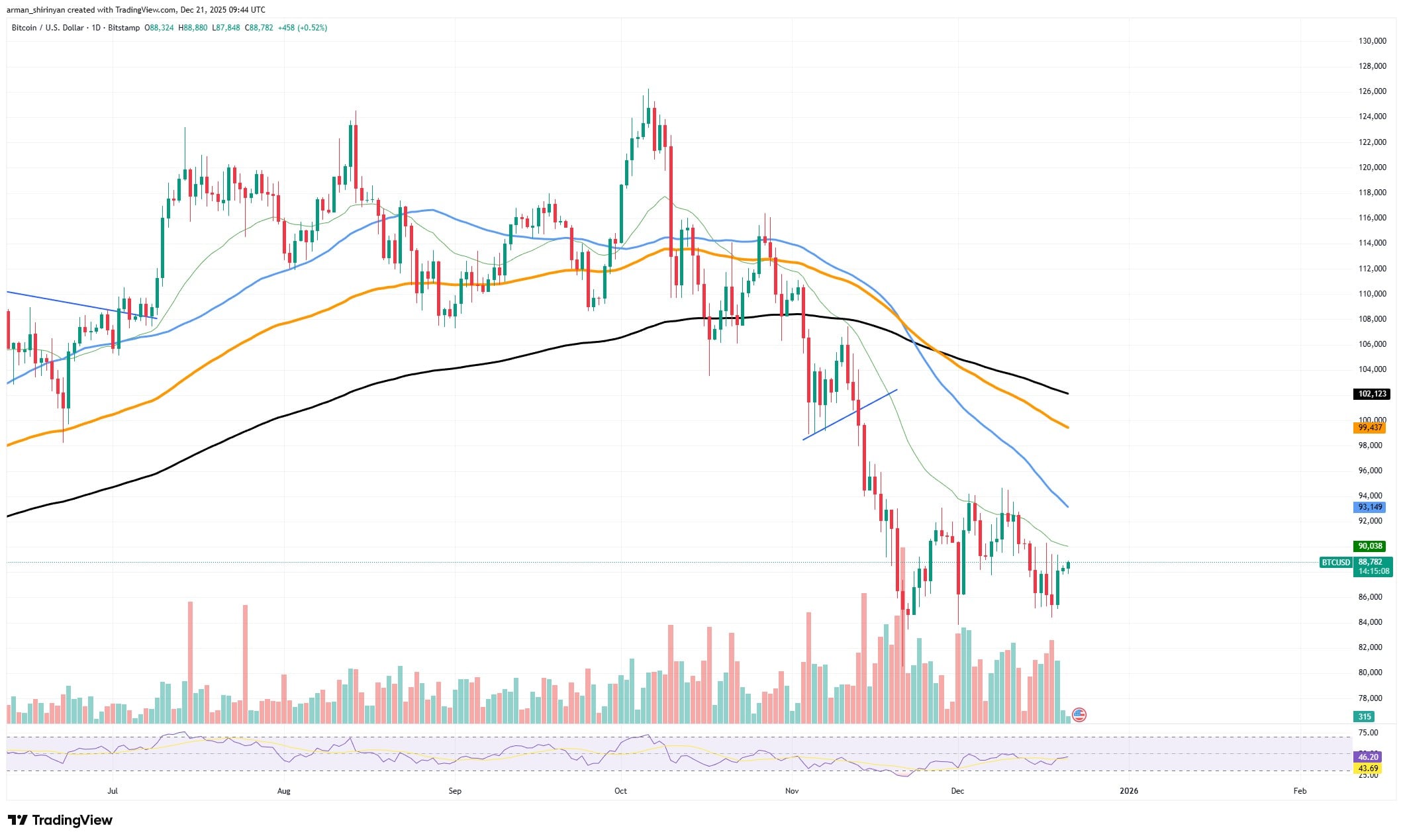
BTC/USDT Chart by TradingView
Two pillars support Grayscale’s thesis. Macro pressure first. The U.S. government’s debt-to-GDP ratio is rising to levels that have historically been linked to currency devaluation risk. Scarce, programmatic assets like Bitcoin and Ethereum are monetary alternatives in that context, not just riskier assets. For that reasoning to be valid, persistent fiscal drift is sufficient; hyperinflation is not.
Regulation is main barrier
The second is regulation. In 2026, Grayscale anticipates the enactment of bipartisan U.S. legislation pertaining to the structure of the cryptocurrency market. Price action is not as important as that. On-chain issuance, regulated trading of digital asset securities and institutional participation at scale are all made possible by clear regulations. ETFs were the first step. Step two is broader market plumbing.
You Might Also Like
Sat, 12/20/2025 - 15:09 'Beyond Single-Chain Paradigm': Cardano Lays Out Interchain VisionByTomiwabold Olajide
Where does the growth really end up? According to Grayscale, the main beneficiaries of tokenization and on-chain finance are smart-contract platforms like Ethereum, BNB, Solana and Avalanche. Beneath it all is Chainlink, which serves as middleware to enable the use of real-world data on public blockchains.
Importantly, Grayscale contends that the clean four-year cycle might come to an end in 2026. The growth of exchange-traded products, the maturation of institutional allocation procedures and the direct integration of on-chain assets into traditional finance all contribute to slower, more stable and structurally biased upward capital flows.
免责声明:本文章仅代表作者个人观点,不代表本平台的立场和观点。本文章仅供信息分享,不构成对任何人的任何投资建议。用户与作者之间的任何争议,与本平台无关。如网页中刊载的文章或图片涉及侵权,请提供相关的权利证明和身份证明发送邮件到support@aicoin.com,本平台相关工作人员将会进行核查。


