Bitcoin performed poorly today, consolidating around $88,000 for a long time in the morning, with neither bulls nor bears taking significant action. In the afternoon, there was a quick pullback, briefly touching $86,200, followed by a short rebound to $87,200, but it failed to hold the gains and fell back again. As of now, Bitcoin is maintaining a narrow range around $86,500. The overall volatility has narrowed, and market trading momentum is clearly weak, with both bulls and bears appearing very cautious. This "consolidation-pullback-weak rebound" trend is essentially a struggle between macro policy suppression and technical support, while the upcoming Bank of Japan decision remains the core variable to break the current deadlock.

On the macro level, the market is clearly being pressured by "dual tightening expectations," which is the main reason suppressing Bitcoin's price. The most concerning bearish factor for the market right now is the direction of the Bank of Japan's monetary policy—at the policy meeting on December 18-19, the probability of an interest rate hike has surged to 94%, with most of the market expecting rates to rise from 0.5% to 0.75%, a new high since 1995. Once this expectation emerged, concerns began to grow about a potential large-scale unwinding of yen carry trades, which has already caused Bitcoin to drop about 6% since December. It is also worth noting that in the past three rate hikes by the Bank of Japan, Bitcoin fell by 20% to 30%, so the market's risk aversion remains high.
The hawkish statements from the Federal Reserve have also made the pressure more apparent. Boston Fed President Collins directly hinted that there might be a pause in rate cuts next year, and New York Fed President Williams stated that the current policy is in a "good position," which extinguished market expectations for a rate cut in January. As a result, Bitcoin ETFs experienced a net outflow of $340 million, and the activity level of funds in the market has noticeably decreased. However, U.S. economic data provided some buffer—November employment numbers exceeded expectations, but the unemployment rate surged to 4.6%, a four-year high. This "slightly weak economy" signal has allowed some funds to retain a glimmer of hope for future easing, preventing panic selling of Bitcoin.
After reviewing the macro environment, let's focus on the market itself. Technically, Bitcoin's overall weak pattern has not changed, but the new support range of $85,000-$86,000 has begun to show resilience, becoming the core of the current short-term tug-of-war. From the daily chart, it is still in a descending channel from the October high of $126,000, with prices consistently suppressed by various moving averages. The MACD has maintained a downward divergence after a death cross, and the RSI indicator hovers around the neutral bearish position of 43, indicating that the mid-term weak trend has not loosened. Notably, the quick rebound after the pullback to $86,200 further confirms the effectiveness of the low support, but the rebound failed to hold above $87,200 and fell back again, exposing a severe lack of bullish momentum.
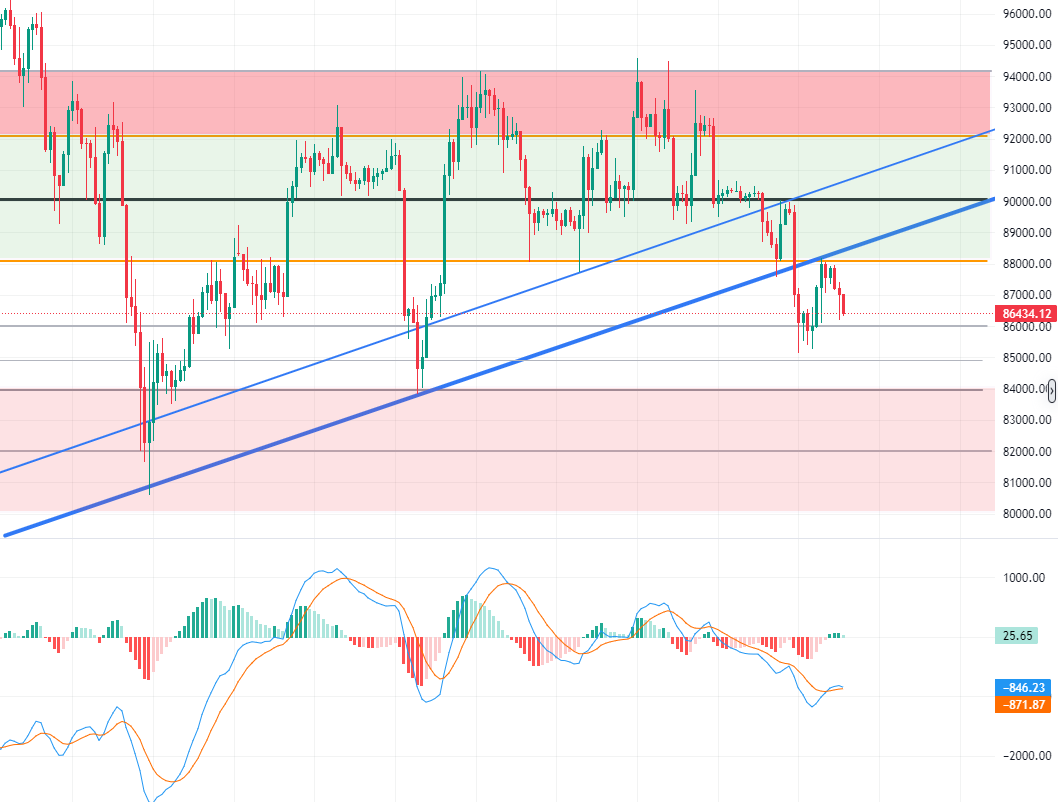
Although the support level has temporarily held, the issue of weak market momentum is becoming increasingly prominent. The price has now tested the support near $86,000 for the third time recently; this area is both a previous pullback low and a key Fibonacci retracement level. On-chain data shows that there is some buying support around $85,000, and the daily RSI bullish divergence signal is still present (price is oscillating at a low level but RSI has not made a new low), indicating that the downward momentum is indeed weakening at the margin. However, the characteristics of weak short-term rebounds are more evident: on the 4-hour chart, even though the MACD green bars have narrowed, the trading volume during the rebound has not increased, indicating a "volume-less rebound"; the RSI has moved out of the oversold zone but remains around 40, failing to generate effective upward momentum. Additionally, the selling pressure in the perpetual contract market has not significantly eased, making it difficult for each rebound to sustain.
As for the next steps, it largely depends on the outcomes of two key events. If Bitcoin can hold the critical support at $85,000, and if the Bank of Japan can say something "soft" after the rate hike—such as hinting at a possible pause in rate hikes—combined with U.S. CPI data coming in lower than expected, it could reignite expectations for easing. In that case, Bitcoin is likely to initiate a corrective rebound, first looking at the resistance zone of $88,500 to $90,000. If it can break through that, it may test the descending trend line at $92,000.
However, if the support at $85,000 is effectively broken, and if the Bank of Japan raises rates by 25 basis points as expected or even exceeds expectations with a 50 basis point hike, triggering a large-scale withdrawal of carry trade funds, the price could accelerate downward, first dropping to the $82,000 to $80,000 range, and possibly testing the support strength at the $80,000 round number.
The market has actually entered a "bottoming phase after deleveraging," with high-leverage positions mostly cleared out. The current selling pressure mainly comes from normal adjustments in the spot market, but there are not many funds willing to enter for bottom-fishing, leading to a continuous decrease in trading volume. For ordinary investors, it may be wise to respond according to the oscillation range of $85,000 to $88,500 in the short term, trying to avoid blindly bottom-fishing or chasing highs. It is crucial to keep an eye on the Bank of Japan's decision on December 18-19, as well as tomorrow's U.S. CPI data; waiting for clear breakout signals before taking action would be more prudent. Additionally, be aware that many institutions will be cashing out profits at the end of the year, which may trigger short-term liquidity fluctuations, so this should not be taken lightly.
This article is exclusively published by (WeChat public account: Jane Crypto) and is for reference only. Trading itself is not difficult; the challenge lies in human psychology and self-discipline. I hope we can all continuously improve ourselves through learning, refine ourselves, and strive for long-term resilience.
Market conditions fluctuate in real-time and are time-sensitive. Feel free to scan the QR code to follow the public account for daily market information and real-time discussions.

Friendly reminder: This article is solely owned by the column public account (as shown above) of Jane Crypto. Any advertisements at the end of the article or in the comments section are unrelated to the author!! Please be cautious in distinguishing authenticity. Thank you for reading.
免责声明:本文章仅代表作者个人观点,不代表本平台的立场和观点。本文章仅供信息分享,不构成对任何人的任何投资建议。用户与作者之间的任何争议,与本平台无关。如网页中刊载的文章或图片涉及侵权,请提供相关的权利证明和身份证明发送邮件到support@aicoin.com,本平台相关工作人员将会进行核查。