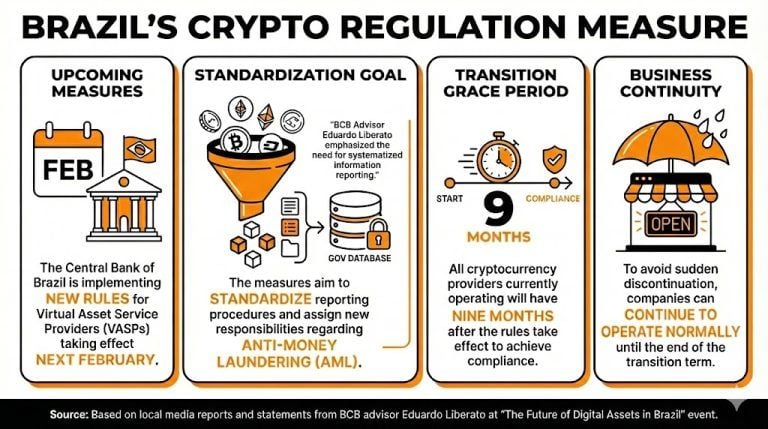
The Central Bank of Brazil is on the verge of implementing new measures for virtual asset service providers (VASPs) to comply with the new rules taking effect next February.
According to local media, the central bank will update the procedures that VASPs must follow to comply with these new rules, given that the new regulation assigns new responsibilities for VASPs regarding anti-money laundering measures.
Eduardo Liberato, who advises the central bank’s regulation department, stated that this new measure aims to standardize how these providers issue the relevant information to the institution.
At a speech given at the “The Future of Digital Assets in Brazil” event, he stated:
An issue present to all PSAVs is the need to provide information to the Central Bank in a systematized way.
Furthermore, he disclosed that all cryptocurrency providers operating in the country will be able to keep operating for nine months after the rules take effect, avoiding the sudden discontinuation of these businesses. “Until the end of the term, companies can continue to operate normally,” he declared.
Read more: Brazil Issues New Crypto Regulations, Tightens Controls on Stablecoins Transactions and VASPs
The standardization of a measure for VASPs to provide the requested information to the central banks means that the institution is serious about implementing these new rules, even in the face of possible opposition from the Brazilian Congress.
Recent developments, including a proposal to tax stablecoin transactions as foreign flows, are being rejected by Congress. A draft law that considers them illegal was introduced recently, specifying that the central bank exceeded its authority.
Until there is real action opposing these measures, VASPs will have to yield and comply with the soon-to-be-effective ruleset, providing the information required by the central bank.
- What new measures is the Central Bank of Brazil implementing for VASPs?
The Central Bank is introducing regulations requiring virtual asset service providers (VASPs) to comply with updated anti-money laundering measures by February. - What is the purpose of the new compliance rules for VASPs?
The new rules aim to standardize reporting procedures, ensuring VASPs provide the necessary information to the Central Bank systematically. - How long will current cryptocurrency providers be allowed to operate after the new rules take effect?
Cryptocurrency providers can continue operations for nine months post-implementation, avoiding immediate discontinuation of services. - What opposing actions have been proposed regarding these new regulations?
Some Congress members have proposed to tax stablecoin transactions as foreign flows and introduced a draft law claiming the Central Bank exceeded its authority.
免责声明:本文章仅代表作者个人观点,不代表本平台的立场和观点。本文章仅供信息分享,不构成对任何人的任何投资建议。用户与作者之间的任何争议,与本平台无关。如网页中刊载的文章或图片涉及侵权,请提供相关的权利证明和身份证明发送邮件到support@aicoin.com,本平台相关工作人员将会进行核查。


