If CZ represents the "technological idealism" of the early days of Binance, then He Yi has always been the most down-to-earth and emotionally vibrant face of this massive machine. From "Co-Founder & Chief Customer Service Officer" to her self-proclaimed title of "Customer Service Xiao He" in the community, her personal narrative is almost intertwined with all the highs and lows of this company.
On the morning of December 3rd, Dubai time, Binance CEO Richard Teng announced that co-founder He Yi officially took on the role of Co-CEO on the main stage of Binance Blockchain Week. During the days when CZ was not in the spotlight, He Yi may have already become accustomed to making more decisions that only a "top leader" could make. Internally, she manages team and business rhythms, while externally, she handles the pressures of regulation and public opinion, all while maintaining trust at the community front. The change in title is merely a formal announcement, but behind it lies a quiet rewriting of Binance's power structure, organizational path, and even industry narrative.
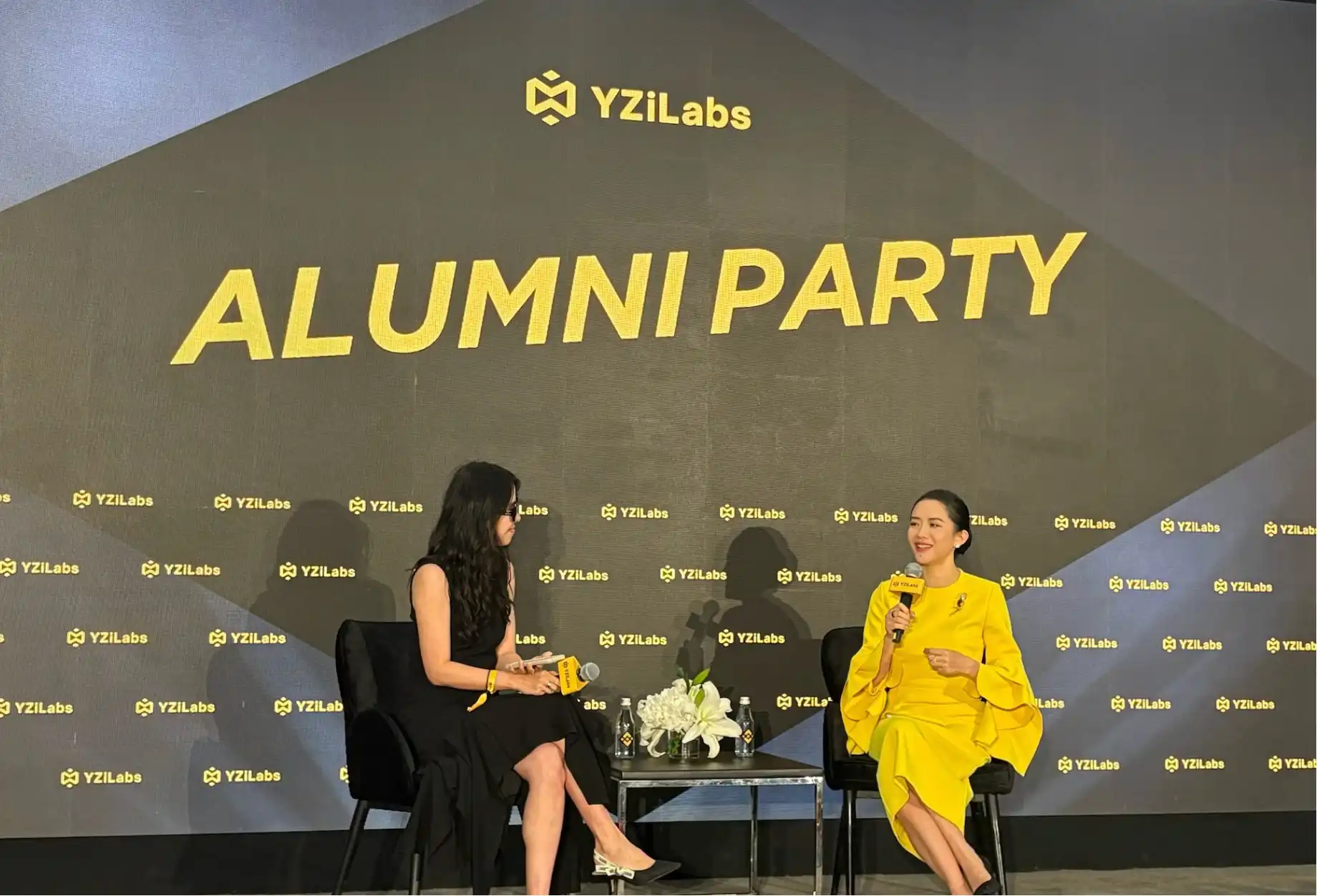
This interview was organized by Rhythm based on the complete recording of the event, with moderate simplification and structural adjustments while trying to retain He Yi's original tone and sharpness. We hope that beyond the noisy news flow of the crypto circle, you can see a more three-dimensional Binance and a more authentic He Yi.
Question: Why was the position of Co-CEO designed? What will be your and Richard's future division of labor?
He Yi: First of all, everyone knows that Richard has a regulatory background and is very familiar with compliance processes. He is the best bridge for communicating with regulators and has helped us elevate compliance standards to a new height. As for myself, I can be considered an industry OG. Based on this, I am mainly responsible for ensuring that a user-centered corporate culture can be well retained within the company.
On the other hand, I have previously mentioned wanting Binance to become a company that lasts for generations. So, over a year ago, I took over the HR department, constantly thinking about and transforming how to build an organization that relies on systems rather than on any individual.
This is the background for us introducing the Co-CEO role. In traditional finance, such as at J.P. Morgan, this role is quite common. The effect we hope to achieve is that 1+1>2.
Question: Recently, some intermediaries in the market have promised to facilitate listing on Binance. Have you heard of such situations? Have you discovered similar violations and thus dismissed some so-called "white gloves," as well as tightened related listing rules?
He Yi: First of all, Binance has never had so-called "white gloves." Although many people impersonate my friends, relatives, or brothers, if you think about it, Binance does not need these roles at all.
The emergence of these so-called intermediaries is because our listing threshold is high. These people either just help you fill out a form or play a probability game, casting a wide net and promising no success, no fee with 100 projects. In the end, if a project succeeds based on its own quality, they take credit and collect money.
If you find someone claiming they can guarantee a listing, please report them, or even directly turn them over to law enforcement. Binance now has more and more licenses; it is definitely not a lawless place, and we firmly combat such fraudulent behavior.
Finally, everyone knows I am the second-largest shareholder of Binance. The so-called "white gloves" would be like stealing money from my own pocket to harm the company's interests, which is completely illogical. If you understand our equity structure, you would know I don't need to do that at all.
Question: As a woman, reaching the position of Co-CEO, do you have any new positioning or thoughts?
He Yi: Discussing women's topics is indeed not easy. Whether in fast-moving consumer goods or other industries, the key is not the industry itself but whether you set a ceiling for yourself. If you subconsciously feel you can't do it, then you really can't.
Secondly, many women like to leverage their gender advantages in the workplace, such as having a good image and strong affinity, thinking that this makes communication smooth and increases influence. But this can actually backfire on your professional image. The other party may only respect your communication skills, not your professional abilities. Whether in Web2 or Web3, the core is always to enhance professional skills.
If you are in marketing, strive to be the strongest in the industry; if you are in user growth or PR, refine your data and articles to perfection; if you are a KOL, polish your content to the top level. When others respect your professionalism, discussions about gender will naturally be bypassed.
In business competition, no one will give way to you just because you are a woman. In life, it can be "Lady first," but the business world is a brutal battlefield where it's a matter of life and death; no one will hold back their attacks on you, and they may even be harsher. Sometimes what you think is an advantage is actually a shortcoming; ultimately, everyone must find their own core strengths.
Question: The community has always been regarded as the core of the crypto industry, and you often say you are "Binance's forever customer service." In the context of the recent rise of prediction markets, will you consider using user votes and prediction results from these markets as a structured tool for public opinion feedback to assist in decision-making or promote product and policy adjustments that are more aligned with community demands?
He Yi: I have a huge lesson learned: Never say never. Back in the day, I said Binance would not do contracts because I didn't understand it at the time; later, I said Memecoins wouldn't work, only to find out it was because I didn't understand them either.
So now, when it comes to prediction markets, I may not fully grasp it yet, so I've learned to be smart and not make definitive statements, not to say "never." But I also can't promise "definitely will." Because when a market's influence is significant enough, there will definitely be different voices, and it can easily be influenced by interests.
Everyone has their own position and interest orientation; the data often reflects just a slice. Frankly speaking, I don't yet understand prediction markets well enough and haven't spent enough time researching them, so it's hard to give a definite answer right now.
Question: Binance currently has over 300 million users globally, making it one of the largest companies in the crypto space by user scale. From your internal perspective as Co-CEO, what do you think Binance will excel at in 2025? In what areas do you still see shortcomings? How will you improve to achieve your vision of making Binance a "lasting enterprise"?
He Yi: There are many areas where Binance needs to improve, such as user experience not being smooth enough, localization not being as user-friendly as local exchanges, technical stability, and how to build a more positive industry image. The outside world often sees the crypto circle as "a den of snakes and rats," where we rise and fall together; we need to show society our positive value.
We haven't done everything perfectly; we may just be slightly better than our competitors, but the core is that we genuinely care about users. With the user base approaching 300 million, traditional financial giants are entering the market, and competition is fully underway, with traditional finance rising and falling together. During volatility, whales first sell altcoins before selling Bitcoin; this is an inevitable logic.
Retail investors are the foundation of Binance, and I insist on being on the front lines to fight for more inclusive opportunities for retail investors in the cracks. For example, the spike on October 11 was precisely because we do not compete against our users. When the market plummets, market makers stop trading, leading to a liquidity vacuum and price gaps in the matching engine. If we were to participate in the betting, this situation would not occur. Overall, we are still constantly thinking about how to establish a fairer and more transparent market.
Question: What is Binance's biggest challenge right now? And which business segments will you focus on next?
He Yi: The biggest challenge is still talent density. With technology developing to this point, not only in Crypto but also in AI, the talent density in traditional finance and internet giants is extremely high, and we are competing for the top talent in the entire market.
However, the crypto industry is relatively stigmatized, and the talent pool is already small. When you ask candidates if they want to move to the UAE, they will definitely think twice. What we need are people who understand financial products, know Crypto, and truly believe in this industry. If you don't believe in it yourself and are just writing code for a $10,000 salary without caring about what you're writing, it's hard to build a top global company.
So my most important responsibility is to help Binance find the best people. Recently, some peers have reacted strongly; I want to clarify that I am looking for talent everywhere, not targeting any specific company, but searching across the entire industry. If there are outstanding talents who want to come to the crypto space, they are welcome to be introduced.
Question: You once mentioned in a live broadcast that you admire Duan Yongping, who has been very successful in both "running a business" and "investing." Now that you are the Co-CEO of Binance, will you also focus part of your energy on investment and entrepreneurial incubation around the Binance ecosystem in your future work?
He Yi: When I started recommending Duan Yongping in public, he hadn't yet become as well-known as he is today; now he is a very hotly discussed entrepreneur. You can understand that I am very envious of him for building a company into a successful and highly efficient organization, allowing the founder to step back while the company continues to operate and iterate.
For me, I have never pursued just the success of Binance; I hope that on top of the Binance ecosystem, a large number of excellent entrepreneurs can grow and establish their own brands. In the future, it is entirely possible for more "Binance ecosystem versions of OPPO, Vivo, Xiaotiancai, and Pinduoduo" to emerge in the crypto industry.
The reason I admire Duan Yongping even more is due to his thinking on "how to build a system," rather than simply believing in a certain personal ability. Today, when people mention him, they talk more about investment because the crypto circle is still a highly financialized, investment-driven industry. From an investment perspective, Duan Yongping and Buffett share a lineage; their investment logic is very simple: long-term holding of top assets.
So what is "top assets"? I have written about it in my social circles and public spaces; of course, this is just my personal opinion and does not constitute any investment advice. If you firmly believe in the long-term prospects of a certain industry and think it will become larger and more promising, then you should go for the top assets in that industry.
In the context of the crypto industry, what are the most decentralized top assets? It is Bitcoin. From another dimension, if you are looking for a company, then look for the one that is "the most competitive, the largest in scale, and always striving to evolve" in this industry, which might be Binance. Whether Buffett understands the crypto space or Duan Yongping understands it, the underlying logic of resource and value allocation in the world is actually interconnected.
On the contrary, many people think that a small startup team of just three to five people can launch a new coin and see it rise tenfold or a hundredfold—why is that? What we can do as a platform is to communicate seriously with project parties, such as what their current valuation is, how their financing structure looks, and whether they are willing to allocate a portion of their quota to reward early real users at a relatively reasonable price, through airdrops or other incentives. If they are willing to incur costs to acquire seed users, that is a reasonable business arrangement.
But whether this project can ultimately succeed, no one can guarantee. What we can do is to try to judge whether this is a team that is seriously working, whether its underlying logic is coherent, and whether there are product prototypes or real progress, rather than just telling a story with nothing behind it. As for the future price of each token, no one can fully control it.
For us, BNB is more like an aircraft carrier; we hope to support more entrepreneurs' success based on this carrier, making the entire ecosystem more prosperous. However, I cannot and will not promise anyone that once you buy it, it will only go up and never down; such things do not exist in any market.
Question: How do you view the recent decline? Additionally, how do you foresee the trends and potential risks of the entire industry in 2026 and beyond?
He Yi: First, I want to clarify that this is a personal opinion and does not constitute investment advice. Bitcoin is the most decentralized crypto asset, and the so-called "prosperity leads to decline" depends on the cycle. Looking at it from a longer perspective, today's decline may just be a minor shake-up.
However, I believe that the current decline and volatility will not be as severe as in the past. This is because it has transitioned from a niche asset to a mainstream core asset. Although there are reports of certain countries selling seized assets in the market, more and more sovereign funds and wealth are allocating to Bitcoin.
So I say the underlying logic has changed; the absolute cycle theory and volatility patterns are being reconstructed. The fundamental strategies that were very profitable in the past few cycles may not work now. This is because the players have changed, the pond has grown larger, and the fish have also grown bigger. If you are still clinging to the old logic of catching small fish in the corner, it may not work in this cycle.
Question: Why did Binance choose to implement the Co-CEO system at this time? What essential changes will this new management structure bring to Binance? Additionally, could you share three specific initiatives that you personally lead and consider most important for Binance?
He Yi: I feel that from the perspective of daily work content, there hasn't been a particularly huge change. But from my personal perspective, there are a few things that will become more important to me.
First is the continuation of Binance's culture. I have always believed that the reason Binance has come this far is fundamentally due to our culture, and the core principle is user-first; this principle cannot change regardless of how the market changes.
I hope to spend more time promoting a systematic construction. As I mentioned earlier, we need to enhance the overall efficiency of the organization rather than just empowering or intensifying certain points. How to make the organization operate more efficiently is a direction I will pay close attention to.
Although I am not from a technical background and do not have a traditional product background, I firmly believe that technological innovation is the underlying driving force for advancing the world. Under this premise, I particularly hope to increase the introduction and application of AI within Binance. Only by truly integrating these new technologies into our business and organization can technological transformation benefit the entire industry, allowing us to move more steadily and further.
Question: Over the past two years, Hong Kong has been vigorously promoting the development of virtual assets, hoping to turn the city into a global virtual asset center, and has successively introduced a series of related policies. Given Binance's leading position in the industry, everyone is very concerned about what specific layouts and plans Binance has in Hong Kong at present. As the new Co-CEO, how would you assess Hong Kong's strategic priority in Binance's global landscape? Additionally, the event on October 11 this year almost drained the entire industry's liquidity, which everyone felt deeply. As an industry leader, how do you and Binance view the issue of "restoring liquidity"? Under the new Co-CEO structure, what specific strategies or measures will Binance take to promote the repair and reconstruction of industry liquidity?
He Yi: Regarding Hong Kong's regulation, we highly respect its status as a financial center in Asia. However, observing the financial reports of local exchanges, we find that their operating conditions are quite difficult. We maintain an open attitude towards the Hong Kong market and hope to make significant progress. However, it is understood that local exchanges still face restrictions in accessing international liquidity, making operations quite challenging. Currently, we can only feel our way across the river, taking one step at a time.
Regarding the draining of industry liquidity, it is important to understand that this usually only means that leading market makers paused trading during a crisis, which does not indicate that funds have disappeared. From on-chain data, users do not lack money; rather, they hold a large amount of stablecoins. Therefore, the market does not lack liquidity; what is lacking is a sufficient number of good investment targets.
Your money has not been taken by Binance; it has flowed to more professional players. The overall market size is expanding, but during periods of volatility, many people choose more conservative strategies, such as stablecoin investments or only allocating to Bitcoin and other major coins, seeking a sense of security.
Question: What are Binance's plans regarding meme coins?
He Yi: I think this question can be viewed from several dimensions. First, from the perspective of the trading platform, I actually don't like everyone focusing on my Twitter to post memes. Because it puts a lot of pressure on me; if I casually throw out a joke, it could turn into a coin; if it goes up, everyone is happy, but if it goes down, they all come to blame me, making me hesitant to speak. But ultimately, people do not care who posted the meme; they do not care if it is called He Yi, Little Dog, or Little Pig; what they truly need is a trading target that carries emotions.
Although everything can be a meme now, if we look at it over a longer time frame, what is truly worth holding long-term will return to Buffett's value investment logic. I might be a bit old-fashioned, often feeling like I can't keep up with the times, learning while trying to "surf the 5G wave."
Meme coins are certainly a fresh phenomenon, but which memes can ultimately have long-term value support and truly accumulate value will determine their price: short-term emotions, long-term value. Any asset goes through phases of "overbought" and "oversold"—when emotions are high, everyone chases the rise, and when it drops, they all rush to sell, fearing "if I don't sell, it will be worthless."
From Binance's perspective, we will try to communicate with project parties, such as whether we can lower the TGE pricing a bit or allocate more for user airdrops. However, the project parties often turn around and say Binance is "greedy, wanting so many coins for airdrops," which then turns into "astronomical listing fees."
In reality, we also encounter situations where some memes have almost nothing in terms of fundamentals; I personally judge that they will eventually drop, but users are still willing to buy and trade. If we completely ignore this demand, we will lose market share. So in the end, we can only strike a dynamic balance between "providing users with enough trading targets" and "the platform's own risk control requirements," which is itself a continuous game.
Question: You just mentioned stablecoin investment-related businesses. Does Binance have plans to restart products or collaborations related to PYUSD in the future? Additionally, are you considering re-entering the U.S. market comprehensively in the future? If the political landscape in the U.S. changes and the Democratic Party regains power, do you think the regulatory environment for Binance in the U.S. will become more severe?
He Yi: My current thought can actually be summed up in one sentence: never say never. Honestly, I don't know what the next step will be; often, it's just a matter of taking one step at a time, trying what can be done, and if it doesn't work out, learning to accept it—what happens, happens.
The political landscape in the U.S. is too vast for us to influence. Moreover, to be frank, we are not that close to the so-called Trump family. Some domestic media particularly like to demonize, sometimes saying CZ did this or that, and at other times saying "paying fines is to buy amnesty," which are not facts. We should view the U.S. more simply; fundamentally, it is a highly competitive two-party game, and in this party struggle, we are at best a victim.
Think about it: as a commercial company, we are currently just trying to survive in the cracks, far from being able to "influence political parties." To put it bluntly, we are not worthy of that. If one day Binance can truly influence government decisions or even intervene in party struggles, that would be considered "entering the hall." But at least for now, we are really just small players.
Question: If you compare the strategies and endeavors you are currently promoting as Co-CEO with the dreams you had at 18, how much has changed in between? What is the inner driving force that has supported you to this day? What is your most steadfast belief? If you could go back to your 18-year-old self or even younger, what did you think was the most important pursuit in life—wealth, family, or something else?
He Yi: At 18, I didn't have a clear concept of wealth, but I really liked the character Chen Changsheng from the novel "Choosing the Heavens" by Catnip. Every time he faced a challenge, he would say, "I want to try." I think that resonates with me. Although I don't look like someone who can rely on my looks, I still tried to be a host. Because it had the lowest cost and the least hassle; I could do my own makeup and accept any payment.
Later, starting a business was the same; although I had never done it before, I wanted to try. I remember a friend (Li Jiayi) asked me what my life dream was, and I somewhat "literary" said, "I want to be a person who influences the world." She thought I was crazy and didn't bother to respond.
Years later, I was included in a selection of internet figures, and she suddenly messaged me saying, "Look, you achieved what you said about influencing the world." In fact, that selection was quite insignificant, and I had forgotten about it, but looking back, my driving force has always been that phrase, "I want to try." What does it matter if I haven't done it before? If I haven't been a CEO, then once I do it, I'll know what to do!
Question: How do you cope with emotions like fear, anxiety, and confusion?
He Yi: I think everyone experiences emotions, whether it's fear, anxiety, tension, sadness, or disappointment; these will occur, and I am no exception, after all, I am just an ordinary person. For me, the more important point is to first accept that these emotions are bound to happen; they are a very normal human reaction and not something that "should not occur."
I really like a saying—"The clouds are in the blue sky, and the water is in the bottle." Although the final outcome for Jiajing was not good, this saying itself moves me. You have to learn to accept the good and bad things that happen in life. The clouds are there, the blue sky is there, and the water and the bottle are all in their respective places; everything has its arrangement. I used to often say that whatever fate gives you, just live it well and enjoy it.
免责声明:本文章仅代表作者个人观点,不代表本平台的立场和观点。本文章仅供信息分享,不构成对任何人的任何投资建议。用户与作者之间的任何争议,与本平台无关。如网页中刊载的文章或图片涉及侵权,请提供相关的权利证明和身份证明发送邮件到support@aicoin.com,本平台相关工作人员将会进行核查。


