Written by: Tia, Techub News
Since the beginning of 2025, the transaction fees on the Ethereum mainnet have remained at extremely low levels, even becoming cheaper than some L2s during certain periods. With client optimizations and decreasing hard drive costs leading to a continuous increase in gas limits, more voices are beginning to propose a viewpoint that was once considered "outdated"—perhaps Ethereum L1 has not aged, and maybe "returning to the mainnet" is regaining practical significance.
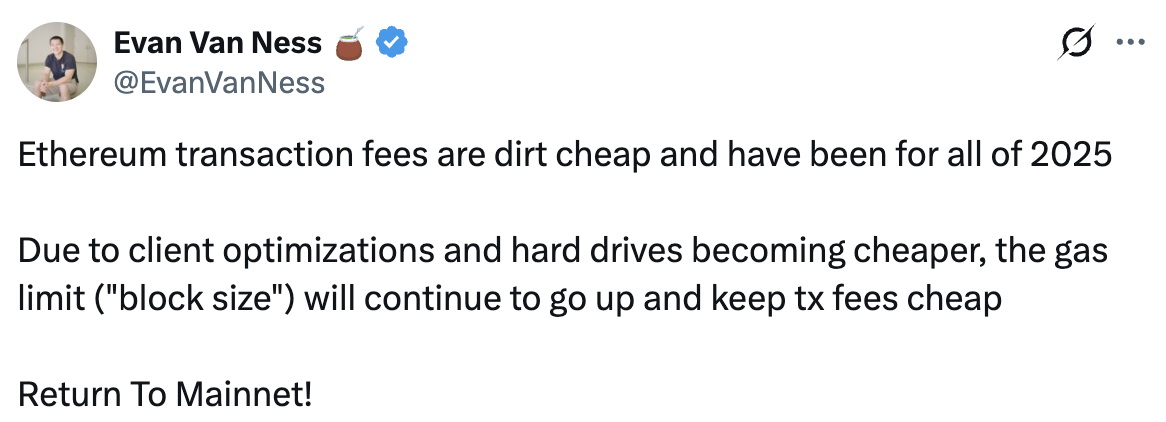
This topic was thoroughly ignited recently. Evan Van Ness, the founder of "Week In Ethereum News," tweeted on November 6:
"The transaction fees on Ethereum are very low, and they will remain so throughout 2025. Due to client optimizations and falling hard drive prices, gas limits (the 'block size') will continue to increase, keeping transaction fees low. Return to the mainnet!"
Then, on December 1, Vitalik retweeted this discussion and succinctly added: "You can just build on L1." He did not elaborate further, but this comment was enough to ignite industry sentiment.
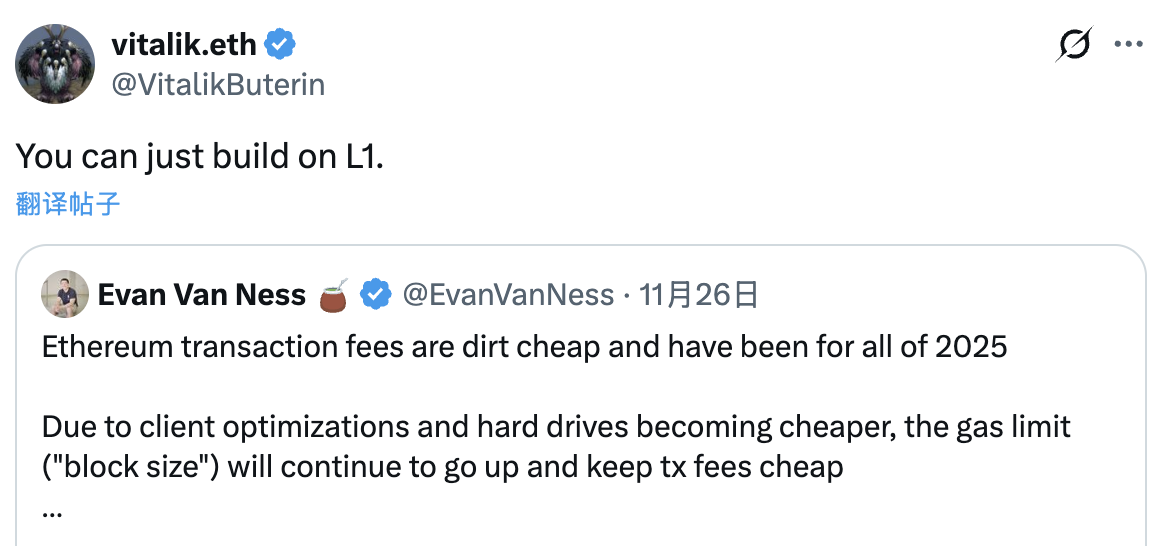
In a context where Rollups have been seen as the established route for Ethereum's scalability and modular narratives have dominated for over a year, Vitalik's statement undoubtedly dropped a heavy signal bomb. Why have transaction fees on the mainnet suddenly become cheaper? Why is there a call to "continue building on L1"? Does this mean that the scalability roadmap is undergoing subtle changes?
Why Have Ethereum Mainnet Fees Decreased in 2025?
The tweet mentioned two key reasons: client optimizations and decreasing hardware costs. These two factors, after years of accumulation, have finally produced significant effects in 2024-2025.
First, client optimizations have gradually matured.
Between 2023 and 2025, Ethereum clients (Geth, Prysm, Nethermind, Erigon, etc.) have continuously optimized both the execution layer and the consensus layer. Specific improvements include:
Increased throughput for single slot execution
Optimized read/write efficiency of the state database
Better transaction pool sorting efficiency
Faster block validation paths
These changes essentially reduce the burden on nodes to process each block. For a long time, Ethereum developers have viewed the gas limit as a safety-sensitive value rather than an "expansion button." Increasing the gas limit means each node must process more transactions and read more states within a fixed time; if hardware cannot keep up, it will lead to more nodes going offline, thereby reducing decentralization.
However, after years of optimization, the improvement in client execution efficiency allows nodes to handle larger blocks without significantly increasing their burden.
Second, decreasing hardware costs enable more nodes to handle larger blocks.
Over the past five years, the cost of SSDs has continuously decreased, I/O performance has improved, and more nodes have begun using NVMe SSDs. This means that synchronizing full nodes and processing state updates is no longer as limited as it was in 2020.
When the gas limit's restriction shifts from a "hardware bottleneck" to a "risk preference choice," the natural growth of the gas limit becomes a reality.
As a result, an essential effect has emerged:
Block capacity has become larger
The cost of individual transactions has become lower
Fee peaks in high-load scenarios have also significantly decreased
Even during certain periods, the cost of executing a Uniswap Swap on the Ethereum mainnet has become comparable to that of multiple L2s.
For many developers who have been deterred by high gas fees on the mainnet for years, this is a dramatic change. Some developers who "had to go to L2" are beginning to reassess their deployment strategies, and many users are experiencing the "Ethereum in 2020 feel" for the first time again.
Why Has the L1 vs L2 Debate Resurfaced?
Over the past 18 months, the market has generally believed that a "Rollup-Centric" route was a foregone conclusion, with the launch of L2s and the explosion of TVL supporting this view. However, as mainnet costs decrease, a series of applications that were previously seen as "must go to L2" are reassessing whether they need a complex cross-chain environment.
For developers, the core attractions of L1 include:
• No need to bridge assets, providing a more intuitive user experience
• Mainnet security is immediately available, without relying on external sorters
• A simpler development environment, without the need to accommodate multiple chains or fragmented ecosystems
• Direct access to Ethereum's own liquidity and identity system
In simple terms, if the costs on L1 are low enough, the overall development costs may even be lower than deploying on multiple L2s. This is also why Vitalik said, "You can just build on L1"—simplifying complexity itself is a form of cost saving.
Does This Mean a Reversal of the Modular Narrative?
The answer is more likely "no." Rollups, DA layers, and off-chain proof systems remain the core pillars of Ethereum's long-term scalability route. Simply increasing the gas limit cannot support large-scale global use cases.
The increase in gas limits will not be endless. The historical debates within the Bitcoin community over block size are still fresh: block capacity cannot expand indefinitely; it will erode decentralization and hardware accessibility. Ethereum's long-term roadmap remains:
L1 for consensus and settlement
L2 for executing intensive computations
L3 or dedicated chains for highly scalable customizations
The value of L2 is not to replace L1, but to carry the scale that L1 cannot support.
However, within this long-term model, L1 still has a clear role: applications with high value and strong security needs will still prioritize L1, while low-cost large-scale applications will land on L2.
Thus, the relationship between L1 and L2 is more like functional layering rather than zero-sum competition.
Is Confirmation Time More Critical Than Fees?
Moreover, some have suggested: "The biggest bottleneck in returning to L1 is not the fees, but the confirmation time of L1."
This comment highlights the core contradiction: a decrease in fees does not equate to an improved experience. In the current Ethereum environment, users can generally accept gas fees of 1-3 Gwei, but find it hard to accept a 12-second confirmation delay. For many applications based on real-time interactions, delays are more fatal than costs.
In other words, cheap fees can attract developers to reassess L1, but whether they truly return to the mainnet still depends on interaction performance, synchronization speed, and predictability.
However, the "return to the mainnet" provides a new perspective:
The goal of scalability is to "lower the barriers to use," not to "drive all applications out of L1."
In the past few years, our narrative has been overly binary—suggesting that all applications should ultimately migrate to L2.
The current reality is:
Highly financialized, high-frequency execution applications are suitable for L2
Infrastructure applications that are sensitive to security and require maximum trust still prefer L1
Some new applications now have the opportunity to launch directly on L1 and gain better exposure and liquidity
This is not a regression of modularity, but a balance following the diversification of the ecosystem.
Uncertainty is Becoming a New Risk Variable
However, some are feeling pessimistic about this. Regarding the call for Ethereum to return to the mainnet, they commented, "Unfortunately, Ethereum is becoming increasingly unpredictable. The L2 paradigm has been canceled, EIP-7825 has broken compatibility, and the foundation is discussing increasing the gas costs for SSTORE. In this uncertainty, developers will flee to other chains."
This reflects another kind of industry anxiety: as Ethereum enters a phase of continuous iteration while also bearing the pressure of harmonizing L1 and L2 ecosystems, the uncertainty of policies and roadmaps itself becomes a cost. The more complex the scalability path, the harder it is for developers to predict the operating environment of applications five years down the line.
While decreasing fees may be a positive, the complexity of the roadmap is undermining this benefit.
Some even raise the question: "If L1 becomes completely cheap, will L2 still have the incentive to continue innovating? After all, L2 is where everyone experiments with new security models."
This reflects the relationship between security models and market models. The value of L2 lies not only in being "cheap," but also in being "differentiable" and "experimental," such as:
New execution environments (MoveVM, SVM, zkVM)
Different sorting models
Data availability alternatives
Custom chains (OP Stack, ZK Stack)
No matter how cheap L1 becomes, it will not accommodate all experimental designs. What may be truly affected are those L2s that do not offer additional differentiation and only market themselves as "cheap."
In other words, a cheaper L1 will reset part of the competitive landscape but will not stifle highly innovative L2s.
Is "Returning to the Mainnet" Just a Momentary Emotion or a Long-Term Trend?
From the current stage, "Return to Mainnet" is neither a complete return nor a simple nostalgia, but a reflection on the existing scalability narrative.
Several real factors driving this trend include:
Client optimizations → Increasing gas limits
Decreasing data availability costs
Maturing research on execution layers (parallel, stateless, RISC-V zkVM)
The backlash from the complexity of some L2 ecosystems
At the same time, there are undeniable limitations:
Mainnet confirmation times remain a bottleneck for application experience
Roadmap uncertainty puts pressure on developers
L2 remains the only scene for experimentation and differentiated innovation
Therefore, it can be said that the industry is entering a new narrative cycle:
Not abandoning L2, but re-discussing the boundaries and functions of L1 and L2.
Not giving up modularity, but allowing the mainnet to regain initiative within the modular system.
The past scalability narrative was "L2 or bust."
The current trend resembles "The division of labor between L1 and L2 is being renegotiated."
Summary
Vitalik's "Build on L1" is not just a slogan, but a market signal:
Developers are reassessing unnecessary complexities and choosing deployment methods that are lower in cost and simpler in path.
The impact on Ethereum may include:
A new generation of L1 native applications (identity, protocol derivatives, payment tools) has the opportunity to revive
Wallets and infrastructure need to re-optimize their support for the mainnet
DApp developers can leverage lower costs for experimental innovation
L2 may adjust its positioning to strengthen its complementary relationship with L1 rather than simply competing for traffic
Of course, "the mainnet becoming cheaper" does not mean:
Ethereum no longer needs L2
Gas limits can be increased indefinitely
Fees will always remain low
Once market enthusiasm rises and activity increases, fees may still rise again. Therefore, the "window period" for L1 is more like an opportunity for developers rather than a permanent trend.
Someone commented very straightforwardly and realistically: "When the cake isn't growing, relationships become complicated; when the entire industry is growing, many problems will disappear." Low fees are not the end point but a signal: the capabilities of the mainnet are changing, the ecological division of labor is changing, and the narrative of the scalability route is also changing. "Return to the mainnet?" Perhaps it is not a step back but an entry into a new phase.
免责声明:本文章仅代表作者个人观点,不代表本平台的立场和观点。本文章仅供信息分享,不构成对任何人的任何投资建议。用户与作者之间的任何争议,与本平台无关。如网页中刊载的文章或图片涉及侵权,请提供相关的权利证明和身份证明发送邮件到support@aicoin.com,本平台相关工作人员将会进行核查。


