Yesterday, the market experienced a rapid decline, dropping to a low of 84,000, which means it fell from around 91,000 all the way down to 84,000, an overall drop of several thousand points.
In fact, during the consolidation phase from last Friday to Saturday, we had already clearly warned: prepare for a new round of decline, with the target looking at the previous low around 80,000 or a break of the integer level.
So for those who positioned short from 91,000, there is now a good amount of space. This position can take partial profits or be protected, but it is not recommended to increase the position with floating profits; just maintain the original position and wait for the low to break.
Reasons for the decline:
The structure has already given signals
The past few rebounds corresponded to pullbacks of 15%, 8–9%, and 12%, but these pullbacks do not indicate a trend reversal.

The key lies in the structure: hourly, daily, and weekly charts are all in a bearish structure. This bottom "V rebound" is merely a three-stage weak rebound, insufficient to drive a multi-cycle reversal.
Therefore, once the rebound is over, a new decline will naturally occur. We have repeatedly emphasized at high levels: do not chase longs; high positions can be used to layout long-term shorts.
Analysis of yesterday's sharp drop
Yesterday, the market dropped sharply from 87,000 to 84,000, a single-day drop of 3,700 points. More importantly:
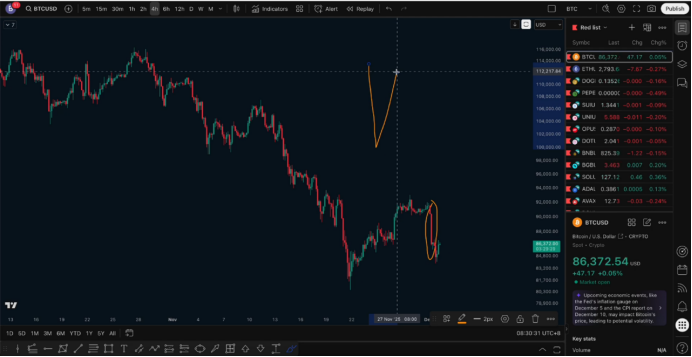
The decline was accompanied by increased volume
After the drop, there was no quick recovery
This indicates it is not simply a "liquidation of long leverage"
But rather a real selling pressure, with increased spot selling power
There were no signals of a stop in the decline, nor any recovery actions, so after the sharp drop, one should not gamble on the bottom to go long. Even looking at the hourly level, there is no stop-loss pattern.
After the rebound, continue to focus on "high shorts," and do not attempt to position long at weak bottoms.
Two main expectations going forward
Expectation one: continue to decline directly
The market may continue to drop, testing the previous low of 80,000, or even breaking below the integer level.
After breaking, observe whether a decent rebound occurs.
Expectation two: rebound first, then provide opportunities for high shorts
If a rebound occurs, the extreme position still looks at:
99,000–100,000
This is the area where the previous low and the descending trend line overlap, and it is also the position of the strongest pressure. Whether this rebound will happen is uncertain in timing, but structurally, this is a reasonable area.
Assuming a healthier market rhythm
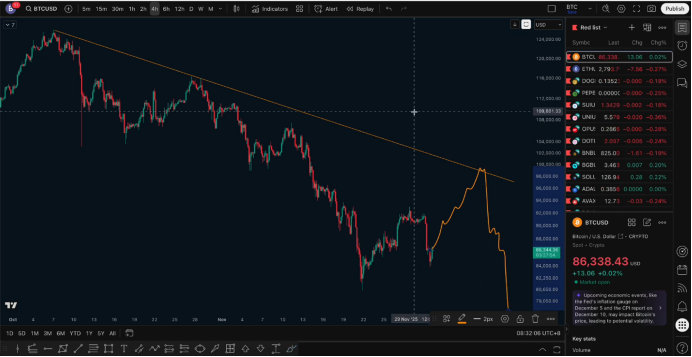
I personally believe a more ideal rhythm is:
Revisit the previous low and attempt to break it
Consolidate at the low
Experience a decent rebound
After the rebound ends, then proceed with a larger decline
Why is this necessary?
If the market continues with "sustained decline + weak rebounds," liquidity will be exhausted:
Longs will not enter
Counterparties will be insufficient
Shorts will also struggle to continue
Therefore, before a larger decline, the market usually needs a strong rebound to absorb enough positions.
Follow me, join the community, and let's improve together. The article is published with a delay and is for reference only.

免责声明:本文章仅代表作者个人观点,不代表本平台的立场和观点。本文章仅供信息分享,不构成对任何人的任何投资建议。用户与作者之间的任何争议,与本平台无关。如网页中刊载的文章或图片涉及侵权,请提供相关的权利证明和身份证明发送邮件到support@aicoin.com,本平台相关工作人员将会进行核查。


