Written by: Bootly
Bitcoin has once again experienced one of the most severe downturns of the year: plummeting from around $90,000 during the day to approximately $83,600. Accompanying this price drop was the forced liquidation of over $500 million in long positions, causing the market fear index to approach "extreme fear" once more.
What appears to be a sudden crash hides deeper structural changes. Macro liquidity is shifting, derivative leverage is accumulating, and technical indicators have shown a mid-term breakdown, with three forces pressing down on Bitcoin almost simultaneously.
The previous rise seemed to have preemptively digested the entire market's expectations for a "rate cut cycle"; now, the market is repricing—reassessing what true liquidity is willing to pay for Bitcoin.
The "Overdraft Effect" of Bitcoin's Rise Begins to Show
If we observe Bitcoin's performance this year within a longer time frame, a clear phenomenon emerges: since the approval of the spot ETF, the rapid rise has outpaced any previous upward phase in both speed and scale.
This "excessively steep" market trend is referred to in macroeconomics as expectation overdraft: the market has pre-priced all future easing, growth, or capital inflows, and when real conditions do not materialize immediately, prices are more likely to lose weight.
This round of decline from a high of $125,000 to over $80,000 is not just a normal technical correction; it resembles a backlash against this year's overly optimistic sentiment.
The first signal of this backlash comes from the ETF.
In November, Bitcoin's spot ETF saw a net outflow of up to $3.5 billion, marking the worst month since February. As a primary allocation tool for traditional funds, the inflow and outflow of ETFs often represent the attitude of "long money." The continuous outflow now indicates that the pace of external incremental funds is slowing down.
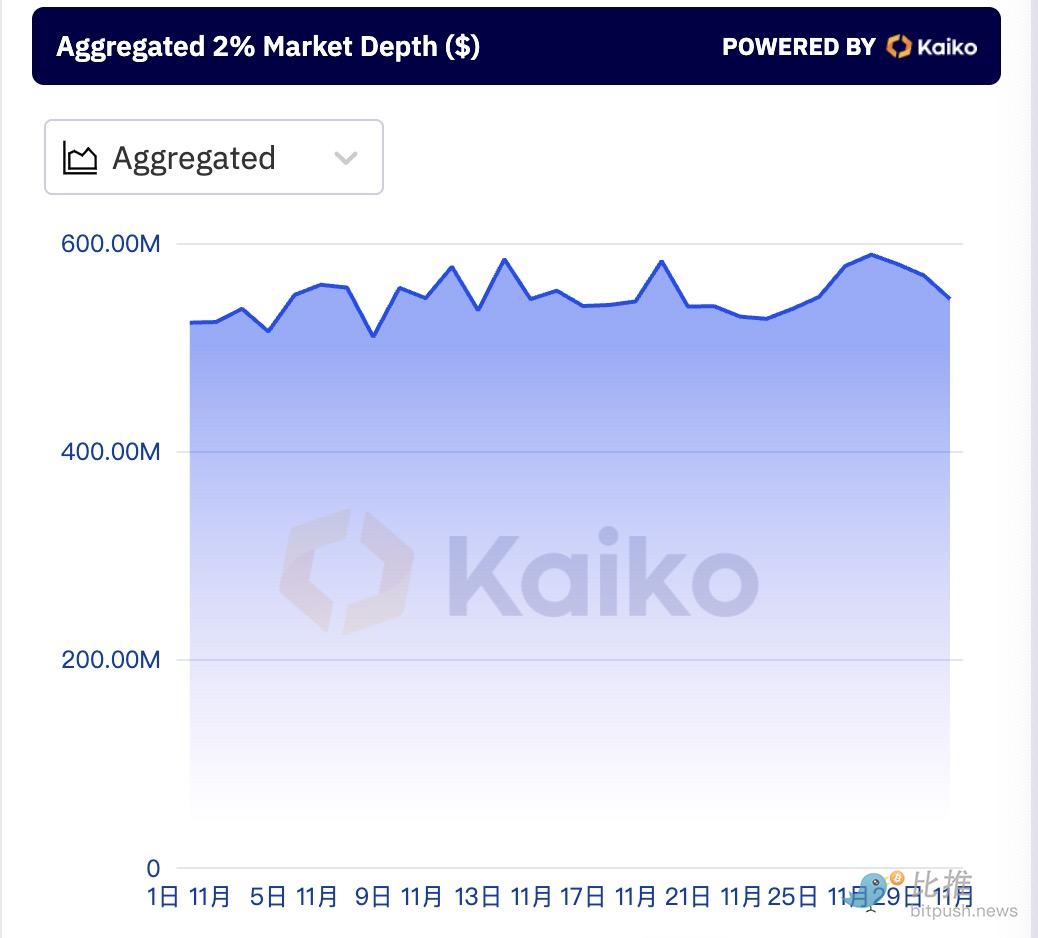
At the same time, data from Kaiko shows that the "market depth" of Bitcoin's order book (an indicator measuring how resistant its price is to fluctuations caused by large trades) hovered around $568.7 million last weekend, down from the peak of $766.4 million in early October, a nearly 30% drop in the past month. Any large trades will lead to greater volatility—especially as the scale of leveraged trading is currently high, becoming a hidden trigger point.
The Stronger the Rate Cut Expectations, the More Tense the Market Becomes
Every major fluctuation in Bitcoin cannot ignore the macro backdrop.
On the surface, the probability of a Federal Reserve rate cut in December has been priced in by the market at nearly 90%, which should be bullish for risk assets. However, the current "rate cut expectations" differ from the past; they resemble the market pressuring the central bank to provide a signal of easing.
The problem is that a rate cut itself cannot immediately bring new liquidity.
With inflation still not returning to the 2% target, the actual room for the Federal Reserve to release easing is very limited. Therefore, the market begins to doubt: is there enough new money to drive risk assets back up? This doubt typically does not manifest in economic data but is first reflected by high-volatility assets.
A more sensitive trigger point comes from Japan.
This week, a rare statement from Japanese central bank officials suggested they might consider raising interest rates, quickly sparking global concerns about a potential reversal of "yen carry trades"—if investors have to buy back yen instead of continuing to borrow yen to purchase U.S. stocks or crypto assets, then global risk markets may enter a phase of "passive deleveraging."
Risk sentiment is much more fragile under macro disturbances, and Bitcoin, as the most frontline risk asset, bears the brunt.
Reflecting on an interesting change: just days before the drop, most traders on Myriad's prediction market believed Bitcoin "would first reach a new high of $100,000"; after the decline began, this expectation flipped instantly, with nearly half betting it would "first drop back to $69,000."
This dramatic switch in sentiment is a typical characteristic of the crypto market:
During a rise, the market is willing to believe any positive news;
But once a rapid decline occurs, the market will immediately embrace the most pessimistic narrative.
Technical Indicators Enter Mid-Term Bearish Zone
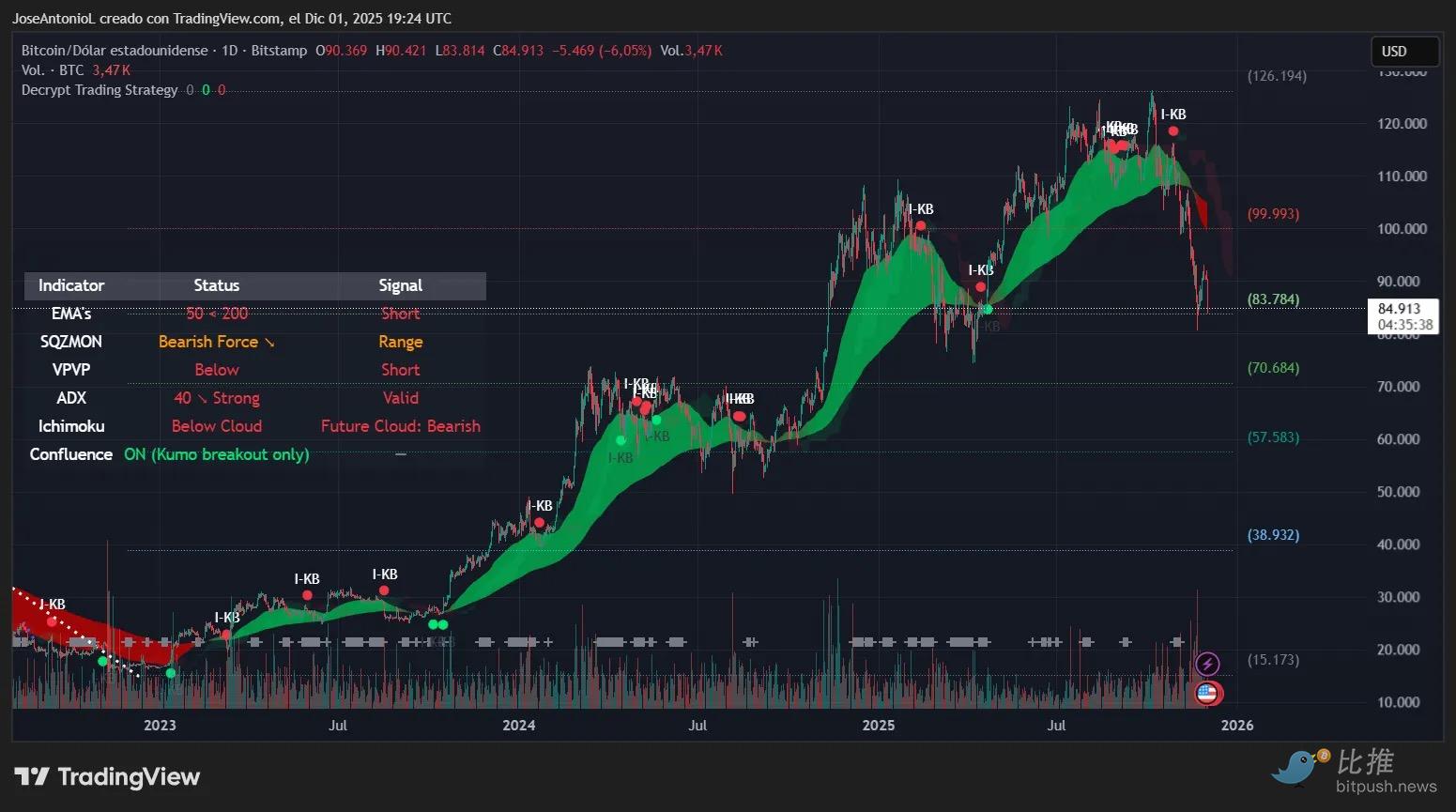
From the perspective of trading technical indicators, Bitcoin's technical structure has undergone substantial changes. Analyst Jose Antonio Lanz states:
The 50-day moving average has crossed below the 200-day moving average, forming a classic "death cross," which is a clear signal of a mid-term trend reversal;
The ADX (an indicator measuring trend strength) has risen to 40, indicating that the market is entering a clear and fast-moving trend;
Momentum indicators like Squeeze Momentum still show that bearish momentum has not yet finished releasing;
The current price range of $83,000 is a key pivot point from the past few months; if it breaks down, the next major support level will be around $70,000.
As the market continues to search for a bottom, a noteworthy piece of news from the traditional financial world deserves attention: Vanguard, an asset management giant that has long viewed cryptocurrencies as "speculative assets" and kept them at arm's length, suddenly announced it would open crypto ETF trading to its clients.
This shift occurs against the backdrop of the crypto market having lost over a trillion in market value since October, and its signal significance is complex. In a trend adjustment, whether the entry of a single institution is enough to reverse sentiment remains a question mark.
Because the market currently seems to be in a trend reversal phase rather than a simple pullback. Trend declines often last longer than emotional declines and are harder to reverse with short-term positive news.
For ordinary investors, in such an environment, the most important thing is not to predict "where it will drop to," but to understand why the market has reached today, how long future volatility may last, and whether they can withstand this volatility.
The phase of risk repricing is most likely to lead to mispricing and excessive declines; but it will also eliminate all positions based on fantasy.
Bitcoin is completing such a process.
免责声明:本文章仅代表作者个人观点,不代表本平台的立场和观点。本文章仅供信息分享,不构成对任何人的任何投资建议。用户与作者之间的任何争议,与本平台无关。如网页中刊载的文章或图片涉及侵权,请提供相关的权利证明和身份证明发送邮件到support@aicoin.com,本平台相关工作人员将会进行核查。


