Author: Lawyer Shao Jiadian
Introduction
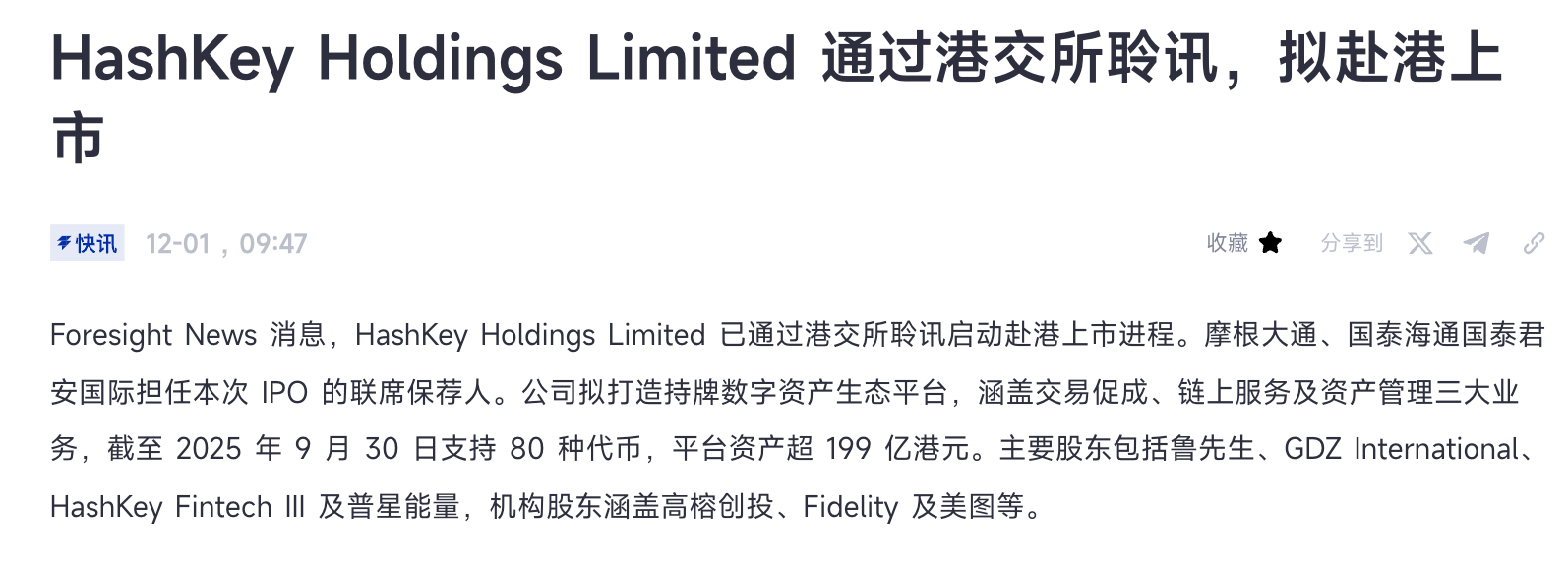
The above image is from Foresight News
On December 1, 2025, HashKey Holdings Limited officially passed the listing hearing on the main board of the Hong Kong Stock Exchange, with J.P. Morgan, Guotai Junan International, and Haitong International serving as joint sponsors. As a leading platform holding a virtual asset trading platform license in Hong Kong, with business covering digital asset trading, on-chain services, and asset management, HashKey is also expected to become Hong Kong's "first crypto asset stock."
For the industry, this is not just a milestone for one company, but a landmark event:
The first batch of regulated crypto platforms in Asia is entering the mainstream capital market.
The signal behind this is very clear:
The crypto industry is undergoing a structural transformation; the narrative of "issuing tokens = going public" is outdated. More and more projects realize that not establishing a company, not considering equity, and relying solely on tokens can no longer support the next round of growth. The HashKey event is the strongest proof of this reality.
Thus, a new question arises for all projects:
Why are more and more Web3 projects starting to consider IPOs? Why is the combination of "corporatization + equity financing + tokens" becoming the new norm?
Next, we will discuss the changes happening in this industry.
The Good Days of Relying Solely on Token Issuance for Financing Are Truly Over
If you have been following the old script from the last round over the past two years ——
- White paper + private placement + going public
- DAO/foundation structure, and if that doesn't work, just create a shell company
- Everything revolves around tokens, with equity being just a "shell"
Then you have likely discovered:
It's harder to secure primary funding, secondary valuations are unsustainable, and regulatory scrutiny is increasing.
Conversely, you will see another type of project quietly changing tracks:
- First, establish a proper company entity and conduct formal equity financing
- Continue with tokens, but focus more on ecological incentives and liquidity
- The long-term goal is no longer just "listing on CEX," but rather: to become a company that can go public, be acquired, and operate sustainably.
This wave of projects is actually moving more steadily and is more likely to secure significant funding. This is not just a change in direction; the structural cycle has shifted.
Why Did Everyone Disdain Equity and IPOs in the Last Round?
Looking back, it’s clear how logical the previous approach was:
1. Issuing tokens brings in money quickly
No need for a prospectus, no need for roadshows to institutional investors, and certainly no need for years of financial history. A white paper plus a few top VC logos, and the money flows in.
2. Regulatory ambiguity, watch and see while doing
Many countries initially didn’t understand "what exactly tokens are," and project teams rushed forward with the shield of "innovation" and "technical experimentation."
3. DAO/foundation structures are very appealing
No shareholders, only a community; no board of directors, only governance voting. There was ample room for storytelling.
4. The illusion that "Token = upgraded equity"
Many founders genuinely believed: tokens are more advanced than equity, they can be liquid, used for over-the-counter collateral, and market pricing is faster.
In that environment, those who were earnestly pursuing equity financing or even considering IPOs were seen as "not knowing how to play the game."
Why Are More Projects Now Actively Considering Equity and IPOs?
The context of this round is different; if you continue to follow the old logic, you will only become more passive.
1. Regulation has started to "clarify the rules"
- In places like the U.S., EU, Singapore, and Hong Kong, some tokens are being directly classified as securities/regulatory assets, requiring management according to categories like securities, payment instruments, and electronic currencies.
- Regulators are increasingly unfriendly towards the model of "no company entity, pure foundation + token financing" — not a blanket ban, but rather a message:
If you are engaged in finance, payments, or asset issuance, don’t hide behind "I’m just doing technical research."
2. Money is coming back, but this time it’s "financially savvy money"
The money coming in this round is different from the waves of 2017 and 2021:
- Many are traditional VCs/PEs and mainstream institutional investors
- They are accustomed to: equity valuation, board seats, exit paths (mergers/acquisitions/IPO), information disclosure, and compliance
If you cannot present a decent equity structure, company entity, or audited financial statements, and only throw a token economic model at them, they will either give you a small amount of pocket money or simply not look at it.
3. Your project may no longer be a "purely on-chain toy"
Look at the currently popular sectors:
- Stablecoins, PayFi, cross-border settlement
- RWA: tokenization of bonds, funds, equipment, real estate, accounts receivable
- DeFi infrastructure, clearing and settlement, custody, compliance components
- AI + computing power, data elements, privacy computing…
These businesses share a commonality: they are all tied to "real assets," "real income," and "real regulatory obligations."
In this context, if you still want to use the previous round's "pure token + foundation" lightweight structure, financiers, regulators, and partners will become increasingly hesitant.
4. Relying solely on token secondary market exits offers too little security
- Secondary market sentiment is highly volatile
- If regulators take action or exchanges adjust rules, the entire project's valuation could be adversely affected
- Many institutions are unwilling to bet their exits entirely on a secondary market they cannot control
Equity + IPO/mergers at least provide a predictable, negotiable, and actionable exit for large funds.
Trend Signal: More Projects Are Starting to Embrace "Corporatization + Equity Financing + Capital Market Integration"
It’s not that all projects need to go public, but several real cases this year have already proven:
The crypto industry is transitioning from "just issuing tokens" to a multi-track model of "issuing tokens + building companies + entering capital markets."
The following directions best illustrate the issue:
1. Star cases directly entering mainstream markets
- Circle: Completed its U.S. IPO this year, proving that "compliance + blockchain infrastructure" can enter mainstream capital markets.
- TRON (Justin Sun): Entered NASDAQ through a reverse merger, demonstrating that "token ecosystem + company entity" can also follow a capitalization path.
2. Infrastructure companies continue to go public
- Bitdeer, Core Scientific, Marathon, Iris Energy — these mining/computing power companies are already trading in public markets, indicating that crypto infrastructure is naturally compatible with traditional capital markets.
3. Large Web3 projects accelerating "corporatization + equity financing"
- Projects like Animoca Brands, ConsenSys, LayerZero, EigenLayer:
Although not yet public, they are all strengthening their company entities, equity structures, audits, and governance, clearly preparing for future capital market options.
4. SPACs, RTOs, and other "lightweight listing" paths are gaining attention from more projects
- Some blockchain games, NFT, and Web3 tool companies are exploring SPAC/reverse acquisition methods, indicating that listing paths are becoming increasingly diversified.
The crypto industry is no longer "issuing tokens = going public," but is moving towards a multi-track parallel of companies + equity + tokens + capital markets.
Projects that understand how to integrate this structure will have the opportunity to advance to the next stage.
Why Will "Equity + Tokens" Become the New Norm?
For projects, this is not "one more path," but rather "two completely different objects":
1. What problems does equity solve?
- It addresses institutional investors: valuation logic, exit channels, governance rights
- It addresses regulators: company entities, responsible parties, audits, and disclosures
- It addresses future acquirers: are you buying a "project" or a "company license + assets + team"?
2. What problems do tokens solve?
- They address users and communities: use cases, incentives, governance participation, network effects
- They address business growth: market development, ecosystem building, attracting developers, forming alliances
- They address liquidity: circulation, market making, collateral, on-chain and off-chain settlement
Thus, you will see more and more projects adopting a "Dual-Asset Model":
Equity is the skeleton of the company, while tokens are the lifeblood of the ecosystem, with clear division of labor rather than mutual substitution.
As a project team, you should now ask yourself three questions:
Question 1: If I currently only have tokens and no company/equity, is it too late to catch up?
It’s not too late, but be mentally prepared — this is a "surgical-level" reconstruction:
- First, establish the company entity: where to set up the parent company, business company, and whether a foundation is needed
- Consolidate the ownership of IP, code, data, and contract income from personal wallets/loose structures into the company or foundation
- Transform the "verbal agreements" and "Excel bookkeeping" of early investors, teams, and advisors into real equity agreements + token distribution agreements
Question 2: If I establish equity, will the community accuse me of "betraying the ideals of Web3"?
The core issue is not whether you have equity, but whether:
- You clearly stated from the beginning:
- Which part of the value belongs to equity holders
- Which part of the value belongs to token holders
- You avoided "double harvesting":
- The same cash flow is not distributed to shareholders nor returned to tokens;
- Everything is just for "control" and "cash out"
To put it bluntly: whether the community criticizes you depends on whether you clearly articulate what you are taking.
Question 3: Is IPO a must-do? Or is it just "the icing on the cake"?
Not all projects are suitable for an IPO.
- If you are essentially a tool protocol or foundational infrastructure, the most realistic approach is:
- To become an acquisition target for leading tech companies/financial institutions
- Or to become a "standard component" within the ecosystem of a major upstream or downstream player
If you are fundamentally financial infrastructure (stablecoins, RWA issuance, custody, clearing and settlement, compliance services), then planning for an IPO is very worthwhile — but it is also a high-threshold, long-cycle path.
What is truly needed is: from today, you should start building yourself into an asset that can be "understood by regulators, invested in by institutions, and acquired or IPOed."
If you want to keep the IPO option, here are a few things you should do now:
1. Transform "the project" into "a group of companies"
- Choose the location of the parent company (Hong Kong/Singapore/Cayman/BVI/EU, depending on business scenarios and target markets)
- Organize operational entities, technical teams, and license application entities, rather than having them scattered under different names
- Clearly define which business belongs to which company and which belongs to the foundation
2. Restructure your cap table: plan equity + tokens together
- Who holds equity? Who holds tokens? Who holds both?
- For future incoming VCs/PEs, will they take equity? Or will they receive conditional token allocations?
- If one day you want to IPO, will the existing token structure get stuck in regulatory and prospectus issues?
3. Build a "regulatory-readable" compliance system in advance
- Are you involved in payments? Are you raising public funds? Are you creating investment products?
- Do you need registration-type licenses (MSB/VASP, etc.), or permission-type licenses (such as certain CASP/VA/DPT types)?
- Can your AML/KYC, sanctions screening, and information disclosure withstand the scrutiny of future regulations and audits?
4. Maintain a "traceable path for the prospectus"
- Financial data: revenue structure, cost structure, reserves, and exposures
- Compliance records: any fines, rectification status
- Governance records: what procedures were followed for major decisions, and were there any governance failure disputes
These elements should not be prepared only in the year you decide to IPO; they should be accumulated from now on, starting with every version of your financial reports and every significant contract.
A "hard truth" for project teams
If your project:
- Has already issued tokens,
- Is currently or preparing to go through another round of equity financing,
- And VCs are already asking you: "What is your long-term path, IPO or who will you sell to?"
Then it can be basically concluded that you are standing at a new crossroads:
Either quickly complete the entire set of "equity + tokens + compliance licenses + exit paths,"
Or continue to rely on the previous round's "pure token issuance logic" until liquidity and regulation come knocking.
This article is not about disparaging tokens; on the contrary — the token mechanism remains a key tool for Web3 to penetrate the boundaries of traditional internet and finance.
However, the next round of truly large projects will certainly not rely solely on tokens.
What you need to do is to quickly upgrade your project from "only issuing tokens" to a "company driven by both equity and tokens."
This way, whether the future involves an IPO, being acquired, or becoming a long-term profitable cash flow company, you will have options.
If you really want to pursue the "equity + tokens" path, what can Mankun do?
Mankun has long been deeply involved in Web3, on-chain finance, and other fields. We can help you clarify:
- The boundaries of rights between the company entity, foundation, and tokens
- The compliance nodes for equity financing and token financing
- The licenses and regulatory requirements needed for business implementation
- Whether future mergers, IPOs, or expansions are possible
We will clearly articulate, design, and document these key issues at once, enabling your project to have the capability of "issuing tokens and running, while also being a sustainable company."
If you want to upgrade your project from a "team" to a "company," and transition from tokens to the capital market, Mankun can help pave the way.
免责声明:本文章仅代表作者个人观点,不代表本平台的立场和观点。本文章仅供信息分享,不构成对任何人的任何投资建议。用户与作者之间的任何争议,与本平台无关。如网页中刊载的文章或图片涉及侵权,请提供相关的权利证明和身份证明发送邮件到support@aicoin.com,本平台相关工作人员将会进行核查。


