As the Federal Reserve's December interest rate meeting approaches, officials have split into two evenly matched camps. Economic data is collectively absent due to the government shutdown, and Trump is about to announce a new chairperson, intertwining three forces into the most complex decision-making dilemma the Federal Reserve has faced in recent years.
The Federal Reserve's December interest rate decision faces an unprecedentedly complex situation— severe internal divisions, the absence of key economic data due to the government shutdown, and an impending leadership change. These three factors together create the most uncertain policy environment for the Federal Reserve in recent years.
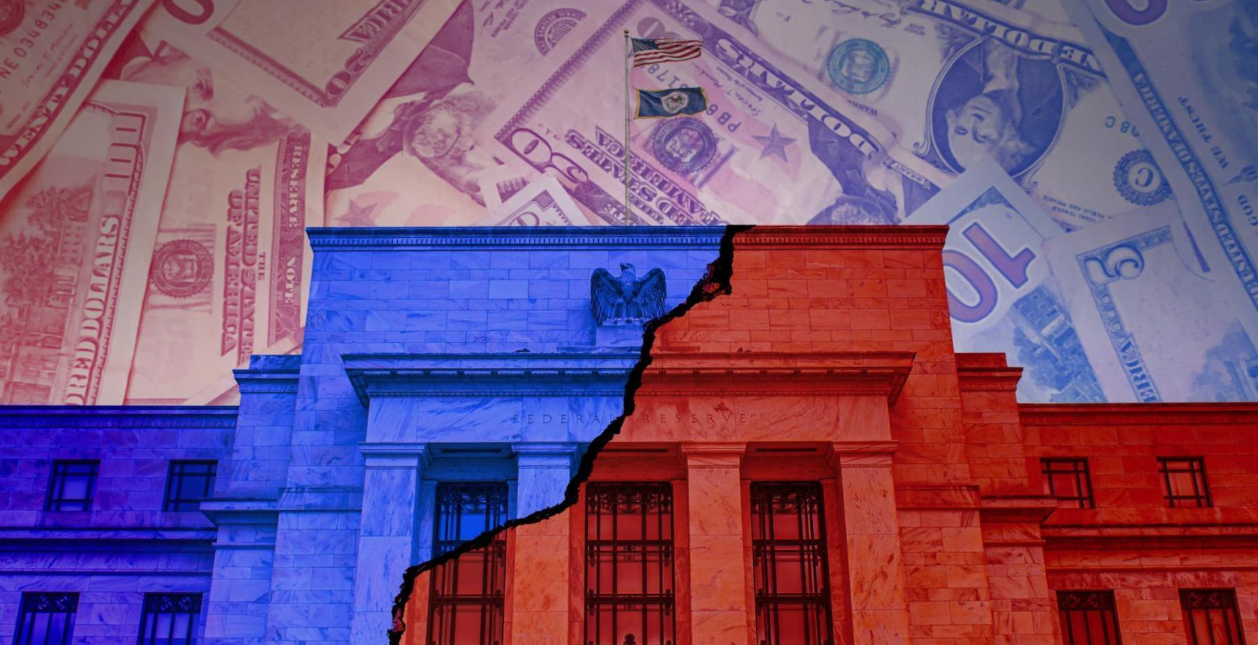
1. Hawk-Dove Split: The Federal Reserve's Internal Divisions Made Public
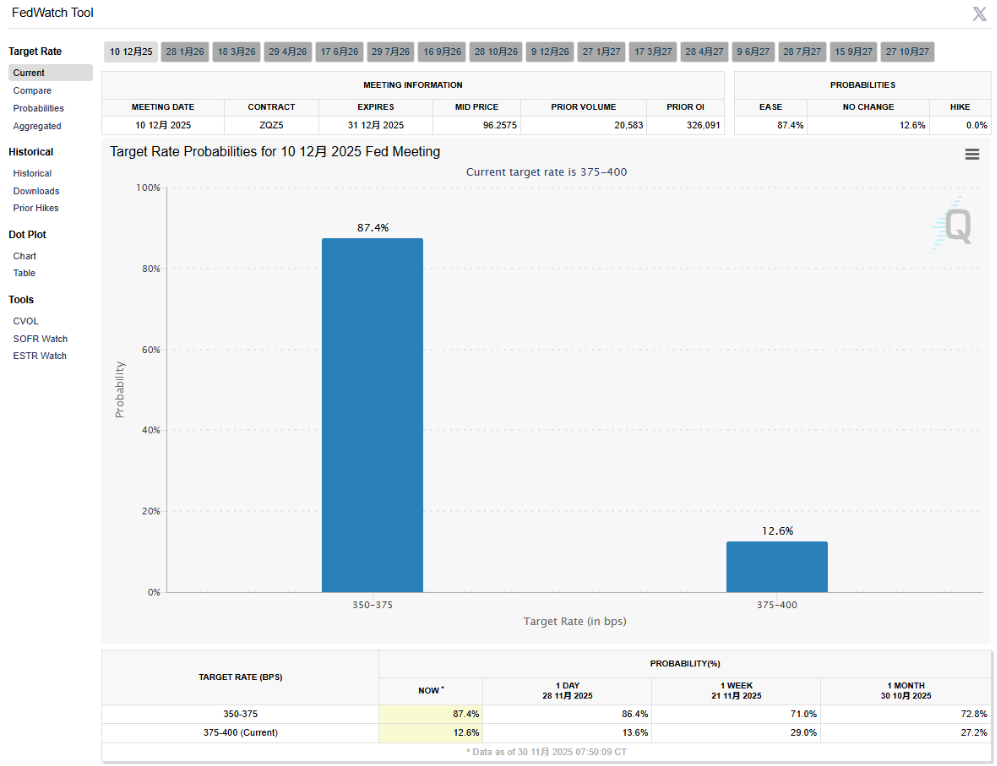
● With less than two weeks until the December Federal Reserve meeting, global investors are being repeatedly pulled in different directions. New York Fed President Williams' dovish statement that "there is still room for further rate adjustments in the short term" caused the probability of a rate cut in December to soar from 30% to 87.4%.
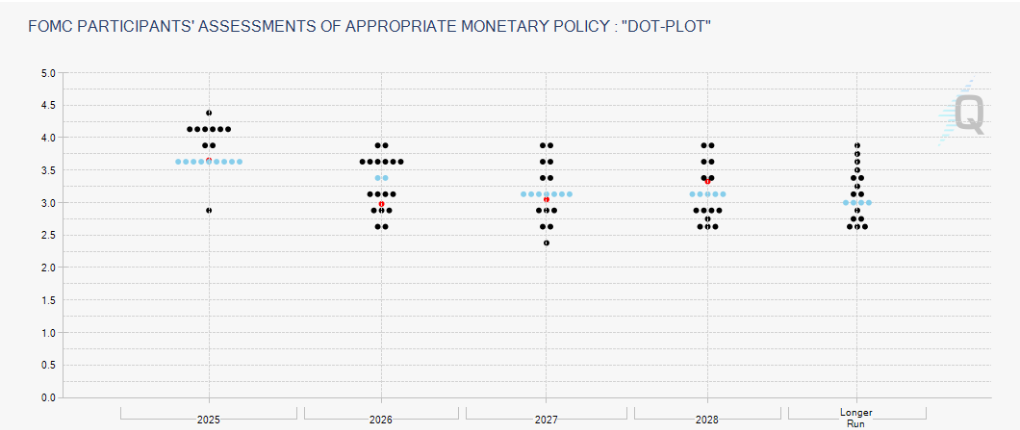
The positions of the "hawks" and "doves" within the Federal Reserve are starkly opposed, and policy differences have been brought to the forefront.
● The "dove" camp is primarily concerned about the deterioration of the labor market and advocates for continued rate cuts. Fed Governor Mulan and Waller are representative figures of this camp. Mulan recently stated that the U.S. economy "needs significant rate cuts" and warned that the current monetary policy is making borrowing costs too high, raising unemployment and hindering economic development.
Specifically regarding the extent of rate cuts, Mulan advocates for a series of 50 basis point cuts to quickly bring rates down to neutral levels.
● The "hawk" camp views inflation as a major concern and advocates for keeping rates unchanged. This year's FOMC voting member, St. Louis Fed President Musalem, stated that given the inflation rate is above target levels, Fed officials should proceed with caution.
In this context, rate cut expectations have swung dramatically in a short period. The CME's "FedWatch" tool shows that after the October FOMC meeting, the expectation for a rate cut dropped from over 90% to 70%; as Fed officials began to issue "hawkish" statements in mid-November, the probability of a December rate cut plummeted to below 30%.
● However, following the recent rise of "dovish" voices, the probability of a December rate cut has rebounded to around 87%.
2. The Federal Reserve's "Foggy Decision-Making"
The absence of key economic data has become a "catalyst" exacerbating divisions. Due to the previous U.S. federal government "shutdown," the release of several key economic data has been delayed.
● The October non-farm payroll report has been officially canceled and will be combined with November's data, to be released on December 16—six days after the conclusion of the FOMC's December meeting.
● At the same time, the October Consumer Price Index report will also be absent, with the November CPI set to be released on December 18, meaning the Federal Reserve will make rate decisions under conditions of missing data.
● This unprecedented information "vacuum" has left policymakers, who typically rely on data, in a quandary. Both "doves" and "hawks" are unable to substantiate their judgments about economic trends with the latest data.
● For the Federal Reserve's decision-making, the absence of key data could have multiple impacts: first, the decision-making model may shift to a more cautious approach. The lack of core data means the Federal Reserve has lost a key basis for policy formulation, being forced to make decisions in a 'data fog'.
● The latest released "Beige Book" also confirms the difficulties facing the U.S. economy. The report indicates that overall changes in U.S. economic activity have been minimal in recent weeks, but a further decline in consumer spending has become a major drag on the stagnation of the U.S. economy, with the government "shutdown" affecting consumer decision-making.
3. Countdown to the Federal Reserve Chair Selection
● Amid the uncertainty of monetary policy direction, the Federal Reserve leadership is also about to undergo a change. President Trump stated on Sunday: "I know who I want to choose as the Federal Reserve chair, and I will announce it soon."
● White House National Economic Council Director Kevin Hassett has become the most popular candidate to replace Powell. Hassett declined to directly respond to whether he is the frontrunner to succeed Powell during a CBS program, but he emphasized the market's positive reaction to the news of Trump's impending announcement.
● Hassett stated: "We had a great Treasury auction, and rates fell as a result. I believe the American people can expect President Trump to choose someone who can help them get cheaper auto loans and easier access to low-rate mortgages."
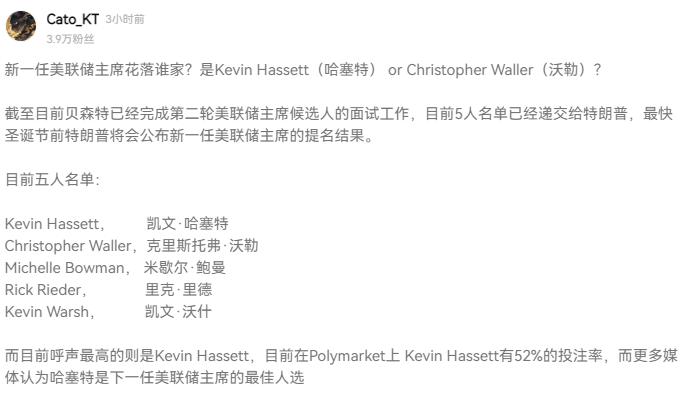
● Treasury Secretary Bessent, who oversees the selection process, stated last week that Trump may announce the nominee before the Christmas holiday.
● If Hassett takes office, it could mean a shift towards a more accommodative monetary policy stance at the Federal Reserve. Hassett has recently been widely viewed as the leading candidate to succeed current Fed Chair Powell, and if appointed, he is expected to push for a more aggressive pace of rate cuts.
4. Global Asset Repricing
The Federal Reserve's policy direction and leadership change will trigger a repricing of global assets.
● According to CME's "FedWatch," the probability of a 25 basis point rate cut by the Federal Reserve in December has risen to 84.7%, while the probability of keeping rates unchanged is 15.3%. The probability of the Federal Reserve cumulatively cutting rates by 25 basis points by January next year is 64.7%, with a 10.9% chance of maintaining rates, and a 24.4% chance of a cumulative 50 basis point cut.
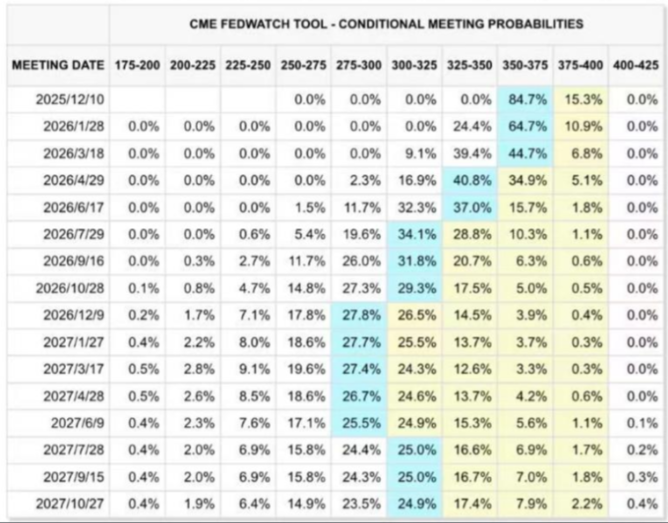
● Wall Street's optimistic expectations for the U.S. stock market are continuously strengthening. Goldman Sachs recently stated that the Federal Reserve will implement its third consecutive rate cut at the December meeting. The slowdown in inflation and cooling labor market provide room for policymakers to further ease monetary policy.
● JPMorgan has urgently revised its forecast, believing that the Federal Reserve will cut rates by 25 basis points in both December and January. The bank also pointed out that the resilience of the U.S. economy and the ongoing AI supercycle will provide strong fundamental support for the U.S. stock market.
● Deutsche Bank strategists expect the S&P 500 index to rise to 8000 points by the end of 2026, indicating an upside potential of about 18%, supported by strong earnings and increasing stock buybacks.
5. The Federal Reserve's "Risk Management" Rate Cuts
Historically, the Federal Reserve cutting rates in an environment of relatively low unemployment is often referred to as "risk management" or "mid-cycle adjustments."
● CME economist Dr. Mark Shore pointed out that since the 1970s, when the unemployment rate is below 4.6%, the Federal Reserve has only cut rates three times as a form of "adjustment," occurring in 1998, 2019, and September 2025.
● During the 1998 adjustment period, the Federal Reserve cut the federal funds rate by 25 basis points due to the Russian default crisis, followed by two additional 25 basis point cuts.
● In 2019, despite a very strong job market with unemployment at a 50-year low, the Federal Reserve still implemented three rate cuts. According to the minutes of the FOMC meetings at that time, the reasons for the rate cuts included "signs of slowing economic activity in recent quarters" and "significant slowdown in economic growth in foreign economies."
Historical experience shows that after the Federal Reserve "adjusts" by cutting rates, it typically proceeds with two additional 25 basis point cuts.
This December, Federal Reserve Chair Powell faces the most delicate balancing challenge of his career. Whether to choose "hawkish rate cuts"—setting a higher bar for future actions while cutting rates, or to opt for "dovish pauses"—waiting for more complete data in January before taking action, will trigger a chain reaction in the market.
The Federal Reserve's upcoming decision is not just a rate adjustment; it will be an art of seeking balance amid data fog, political pressure, and internal divisions.
Join our community to discuss and grow stronger together!
Official Telegram community: https://t.me/aicoincn
AiCoin Chinese Twitter: https://x.com/AiCoinzh
OKX benefits group: https://aicoin.com/link/chat?cid=l61eM4owQ
Binance benefits group: https://aicoin.com/link/chat?cid=ynr7d1P6Z
免责声明:本文章仅代表作者个人观点,不代表本平台的立场和观点。本文章仅供信息分享,不构成对任何人的任何投资建议。用户与作者之间的任何争议,与本平台无关。如网页中刊载的文章或图片涉及侵权,请提供相关的权利证明和身份证明发送邮件到support@aicoin.com,本平台相关工作人员将会进行核查。


