If Tether can prove to the industry that it can comply with regulations without sacrificing profit margins, it will solidify its position as an indispensable leader in the stablecoin industry.
Written by: Prathik Desai
Translated by: Block unicorn
On July 18, Friday, U.S. time, the CEOs of the two largest stablecoin issuers in the world—Tether's Paolo Ardoino and Circle's Jeremy Allaire—sat side by side in the audience of the East Room of the White House. In front of them, U.S. President Donald Trump had just signed the GENIUS Act, which establishes federal rules for stablecoins for the first time in the United States.
A few years ago, this moment was unimaginable.
Because once upon a time, Tether was the "problem child" of the cryptocurrency space. Traders loved it, regulators hated it, and investigations followed closely. It had paid fines, avoided audits, and had minimal contact with U.S. regulators. But on this July afternoon, its CEO received public recognition from the President of the United States.
This is a signal that this "outlaw" stablecoin is ready to become a legitimate citizen.
The GENIUS Act is the long-awaited attempt at stablecoin regulation in the United States. The bill requires issuers to establish dollar-for-dollar reserves, conduct monthly audits, provide redemption guarantees, and set up a licensing system called "Licensed Payment Stablecoin Issuer" (PPSI). To qualify, issuers must hold highly liquid reserves, primarily in U.S. Treasury securities, undergo regular attestations by qualified accounting firms, and comply with U.S. anti-money laundering (AML) regulations.
Foreign issuers like Tether can participate as long as they meet equivalent standards and accept oversight from the Office of the Comptroller of the Currency (OCC). The law provides a lenient but limited three-year transition period to meet these thresholds. This transition window is crucial as it gives Tether time to adjust its structure, reserves, and integrate its flagship product USDT along with a new token compliant with U.S. regulations.
For Tether, headquartered in El Salvador, this public commitment marks a significant shift. After years of regulatory evasion and operating in offshore jurisdictions, the company is finally stepping into the most scrutinized market in the world. Not out of desperation, but out of a desire for dominance.
Despite being shut out of the highly regulated U.S. market, Tether has consistently performed better in global markets. Its token USDT dominates trading pairs, is used for real-world payments in emerging markets, and circulates with unparalleled liquidity across more than 12 blockchains. The circulation of USDT exceeds $160 billion, with a net profit of $13 billion just last year, making it not only the largest stablecoin but also one of the most profitable financial institutions globally.
This is the importance of Tether entering the U.S. market.
Paolo Ardoino has made it clear: Tether will comply with regulations. It plans to adjust its reserves, seek audits from the Big Four accounting firms, and work with the OCC to become a licensed foreign issuer under the new law. Meanwhile, Tether will launch a second U.S.-only version of USDT, designed for efficiency-focused institutions. This strategy aims to capture both ends of the market: global cryptocurrency liquidity and the regulated track of the world's largest economy.
This new chapter in U.S. finance focuses on large funds—fund issuers, banks, fintech companies, and hedge funds. For Tether, entering this market is not a matter of survival, but a question of who will lead the next wave of global financial infrastructure.
If Tether can prove to the industry that it can comply with regulations without sacrificing profit margins, it will solidify its position as an indispensable leader in the stablecoin industry.
However, the cost of compliance is the elephant in the room.
Monthly audits conducted by large firms could cost tens of millions of dollars each year. Anti-money laundering systems require dedicated staff and technology. Reporting obligations under U.S. law will subject the company to greater scrutiny and may even pose future political risks. There is also the opportunity cost: to meet liquidity and transparency requirements, it may need to exclude higher-risk, higher-yield investment tools from its reserves. But with its scale and profits, Tether has the capacity to absorb these costs.
For Tether, the transformation will bring cultural and operational challenges. The company has long positioned itself as an anti-establishment option, especially in markets with high distrust of traditional institutions. Committing to U.S. regulation may alienate this user base. In the past, Tether has faced criticism for freezing funds. Will users in Nigeria or Argentina trust a Tether that starts responding to U.S. subpoenas? If so, what will replace the sense of freedom that USDT once provided?
Moreover, compliance may not eliminate criticism.
Transparency advocates and financial regulators still question Tether's past record. Its previous refusal to provide complete audits, opaque ownership structure, and alleged involvement in shadow banking remain topics of concern. Regulatory compliance may reassure institutions, but it will not immediately rebuild trust among the skeptical public.
Meanwhile, Tether risks ceding more market share to its closest competitor, Circle.
As of July 25, Tether's dominance in the stablecoin industry has dropped to 61.76%, down eight percentage points from 69.69% in November 2024. During the same period, Circle's market share increased by four percentage points to 24.44%.
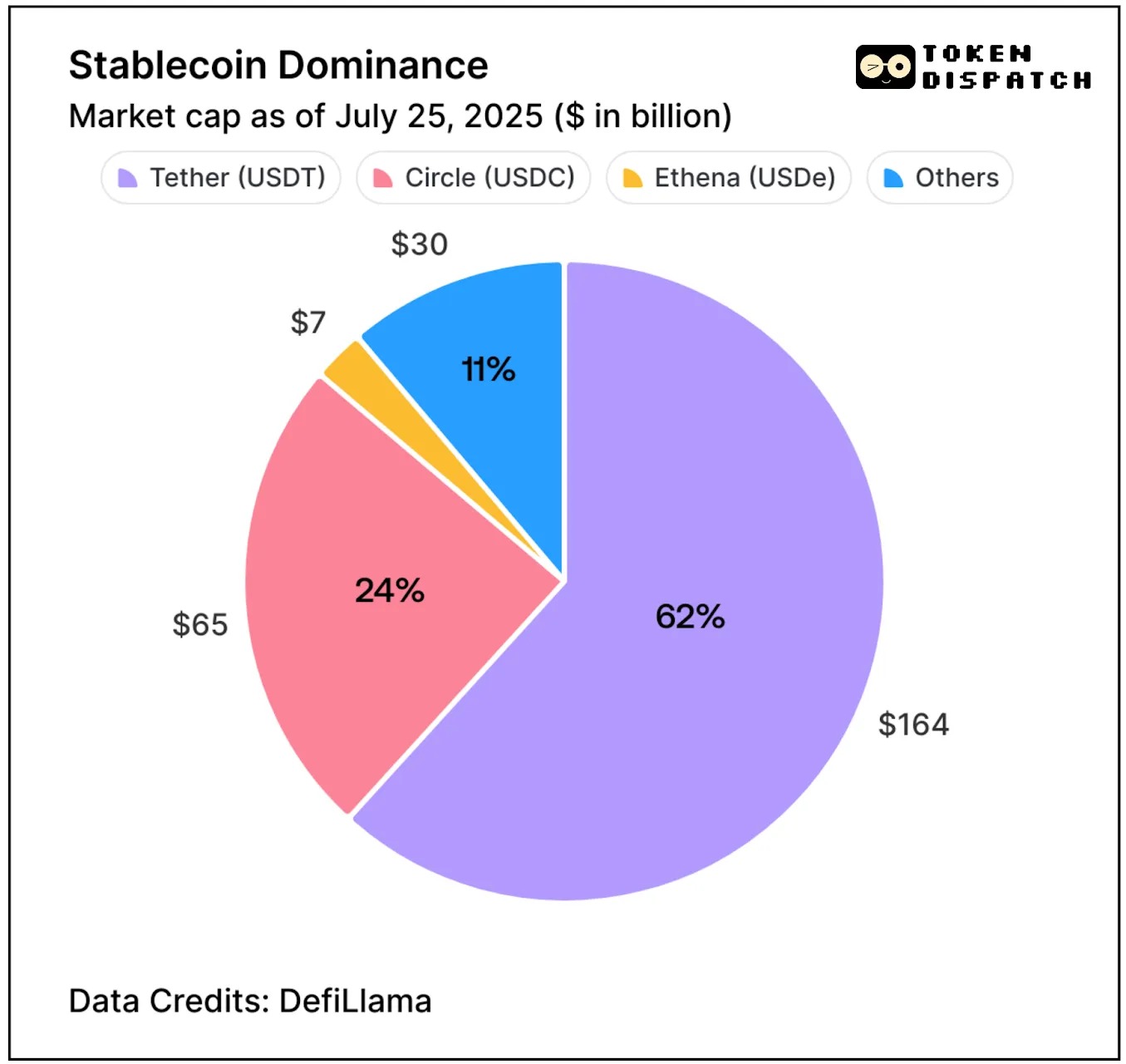
The U.S.-based USDC issuer also has a compliance edge. It has long been subject to audits, maintains comprehensive regulatory coverage in 48 U.S. states, and recently made a splash with its debut on Wall Street. CEO Jeremy Allaire views the GENIUS Act as a green light and points out that it formally establishes the framework Circle has been following for years. Although Circle's market share has recently grown, the company still has a long way to go since its recent debut on Wall Street.
In 2024, Tether recorded a profit of $13 billion. By the end of the year, it held $113 billion in U.S. Treasury securities, $7 billion in reserve buffers, and over $20 billion in equity. As of March 31, 2025, Tether held $98 billion in U.S. Treasury securities. With a conservative yield of 4.4%, its annual income exceeds $4 billion. Even if compliance reduces yields by 10-15%, its business model remains viable.
Compliance may also bring future revenue. A compliant Tether is a trustworthy Tether, which could lead to more business. For institutions that have remained on the sidelines, this could be the incentive they need.
For years, USDC has had a trust advantage. It is transparent, regulated, and audited. But its market cap growth has stagnated. Meanwhile, Tether has thrived in the shadows—growing faster, expanding into more regions, and becoming an indispensable presence in markets that U.S. companies are reluctant to touch.
Support from the White House
With the political support of Commerce Secretary Howard Lutnick (former Cantor Fitzgerald, now Tether's reserve manager), Tether has gained assurance in Washington.
Additionally, there are connections with Bitcoin reserve companies. Lutnick's son operates Cantor Equity Partners (CEP), a special purpose acquisition company that merged with Twenty One Capital—a Bitcoin-native company supported by Tether, SoftBank, and Cantor. This deal further intertwines Tether's interests with U.S. capital markets and policy circles.
With the law granting Tether a three-year transition period, it has ample time. With the advantage of global trading volume, it clearly has leverage.
The landscape of the U.S. market depends on scale. If Tether can manage cost efficiency, it may solidify its lead, making it difficult for even Circle to compete, let alone other lagging stablecoin issuers or newcomers.
But this is a double-edged sword. The U.S. has just provided a blueprint for stablecoins. If Tether executes well, it will continue to lead. If it stumbles in compliance, disclosure, and regulation, it may find that legitimacy can be revoked as quickly as it was granted.
Throughout the history of cryptocurrency, Tether has been the stablecoin most users rely on, even if they do not trust it.
Now, it seeks to become the one they trust.
免责声明:本文章仅代表作者个人观点,不代表本平台的立场和观点。本文章仅供信息分享,不构成对任何人的任何投资建议。用户与作者之间的任何争议,与本平台无关。如网页中刊载的文章或图片涉及侵权,请提供相关的权利证明和身份证明发送邮件到support@aicoin.com,本平台相关工作人员将会进行核查。


