By introducing blockchain and Web3 technology, DeSci is committed to building a more equitable, transparent, open, and collaboration-driven research ecosystem.
 Introduction:
DeSci, or Decentralized Science, provides a fair, transparent, and decentralized platform for funding, creation, review, confirmation, storage, and dissemination of scientific research through blockchain technology and smart contracts. Its goal is to break down the funding barriers in traditional scientific research, promote collaboration among global scientists, and ensure the openness and transparency of research data.
What is Decentralized Science (DeSci)?
Decentralized Science (DeSci) is an innovative movement aimed at transforming traditional scientific research models. By introducing blockchain and Web3 technology, DeSci is dedicated to building a more equitable, transparent, open, and collaboration-driven research ecosystem. The core of this concept lies in redefining the funding of research, the sharing of knowledge, and the dissemination of academic achievements using decentralized tools and technologies.
The essence of DeSci is to address a series of issues faced in the traditional science (TradSci) field, rather than merely advocating for the concept of "open science." Compared to the open science movement, DeSci places greater emphasis on the application of technology in reconstructing research ecological relationships, highlighting the use of blockchain features such as tokens, NFTs, and decentralized autonomous organizations (DAOs) to break the centralized monopoly model and establish a more vibrant and inclusive research system.
Currently, DeSci's goals focus on the following aspects:
- Building incentive mechanisms: Providing researchers with the motivation to share research results and recognizing their academic value through a reputation system.
- Decentralized review and funding: Breaking the monopoly of traditional centralized institutions on the allocation of research funding and the review of results, using a community-driven approach to allocate resources, allowing more valuable projects to receive support.
- Lowering the barriers to scientific research: Allowing more people to access scientific knowledge and contribute to research efforts, promoting the democratization of research.
- Transparent research processes: Ensuring that all aspects of research are open and transparent, increasing academic integrity and trust.
Through these innovative means, DeSci aims to break the imbalance in the flow of information and resource allocation in traditional research, making scientific research more open and efficient. It not only provides researchers with new tools and platforms but also creates opportunities for the global community to participate in scientific research.
Essentially, the philosophy advocated by DeSci is that science should be for everyone, and scientific knowledge should be open and transparent. With the power of Web3 technology, this movement is driving science from a traditional centralized model towards an open, collaborative, and technology-driven new era.
How does DeSci address the pain points of traditional research?
The current research economic model has obvious structural flaws. Theoretically, funders, scientists, and publishers should collaborate to promote the development, dissemination, and application of scientific research. However, the reality is far from this—funders allocate funds, scientists conduct research, and publishers disseminate results, with these three core links being disconnected, each acting as independent economic entities driven more by individual interests than by the overall goals of the research community. This situation leads to inefficient resource allocation and obstructed sharing of results, hindering the healthy development of scientific research.

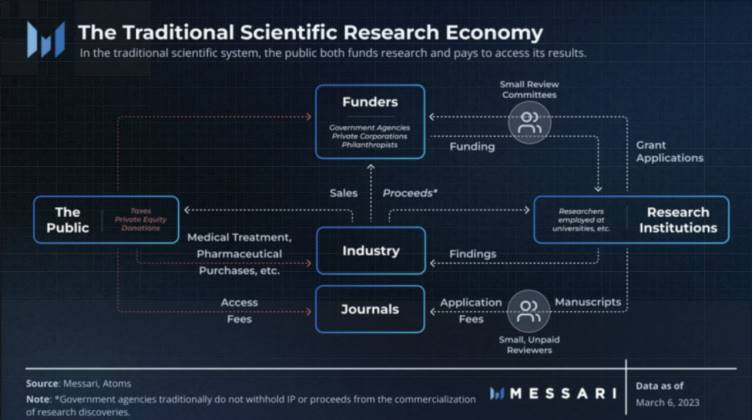
Traditional scientific research economic model, image from: Messari Research
DeSci was born in response to this dilemma. It aims to break the islands of interest and efficiency bottlenecks in traditional science by introducing blockchain and Web3 technology, reshaping the research ecosystem. DeSci targets one of the core issues in traditional research—the "valley of death." This concept refers to the critical gap between basic scientific research and the successful transformation of its results into innovations that benefit society. In the traditional model, many promising studies fail at this stage due to insufficient funding support, closed data, and low collaboration efficiency, failing to make actual contributions to society.
DeSci addresses these gaps through the following innovative means:
- Efficient funding allocation mechanisms: Utilizing decentralized autonomous organizations (DAOs) and tokenized economic models to provide transparent and efficient funding support for research projects, avoiding resource waste.
- Data sharing and collaboration: Establishing open research data platforms to make the acquisition and use of research data more convenient, breaking down information silos and promoting cross-disciplinary collaboration.
- Disruptive publishing models: Utilizing blockchain technology to decentralize the academic publishing process, ensuring the transparency and verifiability of results while reducing publication costs and minimizing the monopolistic influence of traditional publishers.
- Shortening the distance between basic research and application: Accelerating the transformation of research results through community-driven scientific collaboration models, enhancing the actual contribution rate of research to society.
Overall, DeSci is not just repairing the deficiencies in traditional research; it is constructing a completely new research paradigm. In this model, stakeholders are no longer disconnected but achieve deeper collaboration through technological means, jointly promoting the open, transparent, and efficient development of scientific research. This provides new ideas for solving research pain points and opens up more possibilities for the future of science.
How is the DeSci track developing?
As an emerging track, DeSci's development direction encompasses multidimensional innovative paths. According to analysis from Messari Research, the current ecosystem of DeSci projects can be divided into several subfields, including financing, research, data management, peer review, publishing, infrastructure and services, open science ecology, art, and community building. As of July 2023, the number of active DeSci projects has reached 85, with some projects even covering multiple subfields simultaneously. The rise of these projects concentrated between the fourth quarter of 2021 and the first quarter of 2022, closely related to the DeSci-themed discussion held at LisCon in October 2021. Additionally, the crypto market boom at that time provided strong support for the rapid development of DeSci.
Currently, the DeSci track exhibits three notable characteristics: first, most projects adopt DAO as their organizational form, achieving community-driven resource allocation through decentralized autonomous organizations; second, funding issues are the main focus of DeSci projects, utilizing Web3's digital asset tools to efficiently raise funds and promote the development of research projects; finally, biotechnology, especially in the fields of life health and longevity, is the core application scenario of DeSci. Whether it is funding support for basic research or addressing the "valley of death" issue in drug development, DeSci provides innovative solutions.
How is the market performance of DeSci projects?
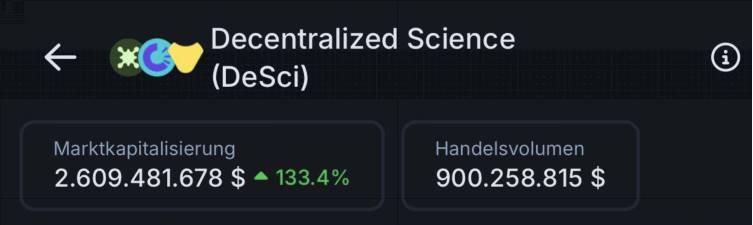
In terms of capital market performance, DeSci projects are still in the early stages. According to CoinGecko data, the total market capitalization of tokens in the DeSci field has surpassed $2.6 billion. However, compared to other Web3 tracks, the overall market capitalization of DeSci projects is generally lower, mainly due to the following factors:
- DeSci is still in the early exploratory stage, with a limited number of projects;
- Many tokens are designed more for project financing and reinvestment, with limited circulation, thus entering the secondary market less frequently;
- The target audience of DeSci is relatively niche, with the combination of scientific research and Web3 attracting more specific audiences within professional fields;
- The close connection to the real world makes DeSci more inclined towards practical applications rather than pure financial speculation, which limits the market hype space for its tokens.
Currently, although the total market capitalization of DeSci projects has not formed a scaled effect, its influence is gradually expanding, especially among user groups focused on research innovation and solving traditional pain points. In the future, as more projects are implemented and research results are transformed, the performance of DeSci in the capital market is expected to gradually rise, bringing greater development potential for the integration of science and Web3.
What are the representative projects in the DeSci track?
1) Molecule
Molecule, founded in 2021, is a decentralized protocol aimed at disrupting traditional biotechnology research and development models. The project aims to establish a new financing ecosystem for early biological research and innovatively bring biotechnology intellectual property (IP) on-chain, pioneering the concept of IP-NFT, and is hailed as the "OpenSea of the biotechnology field."
Core Technology: IP-NFT Protocol
Molecule's IP-NFT (Intellectual Property Non-Fungible Token) protocol is a new tool that combines legal rights, data access rights, and economic value of biological research projects on-chain through legal and smart contracts. This mechanism provides researchers and funders with a new collaboration model, making the ownership and revenue distribution of intellectual property more transparent and efficient.
Molecule Market: Connecting Research and Capital
Based on IP-NFT, Molecule has built a market aimed at translational research, designed to facilitate efficient connections between researchers and funders. On the Molecule Discovery platform, researchers can submit research proposals, and funders can evaluate proposals and negotiate collaboration terms with research teams. In this way, Molecule provides strong support for the transformation of basic research into practical applications, accelerating the rapid implementation of medical research from theory to practice.
BioDAO Launchpad: Incubating Biotechnology DAOs
To further promote the development of a decentralized biotechnology ecosystem, Molecule has launched the Bio.xyz incubator platform. This platform focuses on building and incubating new BioDAOs (Decentralized Autonomous Organizations for Biological Sciences) based on IP-NFTs, bringing together patients, researchers, and enthusiasts to provide funding support for medical research in specific fields.
Molecule's incubator offers up to $100,000 in seed funding support for each early-stage BioDAO project, including several known success stories, such as:
- VitaDAO: The world's first decentralized biotechnology DAO focused on longevity research and the largest funder on the Molecule platform.
- AthenaDAO: Focused on research and funding for women's health.
- HairDAO: Dedicated to scientific research addressing hair loss issues.
Ecosystem Development and Future Outlook
Through its innovative IP-NFT model and strong ecosystem support network, Molecule not only helps researchers secure early funding but also promotes the popularization of decentralized biotechnology. As of now, Molecule has successfully assisted multiple projects in transitioning from basic research to practical applications. Additionally, by collaborating with organizations like AthenaDAO and VitaDAO, Molecule is building a biotechnology ecosystem centered on innovation and openness.
Tokenization and Market Dynamics
Molecule's IP-NFT market has attracted numerous research institutions and funders, facilitating efficient capital flow on decentralized trading platforms like Uniswap. Molecule's vision is to further expand its ecosystem, making the biotechnology research and development process more transparent, open, and efficient, thereby driving the future development of global health technology.
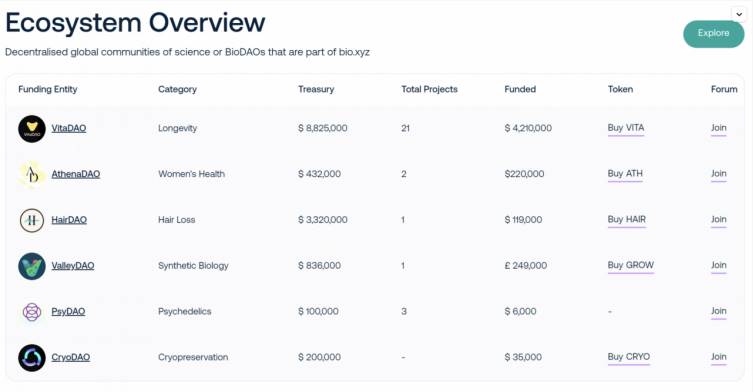
Molecule and BIO Protocol are the backbone of the DeSci track, focusing on promoting the decentralization of scientific research. These projects, with different innovative directions and token mechanisms, collectively build the ecological foundation of DeSci:
- VitaDAO ($VITA): VitaDAO is a community-driven decentralized autonomous organization (DAO) focused on providing early funding support for longevity research. VitaDAO proposes a new solution to the current situation of early funding shortages and technological monopolies in the traditional biopharmaceutical field, especially in longevity research. By introducing blockchain and cryptoeconomic incentive mechanisms, VitaDAO aims to help scientific research projects in the longevity field secure critical initial funding. In return, VitaDAO will directly hold the intellectual property (IP) and data rights of the supported research results and integrate these rights into a publicly accessible asset portfolio. The organization promotes the further development and utilization of these intellectual properties through data markets or traditional biopharmaceutical licensing and commercialization paths, while also achieving asset tokenization and issuing a native governance token—$VITA. Individuals or organizations can earn $VITA tokens by contributing work, funds, or other resources (such as data or intellectual property). Holders of $VITA can participate in the curation and governance of VitaDAO's assets and research.
This model not only reduces the risk of technological monopolies but also provides new avenues for the publicization and widespread application of research results, promoting a deep integration of scientific research and blockchain technology.
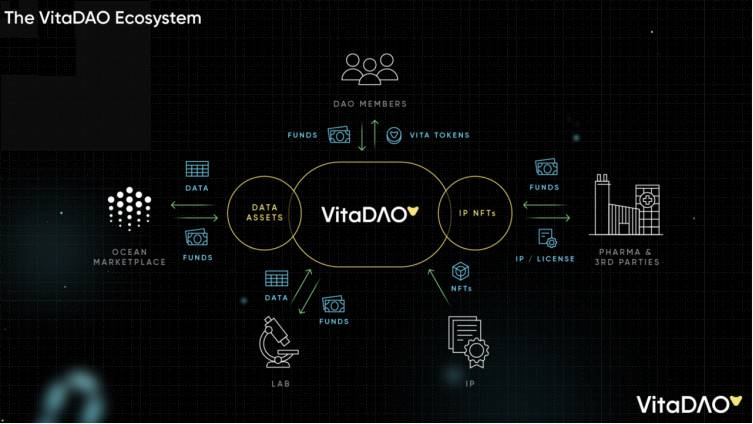
VitaDAO ecosystem, image from: VitaDAO Whitepaper
Project founder Tyler Golato is also a co-founder of VitaDAO, Molecule, and BIO Protocol. VitaDAO whitepaper author Paul Kohlhaas is not only the administrator of the token economics working group and a member of the technical and legal working group but also the founder and CEO of DeSci projects Molecule and BIO Protocol, having previously worked at the ConsenSys fund. VitaDAO has also received its first investment in web3 from Pfizer's medical investment division.
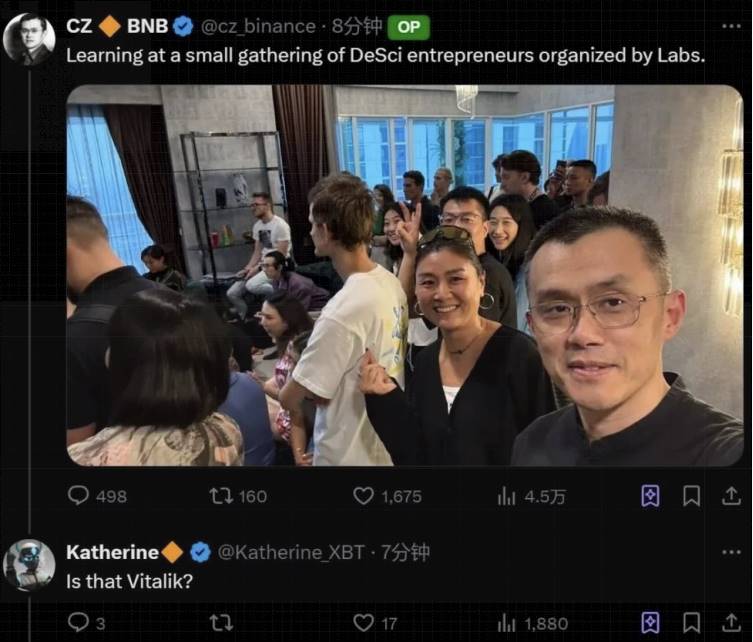
On November 13, 2024, Binance founder CZ posted on social platform X, "Learning at a small DeSci entrepreneur gathering organized by Binance Labs," along with a photo of himself with Vitalik. At this event, Vitalik also showcased VitaDAO's first longevity product—VD001, a natural high-dose spermidine supplement approved by the Thai FDA.
BIO Protocol ($BIO): As the first project in the DeSci field to receive investment from Binance Labs, BIO Protocol has attracted widespread attention. In addition to Binance Labs, the project has received strong support from several well-known venture capital institutions in the crypto and biotechnology fields, including 1kx, Boost VC, Sora Ventures, Zee Prime Capital, and the Northpond Ventures biotechnology fund, which has a scale exceeding $3 billion. In November 2024, BIO Protocol successfully completed its genesis phase community financing, totaling $30.3 million, marking an important step for the project in community support and decentralized governance.
The core mission of BIO Protocol is to accelerate the rapid development of biotechnology. Through this protocol, patients, scientists, and biotechnology professionals worldwide can collaboratively participate in funding, building, and sharing tokenized biotechnology projects and intellectual properties (IP), injecting more possibilities for innovation in the biotechnology field. The BIO Protocol Launchpad platform will provide more efficient funding and liquidity support for innovative projects in the DeSci field and accelerate the application of biotechnology by promoting the creation and development of BioDAOs. Project founder Paul Kohlhaas revealed that the Launchpad and token transfer functions of BIO are planned to be officially launched in the first quarter of 2025.
The native token $BIO is a key component of the ecosystem, with multiple functions:
- Token staking: Holders can lock $BIO and convert it to vBIO for voting and governance.
- Reward mechanism: After successfully supporting winning BioDAOs, stakers will receive additional $BIO rewards and gain priority participation in funding rounds.
$BIO Token Economics
- 56% allocated to the ecosystem and community
- 25.4% allocated to early contributors
- 18.6% allocated to early supporters
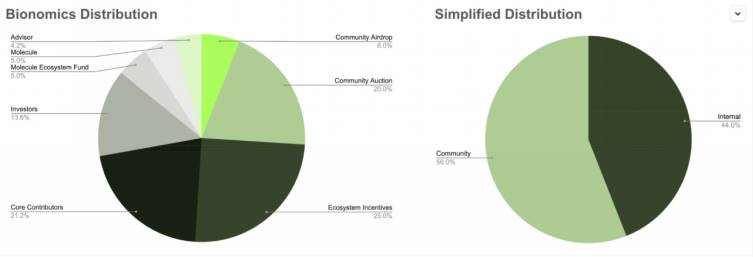
$BIO token allocation, image from: BIO Protocol official website
After opening on January 3, the price of $BIO quickly surged to a high of $1.477, but selling pressure soon emerged, causing the price to drop. As of the time of writing, the price has fallen back to $0.6921, with an FDV exceeding $2.3 billion.
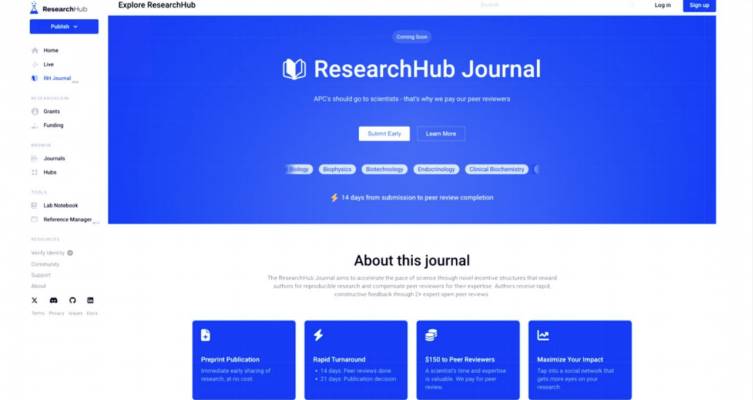
- ResearchCoin ($RSC): ResearchCoin is the native token of the ResearchHub platform, aimed at accelerating scientific research by rewarding users for sharing, discussing, and curating academic content. Platform users can earn $RSC by contributing academic resources.
- AthenaDAO ($ATH): AthenaDAO focuses on scientific research, education, and funding in the field of women's health, having funded over $500,000 to date, with 14 intellectual property transactions pending.
- ValleyDAO ($GROW): ValleyDAO is a decentralized organization focused on the research and development of anti-aging and longevity drugs, aiming to accelerate innovation in the life sciences through interdisciplinary collaboration.
2) Pump.Science ($URO & $RIF)
Pump.Science is a project recently gaining attention in the DeSci sector due to its meme concept, with its core tokens $URO and $RIF being referred to as the two leaders of the DeSci meme sector. $URO (Urolithin A) is based on a naturally occurring metabolite found in pomegranates and nuts, with potential longevity benefits; while $RIF (Rifampicin) focuses on the antibiotic concept and is a widely used antibiotic known as "Rifampicin." Driven by various news, these two tokens have recently performed exceptionally well: $URO's market cap has surpassed $48 million, with a current price of $0.048, experiencing a price pullback of about 20% in the last 24 hours; $RIF's total market cap is $45.53 million, with a current price of $0.045, experiencing a 12% drop in the last 24 hours.
3) DeSci Meme: ($ANTI & $PRO)
$ANTI and $PRO are a meme token combination initiated by algorithm engineer and mathematical physics expert @sshmatrix_, expressing support ($PRO) or opposition ($ANTI) to meme tokens. The unique design of these two tokens has attracted a large number of meme enthusiasts and sparked widespread discussion in the quantum computing community. Currently, these two tokens have a certain liquidity on decentralized trading platforms, and the mechanism of 1 $ANTI = 1 $PRO gives them unique market value. The market caps of $ANTI and $PRO are currently only $1.71 million and $1.93 million, with current prices of $0.0019363 and $0.0017073, respectively, both experiencing about a 5% pullback in the last 24 hours.
4) Donation Concept: Sci-Hub ($scihub)
$$Scihub is a community-driven meme token founded by @0xAA_Science, aimed at supporting the open-source research paper website Sci-Hub. Sci-Hub, dedicated to the free sharing of academic resources, is known as a "shadow library."$$ The design inspiration for $Scihub comes from its spirit, providing new avenues for the open sharing of academic research through decentralization. Currently, $Scihub can be traded on PancakeSwap, attracting many community members who support open science and educational resource sharing.
5) Artificial Intelligence Neuron Network: DeepWorm ($WORM)
DeepWorm is an innovative project that combines artificial intelligence with DeSci, introducing biological neural structures into the blockchain. By constructing a neural network inspired by the 302 neurons of the model organism Caenorhabditis elegans, DeepWorm is developing the first verifiable on-chain digital life form, opening up a new field at the intersection of digital biology and blockchain.
Project Highlights
- Digital Biology: Developing digital entities with self-awareness, simulating biological neural systems.
- Blockchain Integration: All neural processes are completely transparent and verifiable, achieving permanent records through on-chain technology.
- Biomimetic Design: Faithfully reproducing the neural structures and behavioral patterns of C. elegans.
- Autonomous Systems: Building an autonomous currency system and smart contracts based on evolutionary neural networks, driving innovation in on-chain applications.
Technical Implementation
Currently, DeepWorm operates the Nematoduino model on the Hyperliquid EVM testnet, utilizing Marlin TEE (Trusted Execution Environment) technology:
- Users can query the worm's neural and muscular states as well as its coordinate changes through a Web2 interface;
- DeepWorm regularly snapshots this data on-chain, providing foundational components for third-party smart contracts and further developing innovative on-chain applications.
6) Metasci ($METASCI): The token for the Metasci project, focused on integrating AI with scientific research, aims to optimize research processes through AI and drive a technological revolution.
7) The First DeSci Project on the SUI Ecosystem: SUI Desci Agents ($DESCI)
The SUI ecosystem has rapidly risen in this cycle, with a $43 billion FDV and a thriving ecosystem, as well as a coin price that has increased over 8 times during the cycle, attracting significant attention to the SUI chain and its ecosystem. As the first DeSci project on SUI, SUI Desci Agents plans to leverage the scalability of the SUI chain and the developer-friendly Move programming language to fundamentally change decentralized science; it aims to establish a DeSci token launch platform similar to Pump.fun in the DeSci field, pushing DeSci investment opportunities to retail investors in the simplest and most direct way. According to official information, $DESCI will soon be publicly sold on Ape Terminal.
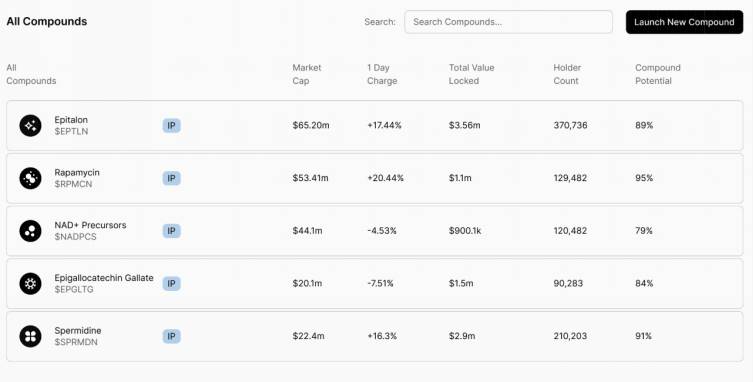
DeSci is still in its early development stage, with its innovative practical impact relatively limited, mainly focused on research funding and data sharing. However, the widespread application of token-based incentive collaboration mechanisms in core scientific processes (such as peer review) has yet to be realized. At the same time, DeSci projects operating in a DAO model also face challenges in organizational efficiency and business models.
Nevertheless, DeSci introduces a completely new approach to the research field: it not only breaks the limitations of traditional research funding but also alleviates the problem of research data silos to some extent. More importantly, DeSci, through decentralized technology, has achieved global interdisciplinary collaboration without the need for trust endorsement for the first time, as well as a more democratic and open mode of research participation. Especially in promoting open science and citizen science, DeSci demonstrates its unique advantages, and this transformation may have a profound impact on the development of modern science, injecting more possibilities and vitality into the future research ecosystem.
Conclusion:
Although DeSci is still in its early stages, the field shows tremendous potential with increasing investment and attention. DeSci is not just a technological innovation; it is a disruption of the scientific research paradigm that could change the organization and incentive mechanisms of scientific research in the coming years. Some DeSci concept tokens in the market have already performed well, indicating the growth potential of this field.
Challenges facing DeSci include regulatory compliance, balancing the long-term nature of scientific research with the short-term speculative nature of the cryptocurrency market, and public awareness of its value. However, DeSci also offers significant opportunities, such as improving funding channels for scientific research, promoting open science, and increasing accessibility and equity in science.
免责声明:本文章仅代表作者个人观点,不代表本平台的立场和观点。本文章仅供信息分享,不构成对任何人的任何投资建议。用户与作者之间的任何争议,与本平台无关。如网页中刊载的文章或图片涉及侵权,请提供相关的权利证明和身份证明发送邮件到support@aicoin.com,本平台相关工作人员将会进行核查。


