This article is from: Deep Value Memetics
Translation|Odaily Planet Daily (@OdailyChina)
Translator|Azuma (@azuma_eth)

Key Points Overview
In this report, we discuss the development landscape of several mainstream frameworks in the Crypto & AI fields. We will examine the current four major frameworks — Eliza (AI16Z), G.A.M.E (GAME), Rig (ARC), and ZerePy (ZEREBRO), analyzing their technical differences and development potential.
Over the past week, we have analyzed and tested the above four frameworks, and the summary of our conclusions is as follows.
We believe Eliza (market share approximately 60%, market cap around $900 million at the time of the original author's writing, approximately $1.4 billion at the time of this publication) will continue to dominate market share. The value of Eliza lies in its first-mover advantage and accelerated adoption by developers, as evidenced by 193 contributors, 1,800 forks, and over 6,000 stars on GitHub, making it one of the most popular software libraries on GitHub.
G.A.M.E (market share approximately 20%, market cap around $300 million at the time of the original author's writing, approximately $257 million at the time of this publication) has developed very smoothly so far and is experiencing rapid adoption. As announced earlier by Virtuals Protocol, there are over 200 projects built on G.A.M.E, with daily request counts exceeding 150,000 and a weekly growth rate exceeding 200%. G.A.M.E will continue to benefit from the explosion of VIRTUAL and may become one of the biggest winners in this ecosystem.
Rig (market share approximately 15%, market cap around $160 million at the time of the original author's writing, approximately $279 million at the time of this publication) features a modular design that is very appealing and easy to operate, with the potential to dominate the Solana ecosystem (RUST).
Zerepy (market share approximately 5%, market cap around $300 million at the time of the original author's writing, approximately $424 million at the time of this publication) is a more niche application, specific to a fervent ZEREBRO community, and its recent collaboration with the ai16z community may generate some synergistic effects.
In the above statistics, "market share" is calculated by comprehensively considering market capitalization, development records, and the breadth of the underlying operating system terminal market.
We believe AI frameworks will become the fastest-growing sector in this cycle, with the current total market capitalization of approximately $1.7 billion likely to grow easily to $20 billion. Compared to the Layer1 valuations at the peak in 2021, this figure may still be relatively conservative — at that time, many individual projects were valued at over $20 billion. Although the above frameworks serve different terminal markets (chains/ecosystems), given our belief that this sector will grow overall, adopting a market cap-weighted approach may be relatively prudent.
Four Major Frameworks
At the intersection of AI and Crypto, several frameworks aimed at accelerating AI development have emerged, including Eliza (AI16Z), G.A.M.E (GAME), Rig (ARC), and ZerePy (ZEREBRO). From open-source community projects to performance-focused enterprise solutions, each framework caters to different needs and philosophies of agent development.
In the table below, we list the key technologies, components, and advantages of each framework.
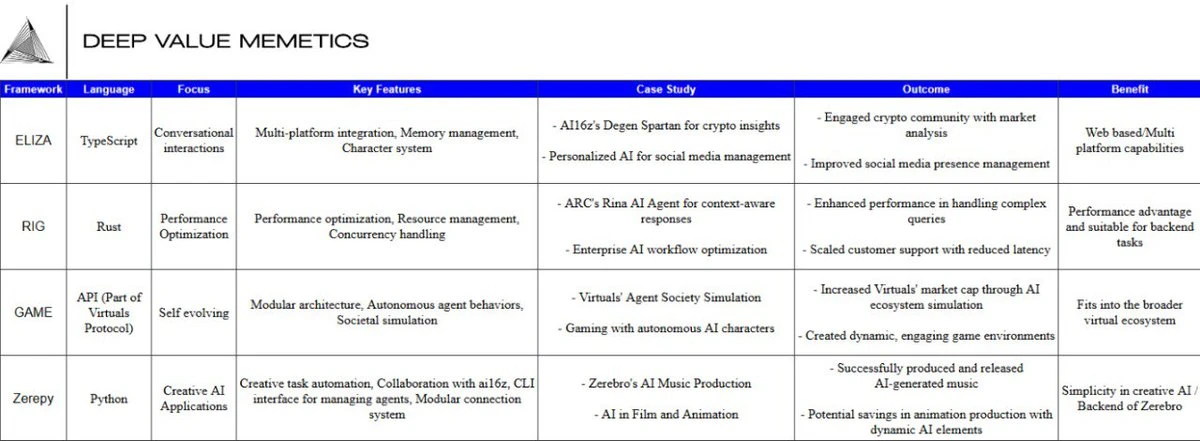
This report will first focus on what these frameworks are, the programming languages they use, their technical architectures, algorithms, and unique features with potential use cases. Then we will compare each framework based on usability, scalability, adaptability, and performance while discussing their advantages and limitations.
Eliza
Eliza is an open-source multi-agent simulation framework developed by ai16z, designed to create, deploy, and manage autonomous AI agents. It is developed using TypeScript as the programming language, providing a flexible and scalable platform for building intelligent agents that can interact with humans across multiple platforms while maintaining consistent personalities and knowledge.
The core features of the framework include: a multi-agent architecture that supports the simultaneous deployment and management of multiple unique AI personalities; a role system for diverse agents created using a role file framework; and long-term memory and context-aware memory management capabilities provided through an advanced retrieval-augmented generation system (RAG). Additionally, the Eliza framework offers smooth platform integration, enabling reliable connections with Discord, X, and other social media platforms.
In terms of communication and media capabilities for AI agents, Eliza is an excellent choice. In communication, the framework supports integration with Discord's voice channel features, X functionalities, Telegram, and direct API access for customized use cases. On the other hand, the framework's media processing capabilities have expanded to include PDF document reading and analysis, link content extraction and summarization, audio transcription, video content processing, image analysis, and conversation summarization, effectively handling various media inputs and outputs.
Eliza provides flexible AI model support, allowing for local inference using open-source models, cloud-based inference using default configurations such as OpenAI and Nous Hermes Llama 3.1B, and integration with Claude for handling complex queries. Eliza adopts a modular architecture, featuring a wide range of action systems, custom client support, and comprehensive APIs, ensuring cross-application scalability and adaptability.
Eliza's use cases cover multiple domains, such as AI assistants related to customer support, community management, and personal tasks; automated content creators, brand representatives, and other social media roles; it can also serve as knowledge workers, acting as research assistants, content analysts, and document processors; as well as interactive roles such as role-playing bots, educational tutors, and agent representatives.
The architecture of Eliza is built around an agent runtime that seamlessly integrates with a role system (supported by model providers), a memory manager (connected to a database), and an action system (linked to platform clients). The framework's unique features include a plugin system that allows for modular functionality extensions, support for multimodal interactions such as voice, text, and media, and compatibility with leading AI models like Llama, GPT-4, and Claude. With its versatility and robust design, Eliza becomes a powerful tool for cross-domain AI application development.
G.A.M.E
G.A.M.E is developed by the official team of Virtuals, standing for "Generative Autonomous Multimodal Entities Framework," which aims to provide developers with application programming interfaces (APIs) and software development kits (SDKs) to experiment with AI agents. The framework offers a structured approach to managing AI agent behaviors, decision-making, and learning processes.
The core components of G.A.M.E are as follows: first, the "Agent Prompting Interface" is the entry point for developers to integrate G.A.M.E into agents to obtain agent behaviors.
The "Perception Subsystem" initiates sessions by specifying parameters such as session ID, agent ID, user, and other relevant details. It synthesizes incoming messages into a format suitable for the "Strategic Planning Engine," serving as the sensory input mechanism for AI agents, whether in the form of dialogue or reactions. The core here is the "Dialogue Processing Module," responsible for handling messages and responses from agents and collaborating with the "Perception Subsystem" to effectively interpret and respond to inputs.
The "Strategic Planning Engine" works in conjunction with the "Dialogue Processing Module" and the "On-Chain Wallet Operator" to generate responses and plans. This engine operates on two levels: as a high-level planner, creating broad strategies based on context or goals; and as a low-level strategist, translating these strategies into executable policies, further subdivided into action planners (for specifying tasks) and plan executors (for executing tasks).
A separate but critical component is the "World Context," which references the environment, world information, and game state, providing necessary context for the agent's decision-making. Additionally, the "Agent Library" is used to store long-term attributes such as goals, reflections, experiences, and personalities, which collectively shape the agent's behavior and decision-making process. The framework employs "Short-Term Working Memory" and "Long-Term Memory Processor" — short-term memory retains relevant information about previous actions, outcomes, and current plans; in contrast, the long-term memory processor extracts key information based on criteria such as importance, recency, and relevance. This memory stores knowledge about the agent's experiences, reflections, dynamic personalities, world context, and working memory to enhance decision-making and provide a foundation for learning.
To enhance layout, the "Learning Module" retrieves data from the "Perception Subsystem" to generate general knowledge, which is fed back into the system to optimize future interactions. Developers can input feedback on actions, game states, and sensory data through the interface to enhance the AI agent's learning and improve its planning and decision-making capabilities.
The workflow begins with developers interacting through the Agent Prompting Interface; the "Perception Subsystem" processes the input and forwards it to the "Dialogue Processing Module," which manages the interaction logic; then, the "Strategic Planning Engine" formulates and executes plans based on this information, utilizing high-level strategies and detailed action planning.
Data from the "World Context" and "Agent Library" informs these processes, while working memory tracks immediate tasks. Meanwhile, the "Long-Term Memory Processor" stores and retrieves knowledge over time. The "Learning Module" analyzes results and integrates new knowledge into the system, allowing the agent's behavior and interactions to continuously improve.
Rig
Rig is an open-source framework based on Rust, designed to simplify the development of applications using large language models (LLMs). It provides a unified interface for interacting with multiple LLM providers (such as OpenAI and Anthropic) and supports various vector storage options, including MongoDB and Neo4j. The framework's modular architecture features core components such as the "Provider Abstraction Layer," "Vector Storage Integration," and "Agent System," facilitating seamless interaction with LLMs.
Rig's primary audience includes developers building AI/ML applications using Rust, while the secondary audience consists of organizations seeking to integrate multiple LLM providers and vector storage into their Rust applications. The repository is organized using a workspace-based structure, containing multiple crates that achieve scalability and efficient project management. Rig's main features include the "Provider Abstraction Layer," which standardizes the APIs used to complete and embed LLM providers through consistent error handling; the "Vector Storage Integration" component, which provides an abstract interface for multiple backends and supports vector similarity search; and the "Agent System," which simplifies LLM interactions and supports retrieval-augmented generation (RAG) and tool integration. Additionally, the embedding framework offers batch processing capabilities and type-safe embedding operations.
Rig leverages several technical advantages to ensure reliability and performance. Asynchronous operations utilize Rust's asynchronous runtime to efficiently handle a large number of concurrent requests; the framework's inherent error handling mechanism enhances recovery from failures in AI providers or database operations; type safety prevents compile-time errors, thereby improving code maintainability; efficient serialization and deserialization processes help handle data in formats like JSON, which is crucial for communication and storage in AI services; detailed logging and instrumentation further assist in debugging and monitoring applications.
The workflow in Rig begins with the client initiating a request, which flows through the "Provider Abstraction Layer" to interact with the corresponding LLM model; then, the data is processed by the core layer, where agents can use tools or access vector storage for context; complex workflows such as RAG generate and refine responses, including document retrieval and context understanding, before returning to the client. The system integrates multiple LLM providers and vector storage, adapting to changes in model availability or performance.
Rig's use cases are diverse, including question-answering systems that retrieve relevant documents to provide accurate responses, document search and retrieval for efficient content discovery, and chatbots or virtual assistants that offer context-aware interactions for customer service or education. It also supports content generation, capable of creating text and other materials based on learned patterns, making it a versatile tool for developers and organizations.
ZerePy
ZerePy is an open-source framework written in Python, designed to deploy agents on X using OpenAI or Anthropic LLMs. ZerePy originates from a modular version of the Zerebro backend, allowing developers to launch agents with functionalities similar to Zerebro's core features. While the framework provides a foundation for agent deployment, fine-tuning of the model is necessary to produce creative outputs. ZerePy simplifies the development and deployment of personalized AI agents, particularly suited for content creation on social platforms, fostering an AI creative ecosystem aimed at art and decentralized applications.
The framework is built using Python, emphasizing the autonomy of agents and focusing on generating creative outputs, aligning with Eliza's architecture and partnerships. Its modular design supports memory system integration, facilitating the deployment of agents on social platforms. Key features include a command-line interface for agent management, integration with X, support for OpenAI and Anthropic LLMs, and a modular connection system for enhanced functionality.
ZerePy's use cases encompass social media automation, allowing users to deploy AI agents for posting, replying, liking, and sharing, thereby increasing platform engagement. Additionally, it is applicable in content creation for music, memos, and NFTs, serving as an important tool for digital art and blockchain-based content platforms.
Horizontal Comparison
In our view, each of the aforementioned frameworks offers a unique approach to AI development, catering to specific needs and environments. This shifts the debate from whether these frameworks are competitors to whether each framework can provide unique utility and value.
Eliza stands out with its user-friendly interface, particularly suitable for developers familiar with JavaScript and Node.js environments. Its comprehensive documentation aids in setting up AI agents across various platforms, and although its rich feature set may present a moderate learning curve, Eliza is very suitable for building agents embedded in the web, as most front-end web infrastructure is built using TypeScript. The framework is known for its multi-agent architecture, capable of deploying diverse AI personality agents across platforms like Discord, X, and Telegram. Its advanced RAG system for memory management makes it particularly suitable for building AI assistants for customer support or social media applications. While it offers flexibility, strong community support, and consistent cross-platform performance, it is still in the early stages and may pose a learning curve for developers.
G.A.M.E is designed for game developers, providing a low-code or no-code interface through APIs, making it accessible to users with lower technical skills in the gaming field. However, its focus on game development and blockchain integration may present a steep learning curve for those without relevant experience. It excels in procedural content generation and NPC behavior but is also limited by its niche focus and the additional complexity involved in blockchain integration.
Rig may be less user-friendly due to the complexity of the Rust language, presenting significant challenges for learning, but it can provide intuitive interactions for those proficient in systems programming. Compared to TypeScript, Rust is known for its performance and memory safety. It features strict compile-time checks and zero-cost abstractions, which are essential for running complex AI algorithms. The efficiency and low-level control characteristics of the language make it an ideal choice for resource-intensive AI applications. The framework's modular and scalable design can provide high-performance solutions, making it well-suited for enterprise applications. However, for developers unfamiliar with Rust, using it may present a steep learning curve.
ZerePy, using Python, offers higher accessibility for creative AI tasks. For Python developers, especially those with an AI/ML background, the learning curve is lower, and strong community support is available due to the popularity of ZEREBRO. ZerePy excels in creative AI applications such as NFTs, positioning itself as a powerful tool in the digital media and art space. While it performs well in creativity, its application scope is relatively narrow compared to other frameworks.
In terms of scalability, the comparison of the four frameworks is as follows.
Eliza has made significant progress with the V2 version update, introducing a unified messaging line and an extensible core framework for efficient cross-platform management. However, managing such multi-platform interactions may pose scalability challenges if not optimized.
G.A.M.E excels in real-time processing required for gaming, and its scalability can be managed through efficient algorithms and potential blockchain distributed systems, although it may be constrained by specific game engines or blockchain networks.
The Rig framework can leverage Rust's performance advantages for better scalability, inherently designed for high-throughput applications, which may be particularly effective for enterprise-level deployments, though achieving true scalability may require complex setups.
ZerePy's scalability is focused on creative output, supported by community contributions, but the framework's emphasis may limit its application in broader AI environments, and its scalability may be tested by the diversity of creative tasks rather than user volume.
In terms of applicability, Eliza leads with its plugin system and cross-platform compatibility, followed by G.A.M.E in gaming environments and Rig for handling complex AI tasks. ZerePy shows high adaptability in the creative domain but is less applicable in broader AI applications.
In terms of performance, the test results of the four frameworks are as follows.
Eliza is optimized for rapid interactions on social media, but its performance may vary when handling more complex computational tasks.
G.A.M.E focuses on high-performance real-time interactions in gaming scenarios, leveraging efficient decision-making processes and potential blockchain for decentralized AI operations.
Rig, based on Rust, can provide excellent performance for high-performance computing tasks, suitable for enterprise applications where computational efficiency is critical.
ZerePy's performance is tailored for the creation of creative content, with metrics centered on the efficiency and quality of content generation, which may not be as universally applicable outside the creative domain.
Combining the above strengths and weaknesses, Eliza offers better flexibility and scalability, with its plugin system and role configurations providing strong adaptability for cross-platform social AI interactions; G.A.M.E can provide unique real-time interaction capabilities in gaming scenarios and offers novel AI engagement through blockchain integration; Rig's strengths lie in its performance and scalability, suitable for enterprise-level AI tasks, focusing on code simplicity and modularity to ensure the long-term health of projects; ZerePy excels in fostering creativity, leading in AI applications for digital art, supported by a vibrant community-driven development model.
In summary, each framework has its limitations. Eliza is still in the early stages, with potential stability issues and a long learning curve for new developers; G.A.M.E's niche focus may limit its broader application, and introducing blockchain adds complexity; Rig's learning curve is steeper due to the complexity of the Rust language, which may deter some developers; ZerePy's narrow focus on creative output may limit its application in other AI domains.
Core Comparison Summary
Rig (ARC)
Language: Rust, focusing on safety and performance.
Use Cases: Emphasizes efficiency and scalability, making it an ideal choice for enterprise-level AI applications.
Community: Less community-driven, focusing more on technical developers.
Eliza (AI16Z)
Language: TypeScript, emphasizing flexibility and community engagement in Web3.
Use Cases: Designed for social interaction, DAOs, and transactions, with a particular emphasis on multi-agent systems.
Community: Highly community-driven, with extensive connections to GitHub.
ZerePy (ZEREBRO):
Language: Python, more easily accepted by a broader community of AI developers.
Use Cases: Suitable for social media automation and simpler AI agent tasks.
Community: Relatively new, but expected to grow due to the popularity of Python and support from ai16z contributors.
G.A.M.E (VIRTUAL, GMAE):
Focus: Autonomous, adaptive AI agents that can evolve based on interactions in virtual environments.
Use Cases: Best suited for scenarios where agents need to learn and adapt, such as games or virtual worlds.
Community: Innovative, but still determining its position in the competition.
GitHub Data Growth
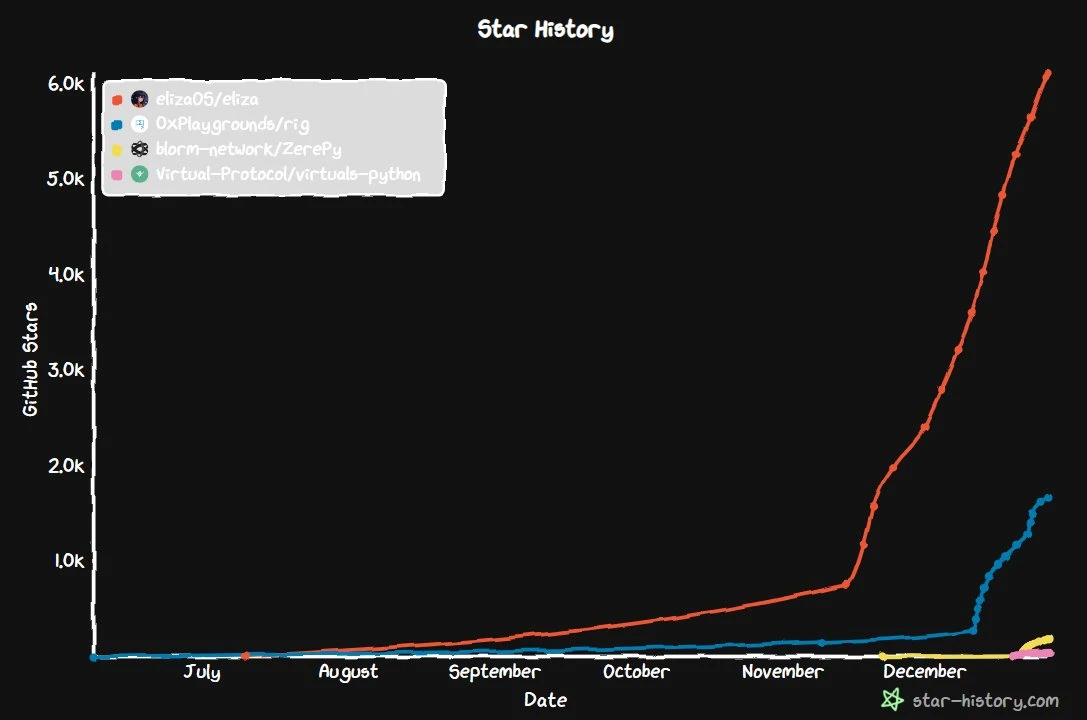
The above chart shows the changes in star data on GitHub since the launch of these frameworks. Generally, GitHub stars can serve as indicators of community interest, project popularity, and perceived value of the project.
Eliza (red line): The chart shows a significant and stable increase in the number of stars for this framework, starting from a low base in July, with a surge beginning in late November, now reaching 6,100 stars. This indicates a rapid increase in interest around the framework, attracting the attention of developers. The exponential growth suggests that Eliza has gained tremendous appeal due to its features, updates, and community engagement, far surpassing other products, indicating strong community support and broader applicability or interest within the AI community.
Rig (blue line): Rig is the "oldest" of the four frameworks, with a modest but stable increase in stars, showing a noticeable rise in the past month. Its total star count has reached 1,700, but it is still on an upward trajectory. The stable accumulation of attention is attributed to ongoing development, updates, and a growing user base. This may reflect that Rig is a framework still building its reputation.
ZerePy (yellow line): ZerePy was just launched a few days ago, and the number of stars has grown to 181. It is important to emphasize that ZerePy needs more development to enhance its visibility and adoption, and collaboration with ai16z may attract more contributors to its codebase.
G.A.M.E (green line): The number of stars for this framework is low, but it is noteworthy that the framework can be directly applied to agents in the Virtual ecosystem via API, thus not requiring a GitHub release. However, although the framework has only been publicly available for builders for just over a month, there are already over 200 projects using G.A.M.E for development.
Expectations for Upgrades of AI Frameworks
Eliza's version 2.0 will include integration with the Coinbase agent toolkit. All projects using Eliza will gain support for future native TEE (Trusted Execution Environment), allowing agents to operate in a secure environment. The Plugin Registry is a feature that Eliza will soon launch, allowing developers to seamlessly register and integrate plugins.
Additionally, Eliza 2.0 will support automated anonymous cross-platform messaging. The Tokenomics white paper, expected to be released on January 1, 2025, has announced related proposals, which will positively impact the AI16Z token supporting the Eliza framework. ai16z plans to continue enhancing the framework's practicality and leverage the efforts of its main contributors to attract high-quality talent.
The G.A.M.E framework provides no-code integration for agents, allowing G.A.M.E and Eliza to be used simultaneously in a single project, each serving specific use cases. This approach is expected to attract builders focused on business logic rather than technical complexity. Although the framework has only been publicly available for just over 30 days, it has made substantial progress with the team's efforts to attract more contributor support. It is expected that every project launched on VirtualI will adopt G.A.M.E.
The Rig framework, powered by the ARC token, has significant potential, although its growth is still in the early stages, and the project contract plan promoting Rig adoption has only been online for a few days. However, high-quality projects paired with ARC are expected to emerge soon, similar to the Virtual flywheel but focused on Solana. The Rig team is optimistic about collaborating with Solana, positioning ARC as Solana's Virtual. Notably, the team incentivizes not only new projects launched using Rig but also encourages developers to enhance the Rig framework itself.
ZerePy is a newly launched framework, gaining significant attention due to its collaboration with ai16z (Eliza framework), attracting contributors from Eliza who are actively working to improve the framework. ZerePy enjoys enthusiastic support driven by the ZEREBRO community and is opening new opportunities for Python developers who previously lacked space to thrive in the competitive AI infrastructure field. The framework is expected to play an important role in the creative aspects of AI.
免责声明:本文章仅代表作者个人观点,不代表本平台的立场和观点。本文章仅供信息分享,不构成对任何人的任何投资建议。用户与作者之间的任何争议,与本平台无关。如网页中刊载的文章或图片涉及侵权,请提供相关的权利证明和身份证明发送邮件到support@aicoin.com,本平台相关工作人员将会进行核查。


