Original | Odaily Planet Daily (@OdailyChina)
1. Bitcoin is the Best Carrier for Building Future Web3 Applications
In the past, many opinions suggested that due to low network efficiency, lack of support for smart contracts, and the inability to build complex applications, the Bitcoin network would not have a thriving ecosystem like Ethereum or Solana, and Bitcoin would continue to be viewed merely as "digital gold" and a global store of value. However, the birth and development of the Ordinals protocol in December 2022 made the market realize for the first time the potential of the Bitcoin ecosystem, discovering that building a Web3 ecosystem on the Bitcoin network has unique advantages compared to Ethereum or Solana.
For example, the Bitcoin network has the highest global consensus, decentralization, and security; the UTXO architecture, although more complex than traditional account systems, offers better fund security and is naturally suited for high-concurrency transactions; and the method of storing data on-chain is simpler and more elegant compared to other blockchains.
If we consider the birth of the Ordinals protocol as the starting point of the Bitcoin ecosystem, it has now been two years since the Bitcoin ecosystem was established. Although overall, the Bitcoin ecosystem has shown initial prosperity, with asset issuance protocols like Ordinals, Runes, and Atomicals supported by the community, Bitcoin L2s like Merlin and Fractal adding more playability and ecological applications to mainnet assets, and the Bitcoin staking narrative led by Babylon gaining more recognition.
However, essentially, the Bitcoin ecosystem still remains in the asset issuance stage, and there has been no substantial progress in truly building Web3 applications.
For an ecosystem to thrive, it cannot remain in the "creating assets" and "opening casinos" phase; the long-term narrative must focus on utility-driven Web3 applications that create value for users, not just PVP.
So, is it currently possible to build utility-driven Web3 applications like on-chain Twitter, on-chain Facebook, on-chain Amazon, and on-chain TikTok within the Bitcoin ecosystem? This is precisely the issue that the recently popular Bitcoin ecosystem protocol MetaID aims to address.
If Ordinals changed the public perception that the Bitcoin network could not develop an ecosystem, then the MetaID protocol aims to truly build the Web3 world on Bitcoin.
2. How Does MetaID Build the Bitcoin Web3 Ecosystem?
The first version of the MetaID protocol was released in April 2020, and it has now developed to version 2. Before the release of v2, MetaID had already accumulated over 170,000 users and generated over 21 million transactions.
In simple terms, MetaID is the first data unification protocol designed specifically for building Web3 applications on Bitcoin. Through the MetaID protocol, developers can build Web3 applications including decentralized social applications, games, e-commerce, etc., on the Bitcoin network. The protocol also supports the issuance of fungible assets MRC-20 and non-fungible assets MRC-721 that are closely tied to data value on Bitcoin.
As mentioned earlier, the UTXO architecture of Bitcoin and its ability to store data on-chain make it a perfect foundation for building Web3 applications. The vision of MetaID is to establish a vast Web3 ecosystem on Bitcoin where user data is stored on-chain, can be freely traded between data, and can interconnect across applications. For example, in social applications, developers can use MetaID to build decentralized Twitter/X and Telegram on Bitcoin, allowing users to seamlessly interact between these applications, such as sending private messages directly from X accounts to Telegram users.
Achieving Data Interconnection
Unlike other Bitcoin protocols, MetaID abstracts decentralized on-chain data into a tree structure and uses "user" as a classification method. Each MetaID is a separate category, and ultimately all data is stored on-chain in the form of a "MetaID tree."
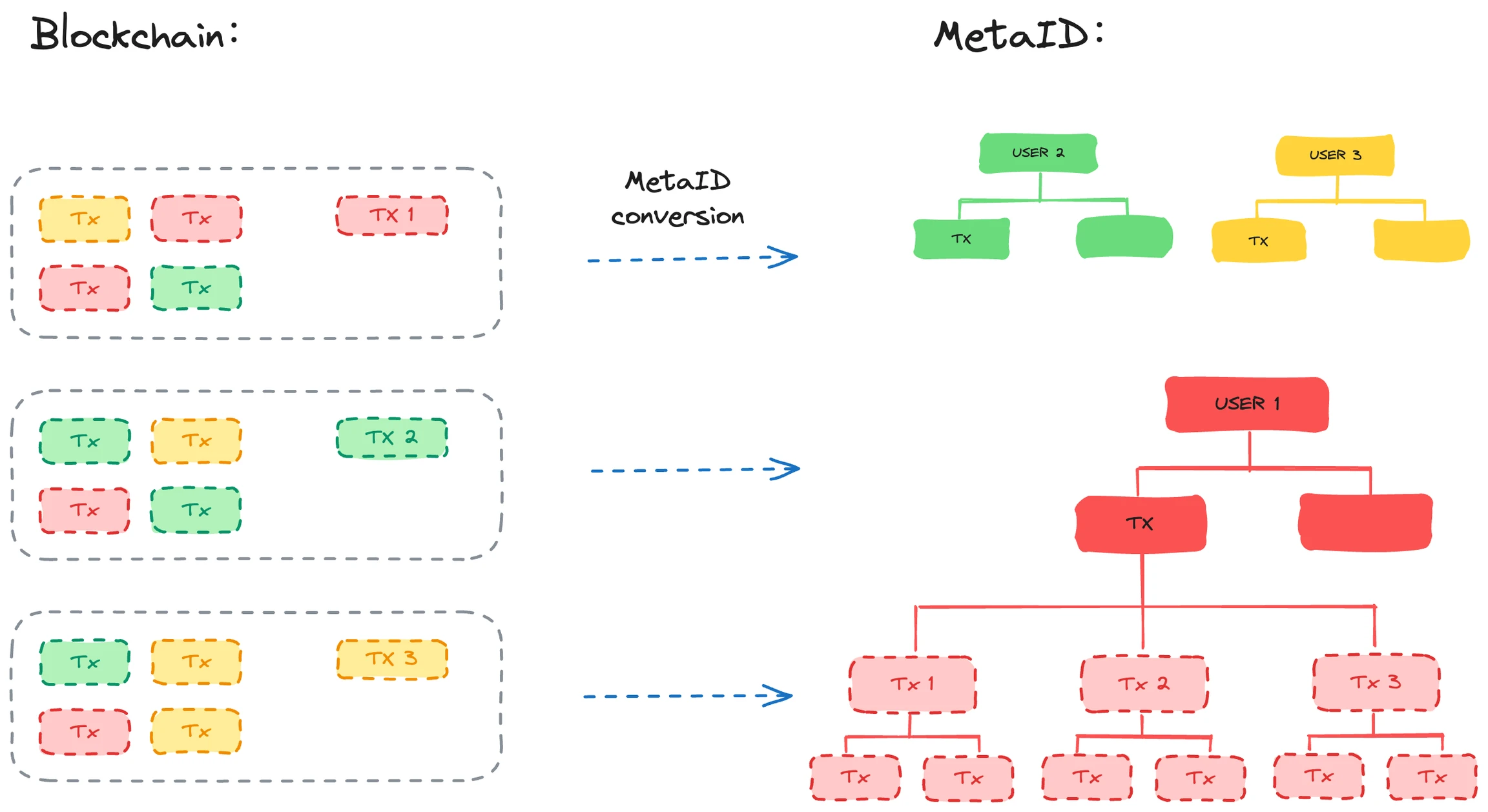
Each node and leaf on the "MetaID tree" is called a PIN, representing the smallest data unit in the MetaID protocol. User MetaID identities, posting or liking posts, deploying and minting assets, and interacting with third-party protocols are all represented by PINs. Essentially, PINs are similar to Ordinals inscriptions, marking specific satoshis on Bitcoin, making the information above NFT-like and transferable and tradable.
However, the biggest difference between PINs and inscriptions is that the format of PINs is designed for building Web3, rather than just for becoming NFT or FT assets. PINs have a path concept, declarative modification and deletion operators, and encrypted on-chain operation operators, all of which are capabilities needed to build Web3 applications, which inscriptions do not possess.
Sunny Fung, the founder of MetaID, vividly illustrates the difference between the two by stating that PINs are the bricks of Web3 applications, while inscriptions are more suitable for carrying assets.
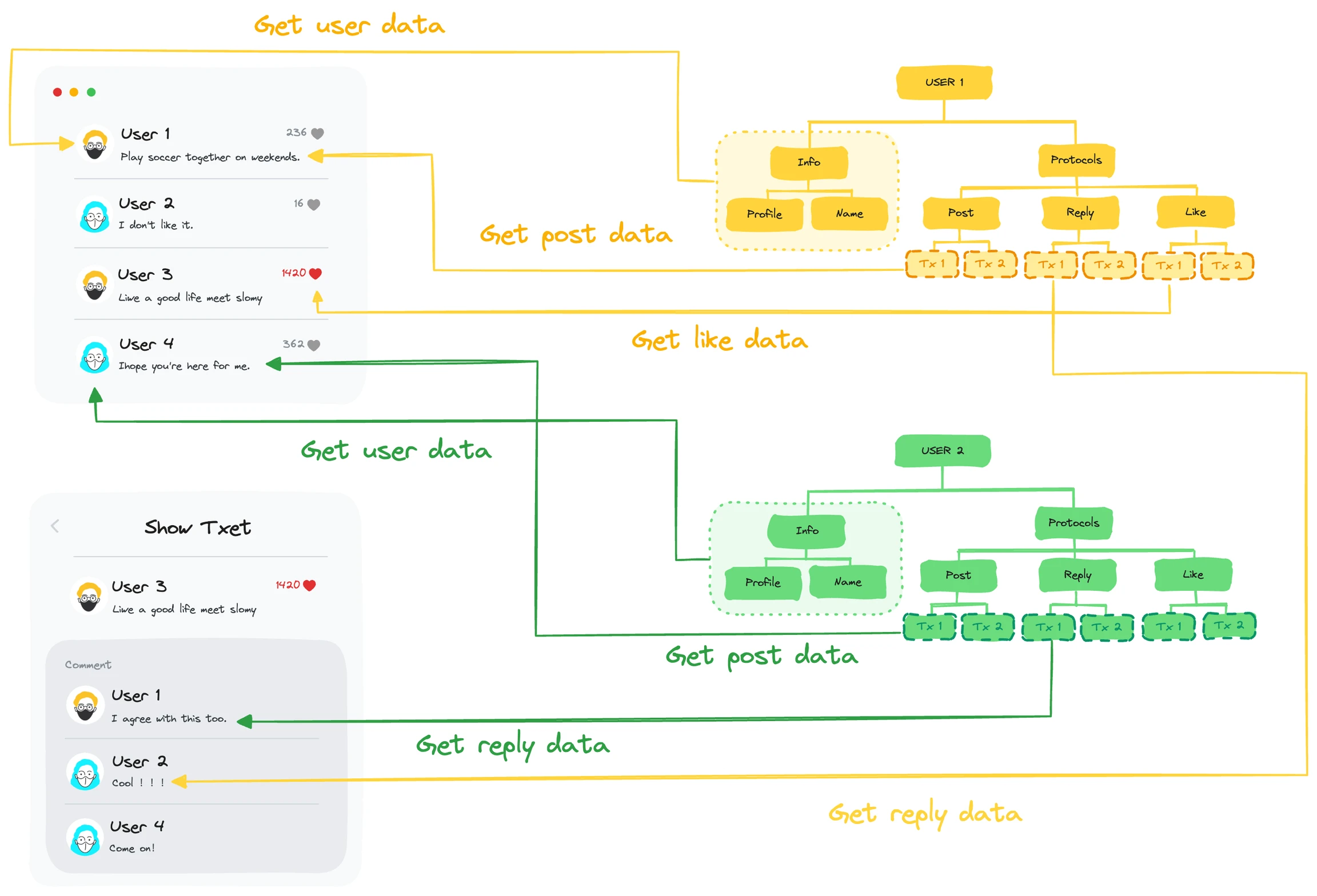
Each PIN is like a Lego block, and different PINs can be combined to create various Web3 applications. This combination approach not only significantly reduces the workload of Web3 application development, but also means that the data generated by each application will be connected in the form of PINs on the user's MetaID tree. This also implies that other applications can combine different protocol PINs through the MetaID tree, achieving data interconnectivity.
Achieving Bitcoin Network Scalability
The congestion and high fees of the Bitcoin mainnet have always been significant factors hindering the development of the Bitcoin mainnet ecosystem. Due to this, many teams have chosen to develop Bitcoin L2 or sidechains to meet more application needs. The MetaID protocol takes a different approach, believing that due to the statelessness and high concurrency of the UTXO architecture, Bitcoin sidechains/L2 based on the UTXO architecture should be viewed as an extension of the Bitcoin network, forming a large, unified UTXO network together with the Bitcoin network.
Therefore, the MetaID protocol supports cross-chain from the design level. In this case, users can freely choose where to store their MetaID data on which UTXO public chain, opting to store general Web3 application data on lower-cost Bitcoin sidechains while keeping important MetaID assets/data on the Bitcoin mainnet.
To realize this vision, MetaID proposed a Bitcoin expansion plan—MetaBitcoin Network. The MetaBitcoin Network is a dynamic and infinitely scalable isomorphic Bitcoin network, centered around the BTC chain, with the advantage of being entirely based on Bitcoin's technical architecture and consensus mechanism, capable of linking mainstream UTXO chains without the need to invent new technologies or develop new public chains, while fully utilizing the infrastructure of other sidechains to realize more complex financial and Web3 use cases.
Any permissionless blockchain that is isomorphic to Bitcoin (adopting the UTXO architecture and supporting traditional addresses) and uses the SHA256 mining algorithm can connect to the MetaBitcoin Network. Currently, blockchains like MVC, Fractal, BCH, and BSV meet the criteria.
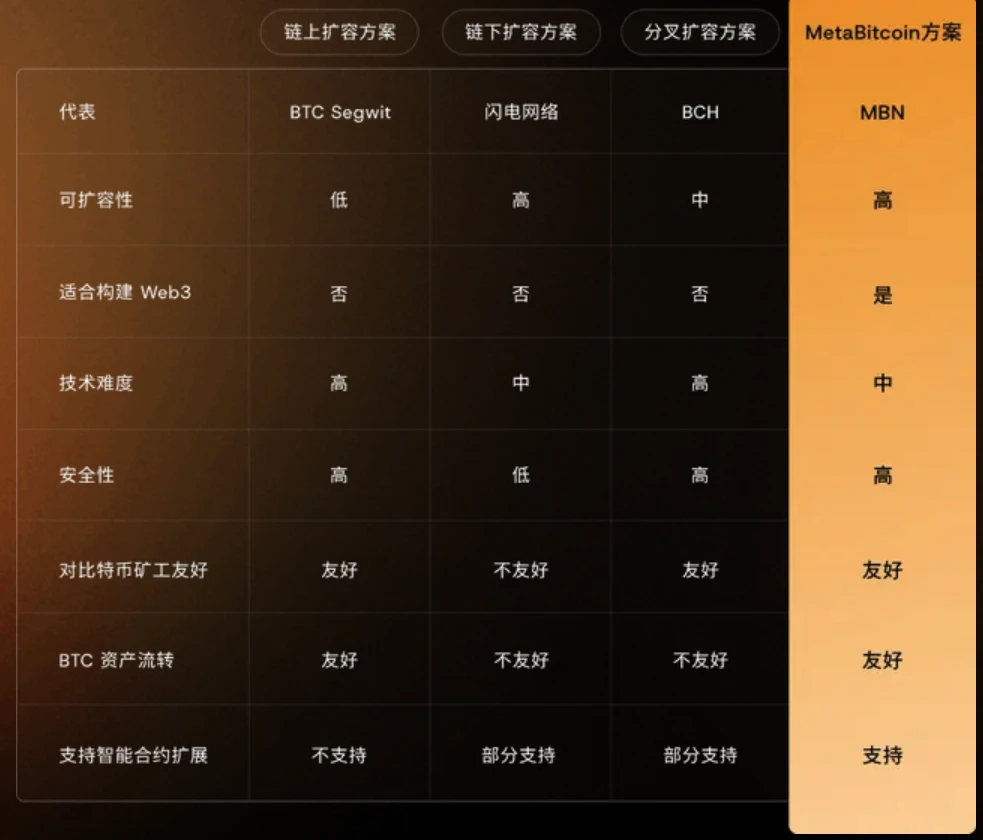
Comparison of MetaBitcoin with Other Bitcoin Scaling Solutions
At the same time, Sunny Fung, the founder of MetaID, stated that MetaID will not independently create an L2 to split the consensus of the Bitcoin ecosystem. The MetaID protocol + MetaBitcoin Network solution can establish a permissionless, open Web3 world on Bitcoin that can accommodate massive daily user usage. Therefore, categorically, MetaID can be regarded as an L0 protocol within the Bitcoin ecosystem.
3. Introduction to Protocol Ecosystem Projects
The MetaID v2 version was launched in May this year, and the protocol ecosystem has now begun to take shape. Next, we will briefly introduce the main ecological projects of MetaID to help readers understand the development status of the MetaID protocol.
MetaSo
MetaSo is a decentralized social media network based on the MetaID protocol. Developers can deploy new Web3 social applications within 20 minutes by simply editing configuration files. MetaSo data is entirely sourced from on-chain data from Bitcoin and its sidechains, with each node locally storing and indexing relevant data. MetaSo nodes interconnect via P2P, relying on no third parties, making it the first truly decentralized social media network based on Bitcoin.
Additionally, data across different MetaSo applications is interconnected and interoperable, allowing users to log into all social applications supporting MetaSo using their accounts or mnemonic phrases. This means that user data across different social platforms can circulate and be shared, enhancing data availability and connectivity.
MetaSo is initiated and operated by a DAO, and users can earn MetaSo token incentives by operating MetaSo nodes. According to official data, MetaSo is still in its early stages, with a total of 1,832 users and 10,810 transactions completed.
MetaLet
MetaLet is the main wallet supporting the MetaID protocol. Currently, applications logging into the MetaID protocol and managing MRC-20 assets and PINs require the use of this wallet.
BITBuzz
BITBuzz is a Web3 decentralized social application built on the MetaID protocol, where users can post, comment, like, and perform other actions. Since it is entirely based on-chain, users need to pay a certain fee for actions like posting, commenting, and liking. Currently, BITBuzz supports the Bitcoin mainnet and the Bitcoin sidechain MVC.
Show.now
show.now is a Web3 decentralized social application deployed on MetaSo, with similar functions to BITBuzz but a different UI. Theoretically, anyone can build customized Web3 decentralized social applications through MetaSo, while interconnecting data with other applications.
metaID.market
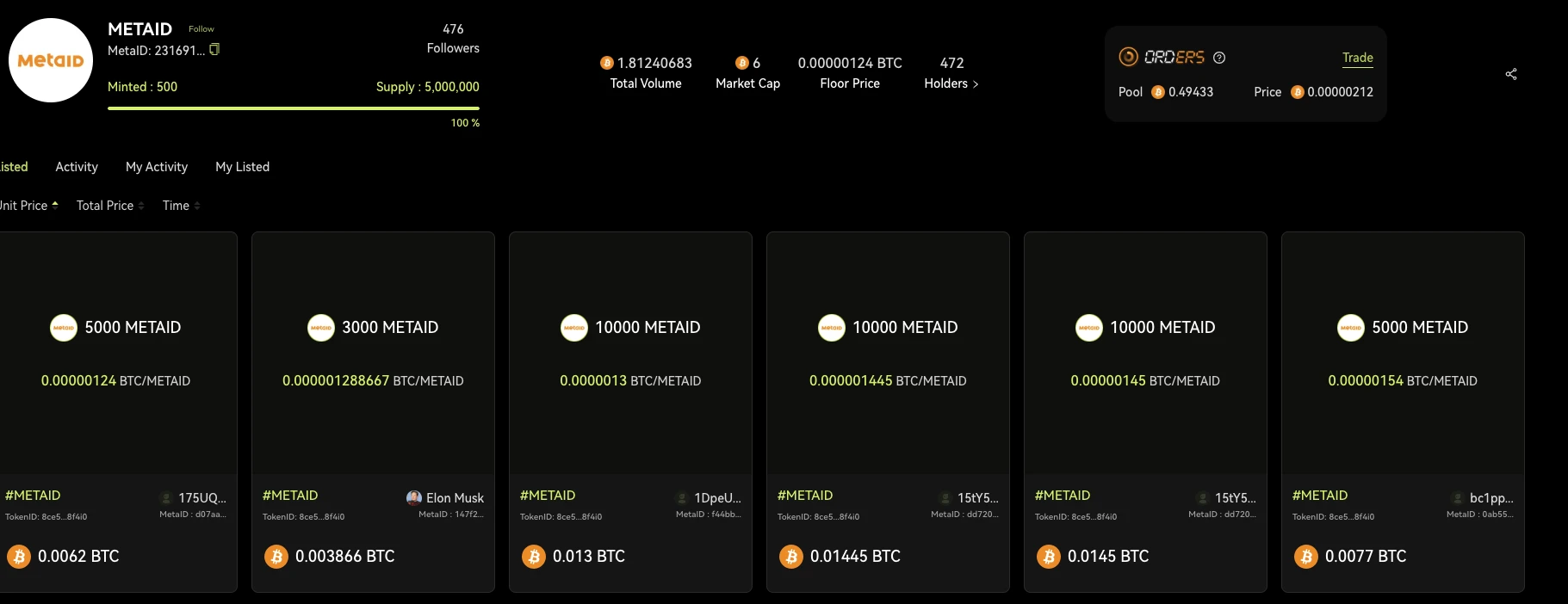
metaID.market is a trading and minting platform for MRC20 and other assets of the MetaID protocol. MRC-20 features a unique ID Coins model, issued through Fair Launch, similar to Pump, but unlike it, only allows followers of the token deployer to trade that token. The platform also supports trading and deploying regular MRC-20 tokens and PINs of the MetaID protocol. The current largest MRC20 token by market cap is METAID, with a market cap of 6 BTC.
Orders.Exchange
Orders.Exchange is an order book DEX on Bitcoin, currently supporting trading of ID Coins launched from metaID.market.
4. Conclusion
From the above introduction and ecosystem, MetaID seems more like a decentralized social protocol or DID protocol similar to Farcaster or nostr on the Bitcoin ecosystem, but its ambitions go far beyond that.
Sunny Fung, the founder of the MetaID protocol, explained the differences between them, stating, “MetaID can do a wider range of applications; it can accomplish everything that the Farcaster and nostr protocols can do, but they cannot do the reverse. More importantly, MetaID aims to realize Web3 on Bitcoin, while they do not.”
The MetaID protocol itself does not have a project token, nor does it have airdrops or incentive activities. Therefore, it initially chose to enter the ecosystem through the social domain, which has led to the market perceiving MetaID as a decentralized social or DID protocol.
“Using social as an entry point allows for quickly gaining a large number of users. For protocols like MetaID, the most important aspect is user scale, so in the early stages, we chose to promote this project, which best represents the characteristics of MetaID, together with the MetaSo team.” Sunny explained in an interview with Odaily.
Currently, the price of Bitcoin has surpassed $100,000, with a total market cap of approximately $2.01 trillion, but the total market cap of the Bitcoin ecosystem is still less than $10 billion, accounting for less than 1%. This may also prove that the Bitcoin ecosystem is still in its early stages.
The future is still uncertain, and MetaID may become that dark horse.
免责声明:本文章仅代表作者个人观点,不代表本平台的立场和观点。本文章仅供信息分享,不构成对任何人的任何投资建议。用户与作者之间的任何争议,与本平台无关。如网页中刊载的文章或图片涉及侵权,请提供相关的权利证明和身份证明发送邮件到support@aicoin.com,本平台相关工作人员将会进行核查。


