"The Dark Forest," a concept derived from "The Three-Body Problem," serves as the most naked summary of the current security landscape in the Web3 space:
The cryptocurrency industry, especially on-chain, is an emerging field with ample room for imagination and innovative gameplay. However, it is also akin to a "dark forest." Whether old users or new players, familiarizing ourselves with the various risks that may arise on-chain and striving to avoid them is an eternal lesson we must always learn.
Recently, a type of scam targeting non-custodial wallet users has quietly gained popularity. It exploits the observation wallet feature (wallets that support "observation mode") by creating a false trust mechanism and a carefully designed logical chain, leading victims into traps without any defenses. For ordinary users, this scam may seem rudimentary, yet it is highly deceptive and destructive.
Scammers take advantage of new users' unfamiliarity with decentralized technology and wallet operation processes to steal cryptocurrency assets. In this context, understanding and being vigilant about these common yet deadly security risks is particularly important. This article will analyze the operational model of this new type of scam in detail and provide users with a series of prevention tips.
What is the "Observation Wallet" mode of non-custodial wallets?
As is well known, the observation wallet mode is a feature of non-custodial wallets for cryptocurrency assets, allowing users to view the balance and transaction history of a specific wallet address.
Due to the transparency of blockchain, all on-chain wallet addresses, corresponding balances, and transfer records are visible. Users can input any blockchain wallet address into a blockchain explorer or other tools to view its asset balance and on-chain records, including receipts, transfers, and on-chain authorizations, while the wallet owner's identity remains anonymous unless they choose to disclose it.
The SafePal wallet, as a non-custodial wallet, also provides an observation wallet mode. For example, when users create a new wallet, they can choose to create a new wallet, restore an old wallet, or import an observation wallet mode (click here to view the official tutorial on importing observation wallet mode in SafePal).
The following image compares the observation wallet mode with the normal wallet homepage, showing that the observation wallet only allows viewing the balance, with no options for transfers, swaps, etc.
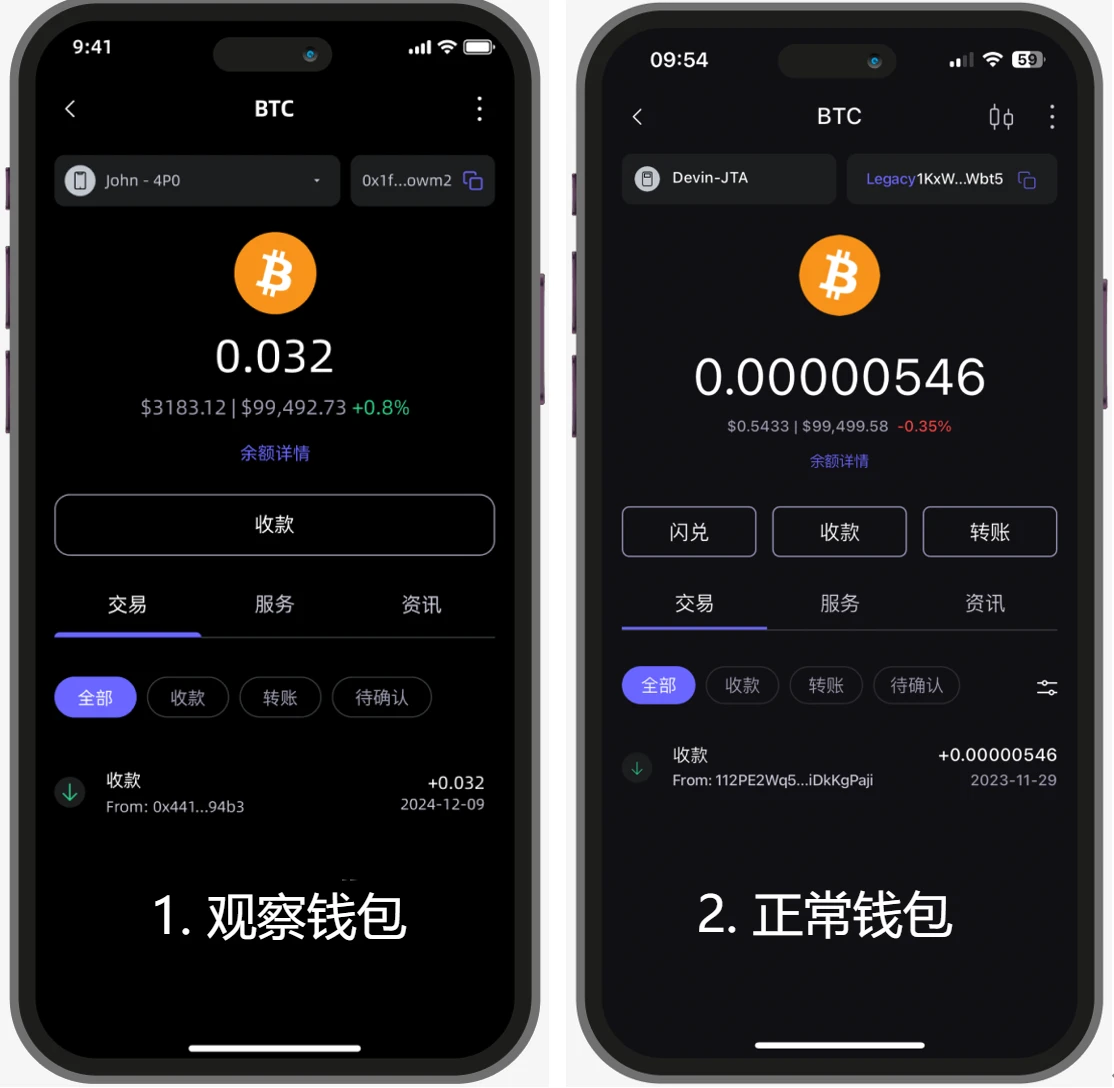
When users import the observation wallet mode, they only need to enter the wallet address to conveniently view the on-chain balance and transaction records of that wallet. However, since the observation wallet does not represent actual ownership of the wallet and only provides a viewing function, users cannot operate the assets within the wallet in observation mode.
For this reason, the observation wallet mode is typically used by the public to track and monitor the on-chain funding situation and trends of specific wallet addresses, such as regulatory monitoring of blockchain anti-money laundering or tracking funds from hacking incidents.
It is crucial to note that it does not support users in conducting any transfer transactions for that wallet address, nor does it equate to owning that specific wallet address. Only users who possess the private key/mnemonic phrase of the wallet address can access and manage the assets within that wallet address.
The scam method we are discussing today is designed by scammers who exploit users' unfamiliarity with this background knowledge.
How does the "Observation Wallet" scam operate?
The core operational idea of this scam is for scammers to contact and manipulate victims, making them believe they can access the funds of a wallet address (usually a wallet address with a large amount of funds). They inform the victim that they need to conduct a transaction to unlock their funds, but in reality, they can only view the wallet balance and have no access or ownership rights.
Here is a typical operational method of this scam:
Scammers approach users: Scammers impersonate wallet support staff, often contacting users through social media platforms (such as Twitter, Telegram, or Reddit) and initiating conversations by offering "help" or "investment" related to wallet issues. Some scammers may also post "fake help requests" online, similar to "I have a problem with my funds and can't withdraw them; can anyone help me? I am willing to pay a generous reward."
Publishing false messages: Scammers claim that the user's wallet needs "verification" or "upgrade" to access the funds inside. They typically guide users to download wallet applications from app stores, making it seem like they are assisting users in completing the normal wallet creation process.
Importing wallet addresses: Then, scammers ask users to import the address into the observation wallet mode, allowing users to see the wallet's balance, which may contain a large amount of cryptocurrency. Scammers continue to assert that users need to pay a Gas Fee or deposit additional cryptocurrency into a specified wallet address, a trick to convince users that they need to pay fees to unlock the funds in that wallet address.
Stealing funds: Once users send funds to the scammer's address, they will not receive any returns, and the scammer will disappear. In other cases, scammers may continue to request more funds to be deposited or transferred to the wallet address under other false pretenses or promises.
Why is this scam effective?
This scam is effective because users often do not fully understand that due to the transparency of blockchain, all wallet addresses can be tracked and viewed on-chain. Viewing the balance of a wallet address may lead inexperienced users to mistakenly believe that this equates to accessing or owning the wallet, while in reality, it is merely a viewing function.
In this scam, scammers exploit the victims' lack of understanding of the observation wallet mode while also stimulating the victims' greed or sympathy through the chat process, creating opportunities for exploitation.
So how can you protect yourself? It's simple. If you are using SafePal or any other decentralized or non-custodial cryptocurrency wallet, be sure to pay attention to the following security tips to avoid falling into these scams:
Do not trust messages from unknown individuals: Normally, the official wallet team will never contact users through social media or direct messages (DM). Any unsolicited offers of help or opportunities to get rich, or requests for personal information should be treated with extreme caution;
Understand observation mode or how to view on-chain wallet addresses: Whether it is SafePal or other non-custodial wallets, the observation wallet mode is a feature that only allows viewing wallet balances. It enables users to track wallet balances and transaction histories but does not permit any transfers or withdrawals (actual access to a specified wallet address requires a private key or mnemonic phrase). Users cannot transfer funds from the wallet in observation mode, so if someone asks you to "unlock" or "access" funds in the observation wallet mode, do not hesitate; that is a scam;
Avoid sending funds to unknown addresses: If someone asks you to send funds to an unknown address to "unblock" your cryptocurrency assets, this is a dangerous warning sign. Scammers often ask users to pay Gas Fees or other fees, but SafePal and most legitimate wallet platforms never require users to transfer to a specific address to unlock funds;
Only download applications from official websites: Ensure that you only download wallet applications from official app stores (such as Google Play Store or Apple App Store) to avoid downloading from unverified websites or links, as these applications may be malicious or scam apps;
Report suspicious activities: If you encounter suspicious messages or potential scams, feel free to report them immediately to the official wallet channels, which helps protect the community and prevent others from becoming victims;
Conclusion
"Not Your Key, Not Your COIN."
This is perhaps the harshest statement in Web3. After all, "decentralization" and "security responsibility" are two sides of the same coin. When asset ownership is truly returned to individual control, it forces every user to take responsibility for their own assets, fully entering the "dark forest."
Therefore, as on-chain scam methods diversify and evolve, learning and understanding how non-custodial and decentralized wallets work, as well as familiarizing oneself with common scam methods, has become an indispensable survival skill for every Web3 user.
Remaining vigilant and safely navigating the on-chain "dark forest" is a compulsory course for each of us to adapt to the rules of the decentralized world.
免责声明:本文章仅代表作者个人观点,不代表本平台的立场和观点。本文章仅供信息分享,不构成对任何人的任何投资建议。用户与作者之间的任何争议,与本平台无关。如网页中刊载的文章或图片涉及侵权,请提供相关的权利证明和身份证明发送邮件到support@aicoin.com,本平台相关工作人员将会进行核查。


