Core Logic: For general-purpose L1, DX is more important than UX.
Written by: Alex Liu, Foresight News
DX is Important
On October 22, Nader Dabit, the DevRel (Developer Relations Head) of EigenLayer, posted a tweet on X featuring screenshots of four different people complaining about the developer experience on Solana, sparking significant discussion in the community.
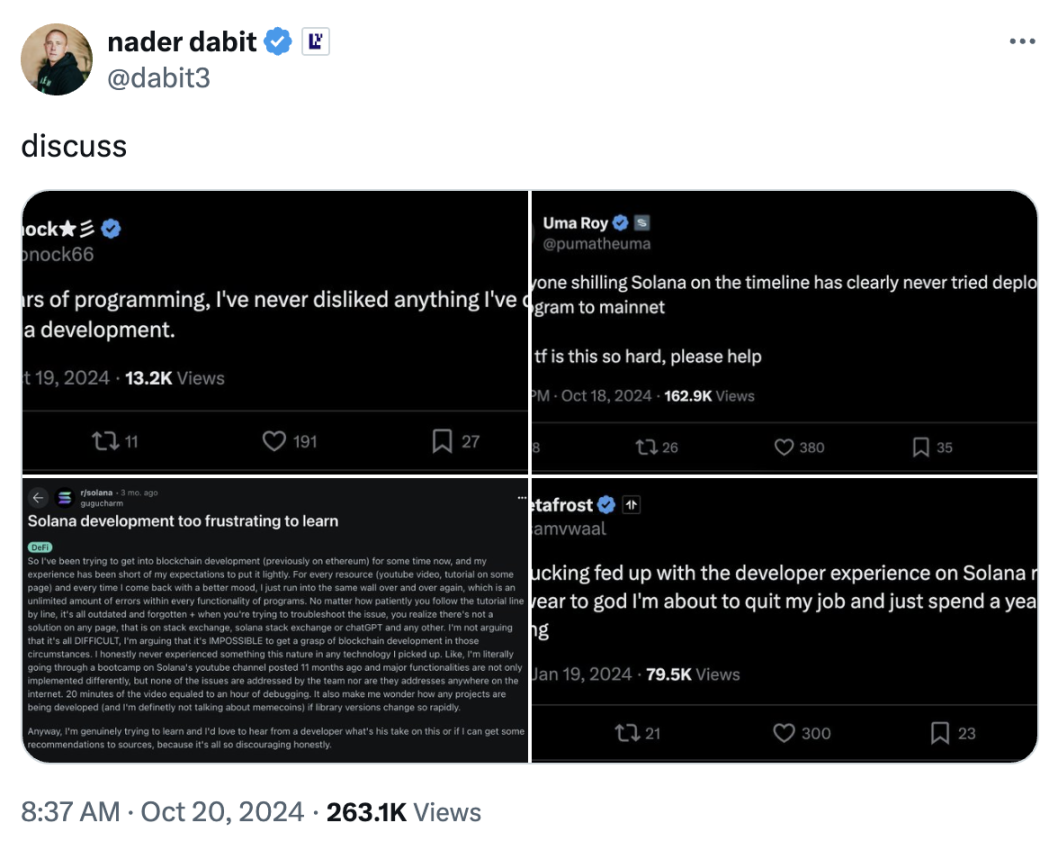
Mert, CEO of Helius and a major figure in the Solana ecosystem, stepped up to refute two of the complaints but had to admit that "writing smart contracts on Solana is not easy."
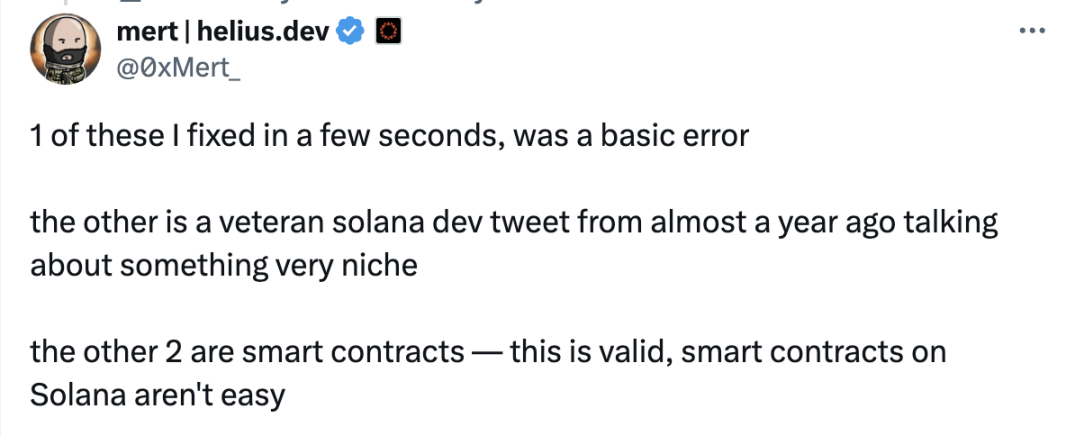
This brings to light a current shortcoming of Solana — Developer Experience (DX). Unlike User Experience (UX), users cannot directly perceive the underlying blockchain's DX, but it is a core factor in my decision to bet on the Move blockchain, despite Solana's dominant position in the high-performance public chain ecosystem. (The author is optimistic about and holds SOL, SUI, APT.)
The logic is simple: in the long run, for general-purpose L1, DX is more important than UX.
Is DX important? DX affects developer onboarding, and developers are the moat of the EVM ecosystem.
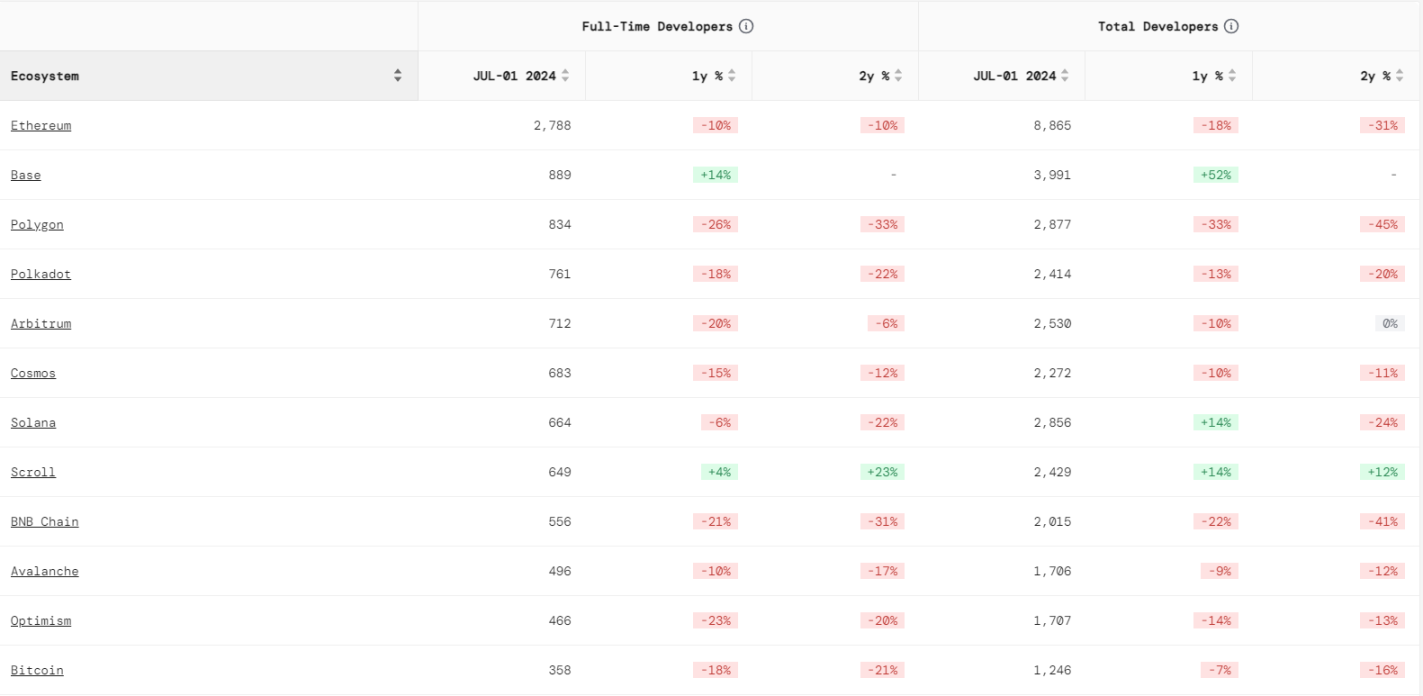
According to developer report data, Ethereum remains the leading blockchain in terms of monthly active developers, with 2,788 full-time developers and a total developer count exceeding 8,865 as of July 1. Since 2019, the number of Ethereum research teams has surged by 2,100%.
The top three blockchains by full-time developer count all come from the EVM ecosystem. This is related to the simplicity and ease of learning of the EVM smart contract development language Solidity (which is similar in syntax to the most commonly used programming language in web development, JavaScript) and the maturity of development frameworks (Hardhat, Foundry).
Does this have any impact? Users have no perception of developer experience, yet they can notice that "Solana's token price significantly outperformed Ethereum last year."
The problem is: in reality, developers are the customers of general-purpose L1. Users need to use apps, not chains. Good DX can attract good developers, create good apps, and lead to mass adoption. Given that all underlying chains are high-performance public chains, in a future where chain abstraction is vigorously developed, users' perception of differences between public chains will approach zero, focusing solely on the UX of apps.
Users do not have a need to use blockchains, but they do have a need to use apps. Polymarket's election prediction market brought a large number of new users to Polygon, and these users may not understand "what is blockchain?", while Moonshot is another typical example — users pay with credit cards, and the on-chain actions are so wrapped that they have almost no presence.
Ethereum and EVM have the largest developer ecosystem, the most talent pool, and the greatest mindshare in people's minds, which is why it remains the largest smart contract platform by market capitalization. An easy-to-use, friendly DX somewhat supports ETH's valuation.
DX Ranking
From the perspective of DX, the current ranking is approximately: Move blockchain > EVM (Solidity) > Solana.
Here, DX refers not only to experience but also to the difficulty of getting started. Solana smart contracts primarily use the Rust language, which has a relatively complex syntax and is not specifically designed for blockchain, often leading to situations where developers need to "reinvent the wheel." The Anchor framework launched by Backpack founder Armani has greatly improved this situation, but it still cannot compete with Move, a language designed specifically for blockchain based on Rust and developed by Facebook.

Future Outlook for Move
If DX is so good, why haven't any killer applications emerged from the Move blockchain yet?
I believe this is related to the industry's development stage. The current blockchain industry is still in the "infrastructure" phase — paving the way for potential mass adoption, with funding and attention not yet focused on the application layer. Solana's UX still needs improvement, but it has achieved undeniable success at present because most users are directly "using the chain," leveraging the blockchain's most primitive and core asset issuance functions to speculate on memes, leaning more towards crypto-native on-chain PvP, rather than users entering en masse due to a specific app. I am optimistic about Solana in the long term and believe its DX will improve in the future, but it is not the best right now.
I believe that "for general-purpose L1, DX is more important than UX"; and an industry that emphasizes applications and is driven by applications will come in the future. I am betting on the Move blockchain with better DX.
免责声明:本文章仅代表作者个人观点,不代表本平台的立场和观点。本文章仅供信息分享,不构成对任何人的任何投资建议。用户与作者之间的任何争议,与本平台无关。如网页中刊载的文章或图片涉及侵权,请提供相关的权利证明和身份证明发送邮件到support@aicoin.com,本平台相关工作人员将会进行核查。


