Understanding the Native Selling Pressure of the Most Widely Adopted Digital Assets
Author: Robert Greenfield IV
Translation: Shanooba, Golden Finance
Selling pressure is the dark enemy of all asset holders.
Although venture capital funds and dishonest KOLs often lead the way in this regard, supply shocks from inventory, miners, and an increasing number of institutional investors have now become the dominant force of fear, uncertainty, and doubt (FUD), controlling billions of dollars in net flows.
However, local selling pressure is a function of the token economics of every network and protocol—this mechanism is encoded in every function of destruction, minting, and annualized yield distribution to incentivize stakeholders while avoiding economic inflation and preventing a sharp decline in the native token price.
In this briefing, we will analyze the local selling pressure embedded in the Bitcoin, Ethereum, and Solana ecosystems. Well, enough said, let's get started.
Bitcoin
Bitcoin has a supply limit of 21 million coins, using a predetermined issuance schedule. With each new block generated (approximately every 10 minutes on average), miners receive additional block rewards, increasing the token supply. Every 210,000 blocks (approximately every four years), this fixed block reward is halved, an event known as "halving." The block reward for Bitcoin at its genesis in 2009 was ₿50.
The zero block reward and fixed supply limit will not be reached until 2140, but with each halving, the inflation rate will continue to decrease, and the block reward will also halve. However, before the supply limit is reached, Bitcoin remains an inflationary asset. Based on the current block reward, ₿164,000 (approximately $10.3 billion) will be minted annually.
Currently, the main sources of local selling pressure for Bitcoin are:
- Miner income (from transaction fees and block rewards)
- Market impact supply (creditor payments, government seizures)
Miner Selling Pressure
Due to the high operating costs and competitiveness of Bitcoin mining, as well as the need for publicly listed mining companies to report quarterly earnings and maintain stock prices, miners are often forced to sell the Bitcoin they mine to realize profits. This creates sustained selling pressure on Bitcoin. The high costs of mining, including financing facilities and ongoing operating expenses (such as electricity, taxes, and personnel costs), compel miners to regularly sell a portion of the Bitcoin they mine. Most importantly, even as the block reward decreases, Bitcoin's total mining capacity (hash rate) has historically continued to increase, further reducing the profitability of each unit of hash power.
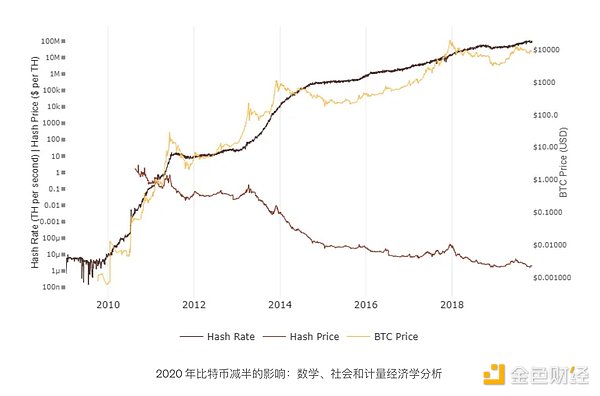
Since the Bitcoin halving in April 2024, miner income (i.e., potential selling pressure) has averaged $218 million per week, compared to a high of $489 million before the halving in April 2024. However, during the same period, the network's hash rate growth has stagnated, indicating a significant compression of miners' profitability.
Given the current Bitcoin price and hardware costs, expanding mining capacity seems to have become less profitable. Profit compression means that miners may need to sell a larger proportion of Bitcoin to cover operating costs, which are mainly denominated in fiat currency.
Market Impact x Supply
In the cryptocurrency field, "market impact supply" refers to a sudden influx of a certain cryptocurrency into the market due to unexpected events. This surge in supply can significantly change market dynamics, often leading to a sharp decline in the price of the cryptocurrency. Such events may be triggered by:
- Large-scale sell-offs: When a large holder (such as a whale or institution) decides to liquidate a large position.
- Token unlocks: When a large number of previously locked or granted tokens enter the circulating market, increasing the circulating supply.
- Regulatory changes or hacking attacks: Regulatory crackdowns, exchange hacks, or other sudden events may lead to panic selling and rapid liquidation of assets.
If this rapid increase in supply does not correspond to a growth in demand, it can bring "impact" to the market, shaking prices and potentially causing broader market fluctuations.
For Bitcoin, market impact supply usually originates from the collapse of centralized Bitcoin liquidity platforms (such as exchanges, market makers, and lending platforms). Unlike other cryptocurrencies, Bitcoin does not have token unlock plans or smart contracts that can be exploited on its network.
Creditor Payments (Temporary Risk)
During the 2024 Bitcoin halving cycle, market impact supply is currently mainly limited to the repayment of 100 billion dollars (168,000 BTC) involved in the Mt. Gox and Genesis bankruptcies. The market is concerned that these creditors may choose to sell their Bitcoin holdings after receiving full compensation, triggering market turmoil, especially if a recession triggered by recent interest rate cuts leads to a wave of selling.
Government Seizures and Sales
The Bitcoin seized by governments from illegal websites (usually on the dark web) has also increased market impact supply.
For example, in February 2024, German authorities seized 50,000 bitcoins from the former operator of the pirated website Movie2k.to, worth about $2.1 billion. These cryptocurrencies were voluntarily surrendered by the suspect in a case involving illegal commercial exploitation of copyrighted works and money laundering. This seizure was part of a joint investigation by the Dresden Public Prosecutor's Office, the Saxon State Criminal Police, and other agencies.
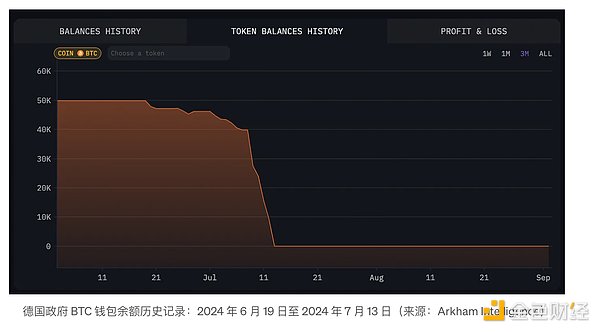
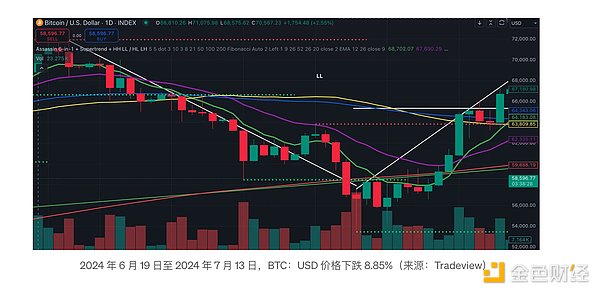
After the seizure of Bitcoin, the Saxony government sold it on the market, causing the Bitcoin-to-USD (BTC) price to drop by 16.89%. However, on the last day of the sale, the price rebounded, ultimately narrowing the decline to 8.85%.
Government-Held Bitcoin
Market impact supply is not limited to Saxony, Germany. As of 2024, several governments worldwide hold large amounts of Bitcoin, mainly obtained through confiscation related to criminal activities:
- United States: The U.S. government is the world's largest holder of Bitcoin, holding approximately 203,129 BTC, worth about $11.98 billion. These bitcoins were mainly obtained through confiscations related to cases such as the "Silk Road" dark web market.
- China: China holds approximately 190,000 bitcoins, worth about $11.02 billion. Most of these bitcoins come from the PlusToken Ponzi scheme, one of the largest cryptocurrency scams in history.
- United Kingdom: The UK holds approximately 61,000 bitcoins, worth about $3.53 billion. These bitcoins were confiscated from various financial crimes, including major money laundering operations.
- El Salvador: As the first country to adopt Bitcoin as legal tender, El Salvador holds approximately 5,800 bitcoins, worth about $400 million. These holdings are part of the country's financial strategy, including the "buy 1 bitcoin per day" plan.
- Ukraine: Ukraine holds approximately 46,351 bitcoins, including assets confiscated by the police and donations received during the war.
Bitcoin ETF Fund Outflows (Theoretical)
In 2024, a new Bitcoin price correlation was introduced: net flows of Bitcoin ETFs. As cryptocurrencies are gradually incorporated into structured products, global investment macro trends will increasingly be determined by the token economics of assets and the performance KPI of their networks/protocols.
Ethereum
Ethereum was initially a network using proof of work (PoW) and later transitioned to proof of stake (PoS) to improve transaction throughput and reduce hardware requirements, which had led to a trend of centralization in the network.
Ethereum is doubly inflationary, using the following three dynamic supply mechanisms to guide its token economics:
- Issuance: Ethereum issues tokens based on the total staked value. Specifically, the total issuance is proportional to the square root of the number of validators.
- Transaction fee burning: Ethereum burns a portion of the ETH from the circulating supply to pay for transaction fees.
As of the time of writing, Ethereum has approximately 1.66 million validators, with a total weekly issuance of 23,300 ETH, resulting in an annualized inflation rate of 0.295%. The APY for staking ETH as a validator or through liquidity staking is 2.8%.
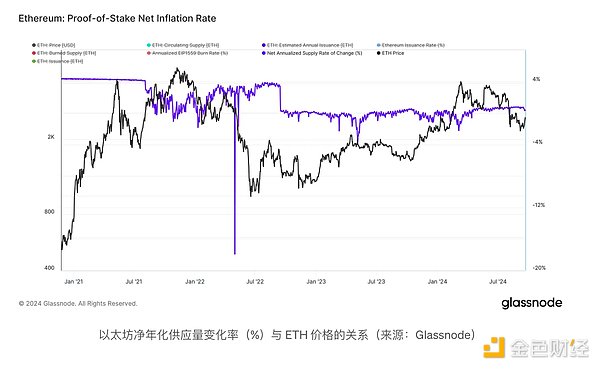
The BASEREWARDFACTOR controls the network inflation of Ethereum. As the usage of L2 Rollup increases, Ethereum's transaction density and burn rate have been steadily decreasing since 2021, leading to an increase in the inflation rate.
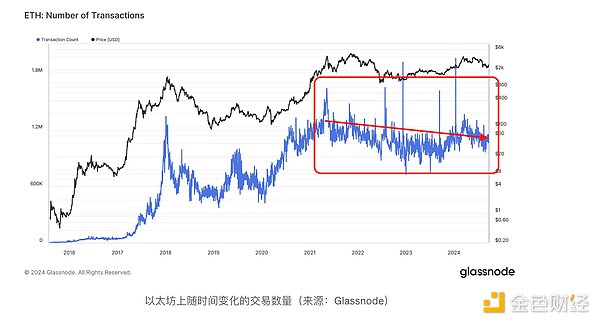
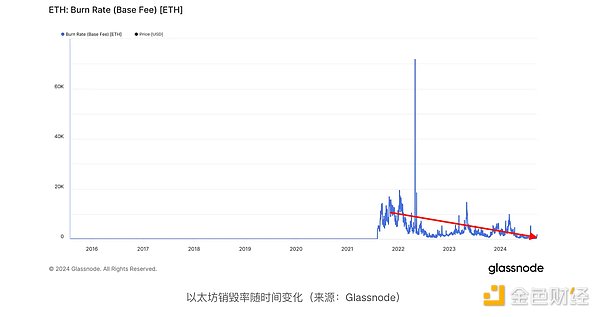
If transaction density continues to decrease due to users choosing lower L2 transaction fees, the profitability of validators and the total staked ETH will inevitably decrease unless the BASEREWARDFACTOR is increased. However, doing so would also increase inflation. Ethereum may need to reconsider better cost scaling on L1 or redefine the relationship between aggregation and the base layer to increase the proportion of staked ETH and/or the amount of burned ETH.
Another factor affecting the supply and demand dynamics of Ethereum is staking, albeit indirectly. Approximately 29% of the total supply of ETH is staked, and this percentage continues to grow. Staking is a significant net supply source for Ethereum and has been widely adopted and simplified through liquidity staking protocols such as Lido and Rocketpool, allowing users to stake without setting up their own validator and earn a certain percentage of validator rewards through APY.
Solana
Solana has been a PoS network from the beginning and has a fixed total inflation schedule that does not change based on the number of validators. Currently, Solana's inflation rate is 5.1% and will continue to decrease by 15% annually until it reaches a terminal inflation rate of 1.5% around 2031.
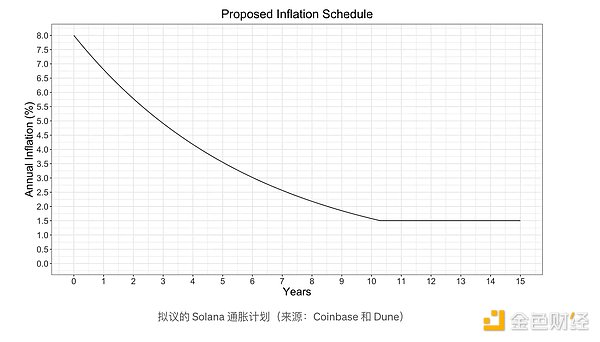
Solana burns 50% of the base fee and priority fee, while Ethereum burns 100% of the base fee. However, Solana's burn rate is much lower, only offsetting 6% of the issuance from the beginning of the year (burning 1.1 million SOL while issuing 18.2 million SOL). Most of Solana's inflation comes from its fixed issuance schedule, adding 528K SOL per week ($84 million)—higher than ETH's $46 million but lower than BTC's $198 million.
Solana's staking rate has remained stable, staying above 60% since September 2021, peaking at 72% in October 2023, and stabilizing at 68% in March 2024. A higher staking rate compared to ETH means there may be more staking rewards being sold.
Conclusion
Token inflation has different effects on traffic based on factors such as issuance costs (mining and staking) and variability (burn rate). PoW chains like Bitcoin face higher selling pressure from miners to cover costs, while PoS stakers can retain more earnings. The PoS inflation rate also depends on changes in the staking rate. To fully understand issuance-driven traffic, these two metrics need to be considered. For example, while staking acts as a liquidity sink for ETH, it is not currently the case for SOL.
免责声明:本文章仅代表作者个人观点,不代表本平台的立场和观点。本文章仅供信息分享,不构成对任何人的任何投资建议。用户与作者之间的任何争议,与本平台无关。如网页中刊载的文章或图片涉及侵权,请提供相关的权利证明和身份证明发送邮件到support@aicoin.com,本平台相关工作人员将会进行核查。


