Minichain, a comprehensive solution, may become a breakthrough point for the large-scale adoption of Web2/Web3 through platforms like TG/X.
Author: shaofaye123, Foresight News
Who will become the gateway to the next "billion-level new users" in the crypto world?
Perhaps we need to abandon the single-minded thinking of Web2/Web3 and seek answers with a more integrated vision. Just as the explosion of WeChat mini programs in 2017 disrupted the Web2 commercial ecosystem with its lightweight and consumer application attributes, this year's global impact of the Telegram Mini App explosion provides a new solution:
As a global social platform covering over 900 million users, the Mini App on Telegram is fully expected to give birth to a global consumer application revolution—bringing traditional Web2 players and mainstream apps into Web3 with massive user traffic, and helping Web3 projects reach more incremental users, ultimately making social platforms like Telegram/Twitter the intersection of Web2 and Web3.
But the vision is beautiful, and the reality is tough. The complexity of blockchain technology has long been a barrier for many developers to enter Web3, and the centralized architecture of social platforms like Telegram/Twitter has limited their application innovation potential.
In this context, Nubit, which has just announced its expansion from the Bitcoin DA track to a higher dimension, has pioneered the concept of "Minichain" and launched a comprehensive solution to help Web2 and Web3 developers focus on building innovative applications without facing complex payment and security issues. Could this be a breakthrough point that is expected to be widely adopted by Web2 & Web3?
The Mini Program Revolution and Insights
The future of Web3 can often be glimpsed from the development history of Web2.
For example, the concept similar to mini programs was proposed in 2013, but it did not attract much attention at first, until it experienced explosive growth several years later.
The reason lies in the fact that although it fits the market's trend of demand, the set of development tools, infrastructure, and collaborative ecosystem needed by developers and the market was not mature in the early stages. And now, the further prosperity of Mini Apps similarly requires a set of development infrastructure that is usable and user-friendly for both Web2 and Web3 developers, and Nubit is providing the Minichain comprehensive solution.
Learning from the rise of mini programs, this chapter will dissect the reasons behind the rise and seek the next billion for Web3.
The Rise of WeChat Mini Programs
Mini programs originated from Baidu's "lightweight applications" concept in 2013, but it did not cause much of a stir when it was first proposed. During this time, major companies like Google also proposed the concept of PWA (Progressive Web App), which was not widely adopted until 2017, when WeChat mini programs exploded with the popularization of mobile internet.
Nowadays, every aspect of life is inseparable from mini programs. As lightweight applications, they have quietly changed user habits and built an extremely large commercial ecosystem.
According to the latest report, WeChat mini program traffic has reached 945 million, forming a powerful "traffic pool" effect. Not only are WeChat mini programs widely used, but also Alipay mini programs, Douyin mini programs, and others have blossomed, proving the huge potential of lightweight applications in meeting user needs and improving user experience, which is a successful practice for Web2 in exploring user growth.
Looking back at the development history of WeChat mini programs, it can be seen why it sparked a market frenzy and successfully gained new users.
From the official launch of mini programs in 2016 to the release of "Jump Jump," WeChat mini programs rapidly accumulated a large number of users with the explosion of mini games. Subsequently, the supporting facilities for mini programs continued to improve: the establishment of advertising components, the development of order management functions, and the launch of the rendering engine Skyline. Its development tools and infrastructure are constantly evolving.
From a technical perspective, it can be said that every milestone-like user growth in the mini program ecosystem is inseparable from the improvement of development tools and infrastructure. It is the developers and projects that provide down-to-earth infrastructure construction that enable the continuous development and prosperity of the mini program ecosystem. From the perspective of the three parties involved in the mini program, including users, entrants, and platforms, the user experience is convenient and the social connection is strong; the deployment of entrants is simplified and the promotion is rapid; the user stickiness of the mini program platform increases, and the ecological value rises.
From a business perspective, it can be said that every participant in the mini program ecosystem has strong motivation for construction. This ultimately leads to the continuous improvement of the mini program ecosystem, the expansion of application scenarios, and the positive promotion of all parties, forming a positive flywheel effect.
How to Open the Door to Web3?
Looking globally, not only has the business model of WeChat mini programs in China been successfully practiced, but the international development of the Telegram Mini App ecosystem has also attracted a large number of developers and projects from around the world. This international attribute enables Mini Apps to better adapt to the diverse needs of users in different regions and cultures, providing diversified services for global users.
In the face of the rapid expansion of the Mini App ecosystem, its competitive advantages and development trends are gradually becoming apparent. Looking back at Web2, we cannot help but think, what is the next major milestone for Mini Apps? What do users still need?
In the analysis of the three parties involved, we see that the rights of users have not been fully released, and even their data ownership is difficult to guarantee. As commercial competition intensifies, the profits of project parties are gradually eroded by the platform and are entirely determined by the platform. Whether it is Telegram or WeChat, the problems brought about by this centralized architecture are difficult to solve in Web2. With the widespread adoption of lightweight consumer app models, more and more Web2 projects hope to enter Web3 through the Mini App model, and Web3 projects also realize that they can better attract Web2 users through Mini Apps.
Therefore, the next step is to open the door to Web3.
The Gulf between Web2 and Web3
But opening the door to Web3 is full of challenges. Whether from a technical perspective or a governance model, there is a deep gulf. The current realization of Mini Apps faces practical difficulties in the intersection of Web2 and Web3.
- Increased development difficulty: Just developing WeChat mini programs requires dealing with dual-threaded mode, various rendering challenges, and more. The core technology of Web3 is even more complex, with different blockchain development languages being incompatible, and deploying chains is particularly difficult. This steep learning curve will hinder developers from entering.
- Increased security issues: Web3 applications have many security vulnerabilities when bridging with Web2, making it difficult to guarantee fund security. There are also a series of hacker attacks, phishing scams, and more. Insecure underlying infrastructure easily leads to security issues.
- Difficult migration of user habits: Web2 users are accustomed to a simple and lightweight user experience. Just looking at the entry-level Web3 wallet, 12 mnemonic words make many users hesitate.
- Difficult transition of economic models: Web2 adopts an advertising-based revenue model, while Web3 introduces tokenization and new economic structures, making it difficult for project parties to design and users to understand.
Faced with this dilemma, not only do we need to deeply consider, what kind of key do we need to open the door to Web3?
Minichain: Upgrading Mini Apps, Building a Bridge between Web2 & Web3
From the evolution of Web2 mini programs, it is enough to prove that the improvement of infrastructure and collaborative ecosystems can reduce technological barriers and bring about business growth and large-scale adoption. In the current construction of Mini Apps, we can clearly see the outstanding performance of third-party service providers in the development of the mini program market. Among the 580,000 mini programs that have been launched, nearly one-tenth are launched through the Instant App; among the 1 million mini program developers who have joined, 140,000 mini program merchants have joined through the Instant App.
Based on this, if a set of user-friendly and practical infrastructure can be built, seamlessly connecting components like mini programs, for Web2/Web3 developers, the next "billion-level" may appear in the foreseeable future, just like mini programs.
Nubit: A Key to Open Two Doors
In Web2 WeChat mini programs, the improvement of infrastructure and collaborative ecosystem is the abstract result of key links. Its development framework encapsulates different types of native APIs, which can easily invoke various capabilities provided by WeChat, such as event listening APIs, synchronous APIs, asynchronous APIs, etc. This encapsulation mode significantly reduces development costs.
Secondly, the most frequently used payment-type mini programs in the user end, such as Tencent mobile recharges, utility bill payments, e-commerce services, have also abstracted the payment process. The developer end encapsulates to attract rapid ecosystem construction, and the user end encapsulates to promote convenient user participation. With the mutual improvement of the B end and the C end, the demand-supply achieves a high degree of matching, leading to the positive prosperity of the ecosystem.
Now, in Web3, chain abstraction and intent ecosystem are developing rapidly, but they either pursue extreme simplicity in user experience at the expense of decentralization, or pursue perfect technical logic at the expense of user experience. In the abstraction of key issues, one side of the B end or the C end is often overlooked, and this imbalance in supply and demand has always failed to trigger a true large-scale outbreak, just like the early stage of mini programs in 2013.
Therefore, in the abstraction and encapsulation of key links, it is necessary to ensure both the user experience flow and seamless development. Therefore, the most pressing issue to be addressed is the integration of "Telegram mini apps + chains". Secondly, the wallet as an entry point, "payment interface + blockchain wallet" is an unavoidable second issue.
Nubit's encapsulated black box gives a universal key to open these two doors. Opening up the incremental B end and C end, opening up the incremental Web2 and Web3.
This key originally came from a letter to the community released by Nubit on September 2.
In the letter, Nubit announced the Minichain construction solution for consumer-level applications. It is based on the Nubit Data Availability (DA) solution and has been expanded to include tools such as DeKit, Minichain-as-a-Service, and Universal Bridge to help developers focus on building products. From this short letter, we see not only the full set of solutions provided by Nubit, but also its transition from technical solution exploration to business model empowerment.
The comprehensive solution and development tools provided by Nubit can not only help existing consumer apps quickly migrate to Web3 and become decentralized applications (Dapps), but also provide customized Minichains for them. This not only helps Web2 applications seamlessly enter Web3, but also allows Web3 projects to easily expand to Web2, truly achieving bidirectional integration and expansion between the two.
Nubit: The Full Solution of Minichain
Nubit's solution brings a universal key—it abstracts the development issues into a "technical black box". Developers do not need to worry about payment and security issues, and can directly use a complete set of mature tools (Dekit) on Telegram for Minichain development and deployment. Nubit's abstraction of key links, in the direction of simplifying the entry and reducing costs, provides a good example.
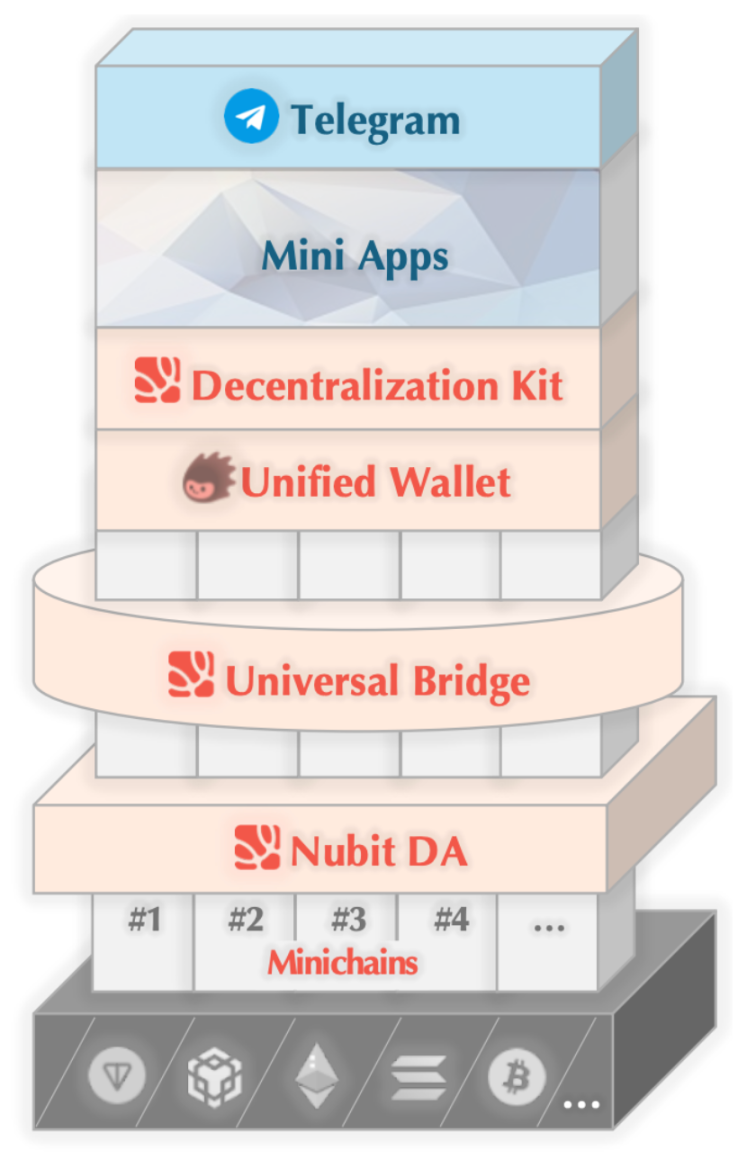
Analyzing Nubit's full solution, its technical architecture covers the two key issues that have been abstracted.
- "Telegram mini apps + chains", "payment interface + blockchain wallet" integration.
"Telegram mini apps + chains"
- How to achieve interoperability between different chains?
With the increase in Minichains, there will inevitably be issues of fragmented liquidity and inconsistent user and developer experiences. The technology black box encapsulated by Nubit has two layers that can effectively solve this problem. From the perspective of Nubit DA, the Nubit DA is based on Bitcoin's trust mechanism and has built an efficient, trustless shared data availability layer.
On this basis, it can ensure fast and reliable data exchange between Minichains, while ensuring the security and scalability of the system. From the perspective of the Universal Bridge, this is a more traditional general solution that can provide efficient communication and transaction solutions across different Minichains, ensuring seamless interaction between different chains and avoiding the risks of fragmented liquidity and transaction failures. These two layers provide a good solution to the fragmented liquidity and inconsistent user experience caused by the rise of Minichains.
- How can developers deploy quickly? How can components be seamlessly and securely integrated?
Although the basic issues between different chains can be resolved, developers still face significant obstacles. From Nubit's technical architecture, DeKit and Minichain as a Service (MaaS) effectively address these issues.
DeKit is a decentralized toolkit built on the Model-View-Controller (MVC) architecture. MVC divides the application into three interrelated components, allowing developers to separate the internal representation of information from its presentation and user acceptance.
The model layer is used for ledger management, where all on-chain data is stored and managed. Developers can perform common operations such as updating account balances, transferring assets, or querying transaction history through simple application programming interfaces. The view is used for the user interface, responsible for the content that users see and interact with. Developers can create user interfaces that interact with Minichains and Telegram wallets without needing to understand blockchain expertise. The controller is used for smart contract logic, handling the business logic of the application.
Developers can use pre-built smart contracts provided by Nubit, or customize them as needed. The separation model built by DeKit simplifies development, testing, and maintenance, significantly reducing complexity. Developers can easily integrate blockchain functionality, especially suitable for platforms like Telegram.
Minichain-as-a-Service (MaaS) further leverages DeKit to empower developers to create and manage Minichains for their specific applications. MaaS simplifies the traditionally complex blockchain deployment process and provides a codeless dashboard for easy configuration. In addition to infrastructure services such as RPC services and state verification, MaaS also reduces operational costs.
These tools enable developers to focus on innovation rather than complex infrastructure management. Developers can implement chain-specific functions for their applications through customized Minichains, reducing costs and improving performance and user experience, while allowing users to have deeper participation and ecosystem rights.
"Payment interface + blockchain wallet"
- How to achieve a seamless and secure wallet experience?
A seamless and secure wallet experience is crucial for Web2 users to join Web3. The Unified Wallet provides this service very well. It can help developers easily connect to blockchain payment systems, with smooth interaction. The wallet not only supports multiple assets but also supports social logins. By using familiar login methods such as Google, Apple, Facebook, X (Twitter), GitHub, and Discord, it further optimizes the frontend experience. Abstraction is also applied as much as possible in the access and management of funds in the blockchain ecosystem, allowing users to experience the security of the blockchain without perceiving the complexity of the underlying technology.
Nubit's abstraction of these two key links opens up new possibilities. The optimization of the B end and C end in the intent ecosystem is well integrated in Nubit, and its technical architecture is clear and directly addresses pain points, effectively filling the market gap. It not only helps Web2 applications seamlessly enter Web3, but also enables Web3 projects to expand to Web2, achieving bidirectional integration and expansion.
With billions of users entering Web3 through Nubit, and more and more builders easily developing projects, the positive flywheel effect is beginning to take effect. Nubit is expected to become a key driver of integration between Web2 and Web3.
Conclusion
With the rise of the global Mini App model, the decentralized global Mini App ecosystem is on the verge of an explosion. The incremental Web2 users bring endless possibilities. Nubit, having gone through many trials, is no longer just limited to DA. As the key to opening the door to Web3, it not only builds a bridge between Web2 and Web3, but also leads to a more distant future.
As the key to opening the door to Web3, the future of Nubit is worth looking forward to.
免责声明:本文章仅代表作者个人观点,不代表本平台的立场和观点。本文章仅供信息分享,不构成对任何人的任何投资建议。用户与作者之间的任何争议,与本平台无关。如网页中刊载的文章或图片涉及侵权,请提供相关的权利证明和身份证明发送邮件到support@aicoin.com,本平台相关工作人员将会进行核查。


