EtherVista is a new decentralized token issuance decentralized exchange (DEX) on Ethereum, and it is a direct competitor to Pump.fun on Solana.
Author: Rada Mateescu
Translation: Blockchain in Plain Language
EtherVista is a new token issuance decentralized exchange platform (DEX) on Ethereum, and it is a direct competitor to the memecoin issuance platform Pump.fun on Solana.
This blockchain-based platform aims to establish a decentralized digital asset system, providing a wide range of services to ensure that users can manage and trade digital assets in a secure, efficient, and transparent manner.
Here is all the information about the DEX token issuance.
1. What is EtherVista?
EtherVista is a decentralized trading platform that introduces a new liquidity management and token issuance method on the Ethereum network.
According to the project team, EtherVista is a new standard for decentralized trading platforms designed for Ethereum and its Layer2 network.
2. EtherVista Standard
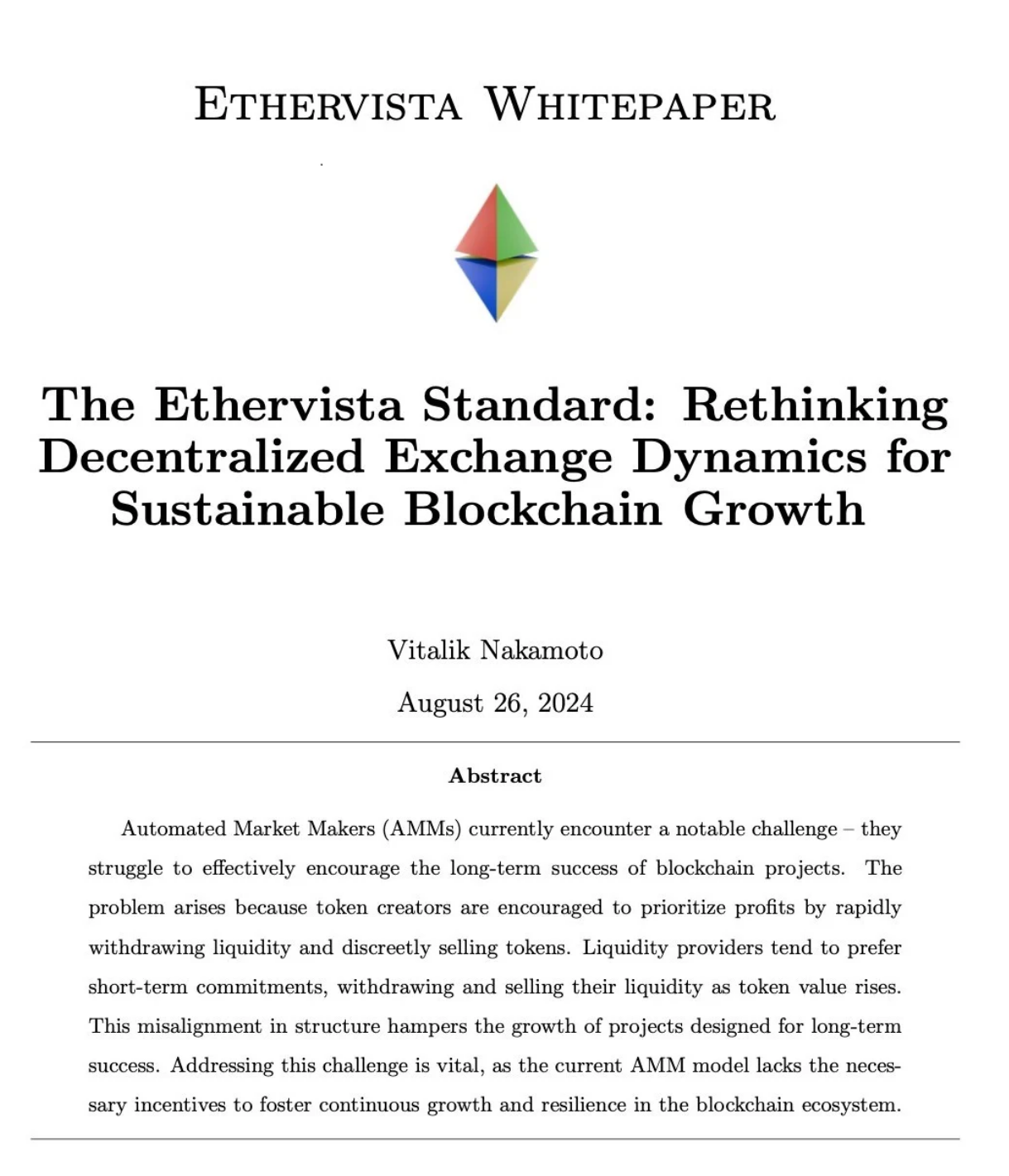
In the official whitepaper released on the X platform, the team describes the "EtherVista Standard: Rethinking the dynamics of decentralized trading platforms for sustainable blockchain growth."
The whitepaper is dated August 26, 2024, and the author is "Vitalik Nakamoto," a name that combines the creator of Bitcoin, Satoshi Nakamoto, and the founder of Ethereum, Vitalik Buterin.
The whitepaper abstract discusses a significant challenge facing automated market makers (AMMs), which is the inability to effectively promote the long-term success of blockchain projects.
According to the team, the problem lies in the token issuers' preference for prioritizing profit by quickly withdrawing liquidity and quietly selling tokens. The EtherVista team points out that liquidity providers also prefer short-term operations, often withdrawing and selling liquidity when token prices rise. This behavior hinders the growth of projects aimed at long-term success.
Addressing this issue is crucial because the current AMM model lacks incentive mechanisms to promote the sustainable growth and resilience of the blockchain ecosystem.
3. Custom Fees Paid in ETH
Unlike most current AMM platforms, which charge a 0.3% fee for each token exchange, traditionally paid in token form, the new standard of EtherVista requires fees to be paid only in native ETH.
According to the EtherVista whitepaper, these fees will be allocated to liquidity providers and token creators. Each exchange adopts a new mechanism to distribute rewards to millions of users at a low gas cost.
Additionally, the creator's fee is a protocol fee, and this portion of the fee is allocated to smart contracts and the treasury.
4. Use Cases and Features
The main use cases include:
Automatic buying
Staking rewards
Other DeFi applications
The features of this model include:
Market makers and creators benefit from trading volume rather than token price.
The model encourages long-term development, avoiding short-sighted price fluctuations.
Investors benefit from a delayed liquidity withdrawal mechanism, preventing developers from quickly conducting "rug-pulls."
This approach reduces the risk of market mutations while increasing the overall investment success rate.
EtherVista plans to expand beyond traditional liquidity pools, gradually building ETH-BTC-USDC pools, providing:
Borrowing
Futures
Zero-fee flash loans
Overall, according to the official whitepaper, EtherVista aims to be a "multi-in-one decentralized application."
5. Mathematical Principles Behind the EtherVista Model
The technical overview of EtherVista describes the allocation of liquidity provider fees.
EtherVista's pairing smart contract maintains a set of increasing numerical sequences called Euler amounts. Each time native ETH is transferred to the pairing contract, these values are updated. The calculation method for each Euler number is to add the fee to the ratio of the current liquidity provider token (LP) total supply to the previous Euler number. The initial Euler number is set to zero.
The core of their mathematical approach lies in the following points:
Ability to accurately calculate each user's allocation share in a single exchange
Maintaining the highest level of accuracy even as the total supply of LP tokens continues to change
6. Pool Configuration and Protocol Fees
According to the official website, the person who initially provides liquidity is called the "creator" and has write permissions to configure the pool settings.
These settings include:
Pool fees
Protocol address
Metadata
The most important parameter is the protocol allocation smart contract address. While this is optional, by default, it is the creator's address. This address receives ETH from the protocol fees through the smart contract's custom logic, enabling widespread DeFi applications that are not achievable under the current AMM standard.
This new revenue generation method shifts the focus from short-term gains and price fluctuations to:
Activity
Longevity
Utility
Creators can define on-chain metadata for their tokens, including website URLs, logos, project descriptions, social media, and chat links. All of this data helps creators effectively showcase their projects, ensuring that users can access verified and secure information, reducing the risk of phishing attacks.
In addition to pool fees and protocol fees, there will be a fixed $1 fee for the continuous development of EtherVista DEX and VISTA Token.
This fee will be used for the implementation of the following projects:
Zero-fee flash loans
Futures
Borrowing
Support for potential listings on centralized trading platforms and marketing plans
7. EtherVista Platform
The interface design of the EtherVista platform has a retro feel, reminiscent of early versions of Windows.
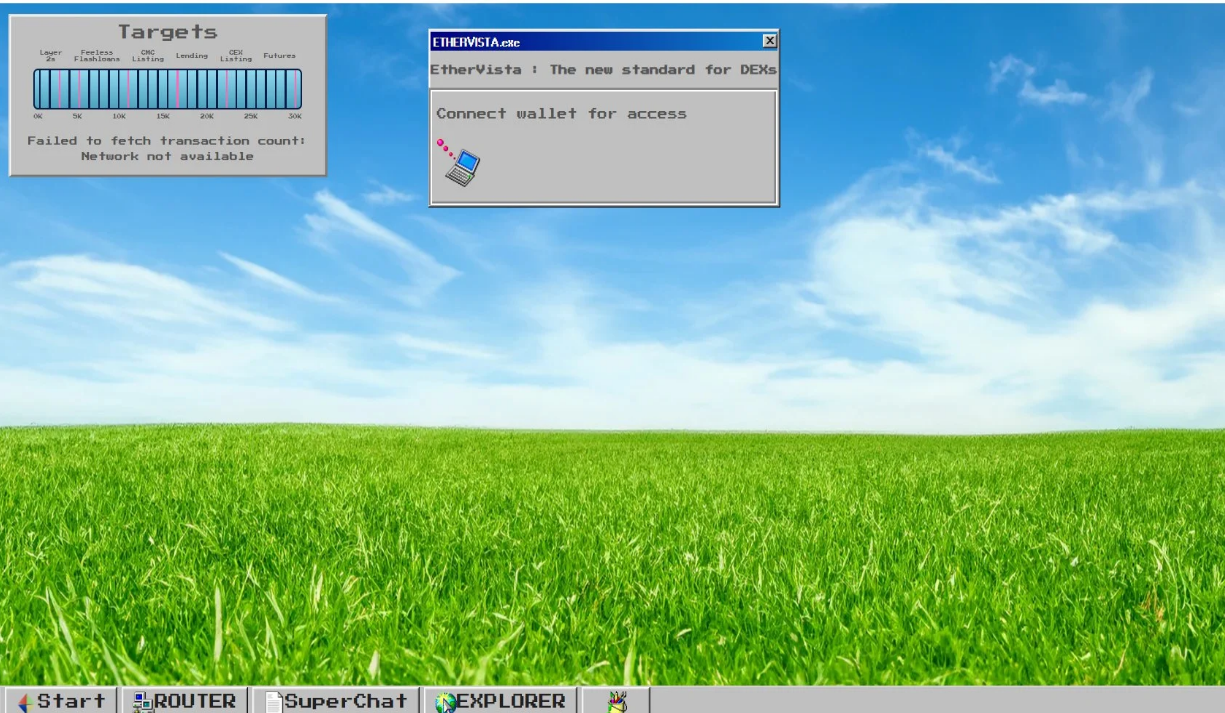
As mentioned earlier, EtherVista offers flash loans, futures, and borrowing functions, which users can find through the "Start" button in the bottom left corner.
Additionally, the platform also features a "Super Chat" button. According to the official whitepaper released by the project team on the X platform, this is a global real-time chat function directly integrated into the DEX platform, making it convenient for users to exchange information quickly.
The official description indicates that access to "Super Chat" is based on levels, depending on the amount of VISTA Tokens held by the user.
Creators who want to restrict token trading exclusively to the EtherVista platform can limit the ERC20 transfer function to the EtherVista router address, which is stored in the factory contract address.
8. VISTA Token
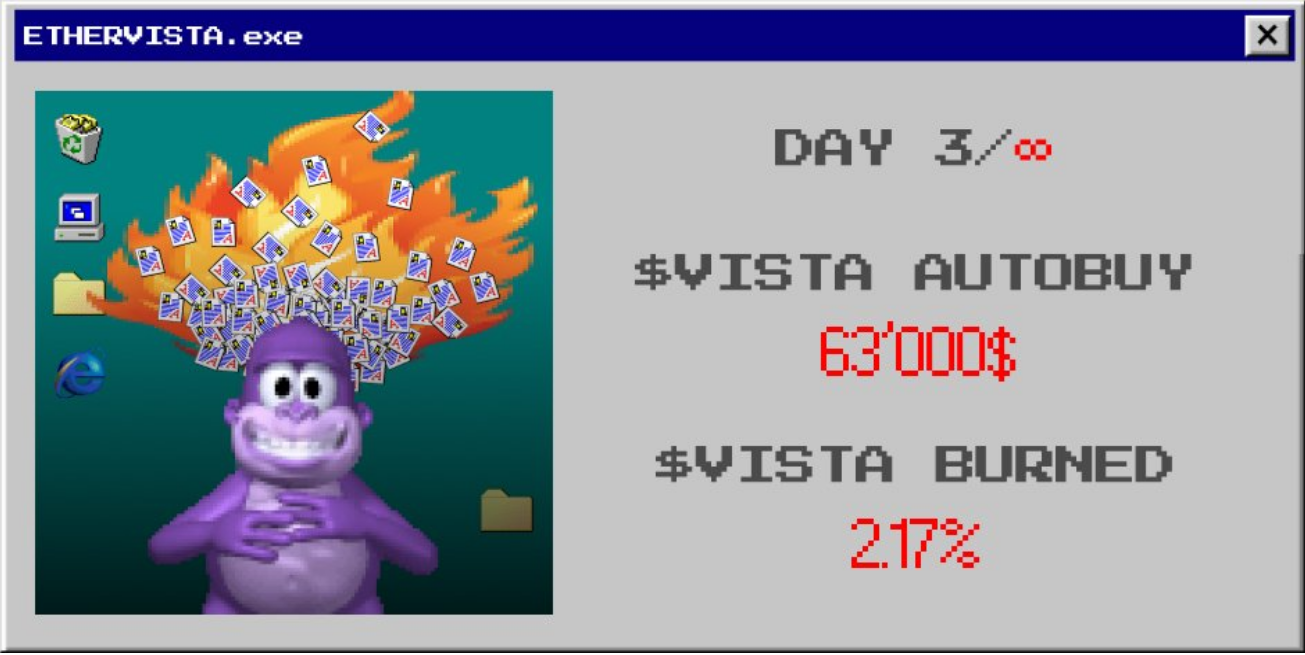
VISTA is the native token of this decentralized trading platform, with a maximum supply limit of 1 million tokens. It is a deflationary token with value accumulation functionality.
The protocol's smart contract implements an on-chain processing mechanism, where each token burn event not only reduces the circulating supply but also increases the token's price floor.
This effect is maintained by continuously repurchasing and burning tokens with the fees generated by each transaction within the protocol.
In a post on the X platform, the EtherVista team pointed out that as of September 3, 2024, 2.17% of the total supply had been permanently bought and burned.
The benefits of VISTA include:
- Serving as a tool against inflation by linking activity with supply reduction and price floor growth
- Enhancing the value of VISTA with each transaction
- Driving continuous growth and scarcity
9. VISTA Public Testnet Officially Launched
The EtherVista team announced on the X platform on September 4 that the VISTA public testnet is now live. According to the team's explanation, users should log in and claim their VISTA quota, which is limited. Additionally, gas fees are required when signing the wallet.
10. EtherVista, the ETH Version of Pump.fun?
EtherVista is described as the Ethereum version of Pump.fun, which is the memecoin generator on Solana. DeFi users on Ethereum have complained about the lack of innovation on the mainnet, and EtherVista's new LP and fee mechanisms aim to address this issue by filling the market gap.
EtherVista recently released its whitepaper, promoting its fair distribution. An analysis found that most "rug-pulls" occur within 2 to 4 days, so a 5-day liquidity lock period has been set. As of September 2, official data shows that the token's market value has exceeded $15 million.
In addition, EtherVista announced plans to deploy on Ethereum L2 and upcoming features such as the ETH-BTC-USDC liquidity pool, borrowing, and flash loans. The project adopts a deflationary model, and whether it will appreciate over time remains to be seen.
A few days ago, EtherVista gained attention when reports indicated that a trader had made significant profits by leveraging the platform's launch. By strategically distributing VISTA Tokens to seven different wallets, the trader invested $5,000 and quickly sold the held tokens, converting the profit into Ethereum within 48 hours, ultimately earning a total profit of $670,000, equivalent to a 130x return.
Pump.fun also has notable achievements, with one being the platform achieving $100 million in revenue in just 217 days, making it the fastest-growing application in crypto history.
Original article link: https://www.hellobtc.com/kp/du/09/5402.html
Source: https://crypto.ro/en/education/what-is-ethervista-pump-funs-competitor-on-ethereum/
免责声明:本文章仅代表作者个人观点,不代表本平台的立场和观点。本文章仅供信息分享,不构成对任何人的任何投资建议。用户与作者之间的任何争议,与本平台无关。如网页中刊载的文章或图片涉及侵权,请提供相关的权利证明和身份证明发送邮件到support@aicoin.com,本平台相关工作人员将会进行核查。


