On September 5, 2024, in an interview with @BanklessHQ, analyst Max Resnick delved into the future development of Ethereum, including decentralized sequencers, Ethereum-based Rollups, a comparison of ZK and Optimistic technologies, challenges of L2 tokens, and the goal of increasing Ethereum's throughput.
Author: @0xBreadguy
Translation: Blockchain in Plain Language
On September 5, 2024, @BanklessHQ hosted an interview titled "Is the Ethereum Roadmap Off Track?", which provided an in-depth discussion of the future development roadmap of Ethereum. The main guest of the interview was Max Resnick, an analyst and commentator in the crypto space. The interview focused on the following aspects:
1) Decentralized Sequencers: The discussion revolved around how to decentralize sequencers in L2 (Layer 2) solutions, the current technical challenges, and implementation difficulties. The interview pointed out that while decentralized sequencers are a worthwhile goal, there may be certain challenges in practical implementation.
2) Ethereum-based Rollups: The interview introduced Ethereum-based Rollups as an improvement for L2, utilizing Ethereum for sequencing and sacrificing a portion of execution rewards. This method is considered a good choice for aligning incentives, enhancing L1 performance, and improving L2 user experience.
3) Comparison of ZK and Optimistic Technologies: A comparison was made between ZK (zero-knowledge) technology and Optimistic technology. While ZK is considered a superior technology, Optimistic has dominated Ethereum's roadmap to a certain extent due to its early introduction and significant market impact. The interview suggested that the Ethereum Foundation should refocus and strive to improve coordination between the mainnet and ZK.
4) Value and Challenges of L2: The discussion covered the risk of devaluation of L2 tokens and predicted that various teams may take measures to weaken the value proposition of ETH in order to enhance the value of their own tokens.
5) Future Goals of Ethereum: The interview mentioned that Ethereum needs to significantly increase its throughput, aiming for a 100x performance improvement to remain competitive in the blockchain space.
Overall, this interview provided profound insights into the development roadmap of Ethereum from a non-traditional perspective and offered constructive suggestions for current technology and strategies.
Below are some key points summarized by @0xBreadguy regarding this interview:
1. Decentralized Sequencers
Max believes that if L2 truly values this issue, they should prioritize decentralizing their sequencers. In fact, this is not difficult to achieve, as all necessary components (i.e., consensus mechanism) to achieve this goal are already available and applied on each L1. This is one of the few points where I have a slightly different view, but it's just a minor difference.
I think the PoA/rotation mode as an intermediate solution for fully decentralized consensus is a good choice, as it allows L2 to operate without bearing the full consensus overhead, while avoiding the incentive misalignment that may arise from L2 acting as a completely independent blockchain (thus increasing their likelihood of becoming L1).
For example, @megaeth_labs' model uses a set of sequencers that rotate based on time, such as servers in the United States serving as leaders during U.S. time periods.
2. Users are the Lifeblood of Ethereum
Max pointed out that a current issue is the migration of users from the mainnet to L2 for the same use cases, making L2 appear as a parasite (paying homage to @KyleSamani). He views application demand as a spectrum, encompassing decentralized, permissionless, and other different attributes. The current problem is that the application scenarios of Ethereum and L2 largely overlap. His ideal situation is for DeFi to continue operating on Ethereum, while other value-added applications (such as coffee payments) can be conducted on L2.
I fully agree with this viewpoint and have created a diagram showing the difference between the current situation and an ideal symbiotic state.
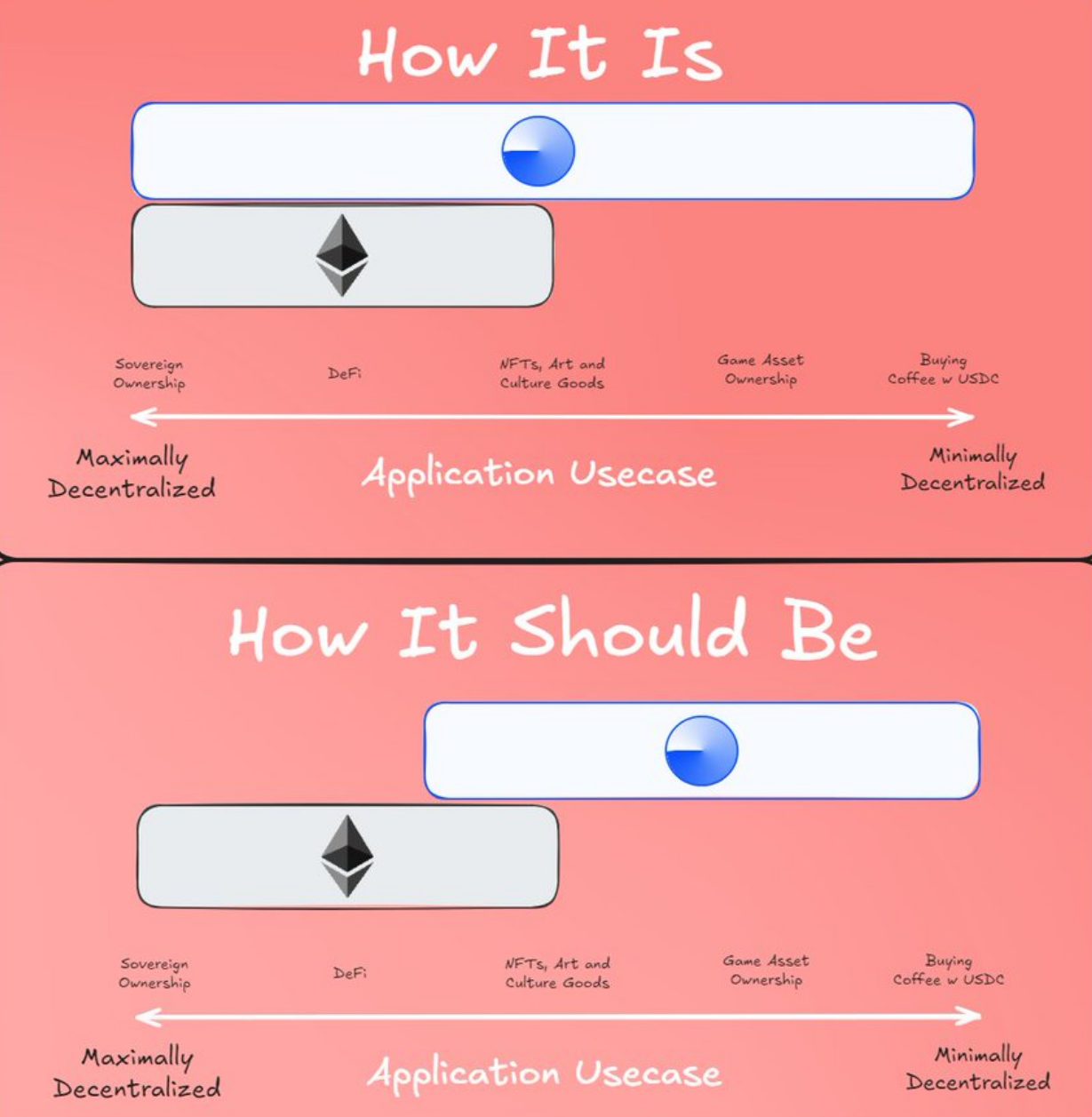
Of course, there will always be overlapping choices for users, but the core idea is to align incentives and improve L1 performance, so that users can clearly understand that Ethereum retains strong decentralized characteristics and should be used for high-value transactions, while L2 provides better user experience and compensates for the lack of decentralization for low-value transactions.
I firmly believe that the "monetary properties" obtained from L2 cannot compensate for the loss of execution power on the mainnet, and Ethereum's biggest challenge so far remains the message passing problem.
3. Ethereum-based Rollups
Max believes that Ethereum-based architecture is a more "aligned" version of L2, as they utilize Ethereum for sequencing and to some extent, sacrifice execution rewards. Furthermore, improvements to the mainnet will simultaneously enhance the user experience of Ethereum-based Rollups and L1 capacity (especially block time).
He also proposed the concept of "super Ethereum-based" Rollups, which provide user protection in blocks, rather than maximizing rewards for block builders. If Ethereum had adopted this Ethereum-based design from the beginning, the current situation might have been better, as the incentive mechanism and ecological direction would have been more consistent.
I completely agree with his views. He also mentioned that the emergence of these designs was too late, which is regrettable, as the lack of incentive mechanisms makes it difficult for existing architectures to transition to Ethereum-based designs (I have also commented on this before: https://x.com/0xBreadguy/status/1830221991749484630). Although teams are pushing for this change, it may be too late.
I increasingly appreciate Max's viewpoints.
I would also like to add that Gwenyth Taiko is an Ethereum-based architecture that possesses a property I believe can truly enable L2 to become a genuine extension of the Ethereum network: atomic composability with L1 contracts.
4. Is L2 Ethereum?
1) Optimistic vs ZK
Max pointed out that ZK technology is superior, but Optimistic has captured market share not only because it was ready early, but also because its prominent position has to some extent guided Ethereum's roadmap. He believes that the Ethereum Foundation (EF) should return to its core and work to improve alignment between the mainnet and ZK.
He also noted that ZK plays a role in the required area (bandwidth), while Optimistic contributes to execution.
On this point, I don't have much disagreement, as I also believe that ZK technology is superior, but it still has some research challenges to address. I would like to add that Max mentioned the release of ZK state differences to the mainnet, which, while compensating in terms of bandwidth, also incurs some losses, such as losing historical records within batches (for example, A->B and B->C on the mainnet would be considered as A->C).
2) Ethereum needs to increase throughput by 100x
Max specifically mentioned various proposals to achieve a "100x" increase in Ethereum's throughput, such as by shortening block times and having multiple parallel proposers, in order to catch up with other blockchains.
I think this is a great opportunity to visualize what a "100x" increase in throughput on chains like Solana means.
Below are the data throughput situations for Bitcoin, Ethereum, Solana, and Ethereum with a 100x increase in throughput today:
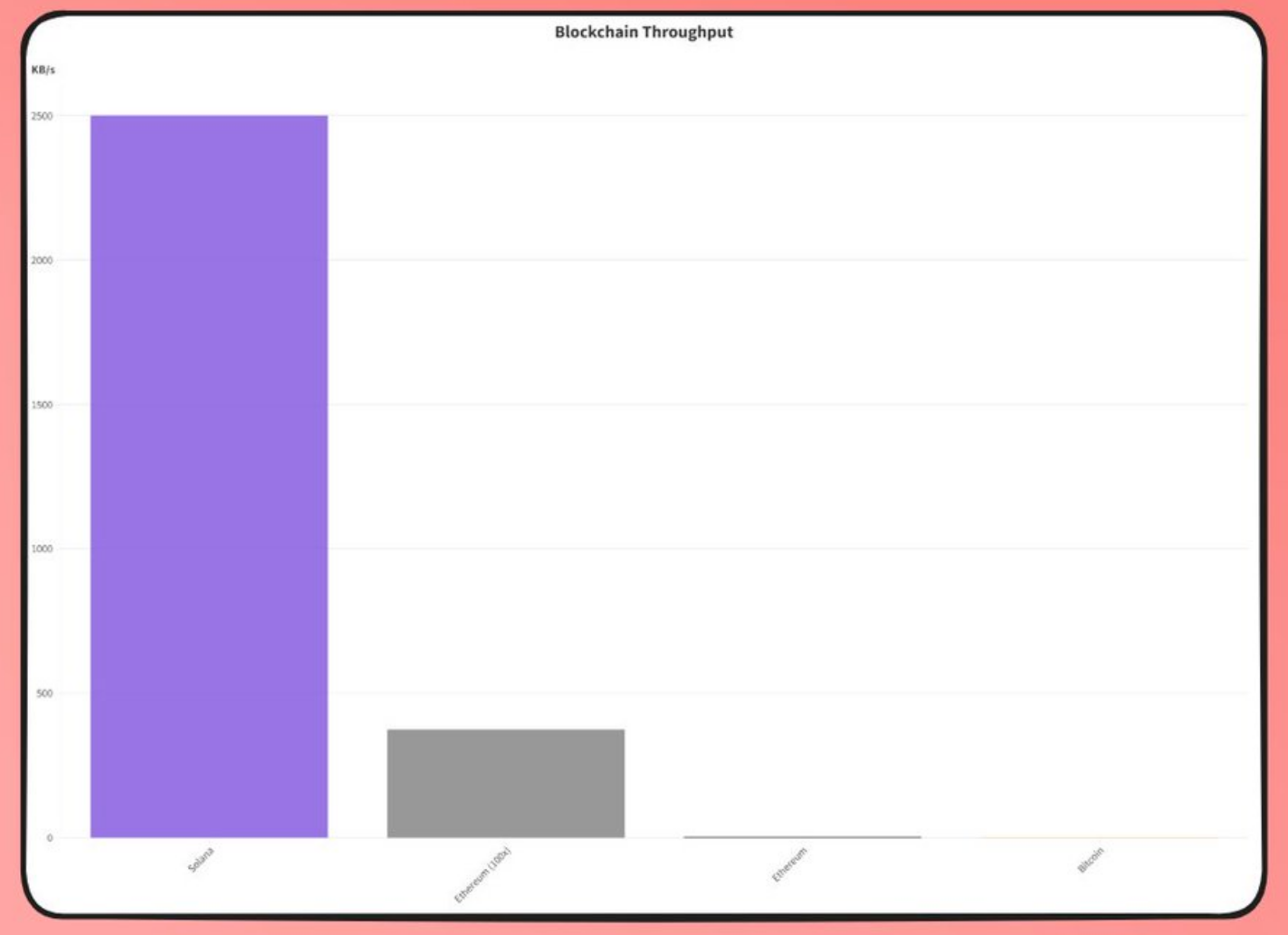
Even with a 100x improvement achieved (Vitalik is skeptical about whether this can be done while retaining the value of Ethereum), Ethereum still lags far behind Solana. I don't think this goal should be considered unattainable, after all, it can bring about many synergistic effects.
5. Other Points
He pointed out that although ZK technology is superior, Ethereum's roadmap is to some extent dominated by the Optimistic team and should return to balance. He is increasingly skeptical about whether Arbitrum and Base can have an overall positive impact on Ethereum, mainly because of their corporate governance structure and the interests they need to give up (such as user fees). He also mentioned that compared to other L2 solutions, Base charges users much more than what they pay to the mainnet, which feels excessive.
He predicts that L2 tokens may depreciate, so various teams may take steps to weaken the value proposition of ETH in order to enhance the value of their own tokens. All of this involves incentive mechanisms. Finally, he emphasized that while Ethereum has many people dedicated to a noble vision, they may have deviated from the best way to achieve common goals.
6. Conclusion
Overall, this interview provided a non-traditional perspective and brought valuable insights, highly recommended for everyone to listen to. His views align closely with my own views on the future direction of Ethereum, and I hope Ethereum can adopt some of the suggestions.
I particularly like a quote to end with: "I don't think people would have thought that the future of Ethereum would become a cheap and featureless infrastructure platform, ultimately being used by a group of big companies to make as much money as possible."
It hits the nail on the head.
Original article link: https://www.hellobtc.com/kp/du/09/5397.html
Source: https://x.com/0xBreadguy/status/1831419606143267218
免责声明:本文章仅代表作者个人观点,不代表本平台的立场和观点。本文章仅供信息分享,不构成对任何人的任何投资建议。用户与作者之间的任何争议,与本平台无关。如网页中刊载的文章或图片涉及侵权,请提供相关的权利证明和身份证明发送邮件到support@aicoin.com,本平台相关工作人员将会进行核查。


