Original | Odaily Planet Daily (@OdailyChina)
Author | Azuma (@azuma_eth)
As the cryptocurrency market plummeted rapidly yesterday, the discussion on the risks of Ethena and its stablecoin USDe has once again come to the forefront.
According to Dune data, as of the time of writing, the supply of USDe has decreased from over 3.6 billion tokens at its peak to about 3.1 billion tokens, with a supply reduction of approximately 95 million tokens in just one day. The fundamental reason for the reduction in USDe circulation is actually the shrinking of the arbitrage space for funding rates in a downward trend, and even the potential transition to negative values. Investors have chosen to reduce their positions out of risk aversion and adjustment of arbitrage strategies.
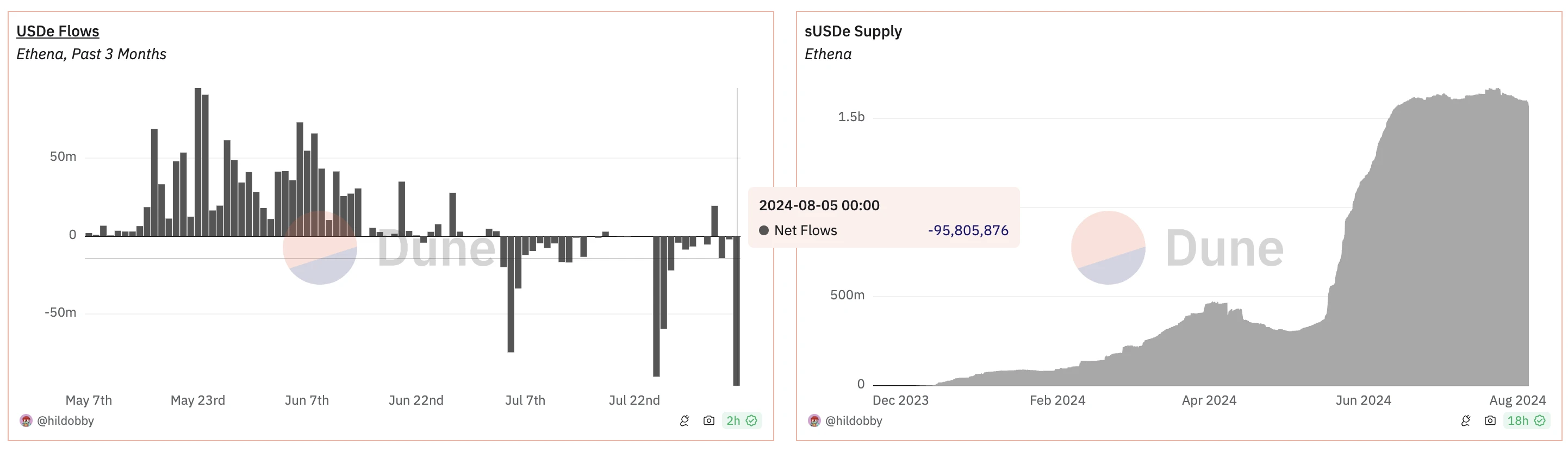
In a somewhat panicked market sentiment, some users are concerned that USDe may not be able to withstand large-scale redemption pressure. Some users have even started comparing USDe with UST, fearing that the former may experience a death spiral similar to the latter.
In our view, while USDe certainly has its own risks, comparing it to UST is not fair. The differences in their design mechanisms determine that they are two completely different systems, and their response logic under pressure is also completely different. Even in the most extreme circumstances, USDe would only face irreversible systemic trauma after several detectable extreme conditions occur (as will be discussed below).
Ethena: Funding Rate Arbitrage Protocol
For users who are not familiar with Ethena, they can read "An Analysis of Ethena Labs: Valued at 300 Million USD, the Stablecoin Disruptor in Arthur Hayes' Eyes" before reading this article.
In essence, Ethena is a funding rate arbitrage protocol, and USDe is a new type of stablecoin collateralized by an equal amount of spot long positions (currently only supporting ETH and BTC) and futures short positions.
The biggest label for USDe is "Delta Neutral." The so-called Delta is an indicator used in finance to measure the impact of changes in the price of the underlying asset on the portfolio. Considering the nature of USDe's product, since the collateral assets of this stablecoin are composed of an equal amount of spot long positions and futures short positions, the Delta value of the spot position is "1," the Delta value of the futures short position is "-1," and the Delta value after hedging is "0," achieving "Delta Neutrality."
Compared to traditional stablecoin projects, the biggest feature of USDe is its more imaginative yield space.
- First, it comes from the stable yield of spot long positions. Ethena supports pledging spot ETH through liquidity staking protocols like Lido to earn an annualized yield of 3% - 5%.
- Second, it comes from the unstable yield of funding rates for futures short positions. Users familiar with contracts understand the concept of funding rates. Although funding rates are an unstable factor, for short positions, the majority of the time, the funding rate is positive in the long term, which also means that the overall yield will be positive.
The combination of these two yields has achieved a considerable yield for Ethena (the latest protocol yield rate published on the Ethena official website is 8.83%, and the yield for sUSDe is 12.61%), which under normal circumstances can sustainably exceed the yield of national debt-like products denominated in sDAI, making USDe the most attractive stablecoin product in the current market.
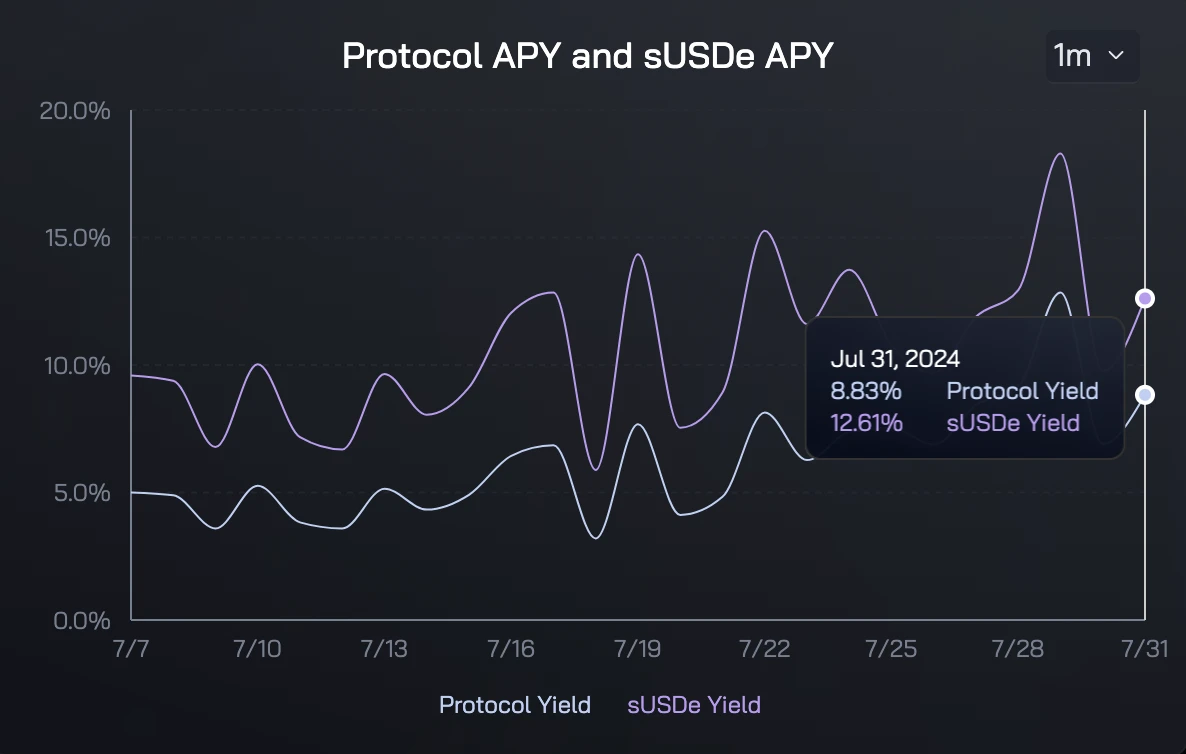
- Odaily Note: The yield rate data provided by the Ethena official website often has a delay of several days, and the latest data has not been updated.
The Fundamental Differences Between USDe and UST
The story of UST has ended for too long, and old players may have forgotten its design model.
In Terra's economic model, the price stability of UST is regulated through arbitrage systems and protocol mechanisms. Market participants can mint UST by burning an equivalent amount of LUNA, and conversely, they can burn UST to exchange for an equivalent amount of LUNA.
For example, if the demand for UST exceeds supply (assuming the price is $1.01), arbitrageurs have the opportunity to burn LUNA on-chain and mint UST, then use the price difference as profit in the open market. Conversely, if the supply of UST exceeds demand (assuming the price is $0.98), arbitrageurs can buy 1 UST for less than $1, then burn and mint $1 worth of LUNA for profit.
The design model of UST has two fundamental problems: UST itself does not have sufficient value support and is entirely based on algorithm maintenance; and in extreme market conditions where both UST and LUNA are falling, its built-in balance mechanism will lose its regulatory ability and may even become a double-edged sword—arbitrage programs will accelerate the decline of LUNA, thereby intensifying panic sentiment.
This is also the fundamental difference between USDe and UST.
- USDe fundamentally still has sufficient "spot + futures" position support. Guy Young, the founder of Ethena, mentioned yesterday that the collateralization ratio of USDe has always remained above 101%, while UST has made a commitment to anchor at $1 without sufficient collateral.
- In addition, the operation of UST depends on LUNA, and the volatility of the latter's coin price will affect the system itself; whereas the operation of USDe is not directly tied to ENA, and even if ENA goes to zero, it will not directly cause the collapse of the system.
With such fundamental differences, USDe and UST also have different response strategies when facing large-scale redemptions. When UST faced the failure of its balance mechanism, it could only seek external funding assistance from entities like Jump, whereas USDe only needs to ensure the smooth redemption of collateral assets—this involves the liquidation of futures and the sale of spot (including already pledged spot), which also carries independent risks, as will be discussed in the next section.
The Four Layers of Risk for USDe
Regarding the potential risks of USDe, Austin Campbell, a professor at Columbia Business School and the founder and managing partner of Zero Knowledge Consulting, has previously conducted a breakdown, which we believe is the best risk analysis of USDe in the current market.
In his article, Austin analyzed the four layers of potential risks for USDe.
- The first is the security risk at the collateral level, i.e., whether the security and sustainability of the collateral can be guaranteed. As mentioned earlier, Ethena will pledge spot ETH to earn collateral yield, but if the pledging protocol itself is attacked, it may lead to holes in Ethena's collateral assets.
- The second is the security risk of the futures contract opening platform. Both DEX and CEX are exposed to the risk of hacking attacks, which may also lead to the loss of collateral assets.
- The third is the contract availability risk. As Ethena's scale expands, the liquidity it needs also continues to increase. Sometimes, there may not be enough liquidity in the trading platform to go short, and in extreme cases, there may not even be enough liquidity to close positions, or the platform may even pull the plug (for example, at 3:12, assuming one side of the spot has been sold, and the other side of the futures cannot be closed)… All of this may cause the arbitrage mechanism of Ethena to malfunction, leading to losses for the protocol.
- The fourth is the funding rate risk, which is the situation USDe is currently facing. Although the funding rate for short positions is mostly positive, there is also the possibility of it turning negative. If the comprehensive yield rate after weighted collateral yield is negative, it will inevitably lead to outflows from the protocol.
Since the market downturn, the funding rates for BTC and ETH have both temporarily turned negative, leading to losses for the Ethena protocol during these periods. As of the time of writing, the funding rates for BTC and ETH are still negative, so the protocol continues to incur losses.


Future Predictions
In summary, it is expected that the funding rates may continue to remain at low levels (including negative values) due to market panic in the coming period, which also means that USDe is likely to continue facing outflows—outflows are also a form of self-repair for the protocol.
However, from the design model of Ethena, the trading periods with negative rates are predictable, in other words, the current situation is a not very common but inevitable state in the normal operation of Ethena. Based on historical patterns, periods with positive rates tend to last longer, which still makes the overall yield expectation for Ethena objective. But at the turning point to a bear market, whether historical patterns will still be effective, no one knows the answer.
We are more inclined to believe that as long as the market does not experience extremely extreme conditions, Ethena will have enough time to handle redemptions, even if the downward trend continues. The most pessimistic outcome here is a significant reduction in the circulation of USDe, but the protocol itself will still function.
Relatively speaking, the more dangerous aspect is still extreme market conditions—mainly the third risk mentioned earlier—because the probabilities of the first two risks are relatively low—namely, problems with the contract liquidity of the trading platform itself, which will cause the operational logic of Ethena to malfunction, thereby causing irreversible damage to the protocol.
免责声明:本文章仅代表作者个人观点,不代表本平台的立场和观点。本文章仅供信息分享,不构成对任何人的任何投资建议。用户与作者之间的任何争议,与本平台无关。如网页中刊载的文章或图片涉及侵权,请提供相关的权利证明和身份证明发送邮件到support@aicoin.com,本平台相关工作人员将会进行核查。


