Original | Odaily Planet Daily
Author | jk
 The rise of VanEck, an investment company focused on ETFs, is filled with bold innovation and strategic decision-making. From launching the Gold ETF to the recent Solana ETF, VanEck has continuously pushed the boundaries and driven change in the financial market. With the rapid development of the cryptocurrency market, VanEck has been at the forefront of the industry, applying for a Solana ETF and opening up new investment opportunities for investors.
In this article, Odaily Planet Daily will delve into VanEck's history and its decision-making process from the Gold ETF to the Solana ETF.
VanEck's History
In 1955, John van Eck founded Van Eck Global, taking advantage of the growing international stock market to bring post-World War II investment opportunities to American investors following the Marshall Plan's opening of Western Europe to American investors. His father immigrated from the Netherlands to the United States in the early 20th century. That same year, Van Eck established the first international equity mutual fund.
In 1968, the company launched one of the first Gold Funds in the United States, the International Investors Gold Fund, and shifted most of its portfolio to gold mining company stocks. From the 1970s to the mid-1980s, gold experienced a bull market, and the company achieved significant success. The International Investors Gold Fund attracted a large number of subscriptions, managing assets exceeding $1 billion. As a result, John van Eck was invited to participate in popular talk shows at the time, such as "The Wall Street Journal" and "The Merv Griffin Show."
1980s to the Early 21st Century: Downturn
However, after the mid-1980s, the prosperity of the gold market ended, and the company's business slowed down. By February 1998, the assets of the International Investors Gold Fund had shrunk to $250 million. John's son Jan said, "He became a gold fanatic. Basically, throughout my entire career, the value of gold has been declining, which means you are suffering redemptions, the fund is depreciating, because the price of gold has dropped from $800 per ounce to as low as $250 per ounce."
To cope with the decline in the gold market, the company began developing investment business in emerging Asian markets in the 1990s. In 1996, the company signed a joint venture agreement with the predecessor of Shenwan Hongyuan, ShenYinWanGuo, aiming to develop the fund market in China. However, the 1997 Asian financial crisis led to a sharp decline in demand for emerging market funds. One of the company's funds, the Van Eck Asia Dynasty Fund, saw its managed assets drop from $46.3 million at the end of 1996 to $11.2 million at the end of 1997.
From 1994 to 1998, the company's managed assets decreased by 21%, from $1.82 billion to $1.44 billion. In 1997, metal prices reached their lowest point in 12 years. Only its Global Hard Assets Fund achieved a positive return of 26% in the three years ending in December 1997. As a result, the company faced redemptions and a shrinking client base.
After 2006
In 2006, the company decided to enter the ETF business, launching its first ETF product, the Market Vectors Gold Miners ETF, allowing investors to invest in gold mining stocks through the stock market rather than directly in gold. Although not as popular as the SPDR Gold Shares launched in November 2004, its managed assets increased to $5 billion, becoming one of the company's biggest successes. By November 2009, the company had issued over 20 ETF products, with total managed assets reaching $9.7 billion.
John van Eck often traveled overseas for business, especially in Europe. During one trip, he met a German woman, Sigrid, 20 years his junior, and brought her back to the United States to marry. She later became VanEck's chief financial officer and the mother of two children. In the early 1990s, his sons Derek and Jan joined the company, and VanEck embarked on a series of business initiatives, with a focus on ETFs, leading to significant growth. Since Derek's passing in 2010, Jan has been managing the company's continuously growing global business, continuing to the present day. Jan, a graduate of Stanford Law School, inspired by technology entrepreneurs, joined the family business and began the transformation of ETFs.
Jan van Eck, "My father valued economics and history greatly, while I am more business-oriented, which allowed me to seize the opportunity of ETFs and shift towards non-actively managed gold funds."
In Europe, VanEck opened its first office in 2008, focusing on index business, and subsequently opened an office in Switzerland in 2010, with a focus on institutional distribution and the development of alternative and active investment management strategies. In 2018, VanEck acquired the Dutch ETF provider "Think ETF Asset Management B.V." to expand its ETF product portfolio in Europe and international markets.
On March 2, 2021, VanEck launched the Vectors Social Sentiment ETF on NYSE Arca, with the stock code "BUZZ." The fund consists of stocks popular on social media. On the first day of trading, the fund received $280 million in inflows, making it one of the top 12 best debuts in history.
To date, VanEck has issued over 100 ETFs, managing over $90 billion in assets.
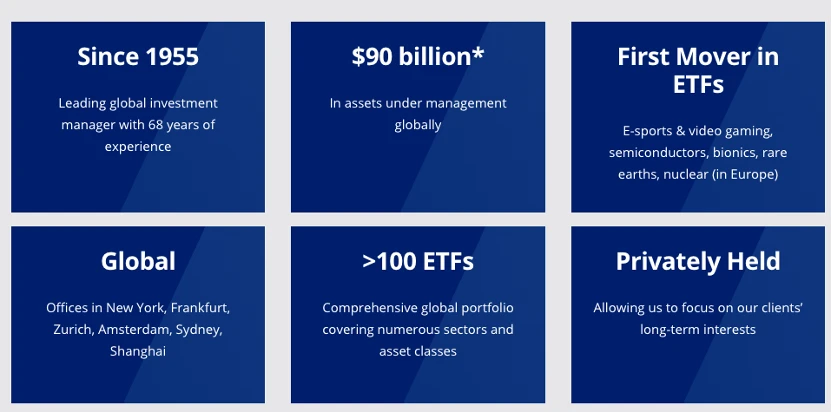
VanEck's successful history, image source: VanEck official website
Gold ETF and VanEck
Gold ETFs are financial products that track the price of gold, allowing investors to buy and sell gold shares through stock exchanges without the need to physically hold gold. The emergence of Gold ETFs has greatly simplified the process of investing in gold, reducing trading costs and risks.
The first gold exchange-traded product was the Central Fund of Canada, a closed-end fund established in 1961. The fund amended its articles of incorporation in 1983 to provide investors with products holding physical gold and silver.
In 1968, VanEck established the first open-end gold stock mutual fund in the United States.
In 1971, U.S. President Nixon abandoned the gold standard. VanEck's gold fund (now known as the VanEck International Investors Gold Fund) was the first of its kind, and as the price of gold soared from $35 per ounce to $800 per ounce, the fund became the best-performing fund in the industry.
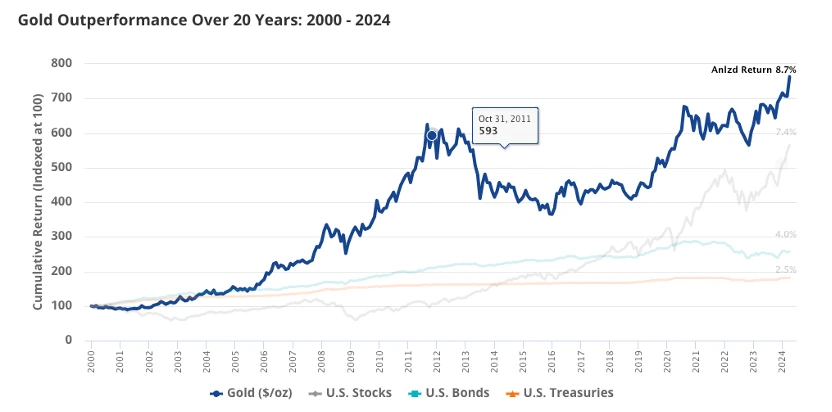
Gold performance since 2000. Source: VanEck
Although John was passionate about gold, his son Jan van Eck realized that the company's overreliance on gold was a vulnerability. He shifted the company's focus, leading the way into the ETF field. Today, ETFs account for 90% of VanEck's business.
On March 28, 2003, the first gold ETF developed by ETF Securities was listed on the Australian Securities Exchange. On November 18, 2004, State Street Corporation launched the SPDR Gold Shares listed in the United States, and the fund's assets exceeded $1 billion within the first three trading days.
In 2006, VanEck launched its first gold ETF product, the Market Vectors Gold Miners ETF, just two years after the first gold ETF in the United States. To date, the average trading volume of this ETF has reached around $20 million, with total net assets under management reaching $13.2 billion.
VanEck in the Crypto World: Applying for the First Bitcoin Futures ETF, First Spot Ethereum ETF, First Solana ETF
VanEck is an important player in the well-known Bitcoin ETF and Ethereum ETF. Unlike BlackRock's high approval rate, VanEck has always been labeled as "first application, bold trial and error." On August 11, 2017, VanEck submitted an S-1 application to launch the first Bitcoin futures ETF, becoming the first issuer to apply for an ETF investing in Bitcoin futures. Subsequently, VanEck also promptly applied for a spot Bitcoin ETF.
However, in November 2021, the U.S. SEC rejected the application, citing concerns that potential fraud in the cryptocurrency market could extend to regulated exchanges. From 2021 to March 2023, its application was rejected three times. However, VanEck persisted and continued to fight, finally succeeding in listing the spot Bitcoin ETF in 2024 amid a wave of approvals.
Subsequently, VanEck was the first company to submit an application for a spot Ethereum ETF in 2021, almost three years before the SEC began engaging with issuers including BlackRock, Fidelity, and Ark Invest.
However, unlike companies such as Fidelity and BlackRock, which only insist on Bitcoin and Ethereum ETFs (Fidelity's digital asset manager Robert Mitchnick publicly stated that Fidelity believes clients have "almost no interest" in cryptocurrencies other than Bitcoin and Ethereum), VanEck took an extra step: applying for a Solana ETF.
At the end of June, VanEck submitted an application to the U.S. Securities and Exchange Commission (SEC) for a spot Solana ETF, becoming the first issuer to apply for a Solana ETF. In a post on the X platform, VanEck's digital asset research director Matthew Sigel stated, "SOL's decentralized nature, high utility, and economic viability are consistent with the characteristics of other established digital commodities, reinforcing our belief in SOL as a valuable commodity with utility for investors, developers, and entrepreneurs seeking an alternative to the duopoly app store."
Coindesk stated, "VanEck is known for its pioneering position in the digital asset field."
免责声明:本文章仅代表作者个人观点,不代表本平台的立场和观点。本文章仅供信息分享,不构成对任何人的任何投资建议。用户与作者之间的任何争议,与本平台无关。如网页中刊载的文章或图片涉及侵权,请提供相关的权利证明和身份证明发送邮件到support@aicoin.com,本平台相关工作人员将会进行核查。