Article: Average Joe’s Crypto, Messari Researcher
Translation: Coolman, Foresight News
Key Points
- Particle Network is developing a modular Layer1 blockchain to achieve chain abstraction by aggregating users' on-chain addresses and balances to generate a universal account.
- Through its L1 blockchain, Particle Network has implemented three core functions: universal account, universal liquidity, and universal Gas. Each function supports unique use cases by eliminating manual multi-chain interactions in user experience.
- Particle Network also implements dual staking through Babylon to guide the security of the encrypted economy, while using aggregated data availability to eliminate single points of failure in network data availability.
- Particle Network's public testnet was launched on May 2nd, along with the "Particle Pioneer" reward program. Currently, 1.3 million accounts have been registered, distributing 6.71 billion $PARTI tokens.
Introduction
Regardless of the market conditions, the continuous increase in the total number of blockchains seems to be one of the few constants in the cryptocurrency industry. Whether it's Ethereum Layer2, non-EVM Layer1, or specific application chains, there are new blockchains almost every month.
Regardless of market conditions, the continuous increase in the number of blockchains seems to be one of the few constants in the cryptocurrency industry. Whether it's Ethereum's Layer 2, non-EVM Layer 1, or specific application chains, it seems that new blockchains are launched almost every month. While diverse blockchain systems can provide users with various choices, the multi-chain ecosystem has drawbacks for both developers and users due to each blockchain being tailored to specific needs or use cases.
Developers not only have to worry about the application or product they are developing, but also have to consider which blockchain ecosystem to deploy on. Whether to deploy on multiple chains, incurring additional development costs, or to deploy on a single chain to save costs but be isolated from the broader multi-chain ecosystem, these are issues that developers need to consider at the early stages of product design. For users, more chains mean more complexity and liquidity, and the user experience (UX) is far from being as simple as Web2.
For the Web3 space to truly reach the adoption level of Web2, chain abstraction seems to be an inevitable path. Particle Network is developing a modular L1 blockchain to achieve chain abstraction by providing each user with a unified on-chain address and balance across all blockchains.
Project Background
Particle Network was co-founded by Pengyu Wang and Tao Pan in April 2022. Both founders have experience in mobile game development, and the initial purpose of creating Particle Network was to provide backend infrastructure for developers. To date, Particle Network has raised $25 million through four rounds of financing. On May 2, 2024, Particle Network's incentive L1 testnet was launched, providing point rewards through Particle Pioneer, and its mainnet is scheduled to launch in the second half of 2024.
Network Features
Particle Network's Layer1 chain enables the realization of three core functions: universal account, universal liquidity, and universal Gas. Each function has a unique use case, with the clear purpose of achieving chain abstraction for users by eliminating manual multi-chain interactions in user experience.
Universal Account
Source: Particle Network
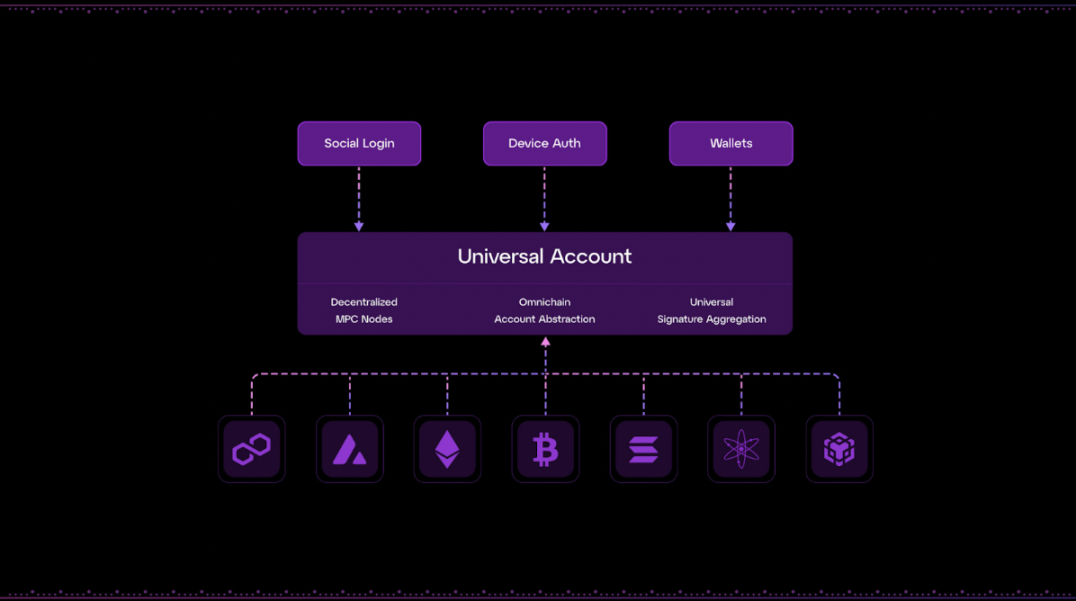
Particle Network's universal account provides each user with a unified address, balance, and interaction point, without considering which dApp the user is using or where the funds are located on which chain. In addition, the universal account is EVM and non-EVM network compatible through ERC-4337, and can even be deployed on networks with limited programmability such as Bitcoin. Compared to classic EOA accounts, smart accounts have greater flexibility, programmability, and security. Furthermore, the universal account improves EOA through cross-chain unification, allowing users to use a consistent account and balance on all chains.
For example, if a user wants to mint an NFT on an L2 rollup, but all their ETH is on the Ethereum chain, using EOA, the user must sign the following transactions:
- Approve the bridge contract
- Bridge ETH from Ethereum to L2
- Approve the minting contract
- Mint the NFT
However, with a universal account, the same user only needs to sign one transaction.
Particle Network is also developing a universal WaaS SDK to allow any application to easily integrate universal accounts into their products. In addition, universal WaaS will allow applications that have already integrated with Particle Network's existing wallet abstraction service, modular smart wallet-as-a-service, and BTC Connect to automatically upgrade existing smart accounts to universal accounts.
Universal Liquidity
Source: Particle Network
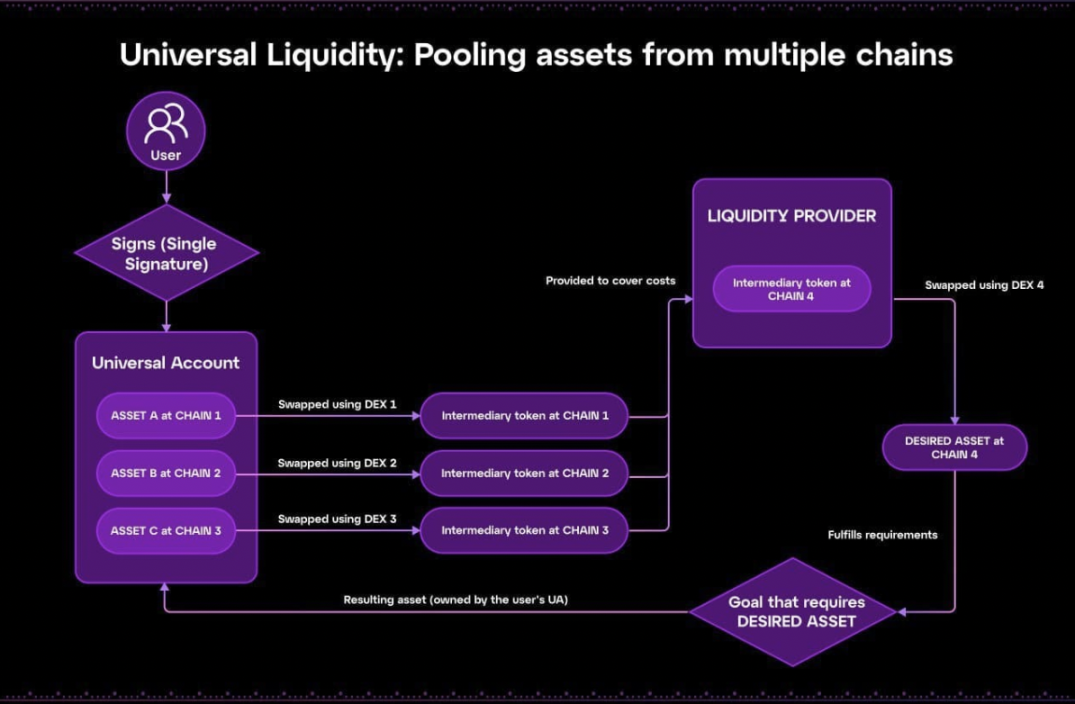
Universal liquidity is the foundation for Particle Network's universal account to aggregate all on-chain liquidity and generate single balance data. In simple terms, universal liquidity is Particle Network's cross-chain bridge solution, allowing users to transact on any supported blockchain.
For example, if a user wants to purchase SPL tokens on Solana, but all their funds are on Ethereum, using Particle Network's universal account, the user only needs to sign one transaction to complete the purchase. The underlying liquidity mechanism of this transaction bridges funds from Ethereum to Solana. These transactions will be executed on behalf of the user through Particle Network's Bundler node distributed network.
Ultimately, universal liquidity aims to automate cross-chain activities based on each transaction. Typically, cross-chain activities involve multiple manual transactions on different blockchains. Through universal liquidity, the user experience is simplified, requiring only one transaction to complete the cross-chain activity as described above.
Universal Gas
Source: Particle Network
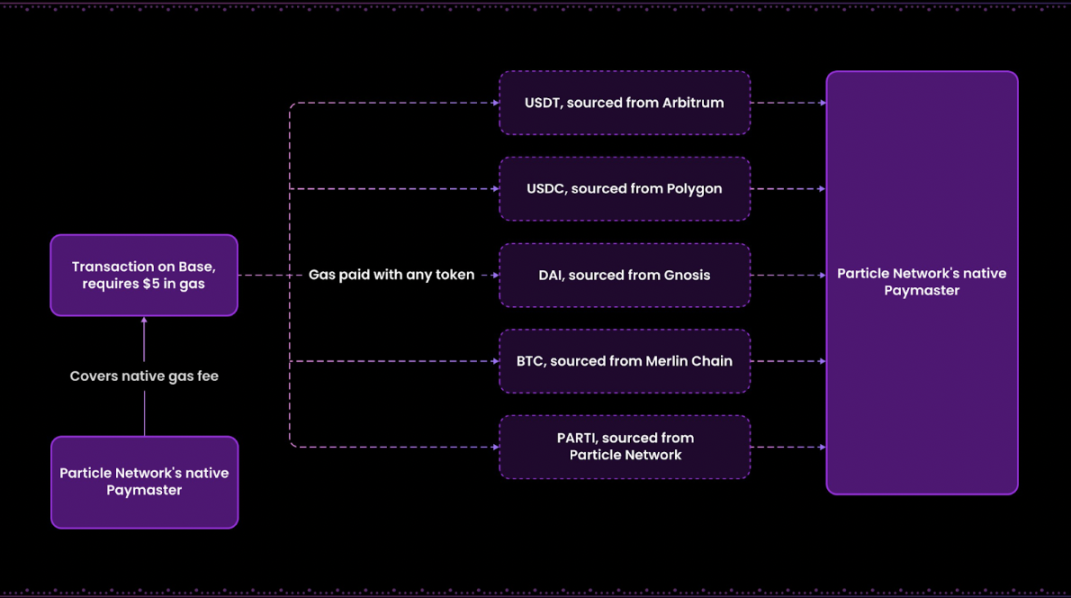
The challenge faced by multi-chain frameworks is gas payment. Particle Network's universal Gas aims to solve this complex issue by abstracting away the specific Gas tokens used. Through the use of Particle Network's Paymaster, users can pay transaction gas fees using any supported on-chain tokens. For example, USDC on Ethereum can be used to pay for Gas on transactions on Solana.
When conducting transactions through the universal account, Particle Network prompts users to choose which tokens to use for paying the related gas fee. Users can choose multiple tokens, even tokens from multiple blockchains, for payment. Subsequently, these tokens are transferred to the Paymaster, exchanged for Particle Network's native token PARTI, and used for settling relevant transactions on Particle Network. The Bundler node then executes the relevant transactions.
Technology
Particle Network is a modular Layer 1 built on Cosmos SDK and CometBFT. Cosmos SDK is an open-source software development toolkit for building sovereign, multi-asset, public, PoS blockchains, typically used to construct custom application layers or state machines, while CometBFT is used to securely replicate the state machine across all nodes in the network. CometBFT is an application-agnostic engine that handles the network layer and consensus layer through two main components:
- The consensus algorithm, Tendermint.
- The socket protocol, Application Blockchain Interface (ABCI).
Tendermint validates requests on the source chain and confirms changes on the target chain. Its consensus provides instant finality and Byzantine fault tolerance. Additionally, Particle Network also adopts BeaconKit from Berachain, which also features an EVM-compatible execution environment.
Modules
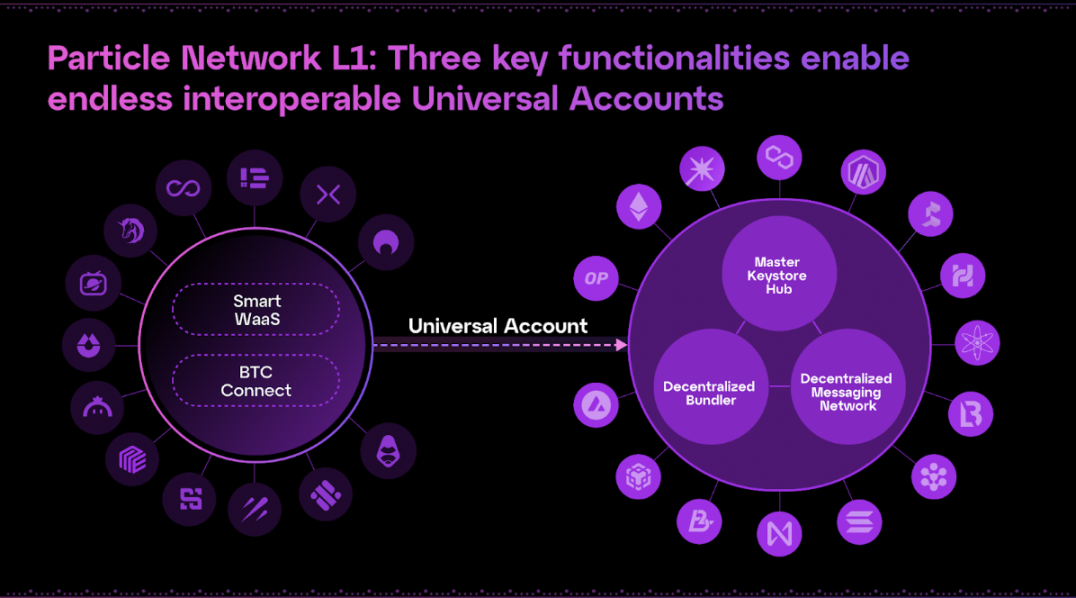
Particle Network's core functions (universal account, liquidity, and Gas) are implemented through three main modules: Master Keystore Hub, Decentralized Message Network, and Decentralized Bundler.
Source: Particle Network
Master Keystore Hub
The Master Keystore Hub module acts as the central "truth archive" of Particle Network by synchronizing state changes for universal accounts across all supported blockchains. This allows the Master Keystore Hub to maintain state equality across networks and record any changes occurring on Particle Network.
Decentralized Message Network
Particle Network's Decentralized Message Network (DMN) module forwards successful user operations (transactions of universal accounts) from external blockchains to Particle Network. The DMN is built on the Relayer node system (the node information hub on Particle Network). Additionally, the DMN collaborates with the Master Keystore Hub to transmit state data to supported blockchains or from supported blockchains to the Master Keystore Hub.
Decentralized Bundler
The Decentralized Bundler module is responsible for executing external user operations (UserOperations), which is the core component of universal liquidity. This module consists of a distributed network of Bundler nodes. Bundler nodes conduct transactions on behalf of universal accounts, such as purchasing NFTs or token swaps. Bundler nodes achieve this by interacting with liquidity providers. It's important to note that the liquidity providers here are not traditional decentralized exchanges (DEX), but rather liquidity pools spanning multiple chains, available for bridging liquidity funds.
For example, if a user wants to purchase SOL on Solana, but all their funds are in USDC distributed evenly across Ethereum, Optimism, and Arbitrum, a universal account can sign a single transaction to achieve the following:
- Particle Network's L1 processes the user operation related to the signed transaction.
- The Bundler forwards the user operation to the liquidity providers, sending the USDC on Ethereum, Optimism, and Arbitrum to the respective liquidity providers.
- Upon receiving the USDC, the liquidity providers send the USDC on Solana to the user's account.
- The Bundler node executes the transaction on the Solana DEX, exchanging USDC for SOL on behalf of the user.
Finally, Watchtower nodes ensure that these interrelated modules function properly by providing execution proofs or fraud proofs for each block generated in every epoch.
Dual Staking
Particle Network features a DPoS consensus mechanism with a dual staking system. Particle Network will utilize two sets of different validator nodes: one set validated by Particle Network's native token, and the other set validated by the Bitcoin anchoring protocol Babylon using BTC. The two sets of validators will independently reach consensus. The dual staking system can bootstrap the security of the encrypted economy using verified crypto assets like BTC and the network's native token.
Aggregated Data Availability
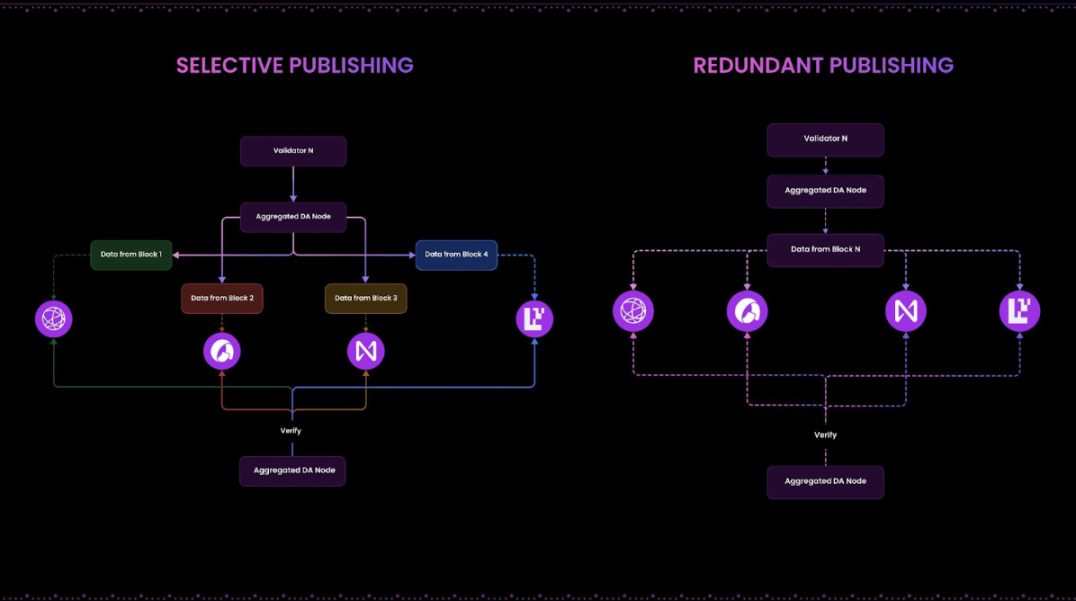
Data availability is also an integral challenge in the blockchain space. Data availability ensures that all nodes can access all the data required to validate transactions and maintain the chain's state. Additionally, relying on a single data availability solution can lead to single points of failure. If the data availability solution malfunctions, Particle nodes cannot guarantee the validity of blocks. Therefore, Particle Network adopts Aggregated Data Availability (AggDA), a unique approach that utilizes multiple data availability networks: Celestia, Avail, and NEAR DA.
Source: Particle Network
For each block generated on Particle Network, the data is randomly published through either of the following methods:
- Selective publishing - Data related to the block is only published to one of the supported DA solutions. This method helps reduce the associated cost of publishing data.
- Over-publishing - Data related to the block is published to all supported DA solutions. While this method is more costly than selective publishing, it disperses the risk of any single DA solution failing to function properly.
Public Testnet
The public testnet of Particle Network was launched on May 2, 2024. The testnet features Particle Network's universal account and universal Gas as its core functionalities. Users can register on the testnet and create a universal account using EVM wallets such as MetaMask or Rainbow, serving as the signers for the relevant universal accounts. Additionally, through Particle Network's BTC Connect, users can also control universal accounts using Bitcoin wallets like Unisat or OKX.
Users can deposit local tokens from supported test networks (such as ETH on Ethereum, BNB on BSC, etc.) to test Particle Network's universal gas functionality. Once deposited, these tokens are automatically converted to universal gas (USDG). With USDG, users can then send transactions on the testnet. As of the time of writing, there have been 9.6 million transactions using USDG on Particle Network's testnet. Furthermore, the user operations associated with these transactions have exceeded 1.215 billion. It's worth noting that this is an early version of the universal Gas, and a new implementation will be adopted after the mainnet launch.
Particle Pioneer
Particle Network has introduced the Particle Pioneer program to incentivize user participation in the Particle Network testnet. The program offers $PARTI token rewards to testnet users in exchange for future airdrops, bonuses on the People's Launchpad, and whitelist allocations for various ecosystem projects. The People's Launchpad is a Particle Network ecosystem project aimed at guiding projects and applications within the ecosystem.
Users earn points by using USDG to send transactions and pay for Gas. Each transaction earns 50 points, with a maximum of 100 transactions per day. Additionally, users can earn additional points by signing in daily. The more consecutive days of sending transactions, the more points are earned.
Particle Pioneer also provides additional points for holders of Particle Pioneer NFTs (NFTs specifically for testnet users and participants in previous events). It is reported that there are three types of NFTs, with point boosts ranging from 2% to 30% depending on the type of NFT.
So far, 1.3 million accounts have registered to participate in the Particle Pioneer program and have obtained $6.71 billion worth of PARTI tokens.
Roadmap
With the launch of the Particle Network testnet in May, the protocol is one step closer to the final mainnet release. The Particle Network roadmap is as follows:
- Q2’24 - Add universal liquidity and modular nodes to the public test network
- Q3’24 - Launch of mainnet V1, including universal account, liquidity, and Gas
- Q4’24 - Testnet launch of dual staking and AggDA
- 2025 - Mainnet V2 supporting dual staking and AggDA
Competitive Landscape
Chain abstraction is the origin of solving two major problems in the blockchain industry. The first problem is the dispersion of liquidity and users in multi-chain frameworks, leading to isolated ecosystems. The second problem is the poor user experience provided by external-owned accounts (EOA) wallets, which cannot compare seamlessly with Web2 applications. Solutions to these problems are mostly developed separately: bridging protocols connect isolated blockchains, while smart contract wallets enhance user experience. Chain abstraction integrates these solutions, combining the strengths of both into one product. Traditionally, protocols and teams have focused on one solution or the other, but new projects like Particle Network are dedicated to providing both solutions simultaneously, offering a more cohesive and efficient user experience.
Near
NEAR is a multi-purpose L1 smart contract platform with chain abstraction services. NEAR's multi-chain signature service allows users to sign transactions on other chains such as Ethereum, BNB, and others using their NEAR accounts. Similar to Particle Network, NEAR achieves chain abstraction through its MPC network and chain signatures, as well as multi-chain Gas relayers.
Avocado by Instadapp Team
Avocado by Instadapp is a smart contract account compatible with multiple EVM-compatible networks, including Ethereum, Polygon, Optimism, Arbitrum, Avalanche, BNB Smart Chain, and Gnosis Chain. Similar to Particle Network, Avocado abstracts away the underlying chains from the user experience. Additionally, Avocado implements a Paymaster gas tank, allowing users to pay all Gas in USD. One major difference is that Avocado only integrates with EVM networks, while Particle Network also chooses to support non-EVM networks.
XION
XION is a modular L1 blockchain designed to create a "universal abstraction" layer for a frictionless Web3 user experience. The universal abstraction layer is a comprehensive infrastructure solution that directly integrates accounts, signatures, fees, and interoperability at the protocol level. The key to this solution is XION's "Meta Accounts," which is a smart contract account solution similar to Particle Network's universal account. However, a key difference is that Meta Accounts initiate cross-chain transactions from XION's L1, while universal accounts initiate cross-chain transactions from the source blockchain and then forward to Particle Network's L1 for further coordination. XION is currently in the testing phase and is planned to launch its mainnet in 2024.
Closing Summary
Particle Network meets the existing needs of the blockchain space by addressing the dispersion of liquidity and user experience issues in multi-chain ecosystems. With its modular Layer1, Particle Network provides three functionalities: universal account, universal liquidity, and universal Gas, to achieve chain abstraction and simplify user interactions across different blockchains. Since its establishment in April 2022, Particle Network has launched an incentive-driven L1 testnet and has received funding support from prominent investors. The Particle team expects to officially release the mainnet in the second half of 2024. Additionally, Particle Network's underlying technologies include Cosmos SDK, CometBFT, and various innovative modules, enabling seamless cross-chain transactions and state synchronization.
The public testnet launched in May 2024 has already featured the functionalities of universal account and universal Gas. In the future, Particle Network will continue to integrate universal liquidity and modular nodes, with the mainnet set to launch in the third quarter of this year, followed by additional functionalities in 2025. In competition with projects like NEAR, Instadapp's Avocado, and XION, Particle Network's comprehensive approach to chain abstraction and dual staking system positions it as a strong contender in the field of chain abstraction design.
免责声明:本文章仅代表作者个人观点,不代表本平台的立场和观点。本文章仅供信息分享,不构成对任何人的任何投资建议。用户与作者之间的任何争议,与本平台无关。如网页中刊载的文章或图片涉及侵权,请提供相关的权利证明和身份证明发送邮件到support@aicoin.com,本平台相关工作人员将会进行核查。


