Jumping on the fast track of DePin, the token price of Livepeer, which has doubled since the beginning of the year, has made a new move - launching the AI subnet.
Compiled by: Alex Liu, Foresight News
Livepeer was launched in 2017 as the first completely decentralized live video streaming network protocol. The platform aims to provide a blockchain-based, economically efficient solution to replace traditional centralized broadcasting. It aims to reform the rapidly growing live video streaming and broadcasting industry by allowing producers to submit their work on the platform, and then be responsible for reformatting and distributing content to users and media platforms in a decentralized manner.
In simple terms, using Livepeer through the DePin facility only requires a small fraction of the cost of traditional solutions, allowing video content to be seamlessly integrated into applications in a decentralized manner.
The DePin track has gained momentum at the beginning of this year, and LPT has also jumped on the fast track of growth, with the token price doubling compared to the beginning of the year. As someone who bought 10 and sold all 9.8 a year ago, the author decided to carefully study Livepeer's new move - launching the AI subnet.
Innovative change, Livepeer launches AI subnet
In the era of generative AI, video creation has ushered in a new revolution.
Since Open AI's Sora demo demonstrated the possibility of creating videos by inputting text prompts, the field of generative video has rapidly developed. The open-source AI video model Stable Diffusion has attracted over 10 million users in just two months. However, the future of generative AI video tools faces serious challenges. The $49 billion GPU market is controlled by a few global internet monopoly companies, such as NVIDIA, Microsoft Azure, and Amazon Web Services (AWS), leading to price increases and causing a global AI computing bottleneck.
Therefore, Livepeer has launched the Livepeer AI subnet: the first decentralized video processing network with AI computing capabilities. The Livepeer AI subnet utilizes thousands of GPUs in the Livepeer open network to provide low-cost, high-performance processing services, addressing the structural problems of centralized AI computing. Based on Livepeer's decentralized video processing network architecture, the subnet provides globally accessible, affordable open video infrastructure and enables unlimited expansion through blockchain token economic incentives.
What is Livepeer AI subnet specifically?
The AI subnet is a branch of the Livepeer video infrastructure network, providing a sandbox environment for secure development and testing of new decentralized AI media processing markets and tools. While the Livepeer network will continue to focus on video transcoding and computation, the Livepeer AI subnet will meet the growing demand for AI computing, handling tasks such as enhancement, subtitle generation, and recognition, and supporting developers to run models for specific video and media tasks.
This subnet allows video developers to add a range of generative AI features to their applications, such as text-to-image, image-to-image, and image-to-video conversion.

This AI-generated output comes from Tsunameme.ai - the first demo program built on the Livepeer AI subnet. It uses text-to-image and image-to-video pipelines. You can try using the Livepeer beta to generate your own AI media at https://tsunameme.ai
Reasons for establishing the Livepeer AI subnet
AI video tools lower the threshold for creation, allowing anyone to create scenes that originally required venues, professional teams, and hours of editing with just a few text commands. As these tools become more widespread, the global centralized AI computing bottleneck will be further exacerbated. In addition, decentralized AI infrastructure can also address the inherent single point of failure risk in highly centralized server networks and the trust and authenticity crisis caused by AI-generated content.
The Livepeer AI subnet provides a choice for creating sustainable and profitable open AI video infrastructure by offering globally accessible ultra-low-cost infrastructure, an open and permissionless AI media market, and content verification and authenticity solutions.
How Livepeer AI subnet works
Livepeer adopts a decentralized pay-as-you-go model, allowing developers to submit and pay for tasks as needed without booking expensive computing capacity. Developers can set their own prices based on the desired performance and network supply situation.
The two key components of the Livepeer AI network architecture are:
- AI coordination nodes: These nodes execute AI tasks, keep AI models "warm" on their GPUs for instant processing, and dynamically load models to optimize response time and resource utilization.
- AI gateway nodes: These nodes manage task flows, assigning tasks to appropriate coordination nodes based on capacity and current load, ensuring efficient task allocation and system scalability.
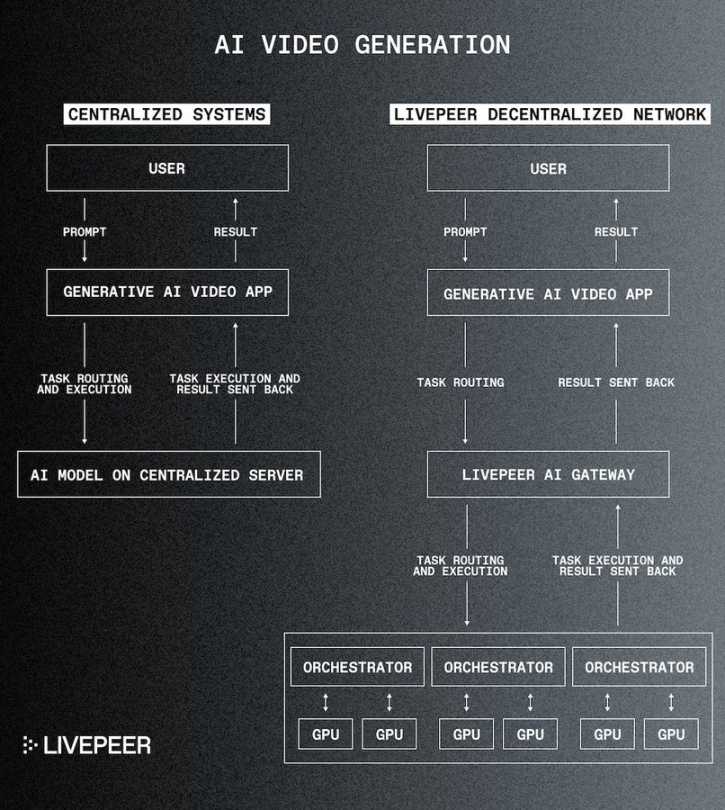
This diagram illustrates how Livepeer allocates tasks to a distributed GPU network based on efficiency, rather than guiding AI processing requests through centralized servers.
Infinite scalability
The Livepeer AI network infrastructure is designed to be infinitely scalable, allowing additional coordination and gateway nodes to be easily integrated as needed. AI-runner Docker images execute AI models, simplifying deployment and enhancing the scalability of new pipelines. Future developments will further enhance performance and expand the capabilities of containers to support increasingly complex AI models and custom user-defined pipelines.
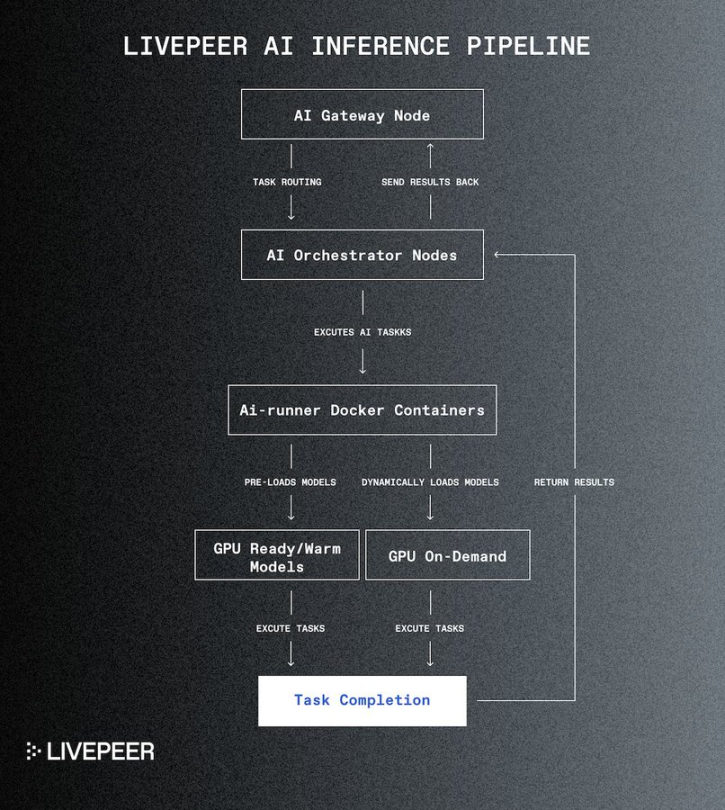
Technical workflow for processing tasks on the AI subnet. Gateway nodes pass tasks to coordinators, which may run multiple AI-Runner Docker containers for the same or different pipelines. These pipelines may already have the requested models or can dynamically load them as needed.
Participating in the Livepeer AI subnet
Hardware providers: Earn fees by contributing GPUs
Existing Livepeer coordinators can set up and run AI coordination nodes to execute inference tasks for text-to-image, image-to-image, and image-to-video, increasing their existing transcoding revenue.
Developers: Introduce models into the network as AI-Workers
Developers can define and deploy custom pipelines and workflows to ensure their applications are at the forefront of AI and video technology. They can also set up AI gateway nodes to test and refine their applications, and access the API for AI tasks.
The launch of the Livepeer AI subnet marks an important milestone for the project and the next step in Livepeer's mission to provide global open video infrastructure. As generative AI is expected to significantly increase the volume of video content in the coming years, the Livepeer network aims to ensure its ability to support this growth wave.
免责声明:本文章仅代表作者个人观点,不代表本平台的立场和观点。本文章仅供信息分享,不构成对任何人的任何投资建议。用户与作者之间的任何争议,与本平台无关。如网页中刊载的文章或图片涉及侵权,请提供相关的权利证明和身份证明发送邮件到support@aicoin.com,本平台相关工作人员将会进行核查。


