Why did the modular public chain Initia choose to build its own InitiaEVM, and what makes it special?
Compiled by: Alex Liu, Foresight News
Initia is a modular L1 public chain that can deploy and vertically integrate many "interwoven" Rollups, officially referred to as "Minitias" (similar to the concept of Dymension and its RollApps).
Built on the Cosmos SDK, in the context of existing EVM solutions such as Evmos in the Cosmos ecosystem, why did Initia choose to build its own InitiaEVM, and what makes it special?
VM-level Interoperability
Initia is committed to making Minitias the simplest way to build high-speed, flexible, and interoperable application chains, and the virtual machine is just a tool in the Minitia toolkit. It should be chosen based on the specific use case or language preference of the team—flexibility from multiple options is a benefit of modular design. Minitias can freely choose InitiaEVM, InitiaMVM (MoveVM), and WasmVM as VMs.
In the future centered around Rollups, thousands of Rollups will need to interact seamlessly, and they should have inherent interoperability from the start, rather than adding it later—even across different virtual machines. This concept prompted Initia to optimize InitiiaEVM for cross-virtual machine interoperability between InitiaEVM, InitiaMVM, and WasmVM.
EVM Cosmos Dual Compatibility
InitiaEVM is designed as a module of the Cosmos SDK, adding interoperability with Cosmos and IBC while supporting Solidity smart contracts and EVM operations.
With full EVM compatibility, Solidity contracts can be deployed and migrated to InitiaEVM without modification.
More importantly, InitiaEVM binds EVM and Cosmos layers together through a custom Bank Interface (BI), replacing the standard Cosmos x/Bank module responsible for Native Coin accounts with ERC20.
Cosmos Bank == ERC20.
Initia's MoveVM also uses a similar model.
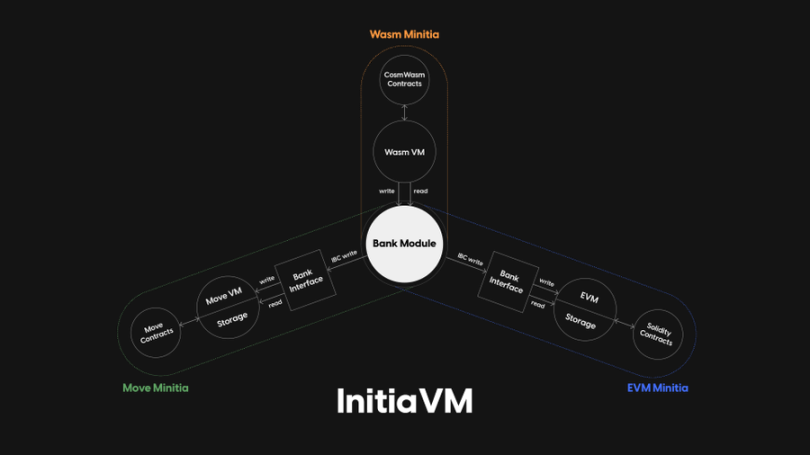
As a result, even though EVM Minitias are Cosmos chains, they only have one token standard: ERC20.
People don't need to consider concepts such as Cosmos tokens, interfaces, or token conversion. Solidity projects can migrate without any burden and can choose to integrate with Cosmos.
IBC Priority
IBC is the most proud cross-chain protocol in the Cosmos ecosystem, enabling easy asset transfer between different Cosmos chains. In InitiaEVM:
Migration out: ERC20 created in Solidity smart contracts can be immediately transferred to other chains via IBC without any fancy operations.
Migration in: Native Cosmos assets can be transferred to EVM Minitia via IBC and converted into ERC20.
This simplifies asset transfers between Minitias.
Simplified Precompilation
InitiaEVM can directly execute any Cosmos message or query Cosmos chain state from Solidity contracts. Interchain accounts, ICQ, Slinky queries, and more are all available. The development experience is no different from EVM chain development, embracing the vast Solidity ecosystem development community and reducing development burdens.
Interactions Across EVMs
InitiaEVM has integrated IBC hooks, supporting multi-chain, cross-virtual machine, and contract interactions, which are crucial for the new multi-chain world order.
Summary
In Initia's view, a good modular EVM, first and foremost, "is an EVM." Developers can run past Solidity programs on a new application chain without learning any new concepts or modifying any source code, achieving zero-cost migration. Secondly, it needs to have interoperability across Rollups, different virtual machines, token standards, asset transfer functionality, and underlying chain integration to provide a good user experience in the future multi-chain world.
免责声明:本文章仅代表作者个人观点,不代表本平台的立场和观点。本文章仅供信息分享,不构成对任何人的任何投资建议。用户与作者之间的任何争议,与本平台无关。如网页中刊载的文章或图片涉及侵权,请提供相关的权利证明和身份证明发送邮件到support@aicoin.com,本平台相关工作人员将会进行核查。


