Author: David Zhang@Foresight Ventures
With the long-term rapid development of world technology, the market value of giant companies such as OpenAI and NVIDIA has grown several times in the past two years. Crypto x AI has become the core narrative of this cycle, and the soaring market sentiment and continuous capital injection prove that a strong consensus has been formed. In the context of AI as the target, decentralization as a powerful tool for AI development is indeed very attractive and imaginative. Although there is still a huge gap between the actual business landing and the centralized model, leveraging the advantages of web3 to expand the four core aspects of AI and continuously optimize to unleash greater potential has become a common goal for web3 participants.
- Data
- Model
- Training
- Inference
Currently, decentralization can provide support in the four aspects mentioned above through technology. Firstly, data is definitely the most crucial, and models, training, and inference are all ways of processing data, so it can be said that data is the raw material of AI technology, and the rest are processing methods. Whether it is data labeling or data storage, decentralization has a great role and value here.
If data is the raw material, then computing power is the tool for processing the raw material to maximize output efficiency. Next, let's focus on the main topic of this article. This article will analyze the ecological framework of "computing power" in Crypto x AI x DePIN and its economic model.
In this article, I will mainly explain the ecological framework and market situation of "Crypto x AI x DePIN", helping readers understand the value and potential of decentralized computing power.⬇️
I. DePIN & Decentralized Computing Power Ecological Framework
Pain Points: High-quality computing power is essential for AI development, and this scarce resource has been monopolized by traditional giants, making it difficult for startups and individual users to buy cost-effective computing power, a high price that most buyers find difficult to accept.
Decentralized Solution: Currently, most projects in the DePIN track adopt a P2P economic model to provide high-quality resources to resource demanders, allowing each user to act as a physical facility resource provider and receive token rewards at the same time.
With the explosive growth in demand for decentralized AI computing power, the development of the decentralized AI computing power supply ecosystem has formed a balanced and comprehensive framework to better meet customer needs. Among the leading projects, Io.net, Exabit, and PingPong each play different important roles in the ecosystem, and the technological barriers and layout for the future development of decentralized computing power are quite impressive.
The decentralized AI computing power ecosystem mainly consists of three parts, with each part playing the role of resource agent, resource provider, and channel provider in the ecosystem:
Resource Agent - Io.net

Io.net is a decentralized computing network that acts as a computing power agent to provide high-quality AI computing power to customers at affordable prices. On the supply side, it has GPUs distributed globally, and the client is currently in the seed round to Series B, focusing on AI inference for startups.
Recently, this DePIN project based on the Solana chain completed a Series A financing of $30 million, led by Hack VC, with participation from Multicoin Capital, Foresight Ventures, Solana Labs, and others.
As the top AI computing power resource agent, Io.net aggregates 1,000,000 GPUs to form a huge DePIN computing power network, aiming to provide lower-cost computing power to customers. Users can manually contribute their idle GPU & CPU computing power to the io.net platform to receive $IO token incentives. The core goal is to provide high-quality AI computing power at a lower price through decentralized price control to help AI startups reduce costs.
Io.net provides the computing service IO Cloud. IO Cloud adopts a cluster building module to keep all GPUs interconnected, allowing GPUs to coordinate on a large scale during training and inference processes. When GPUs coordinate, they can concentrate computing power to access larger databases and compute more complex models. AI startups can obtain what they need, and by using io.net's products, they can complete computing hardware deployment at one-tenth of the centralized price. More notably, io.net focuses on aggregating machine learning computing power. Io.net can help giants in the DePIN field such as Render Network and FileCoin format GPU supply for machine learning, providing the most fundamental and direct resource support for underlying technology.
Currently, the number of GPU clusters aggregated by io.net is the highest in the industry. The number of available GPUs online at io.net exceeds 200,000, with the most available being nearly 50,000 GeForce RTX 4090s, followed by over 30,000 GeForce RTX 3090 Tis.
Resource Provider - Exabit
As the most promising AI computing power provider, Exabits serves as an AI computing power service node, providing sufficient chips for deep machine learning. The Exabits team is also outstanding in traditional AI computing power resources and can be considered a unique presence. With its technological resource barriers, Exabit can directly access hundreds of data centers, with access to A/H100, RTX4090, and A6000 machines.
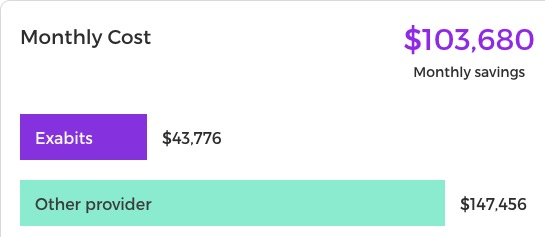
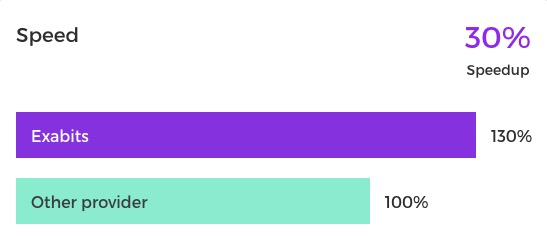
Exabits provides large-scale machine learning computing power to web3 computing power giants on the client side. Compared to Nebula Block, which requires clients to spend over $140,000 per month on cloud services, after migrating to Exabits, the monthly cloud service usage fee for clients is around $40,000, reducing expenses by over 70% and increasing efficiency by 30%.
The main goal of Exabits is to provide customers with the fastest, highest quality, and most reliable computing power through unique computing power supply channels. High-quality computing power can save user costs and provide customers with a comprehensive service selection.
The quality of AI computing power provided by Exabits has been recognized by multiple AI computing power agents, and it has now partnered with giants such as Renders Network and Io.net to contribute to machine learning through decentralization.
Resource Channel Provider (Uber) - PingPong
As a resource channel provider for DePIN, PingPong matches service providers through open protocols and provides services after aggregating resources at the underlying level. PingPong's goal is to become a service aggregator for DePIN, which can be understood as the 1inch of DePIN, or the aggregated Uber.
How to provide services: PingPong provides SDKs through routing algorithms by controlling layers, obtaining various networks and strategies, resource situations, performance, stability, and other aspects. These SDKs are then provided to users.
Pain Points: The resources and services in various DePIN networks are limited, and the globalization of resource allocation is hindered by the concentration of services in certain regions, leading to insufficient service quality.
Solution: Routing algorithm - gathering basic information about data, network, and machine, aggregating strategies, and matching service providers based on customer requirements. The goal is to improve the quality and service of the application layer in DePIN and to find the most optimal price for computing power networks in situations where resources are insufficient.
II. Analysis of Decentralized Computing Power Ecosystem
Io.net and Exabits have formed a strategic partnership, with Exabits as a supplier with a rich GPU machine library, dedicated to improving the speed and stability of the io.net network. Io.net allows customers to directly purchase and lease the highest quality computing power provided by Exabits in an agent capacity. Both Io.net and Exabits believe that the success of the decentralized computing industry and the combination of web3 and AI can only be achieved through close cooperation among early industry leaders. With the increasing demand for computing power, traditional cloud computing currently faces some issues:
- Limited availability: Using cloud services such as AWS, GCP, and Azure usually requires several weeks to gain access to hardware, and the most commonly used GPU models are often unavailable.
- Limited choices: Users are limited in their choices of GPU hardware, location, security level, latency, etc.
- High costs: Selecting good GPUs is expensive, and monthly expenses for training and inference processes can easily reach hundreds of thousands of dollars.
The vision of decentralized computing is to provide an open, accessible, and affordable alternative that can address the core issues of centralized cloud service providers, including limited availability, restricted hardware choices, and high costs for training and inference. Currently, challenging the dominant position of major players in cloud computing still requires innovative efforts and mutual support to take a revolutionary step forward.
Asset Models
- Heavy Asset Model
Exabits, as a supplier, has an absolute barrier with NVIDIA as its backing. The valuable machines for machine learning computing power are only A100, RTX4090, and H100, with each machine priced at around $300,000. These machines have become highly scarce resources and have been monopolized by traditional AI giants for a long time. In this situation, the resources that Exabits can access on the supply side are extremely valuable. Since the quality of individual GPU idle computing power shared by retail investors is not sufficient to support the calculation and processing of large-scale AI models, the role played by Exabits in the decentralized computing power ecosystem is crucial and not easily replaceable.
The heavy asset model adopted by Exabits requires a large amount of fixed asset investment, making it difficult for startups to replicate. Therefore, if Exabits can cooperate with more decentralized computing power agents and continuously expand the supply side, it can easily monopolize the industry and achieve economies of scale in the B2B decentralized computing power field.
However, the biggest risk is the inability to sustainably provide resources to computing power agents after investing a large amount of capital. Therefore, the ability of the supply side to achieve large-scale profitability depends heavily on whether computing power agents can continuously attract customers. Regardless of who the computing power agents are, as long as there are customers and demand, the value of Exabits as a supplier will grow with the increasing demand.
- Light Asset Model
Io.net, as the most outstanding computing power agent, relies on having GPUs distributed globally on the supply side to form a huge decentralized computing network. From a business perspective, Io.net adopts a light asset operation model, establishing a strong brand in the AI computing power agent through community operations and high consensus.
Core business of Io.net:
- Aggregating retail GPU computing power and rewarding tokens
- Purchasing high-quality computing power from the supply side and selling it to AI startups
From an enterprise perspective:
- Buying low and selling high-quality computing power to C-end customers from the supply side
- Helping users earn tokens by sharing idle GPU computing power
- Providing a computing power mining and staking platform for customers, but an initial investment of around $4,000 is required to generate good returns. Based on this, Exabits also offers the option to lease fragmented H100 machines to increase liquidity.
From a customer perspective:
- Io.net network computing power prices are about 80% cheaper than other centralized cloud computing services.
- Stake to earn & Share to earn.
- Customers can earn compound interest after investing a certain amount of capital.
As a typical light asset model company, the biggest advantage is the relatively low risk, as the team does not need to invest a large amount of machine costs to get started as the supply side does. Due to the lower capital investment, it is easier for the company and investors to achieve a higher profit margin. At the same time, because the barrier to entry into the industry is low, the business model is easily replicable, which needs to be carefully considered by long-term value investors.
III. From 10 to 100?
If the collaboration between Exabit and Io.net can help the decentralized computing power ecosystem move from 1 to 10, then adding PingPong to the mix may have the potential to reach 100.
PingPong's goal is to become the largest DePIN service aggregator, directly comparable to web2's Uber. As a channel provider, by aggregating real-time information about various resources, PingPong matches customers with the most optimal resources in terms of price and quality. PingPong adopts a B2B2C light asset business model, with the first B-end being the supply side, the second B-end being the resource agent, and the C-end being provided with the most optimal resource selection through information.
As a platform, if PingPong can develop into a platform that can issue assets, it will make the product more valuable. Through the SDK provided by the routing algorithm, PingPong can calculate resources to create its own AI Agent, convert new financial assets, and dynamically help customers using the application to mine dynamically, focusing on mining computing power that is useful for resources. This model, understood as Assets on assets, can greatly enhance the liquidity of resources and funds.
For PingPong, they hope to see more suppliers and agents enter the decentralized computing power ecosystem, in order to better highlight their advantages, expand their business lines, and attract more customers. Simply put, the reason why Baidu and Dianping can dominate the information field is because more businesses and information are uploaded to the internet, thereby creating a high demand for channel providers.
IV. A Promising Future
Decentralized cloud computing is still evolving step by step. Although the ecological framework and model of decentralized cloud computing have become very clear, the leaders of various roles are fulfilling their responsibilities in the ecosystem. However, it is still far from being able to challenge the position of traditional cloud computing giants. When compared to traditional centralized cloud computing, decentralized computing can conceptually solve many problems for customers, but the overall resources and volume of this market are still very small. In a situation where the computing power resources to support AI are far from sufficient, the market needs another solution or model to overcome the dilemma. We can now see that decentralized cloud computing can indeed meet some of the needs of startup AI companies. As for the future, let us all be witnesses and participants in this revolutionary path, and follow the evolution of the revolution together!
免责声明:本文章仅代表作者个人观点,不代表本平台的立场和观点。本文章仅供信息分享,不构成对任何人的任何投资建议。用户与作者之间的任何争议,与本平台无关。如网页中刊载的文章或图片涉及侵权,请提供相关的权利证明和身份证明发送邮件到support@aicoin.com,本平台相关工作人员将会进行核查。


