Cryptocurrency lawyers are divided into supporters and critics, and they hold different views on the dispute between Consensys and the SEC, and recognize that there are problems with the complaint.
Author: CleanApp
Translation: Plain Blockchain

Cryptocurrency lawyers are divided into two camps. One camp is the jubilant supporters, who, after seeing the dispute between Consensys and the SEC, made some remarks similar to "Hey, Wachtell law firm is involved, top lawyers, we will definitely win, let's see what you can do, SEC!", but most of this is just noise. The other camp is the cryptocurrency lawyers who, after reading the complaint, cannot stop punching the wall, throwing staplers, and cursing loudly. Because a messy complaint can lead to bad legal outcomes. And Consensys's complaint is very messy in both substance and form.
An extremely important point is: this is not an isolated view. After the complaint was filed, the cryptocurrency legal community was in an uproar. Because cryptocurrency lawyers usually behave politely in public, but privately they have harshly criticized this. However, the key consensus is that Wachtell law firm and Consensys have completely exceeded the boundaries in building the Ethereum, blockchain, and ecosystem participants. This has sparked extremely angry reactions, even leading to the use of vulgar language. This is a serious problem facing the senior levels of the cryptocurrency legal community.
We have always adhered to the principle of "public criticism, private support". Therefore, we will certainly do our best to support good blockchain teams (such as Coinbase, Uniswap, Consensys) who are involved in legal disputes in private, because it is obvious that the SEC's actions against them are extremely illegal. However, public constructive criticism is crucial for pointing out subtle but important conceptual slips. Especially for small teams that may mistakenly believe that big companies have the best legal arguments and may be misled into thinking that these are "industry consensus" arguments. At the same time, this is also to prevent you as a developer from being misled by smooth talk: "Oh, that's just legal jargon, don't worry, we've got it all figured out." Because this is not just "legal jargon", and those senior lawyers definitely haven't fully mastered it.
Appendix A:
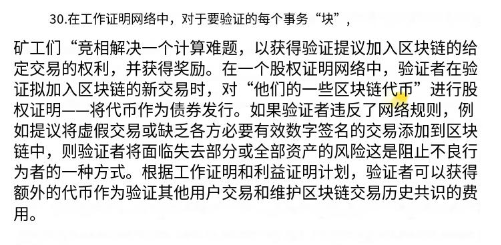
Nooooooooo!
The above image is a serious mistake, it can be said to be a medical malpractice-level mistake. This acknowledgment/abandonment on the title will be the first citation that the SEC may make in a motion for judgment, or it will be claimed in an opinion of the U.S. Supreme Court that "Ethereum is a contract network," which is truly astonishing.
Let's take a closer look.
Bonds are a type of contract, all bonds are contracts. If Consensys proposes a novel bond but non-contract theory, they have a responsibility to propose and prove this. However, they did not present this argument in the complaint. Therefore, according to Wachtell law firm, the validating nodes are parties to the contract with the "network"/"blockchain"/"Ethereum". To deny the existence of a contractual relationship between Consensys and those who interact on-chain through Consensys software, Wachtell law firm implies that a contract does exist, you know, in the form of "bonds" and "transactions", just not related to Consensys.
No, this is not an obsession with vocabulary. In legal terms, words have significant implications for defining cases. Consensys's lawyers know this. In the complaint, the part about the SEC's jurisdiction explicitly mentions this:
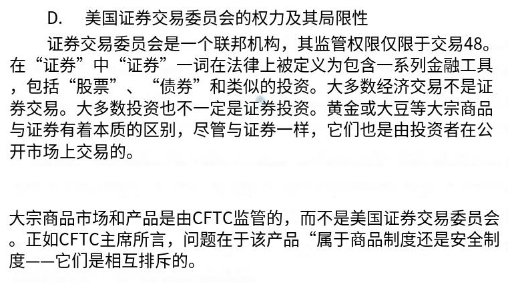
According to Consensys's lawyers, the validating nodes of Ethereum pledge their ETHToken as a bond. This view is redundant, tragic, and a fatal mistake.
There is no investment contract here! According to Consensys, the SEC's jurisdiction is based on the definition of "investment contract" involved in ETH transactions. However, Consensys considers ETH to be a digital asset, also known as a cryptocurrency. They consider the pledged ETH to be a bond. Furthermore, since nearly 8,000 developers worldwide actively participate in developing code for this global computing platform every month, this cannot be considered an investment contract because there is no centralized manager or promoter to obtain investment profits.
Confused? So am I. The situation becomes even more complicated, even if there is an investment contract, the SEC does not have the authority to regulate all investments based solely on profit expectations without contractual obligations. Basically, Consensys is betting everything on this theory, that there are no contracts involving Consensys itself, only traders, transactions, assets, bonds, cryptocurrencies, and tokens. Consensys's software is only used as a tool to facilitate the trading of digital assets.
This theory may have some merit, but the way Consensys presents it has significant problems.
First, this should not be their only or main argument in the case. Secondly, if they claim a lack of contractual relationship, they cannot weaken this argument by the aforementioned fatal abandonment of the bond. Third, they need to go further and actually clarify the existence or non-existence of the contract. This requires identifying the parties to the contract and in the process revealing notable transaction networks based on blockchain and non-blockchain, which may resemble contracts but lack identifiable counterparties. This should have been one of Consensys's strongest arguments, but unfortunately, it is not explicitly mentioned in the document.
Source: https://medium.com/cryptolawreview/consensys-v-sec-constructive-critique-a62d003b8edd
免责声明:本文章仅代表作者个人观点,不代表本平台的立场和观点。本文章仅供信息分享,不构成对任何人的任何投资建议。用户与作者之间的任何争议,与本平台无关。如网页中刊载的文章或图片涉及侵权,请提供相关的权利证明和身份证明发送邮件到support@aicoin.com,本平台相关工作人员将会进行核查。


