Over the past year, venture capital has continued to pour into the Cosmos ecosystem.
Byline: 1912212.eth, Foresight News
In the last bull and bear cycle, the "cross-chain duo" Cosmos and Polkadot fought fiercely. However, with the changing times, Cosmos has now gained the upper hand, while Polkadot appears somewhat subdued. Even though the Cosmos ecosystem suffered a setback due to the Terra incident in the second half of 2022, it quickly recovered from the chaos.
Especially in the past year, venture capital has continuously flowed into the Cosmos ecosystem, including public chains, liquidity staking (recommended reading: Why has Stride quickly risen to become the number one staking protocol in the Cosmos ecosystem?), and a batch of high-quality projects such as AltLayer, Dymention, and Stride have received financing and expanded the market like mushrooms after rain. Now is the time to review the star public chains in the Cosmos ecosystem.
Celestia
Celestia is the first modular data availability (DA) network designed to securely scale with the growth of users. This modularity allows anyone to easily launch an independent blockchain.
As a representative modular public chain, it attracted significant market attention as soon as it went live. After a brief fluctuation around $2, the token price soared to nearly $20, achieving a tenfold return in less than six months.
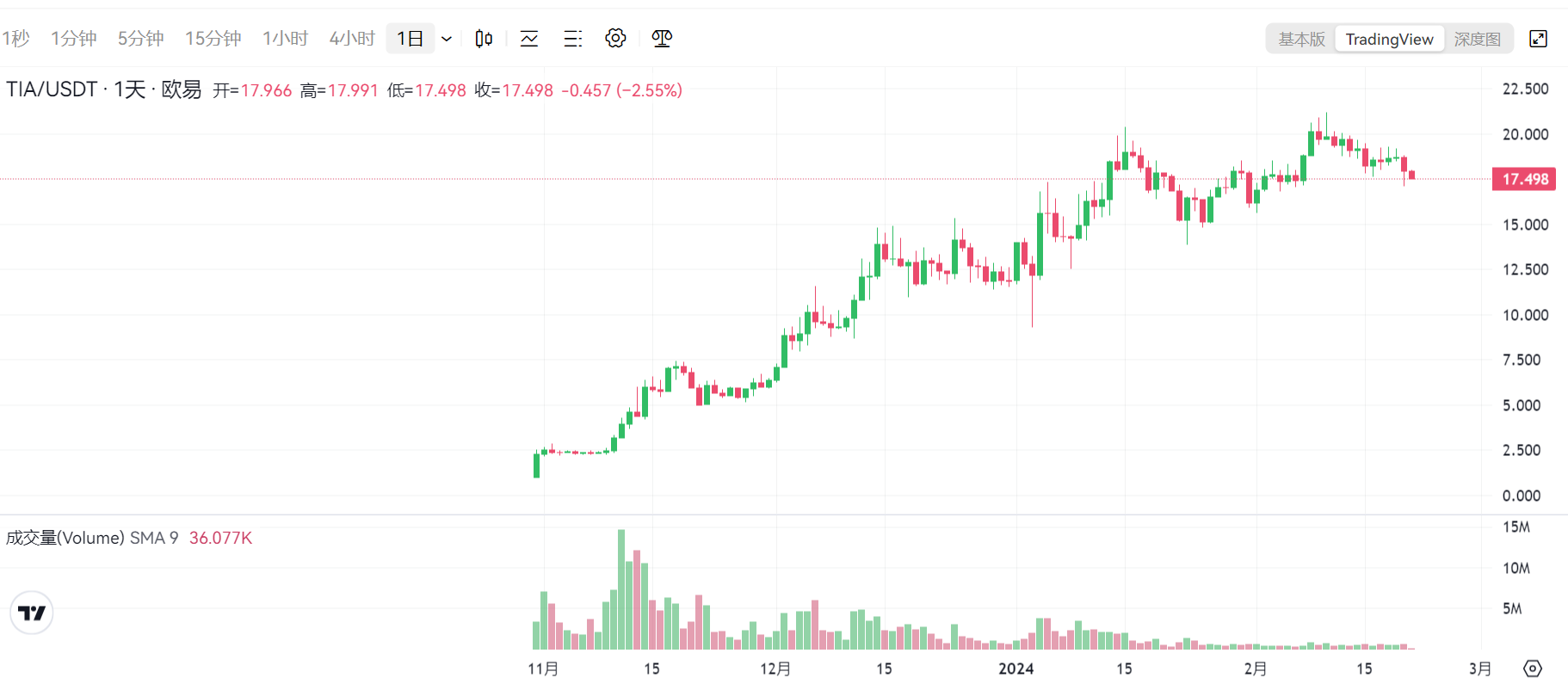 At the same time, its token TIA also became a golden shovel for a while. Projects such as AltLayer, Dymention, and Stride distributed airdrops to TIA stakers, encouraging more people to participate in staking, creating a virtuous cycle.
Celestia has put significant pressure on the Ethereum DA series. Additionally, Celestia Labs launched the Ethereum modular data availability (DA) solution Blobstream in October last year. Blobstream allows L2 developers in the Ethereum ecosystem to integrate with Celestia, providing dedicated blobspace with pricing independent of Ethereum gas costs, thereby maximizing data throughput.
In recent months, Blobstream has integrated Starknet, Orderly Network, RSS3, AltLayer, Manta Pacific, Polygon CDK, OP Stack, Hyperlane, and Arbitrum Orbit, continuously expanding its influence.
Celestia's most recent large financing occurred in October 2022, with Bain Capital Crypto and Polychain Capital co-leading, and participation from Placeholder, Galaxy, Delphi Digital, Blockchain Capital, Protocol Labs, Figment, Spartan Group, FTX Ventures, Jump Crypto, A&T Capital, and angel investor Balaji Srinivasan.
dYdX Chain
In October last year, dYdX launched dYdX Chain, officially upgrading to a derivatives application chain. Version 4 made significant upgrades to the token economy, with all fees going to stakers. After the upgrade, it immediately initiated market maker incentives. Additionally, the application for a $30 million budget over three years was approved, providing the team with sufficient funding in the future. However, due to the massive token unlocking and selling pressure, the token price performed poorly.
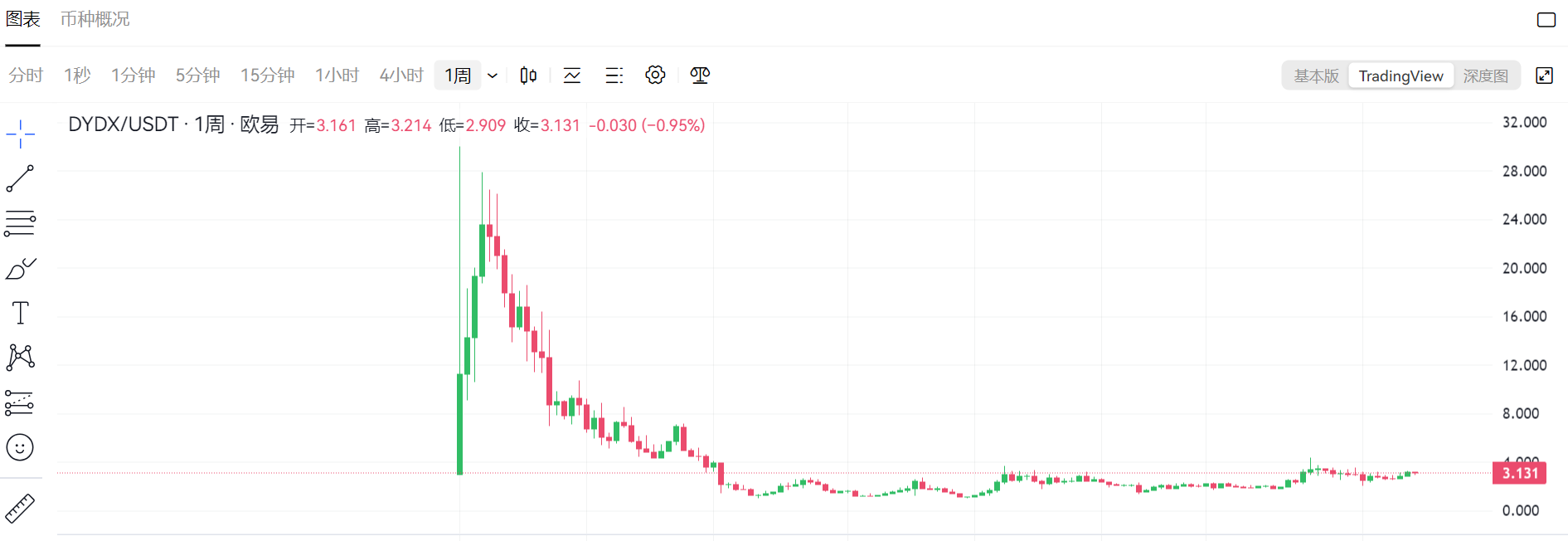 It is worth noting that dYdX Chain recently announced that its trading volume has exceeded $30 billion, just three months after the official launch of v4.
dYdX released its 2024 roadmap: the team will focus on three main areas, including permissionless markets, core trading improvements, and user experience/entry-level upgrades. In the permissionless market aspect, the final state of dYdX software is expected to have:
- Instant + permissionless market listing functionality;
- Providing instant liquidity through LP Vaults for all markets;
- Expanding oracles to achieve perpetual inventory of any asset;
- Protocol-level full position, isolated position, and strengthened risk control. Regarding core trading improvements.
In terms of core trading optimization:
- Improve the reliability and infrastructure of the exchange software;
- Add trading features to help traders execute trades quickly and accurately;
- Add support for other clients in languages such as C++, Rust, and Go.
In terms of user experience upgrades:
- Make registration easier by increasing the number of entry options and creating more connection methods;
- Improve the usability of the exchange by better presenting and reminding important information;
- Integrate social elements into the trading platform software.
Injective
In its 2023 annual review report, Injective saw the number of active wallet addresses increase from 14,000 to over 290,000, and the trading volume increased from $140 million at the beginning of the year to over $390 million. According to CoinGecko research data, among the top 100 tokens by market value in 2023, INJ ranked second with a 2976.4% increase, second only to BONK.
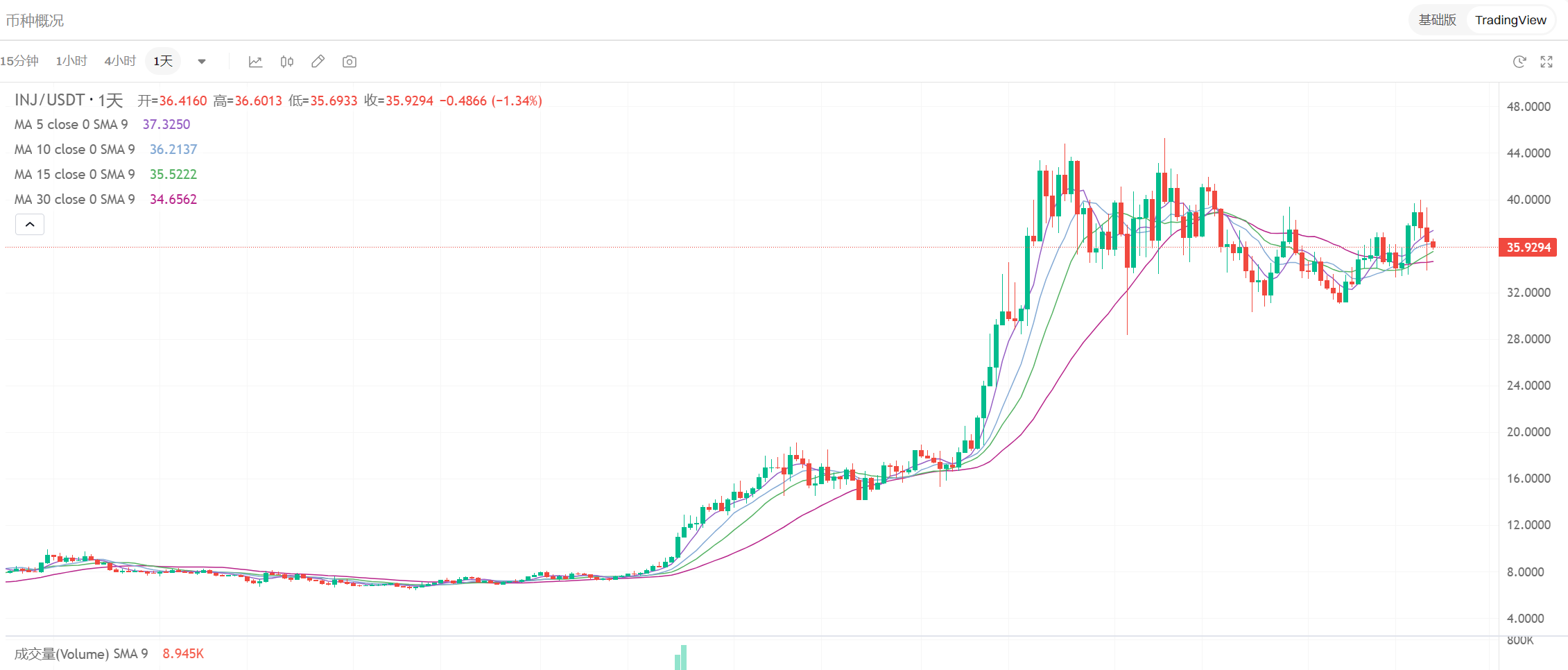
On January 11th this year, Injective completed the Volan mainnet upgrade and enabled new features, including fast trading, interoperability, support for CosmWasm smart contracts, compatibility with the Ethereum Virtual Machine (EVM), and reduced migration threshold for developers. Injective also introduced gas compression, with the current cost of each transaction on the platform being 0.00001 INJ, making the fees extremely low compared to other major blockchains.
Sei
Sei is an L1 designed for trading digital assets, including gaming, social, NFT, and DeFi aspects, and is also one of the protagonists of parallel chain narratives. After launching its mainnet in August last year, the token price climbed from a low of $0.1 to over $1, achieving a tenfold increase. (Recommended reading: A comprehensive review of the Sei ecosystem: What "new things" are there on the L1 designed for trading?)
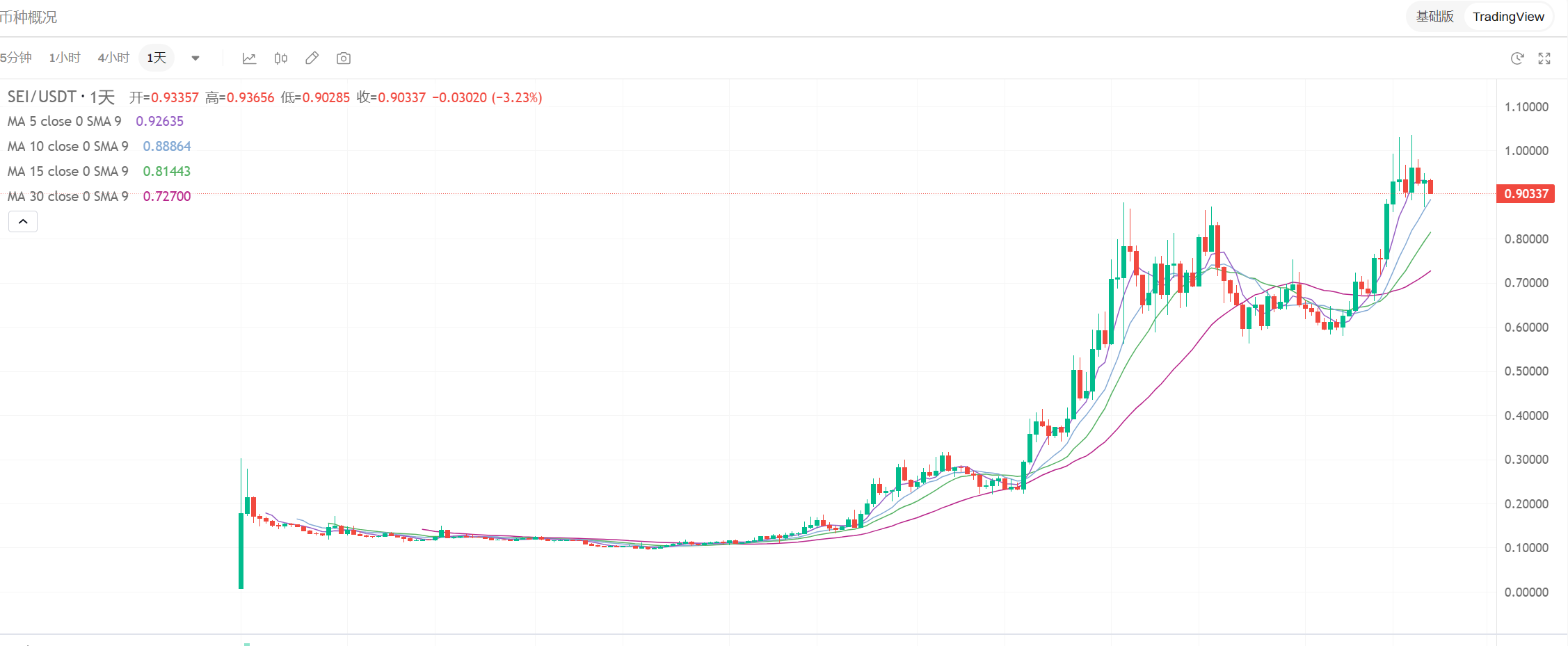 On January 2nd this year, Sei co-founder Jay Jog stated that the Sei V2 feature code has been completed and is undergoing auditing. In a recent interview, Jay Jog mentioned that Sei Labs plans to launch the Sei V2 upgrade in the first half of the year, which will implement EVM parallelization, allowing developers to deploy protocols from Ethereum on Sei. Currently, developers are required to write protocols using languages such as Rust or C++. However, after the Sei v2 upgrade, developers will be able to use languages such as Solidity and Vyper, commonly used by Ethereum developers.
In April 2023, Sei Network raised $50 million for its ecosystem fund, with investors including Bitget, Foresight Ventures, OKX Ventures, Jump Capital, Distributed Global, Multicoin Capital, and Bixin Ventures.
Axelar
Axelar Network is a cross-chain infrastructure protocol that launched the Axelar Virtual Machine (VM) early last year, allowing developers to build a DApp once and run it on all chains. It also partnered with Microsoft mid-year. At the end of the year, it collaborated with the RWA protocol Ondo Finance to launch the ondo bridge. This year, it has collaborated with Frax Finance to promote the frax and frxeth ecosystems and integrated with the popular Monad in January.
In 2023, the number of networks supported by Axelar increased from 30 to 55. According to Messari data, inter-chain transactions and active addresses grew by 478% and 430% year-on-year, respectively.
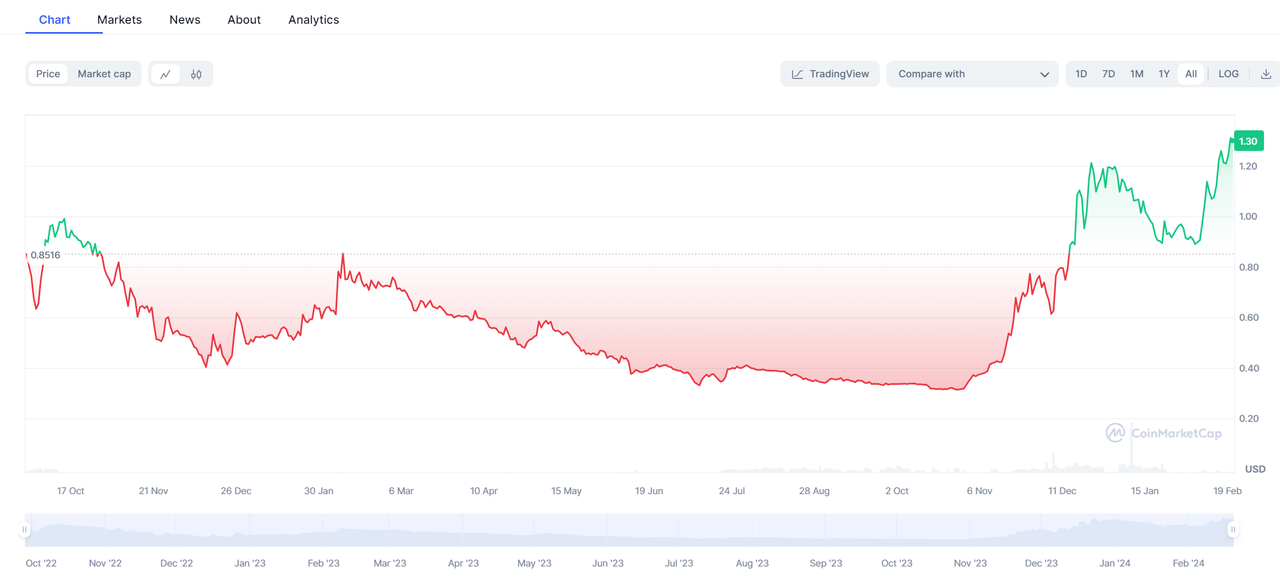
Although Axelar has a strong lineup in terms of funding amount and investment institutions, the token price remained below $1 for over a year due to the late launch of the token in the last bull market. With the continued popularity of projects like Wormhole and LayerZero, Axelar may once again attract market attention.
Neutron
Neutron is supported by Tendermint and built using the Cosmos SDK. It is a permissionless smart contract platform for Interchain DeFi.
Since its mainnet launch in May last year, Neutron has been active. In June, it raised $10 million, with Binance and Coinfund co-leading the investment. At the end of the year, it acquired a 25% stake in CosmWasm developer Conflio to enhance Neutron's virtual machine capabilities, including native zero-knowledge proofs.
It is worth mentioning that last year, Neutron completed the largest technical upgrade "Neutrality," which integrated Duality into the protocol, allowing developers to create effective markets for any asset and replicate any AMM curve: stable pools, weighted or concentrated pools, etc. It also introduced the Block SDK developed by Skip Protocol, allowing application developers to transparently define how the network builds and verifies on-chain blocks, providing an executable and explicit method to manage and reallocate miner-extractable value (MEV).
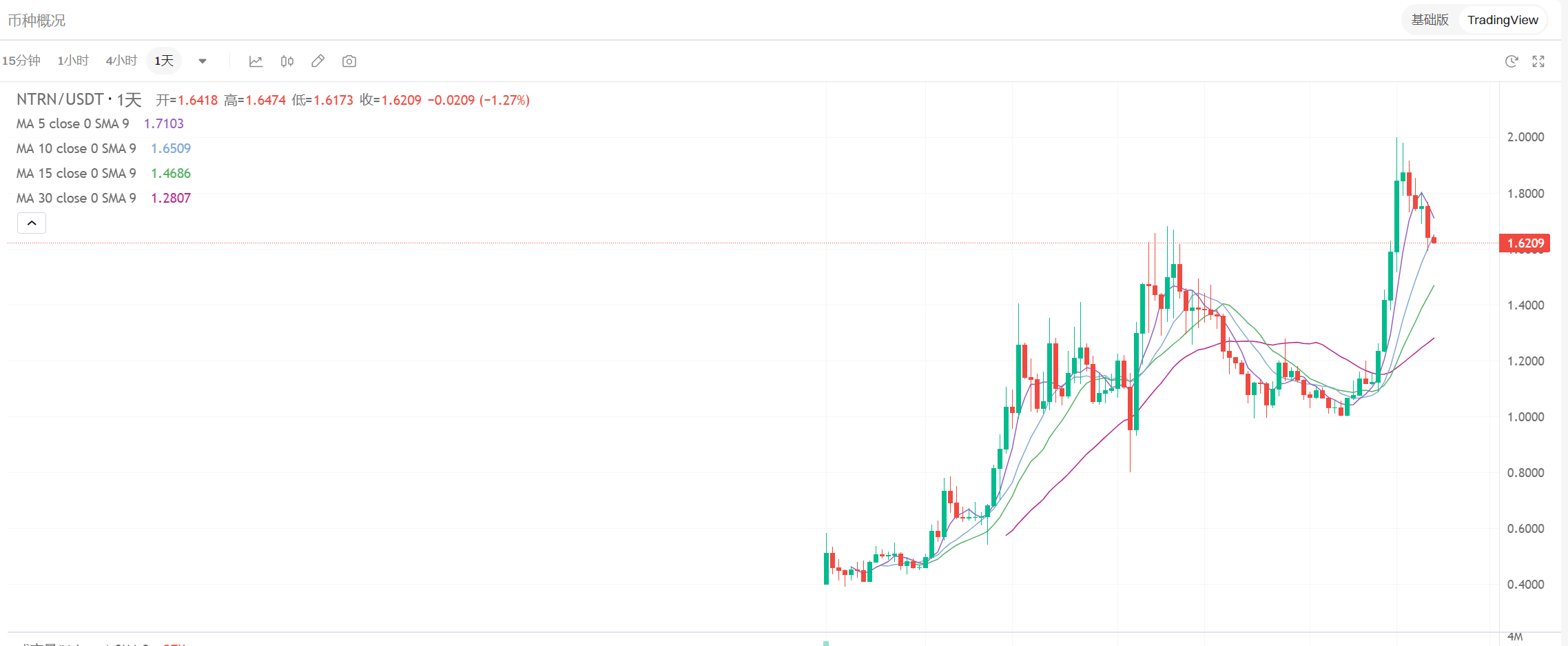
NTRN has nearly increased tenfold in less than a year, showing a remarkable price performance.
THORChain
As a well-known decentralized trading protocol, THORChain shone in the last DeFi boom and received support from several well-known venture capitalists. However, it remained silent for a considerable period due to a hacking incident.
It is worth noting that due to the bullish news of the Bitcoin script ecosystem, THORChain quickly became the leading BTC trading protocol on-chain. In August 2023, it also launched a highly anticipated lending protocol with no forced liquidation, interest, or expiration date, quickly gaining popularity.
The protocol has now integrated cross-chain brands THORSwap, lending LENDS, storage (Saver), and stablecoin TOR products, and supports the Solana network. It plans to launch contract and order book trading functions in the future.
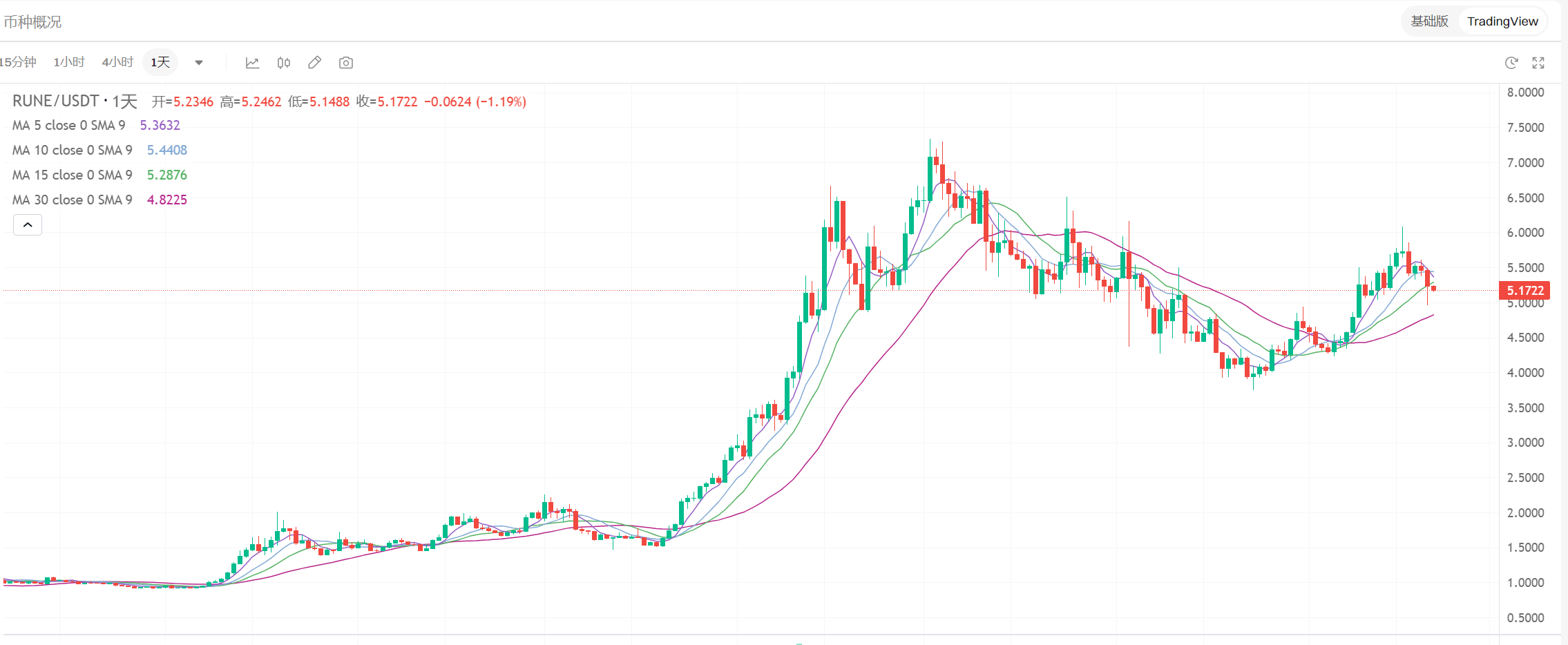
With the recent strong market performance, RUNE has achieved a tenfold increase since July last year.
Kujira
Previously positioned as a collateral liquidation protocol on Terra, Kujira launched its mainnet on the public chain in July 2022, aiming to achieve real profits as an L1. Kujira also has its stablecoin USK, which has nearly tripled in total market value in the last three months, but still remains below $8 million in the entire stablecoin ecosystem. (Recommended reading: Is the quietly rising Kujira the new dark horse of Cosmos, crossing the ruins of Terra?)
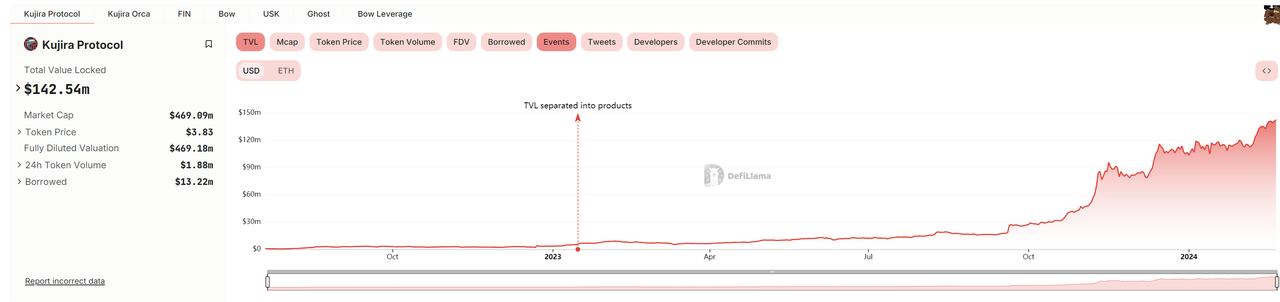
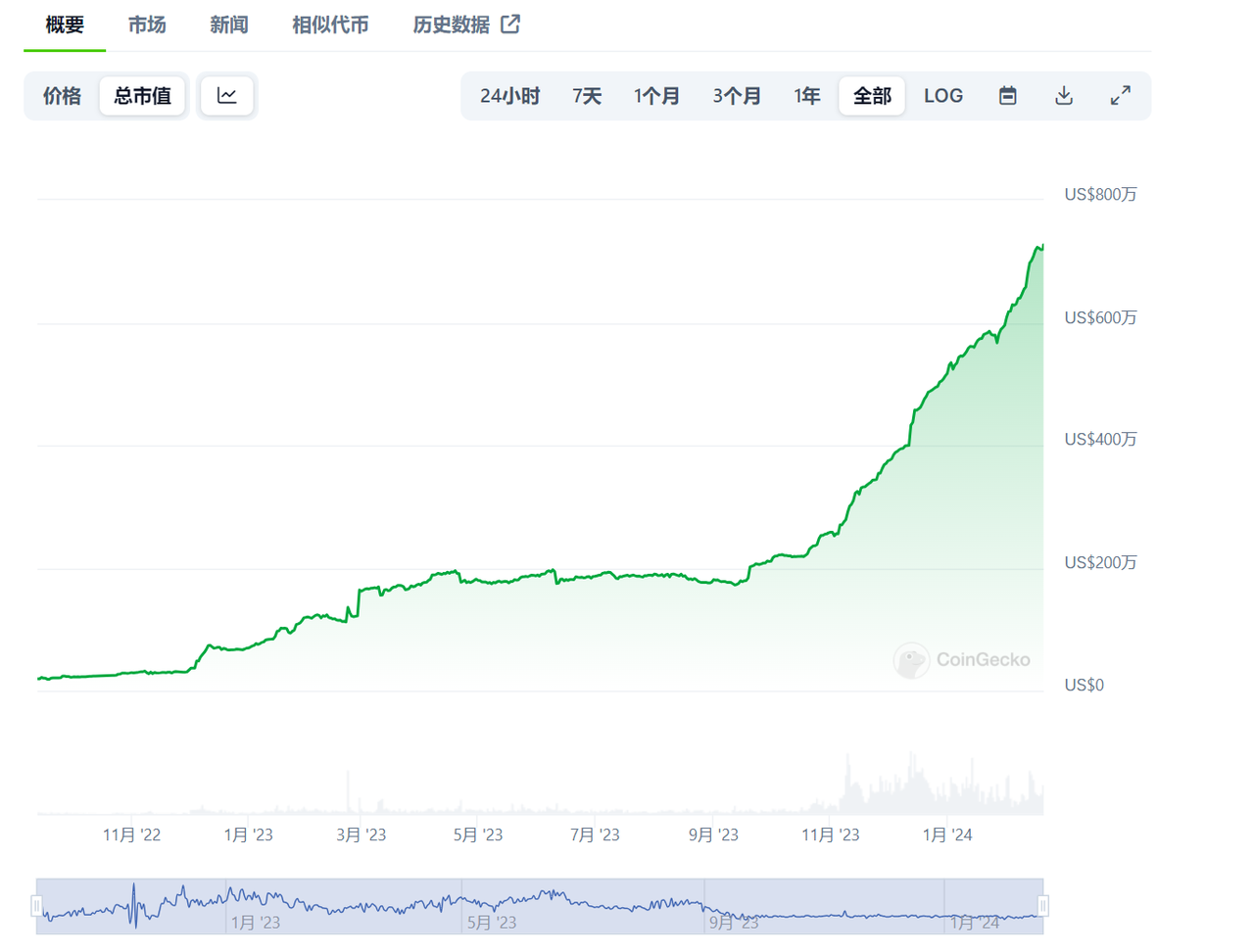 In terms of ecosystem development, it recently integrated with Wormhole to support SOL cross-chain to Kujira. According to DeFiLlama data, its TVL has exceeded $140 million, doubling from $70 million on November 9th last year.
Dymension
Dymension, a modular blockchain network using Cosmos and Celestia technology, completed a $6.7 million financing early last year and attracted significant attention by airdropping 70 million DYM to Ethereum, Cosmos, and Solana users in January this year. (Recommended reading: Apart from the modular "Lego" narrative, what other catalysts are worth paying attention to in Dymension?)
In addition, Dymension integrated with the cross-chain protocol Wormhole and officially launched its mainnet on February 6th. It recently announced the launch of its modular liquidity layer and embedded AMM, with some transaction fees being converted to DYM as protocol fees for burning, reducing the circulating supply of DYM.
Overall, most of the star public chains based on the Cosmos ecosystem have delivered impressive performance in terms of ecosystem actions and token price increases. In the future, high-profile projects like Berachain (Recommended reading: With a $42 million financing and the mainnet about to launch, a comprehensive guide to participating in the overcrowded Berachain testnet) may continue to add luster to the wealth effect of the Cosmos ecosystem.
免责声明:本文章仅代表作者个人观点,不代表本平台的立场和观点。本文章仅供信息分享,不构成对任何人的任何投资建议。用户与作者之间的任何争议,与本平台无关。如网页中刊载的文章或图片涉及侵权,请提供相关的权利证明和身份证明发送邮件到support@aicoin.com,本平台相关工作人员将会进行核查。


