Stride's total TVL has exceeded 100 million US dollars.
Original Title: "Our Stride Thesis", Release Date: December 2023
Author: James Ho, Partner at Modular Capital
Translation: 1912212.eth, Foresight News
Editor's Note: On February 2nd of this year, Stride, a liquidity staking protocol in the Cosmos ecosystem, completed a $4 million strategic financing round, with DBA leading the investment and 1confirmation, Road Capital, Modular Capital, Imperator, Chorus One, and others participating. The financing round aims to drive Stride's development in the Celestia ecosystem. It is worth mentioning that on the same day, Stride's total TVL exceeded 100 million US dollars, reaching a historic high.
Text:
Stride is a staking protocol in the Cosmos ecosystem, currently occupying over 90% of the market share with a TVL of over 60 million US dollars. It supports the Cosmos chain, including ATOM (Cosmos Hub), OSMO (Osmosis), INJ (Injective), JUNO (Juno), and others.
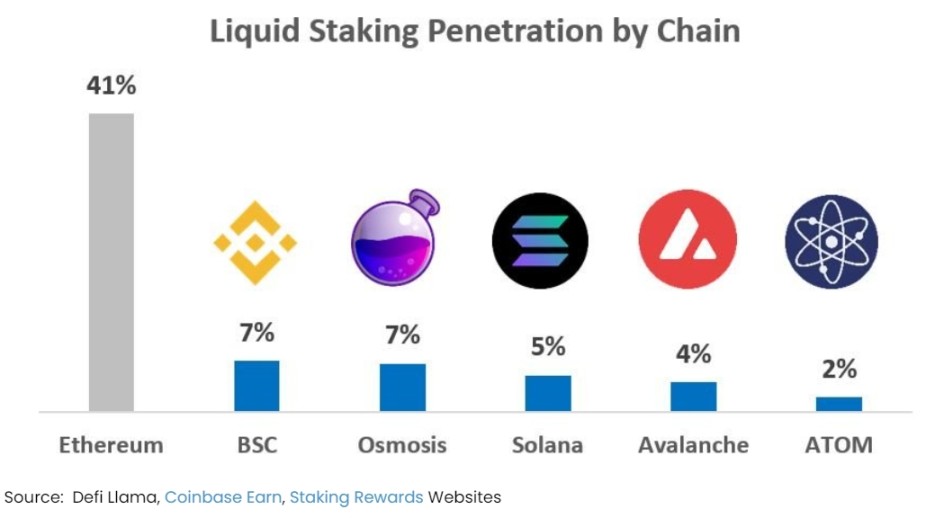
In the Cosmos ecosystem, staking is still in its early stages. On Ethereum, 41% of ETH staking is completed through staking service providers (such as Lido, Rocketpool, Frax, Coinbase, etc.). In comparison, only 2% of the total ATOM and 7% of the total OSMO are participating in staking, providing ample opportunities for further development.
Liquidity staking tokens (LST) are highly attractive to users as they can improve the capital efficiency of staked assets. By issuing staking tokens (stOSMO, stATOM), Stride allows users to freely use their assets in DeFi while earning staking rewards. Additionally, most staked assets on Cosmos chains have a redemption period of 14-30 days, requiring users to wait a long time to unstake. In contrast, in Stride, LST allows users to immediately sell their staked tokens at a certain market slippage.
As a category, liquidity staking possesses strong network effects, often leading to a winner-takes-all situation. With Lido providing deep liquidity for its stETH on Ethereum, Lido's share of LSTs on Ethereum is close to 80%, leading more users to prefer using Lido over its competitors. Considering Stride's 90% share in the Cosmos ecosystem and its continuous growth, we expect similar network effects to come into play in Stride.
Stride intends to support new Cosmos chains' liquidity staking pairs such as Celestia (TIA) and dYdX (editor's note: TIA and DYDX are now supported). The combined market value of these chains exceeds 10 billion US dollars, greatly expanding Stride's market size in the Cosmos ecosystem.
With the increase in market capitalization of the Cosmos ecosystem to 20-50 billion US dollars (currently 5-6 billion US dollars), Stride is expected to generate fee income of 20-70 million US dollars. Assuming a staking penetration rate of 15-30%, and Stride maintaining a 90% market share, applying a multiple of 50 to this figure, Stride's valuation could reach over 1-3 billion US dollars.
PoS
Proof of Stake (PoS) is a consensus mechanism used to determine how transactions are processed and new blocks are created. Ethereum historically used Proof of Work (PoW) to ensure the security of its chain, in which miners use computational resources such as GPUs and electricity to guess a random encrypted hexadecimal number. This is the security model currently used by Bitcoin.
After years of planning, Ethereum completed its transition from PoW to PoS in September 2022. There are many reasons why most public chains transition from PoW to PoS for security and anti-Sybil attack models, including:
Energy consumption: PoW ensures security by consuming real-world resources (computational resources and electricity). In contrast, PoS ensures security based on the value of native network assets (ETH, SOL, AVAX, ATOM), reducing energy consumption by 99.9% compared to PoW networks.
Network consensus: PoW ensures security through economic incentives. The network issues new tokens and rewards miners in exchange for their consumption of real-world resources (which require money to purchase). However, miners typically immediately sell the newly issued tokens (e.g., BTC) to recoup the costs of operating mining facilities. In PoS, the network's security is ensured by owners (those who hold and purchase native network tokens). The principle of this mechanism creates consensus among network owners, who have an incentive to ensure the network's security.
Emissions reduction: In a PoW network, it costs 1 dollar of emissions to obtain 1 dollar of security (in the form of real-world expenditures). This requires the network to continuously have a significant amount of new issuance. In PoS, stakers do not have significant real-world expenditures; instead, they only need a certain proportion of issuance (usually within the range of 3-10%) to compensate for the lack of liquidity of their staked assets. This means the network spends 0.03-0.10 dollars for 1 dollar of economic security, representing a more economically sustainable long-term model. After transitioning to PoS, Ethereum's annual issuance for network security decreased by over 80%.
Currently, almost all major public chains, calculated by TVL, use PoS to ensure their network security, including Ethereum, Solana, Avalanche, Polkadot, and Cosmos Hub. 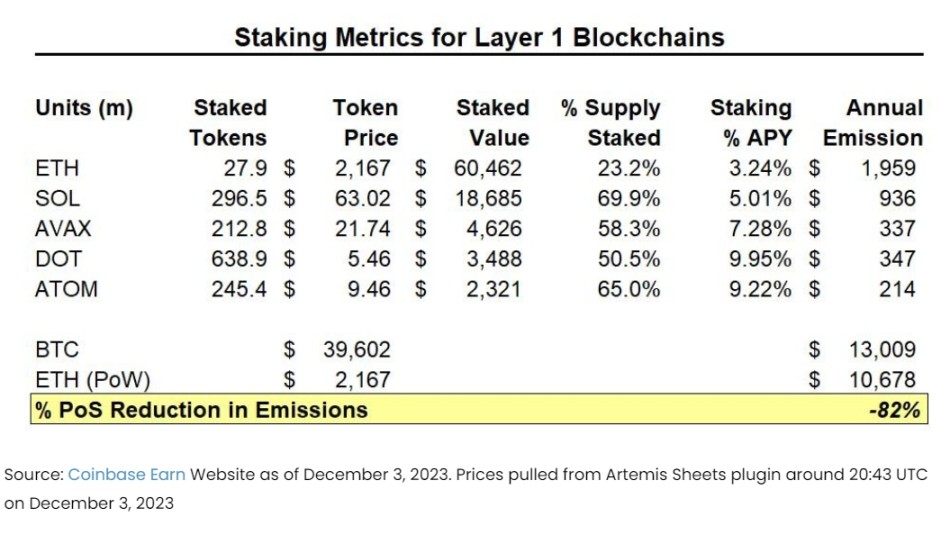
Concept of Liquidity Staking
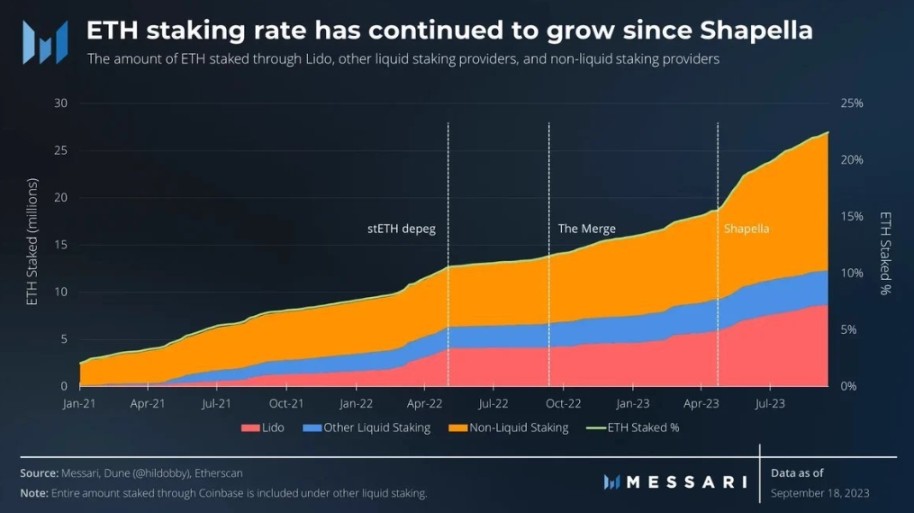
Liquidity staking is a significant category in the DeFi space, with the most successful case being Lido. Lido has now become the largest protocol in the entire cryptocurrency space, with a total locked value (TVL) exceeding 20 billion US dollars, accounting for nearly one-third of all staked Ethereum. Lido earns over 80 million US dollars in fees annually.
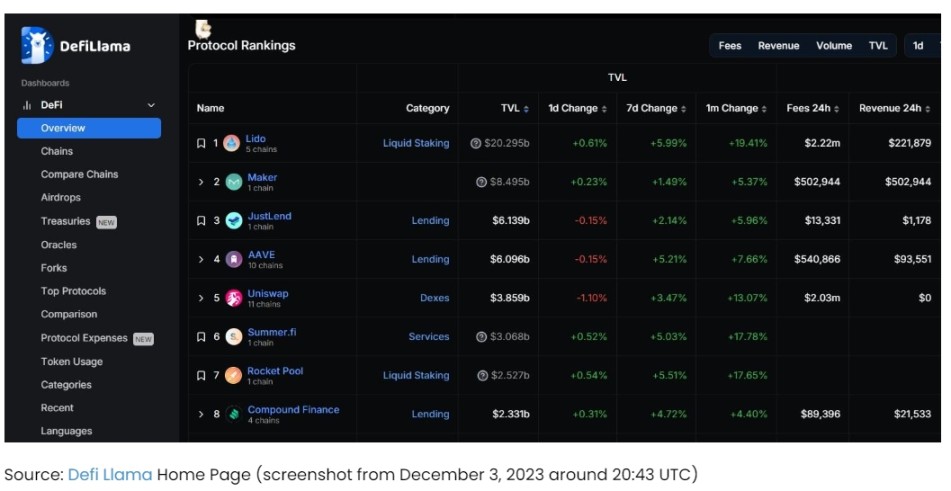
In simple terms, Lido places ETH into smart contracts and then allocates these ETH to a group of node operators to stake on behalf of the protocol. These node operators include Figment, Stakefish, Everstake, and Blockdaemon, among others.
After depositing ETH into the Lido protocol, users receive stETH. stETH represents the ETH staked by users in the Lido protocol, including the value of the initial deposit and ongoing staking rewards. stETH has several uses:
Borrowing: If users want to use it as collateral to borrow assets (e.g., USDC stablecoin), they can deposit stETH into lending protocols such as Aave.
AMM liquidity: If users want to provide liquidity and earn fees, they can deposit stETH into trading protocols like Uniswap, Curve, and others. The wstETH/ETH pool on Curve earns a 2% fee annually, in addition to the 3-4% ETH staking rewards on Lido.
Yield hedging: Users can deposit stETH into Pendle (a DeFi native tool) to lock in their staking rewards for a period of time.
Selling on the open market: Typically, users need to unstake their ETH through Lido, depending on Ethereum's exit queue, which may require waiting for several days to weeks. If users do not want to wait, they can sell stETH on the open market. Selling 1000 stETH (over 2 million US dollars) will result in approximately a 10-15bp slippage.
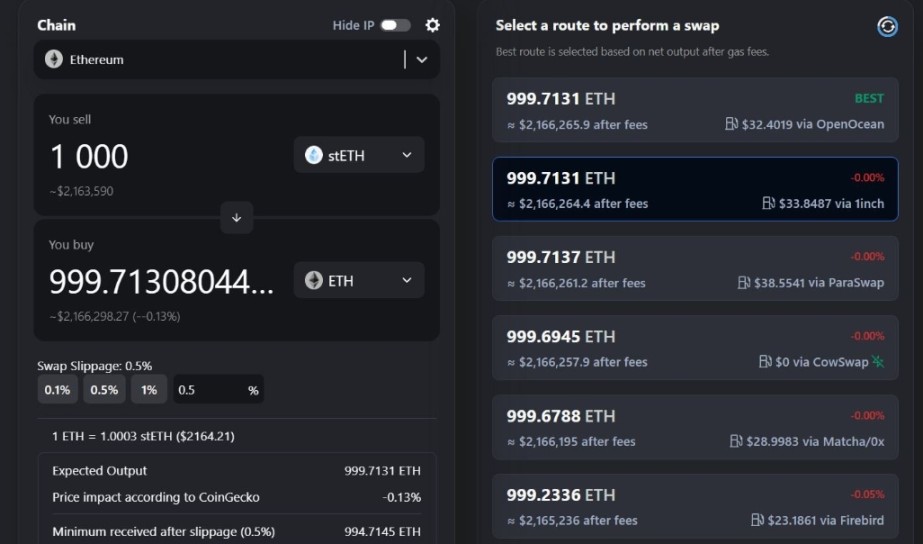
Like many other things in DeFi, any DeFi protocol wishing to support stETH can integrate it (as Aave, Uniswap, Curve, and Pendle have already done). Each protocol supporting stETH creates additional utility and demand for liquidity stakers.
Lido locks over 20 billion US dollars in assets and earns over 80 million US dollars in annual fees (with over 40 million US dollars going to Lido DAO), achieving a TVL of over 20 billion US dollars (ranking among the top 35 tokens by market cap). It is worth noting that the liquidity staking market often tends to have a "winner-takes-all" situation. Lido holds nearly 80% of the LST market on Ethereum, while the second-largest player, Rocket Pool, stakes ETH nearly ten times less than Lido (Rocket Pool at 2 billion US dollars, Lido at 18 billion US dollars).
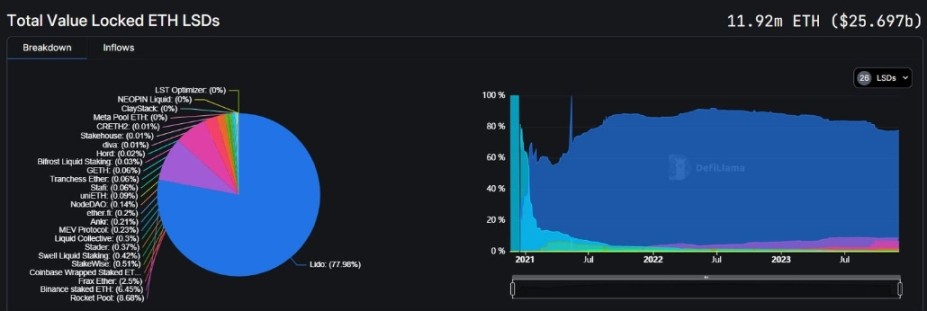
These network effects are driven by several factors:
Liquidity depth of Lido stETH compared to other LSTs: On Curve (the main DEX for stable assets), the TVL of the stETH/ETH pool is 220 million US dollars, with a liquidity yield of 2% APY. In comparison, the TVL of the rETH/ETH pool is 8 million US dollars. The increased liquidity depth of stETH means that stETH holders can exit their positions with less slippage and market impact compared to rETH holders, which is a key value proposition for any given LST.
Security and Lindy effect: Stakers only receive relatively low annual yields on their staked assets (3-4%). This means that security is important on the level of protocols not being hacked (e.g., issuing and redeeming stETH for ETH incorrectly), and users value a liquidity staking protocol with the longest security track record.
DeFi integrations: The largest LSTs often have more integrations with other parts of the DeFi ecosystem (spanning lending, AMM, yield protocols, derivative collateral, etc.), adding utility for stETH compared to smaller LSTs. 36% of stETH is used in DeFi liquidity pools and lending.
These network effects solidify Lido's dominant position, holding nearly one-third of the total staked ETH and steadily increasing its share over the past 2-3 years. As the proportion of staked ETH steadily increases, Lido continues to benefit. In fact, Lido's dominance is so significant that many are calling for an examination of its systemic importance on Ethereum, including implementing Lido + stETH dual-token governance to ensure alignment between Lido DAO and Ethereum/stETH holders.
Given Lido's success (>20 billion US dollars FDV protocol) and its strong network effects in the LST category, similar attempts have also emerged in other L1 ecosystems, including Solana (Marinade, Jito), Avalanche (BENQI), BNB Chain (Binance, Stader), and Cosmos Chain (Stride).
There is a significant difference in the penetration rate of liquidity staking by ecosystem. Ethereum is currently the most mature ecosystem, accounting for 41%, while most other ecosystems are in the range of 2-7%.
Unlike other major L1 ecosystems, the Cosmos ecosystem is designed as the "Internet of Blockchains." Cosmos provides an open-source SDK (Cosmos SDK) that developers can use to write and launch custom blockchains. The first of these chains is the Cosmos Hub (ATOM, with a circulating market value of 2.7 billion US dollars). ATOM aims to be the economic center of this cross-chain and connect/secure other chains in the Cosmos ecosystem.
Over time, many public chains have been launched in the Cosmos ecosystem using the open-source SDK, including Osmosis (AMM), Injective (a public chain focused on DeFi), Sei (a public chain focused on DeFi), Celestia (data availability layer), dYdX (perpetual trading), Kujira (Cosmos DeFi), and Terra (formerly UST stablecoin). These chains have their own PoS blockchains, securing the network with their own set of validators and consensus. This means that for these blockchains, there are native tokens (OSMO, INJ, SEI, TIA, DYDX, KUJI, LUNA) used to secure the network, just like ETH, SOL, AVAX are used for their respective blockchains.
Most Cosmos chains are built using some version of BFT (Byzantine Fault Tolerance), achieving consensus when 2/3 of the nodes agree on the final state of a block. Therefore, most chains rely on a delegated proof of stake model, which limits the number of validators that can participate in consensus, while still allowing for fast block finalization times (within seconds). In contrast, Ethereum has no limit on the number of validators (as of December 3, 2023, there are approximately 880,000 validators, each with 32 ETH), and also requires 2/3 of validators to finalize a block, resulting in a block finalization time of up to 13 minutes.
An important aspect of the Cosmos ecosystem is the existence of IBC (Inter-Blockchain Communication) as the standard for trustless bridging between Cosmos chains. IBC is a protocol for handling data transmission and authentication. By defining standards that each chain built with Cosmos can implement, this allows for trustless cross-chain communication without other security assumptions, unlike other bridges (such as relying on multisig (Multichain), optimistic rollups (Synapse), or active validator sets (Axelar)) when bridging across non-Cosmos chains. This ability to bridge trustlessly using IBC is why Cosmos is referred to as the "Internet of Blockchains" that can communicate and interoperate with each other. 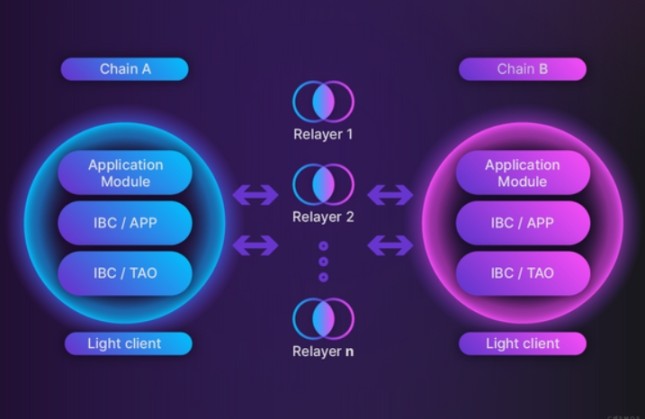
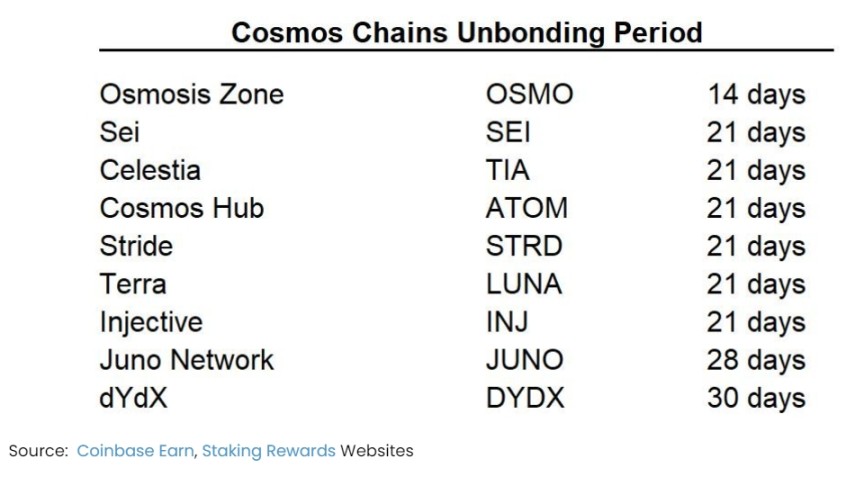
Like other PoS blockchains, Cosmos chains also have a unlocking period for staked tokens. The minimum is 14 days (Osmosis), and the maximum is 30 days (dYdX). The unlocking period for most Cosmos chains is 21 days. When assets are staked and securing each Cosmos blockchain, these assets cannot be used in DeFi (lending, providing liquidity, hedging yields), requiring users to wait for a long time if they choose to sell their assets.
Introduction to Stride
Stride is a rapidly emerging liquidity staking protocol in the Cosmos ecosystem. The protocol was founded by Vishal Talasani, Aidan Salzmann, and Riley Edmunds in June 2022. They raised a seed round of $6.7 million from funds including North Island VC, Distributed Global, and Pantera Capital.
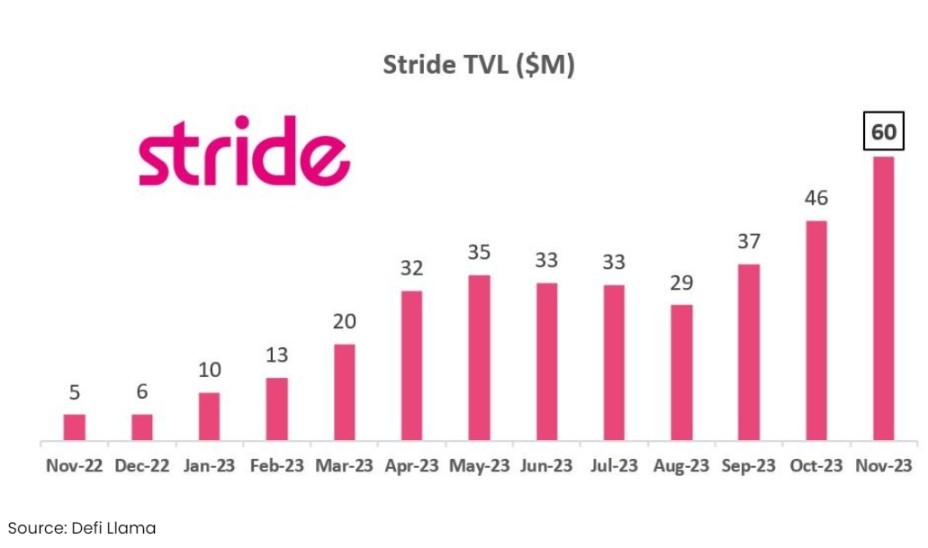
The Stride protocol was launched in September 2022 and has grown to over $60 million in total value locked (TVL) in the past year, supporting all major Cosmos chains/tokens including ATOM, OSMO, INJ, and JUNO, and is soon to support Celestia and dYdX.
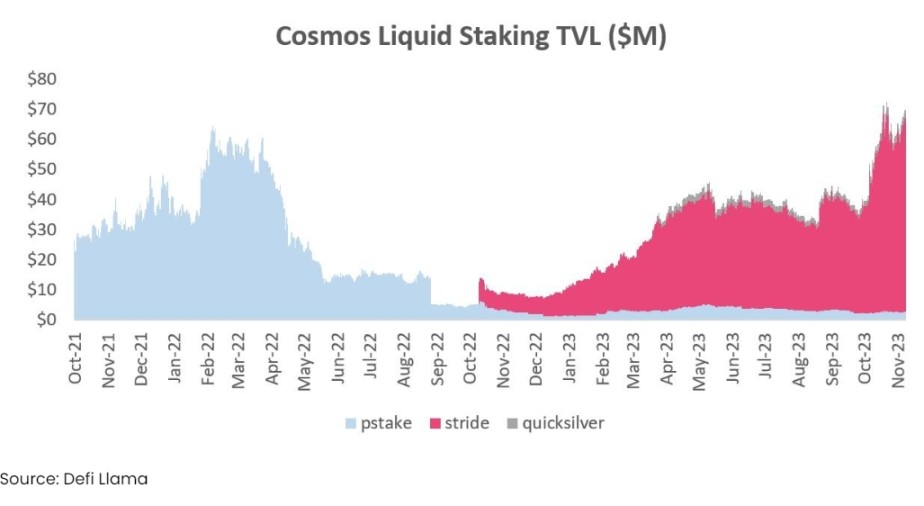
Cosmos has three major liquidity staking participants—Stride, pStake, and Quicksilver.
pStake was the first mover, launching in February 2022 and quickly attracting $60 million in TVL through airdrops and support for OSMO (known as stkOSMO). However, in the bear market and over the past 18 months, Stride has rapidly risen and surpassed pStake in TVL.
Quicksilver is another emerging player but has struggled in the range of $2-3 million in TVL.
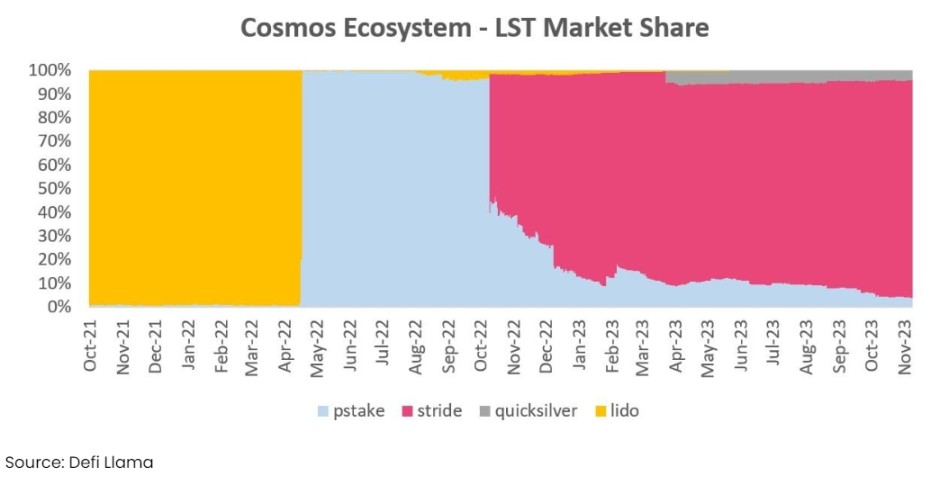
Currently, Stride dominates the liquidity staking market (LST market) in the Cosmos ecosystem, holding over 90% of the LST TVL share.
pStake and Quicksilver each hold a 4% share.
It is worth noting that Lido once held approximately 100% of the liquidity staking assets in the Cosmos ecosystem, with its LUNA LST reaching nearly $10 billion TVL at its peak (April 6, 2022). However, on May 10, 2022, LUNA began a death spiral and trended towards 0 as its stablecoin UST decoupled and LUNA was being minted infinitely. Subsequently, Lido ceased support for Terra, focusing exclusively on Ethereum, and currently has no LST in the Cosmos ecosystem and no known plans.
In the Cosmos ecosystem, the staking penetration rate is still in its early stages, with a 2% penetration rate for ATOM and a 7% penetration rate for OSMO. Today, these two chains represent over 85% of Stride's TVL. This represents 5-20 times additional opportunities for ATOM/OSMO compared to Ethereum's 41% penetration rate (and still growing) before adding other supported Cosmos chains and new chain expansions (Celestia, dYdX).
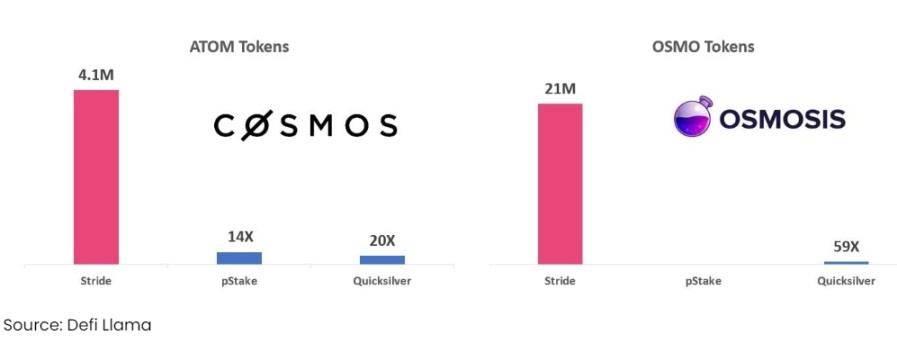
Stride holds 14-20 times more ATOM than its two competitors (holding over 85% of the staked ATOM), and 59 times more OSMO than Quicksilver (holding over 95% of the staked OSMO). This leadership position is very prominent, and we believe this advantage will be maintained over time.
Stride also holds over 95% of the share in other LSTs (including INJ, EVMOS, and JUNO).
In our view, there are numerous reasons for Stride's success:
Support for most chains—Stride supports 10 chains in the Cosmos ecosystem. Since its launch in February 2022, pStake has only supported two asset pairs (ATOM and XPRT).
Ecosystem alignment—Stride is closely aligned with the Cosmos ecosystem. Starting from July 19, 2023, Stride began leveraging ATOM (Cosmos Hub) for economic security (meaning staked ATOM holders secure the Stride blockchain and handle block production). In return, Stride shares 15% of its issuance and protocol revenue with ATOM.
Stronger economic security—Leveraging ATOM for consensus means that Stride has stronger economic security than pStake (with a market cap of less than $10 million). Additionally, the Stride chain is very focused, with no non-LST products on its roadmap. This simplifies the security of the chain.
Network effects—As Stride's asset support in Cosmos reaches a tipping point, network effects begin to emerge. By enabling IBC support for new Cosmos chains, the required code changes are minimal, meaning that Stride's scale and Lindy effect make it the preferred and most secure partner for new Cosmos chains (Celestia, dYdX) to use for their LST.
Deep AMM liquidity—Stride's liquidity in AMM pools is significantly deeper compared to its competitors. Stride's stATOM liquidity on Osmosis exceeds $17 million, while pStake's stkATOM liquidity is less than $1 million. This is often provided by "protocol-owned liquidity" (POL) for the main chain, reducing the incentives Stride needs to provide for expanding to a given LST. For example, Osmosis deployed $11 million worth of OSMO to the stOSMO liquidity pool, and Juno deployed $1.65 million worth of Juno to the stJUNO liquidity pool.
DeFi integrations—Stride's LST can now be used in various Cosmos applications, including Umee ($6.5 million TVL), Shade ($3 million), Kujira ($1.5 million), Mars ($1 million), and others. This increases the utility and network effects of Stride's LST assets. By focusing on LST and not competing with other DeFi protocols, Stride is also able to integrate more widely.
Stride charges a 10% fee on the staking revenue collected through the protocol. Of this, 8.5% goes to the Stride protocol (owned by STRD token stakers), and 1.5% goes to ATOM/Cosmos Hub, providing economic security for the Stride blockchain.
There are significant differences in staking economics between Cosmos and Ethereum:
Validator fees: On Ethereum, starting a new validator node requires staking 32 ETH. Therefore, Lido charges a 10% fee (same as Stride), but must pay 5% to the validators, with the remaining 5% reserved for Lido DAO. Since Cosmos operates on a delegated PoS or equivalent model, where staking is simply delegating to existing large validators, Stride does not incur any additional costs or fee sharing with validators. The result is a higher profit margin, making Stride a more profitable liquidity staking protocol from a net fee perspective.
Staking yield: Cosmos chains typically launch with higher issuance and inflation rates. For example, the annualized staking yield (APY) for ATOM is 18%, OSMO is 9%, JUNO is 15%, and INJ is 15%. In contrast, Ethereum's current staking yield is 3-4%. This naturally tends to capture a larger proportion of the economic benefits for LST and makes LST more attractive for deployment in DeFi protocols.
With TVL growing from $5 million to $60 million over the past year and an average staking APY of 16%, Stride's annualized income has grown to nearly $1 million.
We believe that in the next 6-12 months, the following chains from the Cosmos ecosystem will provide momentum and buying opportunities for Stride's growth. Stride has expressed its intention to support liquidity staking for dYdX and Celestia (through stDYDX and stTIA tokens).
dYdX ($30-40 billion FDV): dYdX is the largest decentralized derivatives exchange, with over $400 billion in trading volume and generating $100 million in annualized fees. dYdX has been developing product upgrades (v4) to migrate its trading platform from StarkEx to its custom Cosmos blockchain. Importantly, trading fees will now accrue to staked DYDX token holders (with a 30-day unlock period). With the market penetration of decentralized perpetual contracts growing from 1-2% to 30% like the spot market, dYdX has the potential to become one of the largest public chains in the Cosmos ecosystem. On November 21, 2023, Stride announced the upcoming launch of stDYDX and the issuance of 250,000 STRD to drive early adoption.
Celestia ($8-9 billion FDV): Celestia is part of the modular expansion roadmap for Ethereum and is one of the leading data availability (DA) layers. They recently deployed to the mainnet on October 31, 2023. With the growth in usage of Ethereum and its L2, Celestia may see development. Stride has communicated with the Celestia governance to begin supporting LST (called stTIA).
Akash (over $4 billion FDV): Akash is a decentralized computing marketplace, recently focusing on GPUs. Since the launch of the GPU mainnet in September, Akash has expanded to around 200 GPUs, with an annualized GMV of approximately $500,000 to $1 million. Importantly, a portion of the 20% fee charged by Akash will be distributed to Akash stakers, along with annual releases.
Noble (native USDC on Cosmos): Circle recently launched native USDC support on Cosmos through the application chain Noble, built specifically for native asset issuance. Currently, there is over $30 million in Noble USDC on Cosmos. With demand coming in from dYdX, Celestia, Akash, and others, the issuance of Noble USDC on Cosmos could significantly increase, stimulating activity on other Cosmos application chains (such as Osmosis), which accounts for a significant portion of Stride's total value locked (TVL).
In the long term, dYdX and Celestia provide opportunities for Stride with over $100 billion FDV, compared to the existing supported chains with around $6 billion. We believe that in addition to the ongoing penetration of LST on existing chains (ATOM, OSMO, etc.), these could be strong additional drivers for Stride's growth.
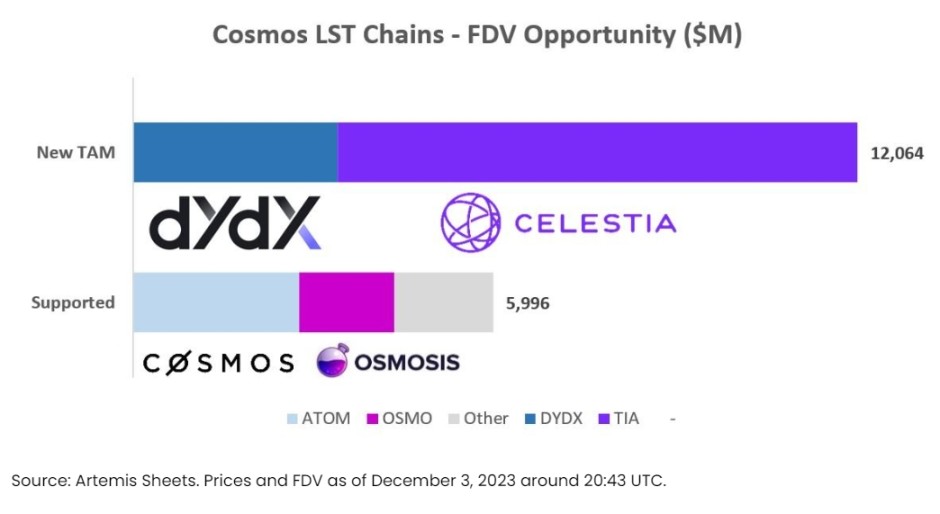
In general, Stride aims to be a pioneer for new Cosmos chains. As long as IBC/Cosmos SDK remains attractive to developers, enabling the deployment of application chains, Stride can continue to support, collaborate, and benefit from the growth of the new ecosystem.
Valuation and Scenario Analysis
Below, we will provide several scenarios for the key drivers of Stride. In our base assumptions:
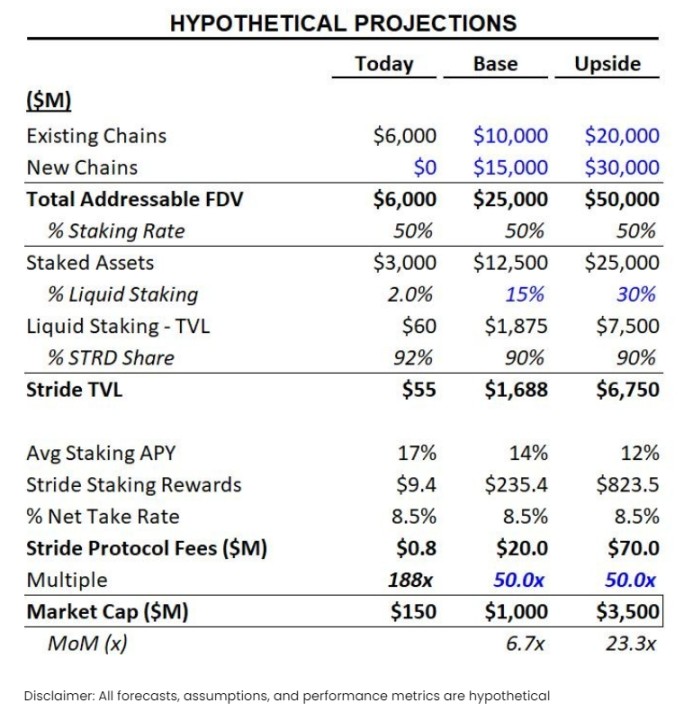
Stride's FDV growth: We assume that Stride's FDV will grow from $6 billion to $25 billion. Currently, Stride receives $6 billion in FDV from existing chains (mainly ATOM, OSMO, and INJ). We assume this will grow to $10 billion within a market cycle. Stride is developing support for dYdX and Celestia (TIA), which together currently represent nearly $10 billion in FDV. Due to our optimism for dYdX and Celestia, we assume their FDV will increase by 50% to $15 billion.
Staking rate remains stable: The staking rate across the entire Cosmos chain remains stable at 50%. There is no change for major existing chains such as OSMO and ATOM.
Staking drive for dYdX and Celestia: dYdX's new products will return its fees to token holders, which should drive staking rates comparable to other L1/Cosmos blockchains. Currently, over 16 million dYdX tokens have been staked. Celestia (TIA) will require a strong validator set to ensure the security of its data availability layer, which may similarly drive high staking rates.
Liquidity staking penetration rate growth: On Ethereum, the liquidity staking penetration rate accounts for 41% of all staked ETH (with LDO accounting for >30% of this share). With increased activity across the Cosmos ecosystem (encompassing DeFi, AMM, lending, perpetual contract trading, etc.), we believe the liquidity staking (LST) penetration rate can significantly grow from 2% to 15%, still far below Ethereum's level. Due to Cosmos typically having longer unbonding times (21+ days) compared to other chains, this should provide greater momentum for LST penetration rate growth.
Market share remains stable: LSTs typically exhibit winner-takes-all effects, as seen with Lido in the Ethereum ecosystem. Since January 1, 2023, Stride's market share has grown from 72% to 92%, and we expect it to continue to dominate this market.
Stride maintains existing fee rates: We believe that Stride may demonstrate moderate pricing power in the future, but we do not assume this in our base case or optimistic scenarios. Therefore, we assume that Stride maintains its existing 8.5% fee rate. Based on the above assumptions and analysis, we can build different financial forecasts and valuation models for Stride to assess its performance and potential under different market conditions.
Investment Risks and Mitigation Measures for Stride
In our investment in Stride, we actively focus on several key risks and have developed corresponding mitigation strategies.
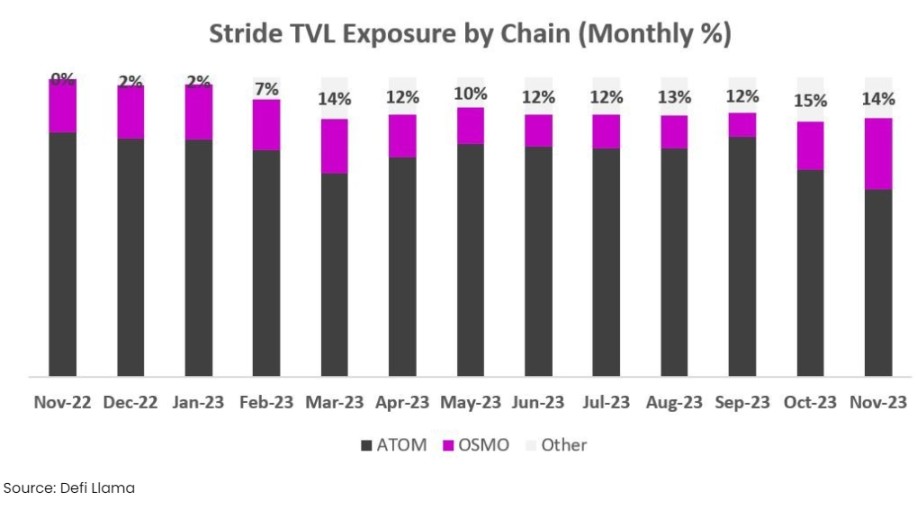
- Exposure to the Cosmos ecosystem: Currently, over 85% of Stride's total value locked (TVL) is only related to two Cosmos chains—ATOM (63%) and OSMO (24%). This results in Stride's performance being closely tied to these two projects and their market cap/token performance. As Stride gradually expands to support new chains with unique demand vectors, we believe this concentration risk will decrease over time. For example, dYdX's usage is related to the perpetual trading market, while Celestia is related to the data availability needs of Ethereum rollups, bringing more diversity to Stride's ecosystem. Since the beginning of 2023, the proportion of TVL for non-ATOM/OSMO has increased from 2% to 14%-15%.
Competition risk: Although large-scale liquidity staking often exhibits a winner-takes-all market pattern, the LST market in Cosmos is still in its early stages, with a penetration rate of only 2%. The Cosmos ecosystem has experienced several turnovers of dominant players (such as Lido, pStake), who gradually lost market share as market conditions changed (LUNA crash, crypto bear market). The risk of Stride failing to dominate liquidity staking in the Cosmos ecosystem still exists. Recently, new players like Milky Way are attempting to compete with Celestia (TIA) for LST.
Osmosis's Superfluid Staking: Osmosis launched Superfluid Staking in early 2022, allowing liquidity providers on the Osmosis DEX to collect OSMO staking rewards while providing AMM liquidity. Although not entirely similar to a liquidity staking protocol, it could serve as an alternative to Stride's stOSMO (which accounts for 22% of TVL). Compared to holding stOSMO (after deducting Stride's 10% fee), Superfluid Staking only allows LPs to receive 75% of OSMO staking rewards, so we believe Stride offers a superior product. Additionally, despite facing competition from Superfluid Staking over the past 12-18 months, Stride has still been successful in the OSMO ecosystem (with an 8% liquidity staking penetration rate, even higher than ATOM).
Special thanks: Thanks to Vishal Talasani (Co-founder of Stride), Jeff Kuan (Axelar), Paul Veradittakit (Pantera Capital), and Cody Poh (Spartan Group) for their review and valuable insights.
免责声明:本文章仅代表作者个人观点,不代表本平台的立场和观点。本文章仅供信息分享,不构成对任何人的任何投资建议。用户与作者之间的任何争议,与本平台无关。如网页中刊载的文章或图片涉及侵权,请提供相关的权利证明和身份证明发送邮件到support@aicoin.com,本平台相关工作人员将会进行核查。


